
Motorcycle Body Positioning Explained: What Actually Works
This post contains affiliate links. As an Amazon Associate, we earn from qualifying purchases.
Motorcycle body positioning is a tool for reducing the motorcycle’s lean angle, which preserves ground clearance and keeps the tire off its weak shoulder. According to the Ed Bargy Racing School, it does not create extra traction. However, the Yamaha Champions Riding School links body position to managing traction (the ‘100 Points of Grip’).
According to the Ed Bargy Racing School, the mechanical purpose is specific: it only matters when you’re about to drag hard parts or run out of usable tire tread. If you’re not near those limits, altering your position has no mechanical benefit. However, the Yamaha Champions Riding School implies body position is a tool for traction management even before reaching absolute limits. This is a key point in motorcycle body positioning explained.
What follows is a breakdown of the two limits that trigger the need for body position, the measurable differences in how men and women sit on the same bike, and the direct conflict between manufacturer advice and racing school reality in the motorcycle body positioning explained. You’ll learn how to self-diagnose your own position and apply just enough technique for the corner you’re in.
Key Takeaways
- The Ed Bargy Racing School states body position is only mechanically useful when approaching ground-clearance or tire-shoulder limits. The Yamaha Champions Riding School, however, links it to managing traction (‘100 Points of Grip’) and safety at speed.
- On average, female riders sit 26 mm further forward with different joint angles than males on the same touring bike, changing the ergonomic starting point.
- The ISO 13232 crash-test dummy’s eye position is over 5 cm off from a real 50th percentile rider, meaning some safety design is based on an inaccurate model.
- Use a “screwdriver grip” on the inside hand to free up your elbow and upper body for movement toward the inside of the corner.
- Dragging a knee is optional showmanship; the real work is done by shifting your hips and torso to the inside.
The Two Limits That Decide Everything
Body position isn’t a style choice. It’s a mechanical adjustment with a narrow job description. According to the Ed Bargy Racing School, the only mechanical purpose of altered body position is to reduce chassis lean angle. This achieves exactly two things: gaining ground clearance and moving the tire off its shoulder.
Common mistake: Thinking body position gives you more traction. The Ed Bargy Racing School is explicit: it “does not give more traction.” Cornering forces are determined by speed and turn radius. Leaning the bike less through body position doesn’t reduce those forces on the tire.
If your footpeg, centerstand, or exhaust isn’t about to scrape, and you can still see a “chicken strip” of unused tire tread near the edge, you don’t need to hang off according to the core motorcycle body positioning explained. Your bike has lean angle and tire to spare. Aggressive positioning here is a waste of energy. The benefit kicks in the moment you’re fast enough to threaten those limits. For a street rider on public roads, that moment is rare.
How Your Body Actually Fits the Bike
Before you can move your body, you need to know where it starts. Ergonomics, the study of how a human fits a machine, gives us hard numbers. They show that the “average rider” is a flawed concept.
Take the Honda CBR650R. For a 175 cm rider, it creates about 23 degrees of forward lean, a 78-degree knee angle, and a 93-degree hip angle. The Suzuki SV650, with a lower seat, puts the same rider at just 5 degrees of forward lean and an 83-degree knee angle. Your body’s baseline angles change completely between models.
A 2006 study presented to the International Motorcycle Safety Conference found that in a comfortable riding position, a real 50th percentile male rider’s eye position is 5.2 cm lower than the Motorcycle Anthropometric Test Dummy (MATD) used in ISO 13232 crash testing. This means critical safety design, like windscreen height and helmet impact zones, may be based on a dummy that doesn’t match reality.
Furthermore, a 2021 International Research Council biomechanics study found female riders don’t just scale down from male data. On a touring motorcycle, female riders sit 26 mm further forward on average. They also have a 14-degree smaller pelvis angle, a 13-degree larger hip angle, and 6–9-degree greater lower spine angles. A motorcycle set up for a male percentile may force a female rider into a different, potentially less optimal, starting posture.
| Body Metric | 50th Percentile Male Rider | 50th Percentile Female Rider (Avg. Difference) | Why It Matters |
|---|---|---|---|
| Seat Position (Fore/Aft) | Baseline | +26 mm forward | Changes reach to bars and weight distribution. |
| Pelvis Angle | Baseline | 14° smaller | Alters spinal alignment and lower back load. |
| Hip Angle (Mid-Sagittal) | Baseline | 13° larger | Affects leg comfort and ability to grip tank. |
| Knee Angle | Baseline | 10° larger | Changes leverage on footpegs and cornering stability. |
The Manufacturer vs. Racer Divide
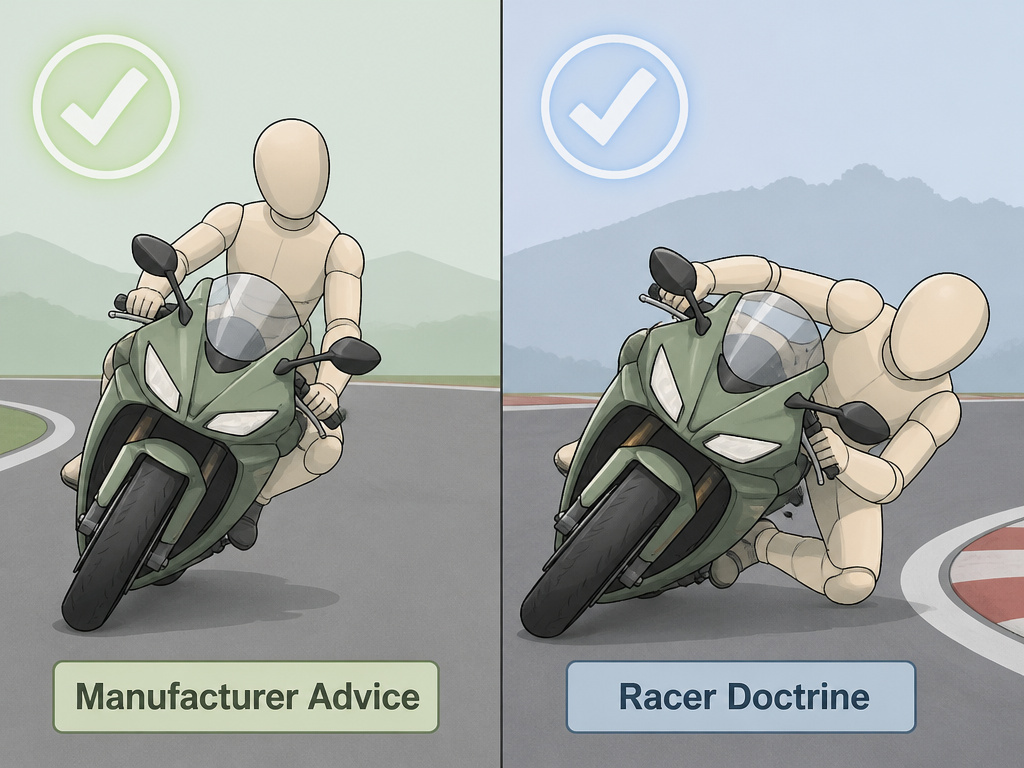
Open a Ducati Multistrada owner’s manual and you’ll find the vague instruction to “assume a correct body position” or “use proper body position while riding.” It’s treated as a universal, always-beneficial rule. The Ed Bargy Racing School tutorial directly contradicts this.
Where this goes sideways: Following generic manufacturer advice when you’re not at the limits. The racing school doctrine states if the bike isn’t about to drag hard parts or use the tire shoulder, body position “will have no beneficial mechanical effect.”
This isn’t just semantics. It frames the entire purpose of the technique. Is it a general “best practice” for safety, as Ducati implies? Or is it a specific performance tool with no effect until high lean angles, as the racers teach? For street riding, the racer’s view saves you from unnecessary contortions. For track riding, it tells you precisely when to deploy the tool.
Street Positioning: Upright and Alert
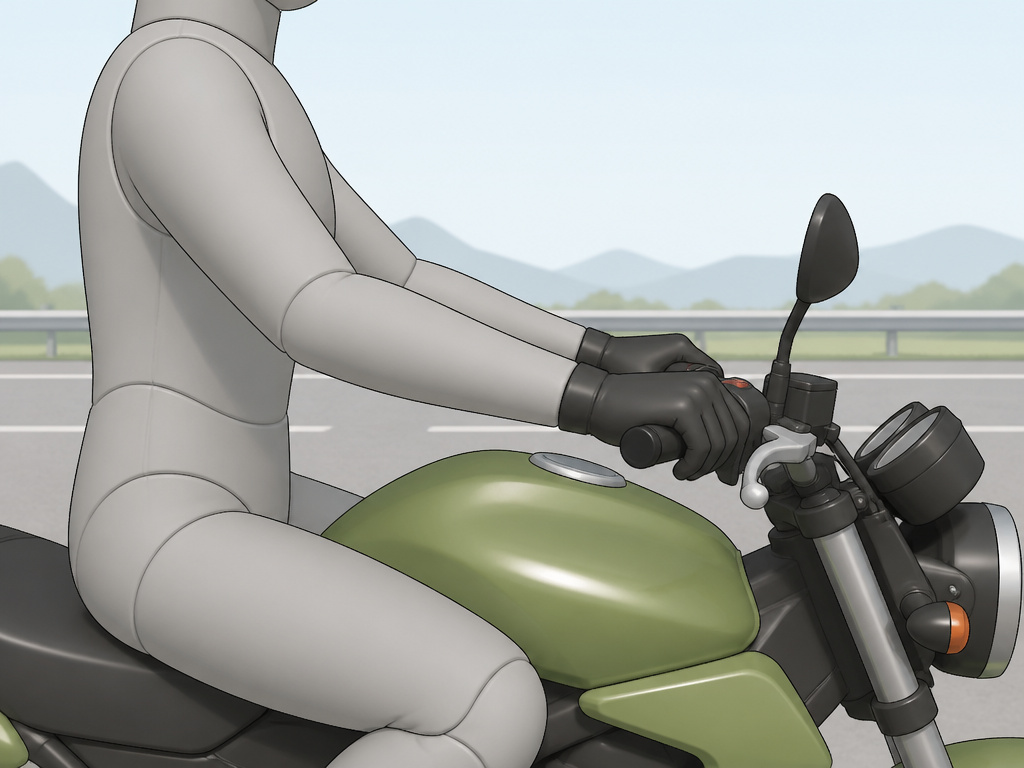
For the road, a primary goal of body position is often to stay loose, see hazards, and control the bike, as you are rarely at the lean angles where reducing lean angle is mechanically necessary. You are almost never at the lean angles where hanging off provides a mechanical benefit.
The best street position is relaxed and neutral. Grip the tank with your knees to take weight off your wrists and stabilize your lower body. Keep your head up and your eyes level, looking as far through the corner as possible. Your elbows should be slightly bent, not locked. This is active relaxation, which allows the bike to move beneath you and provides a platform for quick inputs.
Worth knowing before you start: A legal standard, the New Zealand Low Volume Vehicle Code, states a motorcycle seat must provide the rider with “the best available view to the front and both sides.” Your body position should never compromise this. If hanging off blocks your view of a shoulder or mirror, you’re doing it wrong for the street.
A practical drill is the “push-pull” steering exercise. In a safe, straight-line practice, push forward on the left grip to initiate a left turn while pulling back slightly on the right. Feel how your body wants to stay neutral while the bike tips. This reinforces that cornering is a steering input, not a wrestling match.
Track Positioning: The Progressive Hang-Off
On the track, where speeds and lean angles are higher, body position becomes a required skill. The Yamaha Champions Riding School emphasizes it “allows you to run less lean angle at the same radius.” This conserved lean angle is your safety margin for bumps, throttle adjustments, or less-than-perfect tires.
The movement is progressive and starts from the feet up:
- Weight the inside peg. As you tip into the corner, put pressure on the ball of your inside foot. This helps pivot your lower body.
- Slide your inside hip toward the tank. Move your butt off the seat toward the inside. Your torso should follow naturally. Don’t just throw your shoulder down.
- Get your head inside. Move your head toward the inside of the corner. The Yamaha Champions Riding School recommends keeping your eyes as level as possible.
- Use a screwdriver grip. Rotate your inside hand on the grip so your knuckles point forward and your elbow drops. This technique for body positioning in corners frees your upper body and prevents you from locking your arms.
I won’t recommend a full MotoGP hang for a first track day. I’ve seen new riders focus so hard on getting a knee down that they forget their braking markers, turn-in points, and proper cornering lines. The line is always more important than the pose.
Stay committed to the inside as you accelerate out. Keep weight on the inside peg until the bike is nearly upright. Jumping back to the center too early can make the bike run wide.
Self-Diagnosis: How to Check Your Own Position
You can’t feel what you look like. Without a coach, you need other feedback. The cheapest tool is a friend with a smartphone.
Have them film you from the front and rear as you ride through a familiar corner at your normal pace. Later, pause the video and look for these tells:
- Crossed-up: Your head and shoulders are leaning outside the bike’s centerline while your hips are planted in the seat. This is the most common error and does nothing to reduce lean angle.
- Elbow Lock: Your inside arm is straight, pinning your upper body to the bike. The fix is the screwdriver grip.
- Head Down: You’re staring at the pavement in front of the wheel. Your eyes should be up, looking at the exit.
For a more analytical approach, use a bicycle in a parking lot. Practice leaning the bicycle while keeping your body upright. Feel how the machine angles more beneath you. The sensation of separating your body mass from the machine’s lean is the same core skill.
Adapting for Adventure and Off-Road
The principles flip when the pavement ends. For riding in mud or sand, you want to stay centered over the bike and use your legs as active suspension. The goal is traction and control, not reducing lean angle.
- Stand on the pegs. This is essential for rough terrain. It lowers the bike’s center of gravity relative to your body and allows the bike to move underneath you. Here’s a guide on the proper standing technique on a motorcycle.
- Grip with your knees. Your legs connect you to the bike. In sand, keep your weight back to lighten the front wheel. In ruts, let the bike tip while you stay vertical.
- Arms and elbows up. Unlike the track screwdriver grip, keep your elbows high and out. This gives you the force needed to manhandle the bars without getting pitched over them.
The body is used to manage weight distribution fore and aft, not left and right. It’s a completely different toolkit from sport riding.
How to align your head, shoulders, hips, and elbows
Your head leads your turn. Keep your eyes as level as possible to help maintain balance and a clear view. Your shoulders should follow your head’s direction, staying relaxed to allow movement. Position your hips to the inside of the seat, which helps shift the motorcycle’s center of gravity. Keep your elbows bent and out, using a ‘screwdriver grip’ on the inside hand to facilitate this position and prevent locking your arms. This alignment works together to let you lean the bike less for a given corner.
Body position differences for pro riders vs. Street riders
Professional riders use extreme body position because they operate at the absolute limits of ground clearance and tire contact. For them, moving off the bike is a necessary mechanical tool to reduce lean angle and manage traction at high speeds. For the average rider on public roads, the bike is rarely at those physical limits. Therefore, over-aggressive positioning is a waste of effort with no mechanical benefit. A pro’s technique, like knee dragging, is optional and not necessary for effective street riding.
When to move your body for a corner
Begin shifting your body to the inside just before you initiate the turn, as you enter the corner. This pre-positioning helps the motorcycle lean more easily. At the apex, your head, shoulders, and hips should be committed to the inside, with your weight on the inside footpeg. As you start to accelerate and exit the corner, maintain this inside position. Keep weight on the inside peg to help stabilize the bike as it stands up, rather than immediately returning to a centered posture.
Frequently Asked Questions
What is the best body position for riding a motorcycle?
There isn’t one “best” position. For street riding, a neutral, upright posture that maximizes vision and comfort is best. For track riding, a progressive hang-off that reduces the bike’s lean angle is best. The “best” position is the one that correctly serves your immediate goal: control and awareness on the street, lean angle management on the track.
Do I need to drag my knee to corner fast?
No. Dragging a knee is a side effect of sufficient lean angle and proper hip displacement. It is not a goal, nor is it necessary for fast cornering on a motorcycle. Many very fast riders only occasionally touch a knee down. Focus on moving your hips and torso inside; let the knee take care of itself.
How does body position affect motorcycle suspension?
Your body position is a large, moving weight on the chassis. Abruptly shifting your weight mid-corner can upset the bike’s balance. Smooth, early movements are key. Your static position also affects suspension setup. If you always ride with a pronounced hang-off, your suspension may need slightly different preload and damping settings compared to a rider who stays centered.
Can I improve my body position with gym exercises?
Yes, specifically flexibility and core strength. Tight hips hamper your ability to slide off the seat. A weak core makes it hard to support your torso with your legs, leading to arm fatigue and poor bar control. Yoga, pilates, and exercises that improve hip mobility pay direct dividends on the bike.
Is aggressive body position safer on the street?
Generally, no. The reduced lean angle margin is irrelevant at legal street speeds. The increased complexity and reduced attention to surroundings (as you focus on your form) can introduce new risks. The safety benefits of body position are only realized at the high lean angles found on a track.
The Bottom Line
Body position is a specific tool, not a universal virtue. Deploy it when you need it, when peg feelers start grating or you’re using the very last millimeter of tire. Ignore it when you don’t.
For the street, prioritize a position that allows you to see, react, and ride relaxed for hours. That’s where the vast majority of street riding happens. Save the aggressive hang for the track, where the limits are clear and the consequences of a mistake are contained.
The most important muscle is the one behind your eyes. Look where you want to go. Your body and the bike will follow.
