
How to Ride a Motorcycle in Mud: The 4-Step Entry Sequence
This post contains affiliate links. As an Amazon Associate, we earn from qualifying purchases.
Riding a motorcycle in mud requires matching three things: controlled momentum, precise weight shifts, and a rear-brake bias. Enter in second gear at a brisk walking speed, stand on the pegs to let the bike move beneath you, and use smooth throttle inputs to keep the rear wheel driving without spinning. On some modern bikes, such as the Ducati Scrambler 800 Desert Sled, the manufacturer recommends disabling the ABS for muddy conditions to prevent system interference or failure.
That last point about electronics isn’t a guess. Ducati’s manual for the Scrambler 800 Desert Sled explicitly warns riders to disable the ABS “in case of muddy road surface because under this condition the system might be subject to sudden failure.” Mud doesn’t just test your skill; it tests your bike’s systems in ways dry dirt never does. A key part of how to ride a motorcycle in mud is knowing when to override electronic aids.
What follows is the sequence that works when the trail turns to soup: the specifics of how to ride a motorcycle in mud, from bike setup to the exact throttle and body movements that keep you moving, and what to do the moment you feel the bike start to bog down. We’ll also cover the cleanup that prevents a $200 service bill two weeks later.
Key Takeaways
- Enter mud patches in second gear at a brisk walking speed, first gear often delivers too much torque, causing immediate wheel spin.
- Stand on the pegs and keep your weight centered or slightly back; sitting down locks you into the bike’s movement and guarantees a fight for control.
- Rely almost exclusively on your rear brake; aggressive front braking in mud will wash out the front tire instantly.
- Disable ABS and traction control in deep mud if your bike allows it; these systems can misinterpret wheel slip and cut power or cause brake failure when you need consistent input.
- Clean caked mud from your wheels and radiator before riding at speed; unbalanced wheels cause dangerous vibrations, and a clogged radiator leads to rapid overheating.
Before You Start: The Non-Negotiables
Before you start: Mud hides ruts, rocks, and roots. Never ride a muddy trail alone. Carry water, a detailed map, and tell someone your route. Wear boots with aggressive tread, you will put a foot down.
Mud riding is a high-consequence skill. The DBS Off-Highway Guide states the rule plainly: never ride alone in any season. A buddy can pull you out or go for help. Your gear matters more here than on dry trails. That adventure jacket is fine, but if your boots have smooth soles, you’ll be sliding instead of bracing when you dab a foot. This isn’t the place for short ankle boots.
Bike Setup: Pressure, Protection, and Electronics
You can’t out-ride a bad setup. The right adjustments before you hit the mud mean the difference between floating over it and digging a hole.
The Tire Pressure Debate
Sources disagree here, and your choice depends on your risk tolerance. The DBS Off-Highway Guide cautions against underinflation, warning it may cause wheel damage when ridden in rocky, rough terrain. It advises maintaining the manufacturer’s recommended pressure.
However, Adventure Motorcycle Magazine notes that in thick mud, some riders air down as low as 10–15 PSI to increase the contact patch. Harley-Davidson Insurance adds that slightly reduced pressure may improve grip on wet surfaces, but warns against significant underinflation.
| Approach | Best For | Risk If Overdone |
|---|---|---|
| Maintain Recommended PSI | Mixed terrain (mud + rocks) | Less traction in pure mud, harder to float over surface |
| Air Down (e.g., 15 PSI) | Deep, consistent mud | Pinched tube, dented rim on hidden obstacles |
| Slight Reduction (3-5 PSI) | Wet, slippery mud | Compromised stability at higher speeds |
For most adventure bikes on unknown trails, a slight reduction in tire pressure from your street pressure is a safe compromise. It increases the footprint without risking the rim. Have a pump to reinflate before hitting pavement.
Fender and Radiator Guards
Mud is abrasive and sticky. The Adventure Bike Rider article highlights two specific fixes: move your front fender up so it doesn’t clog and lock the front wheel, and check that your radiator isn’t caked with mud, which causes overheating. Before a muddy ride, zip-tie the fender higher or install a fork brace that creates more clearance. A simple plastic grill over the radiator fins is a cheap insurance policy.
Managing Electronics: ABS and Traction Control
This is where the owner’s manual is your best guide. For the Ducati Scrambler 800 Desert Sled, the manual is explicit: disable ABS in mud. The system can fail suddenly. On most bikes, the safest bet for deep mud is to switch to an off-road mode that reduces intervention or turn the aids off completely. You need predictable power delivery, not a computer guessing at traction.
The 4-Step Mud Entry Sequence
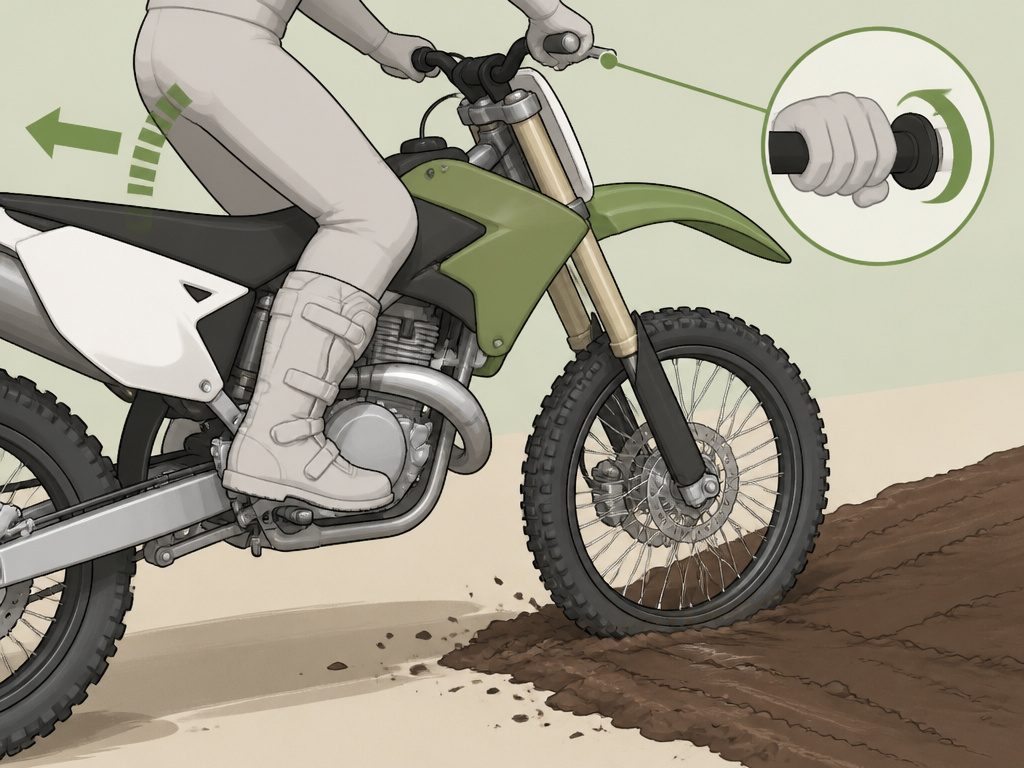
How you enter the mud decides everything that happens next. A rushed entry almost always ends with a stalled bike or a high-side.
Step 1: Scout and Choose Your Line. If possible, get off and walk the section. The rule from Adventure Bike Rider is solid: if you can’t stand on it, you probably can’t ride it. Choose the highest, driest line. Avoid the deep, dark center of ruts.
Step 2: Set Your Speed and Gear. You want enough momentum to carry you through, but not so much that you can’t correct. Adventure Motorcycle Magazine recommends starting in second gear, as first gear can deliver a jerky, torque-heavy punch that breaks traction immediately. Other sources suggest selecting a taller gear for consistent throttle or a gear that provides smooth power delivery. A brisk walking speed is the target.
Step 3: Stand Up and Commit. As the front tire touches the mud, be standing on the pegs, knees bent. Your body is the suspension now. Look ahead at your exit point, not down at the front wheel. Roll on the throttle smoothly.
Step 4: Manage Traction with Weight and Throttle. Feel the rear wheel spin? Add a little more throttle and shift your weight slightly back over the rear tire. Feel the front washing out? Shift weight forward and ease off the throttle a touch. The clutch is your modulation tool, feather it to manage power without chopping the throttle.
A gung-ho approach of blasting at speed through a long patch of mud seldom works for bigger bikes. Instead, commit, look up and ahead, and keep the bike moving at a brisk walking speed. . Adventure Bike Rider
Body Position and Throttle Control: The Feel of Traction
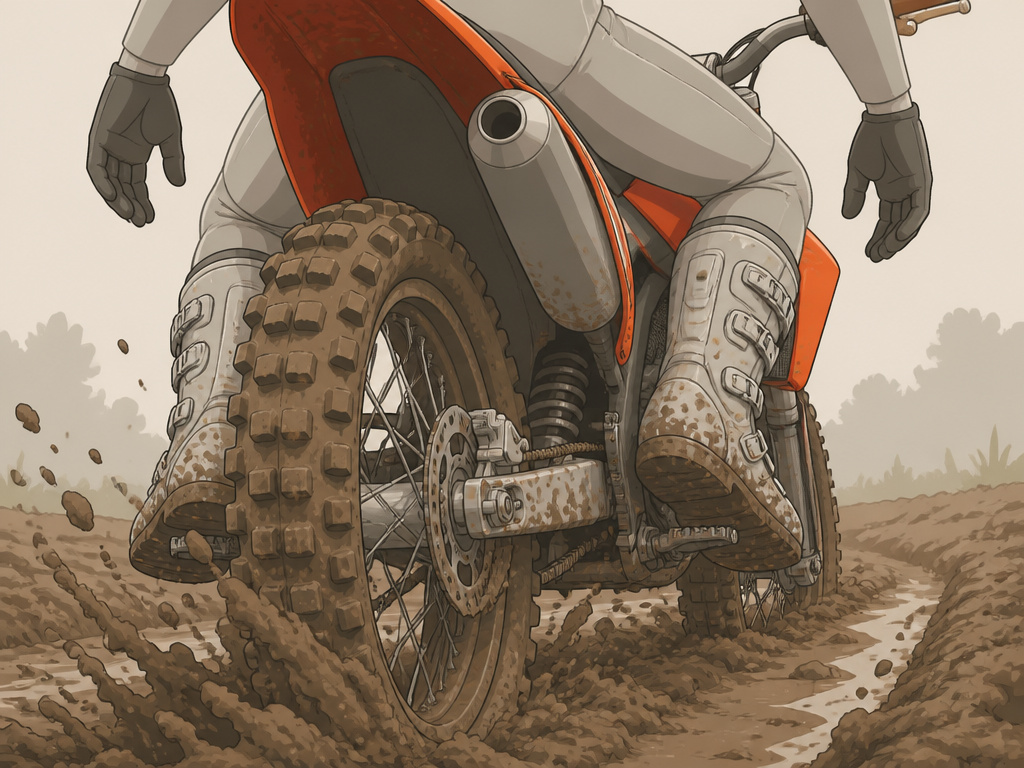
Standing on the pegs isn’t just for looks. It allows the bike to move independently beneath you. Grip the bike with your knees, but keep your arms and hands loose. Death-gripping the bars transfers every wiggle directly into your steering, guaranteeing a tank-slapper.
Throttle control is about consistency. The DBS guide says to select a gear that will provide a consistent throttle and avoid abrupt changes. You’re not trying to accelerate; you’re trying to maintain momentum. Think of the throttle as a volume knob, not an on/off switch. Small, smooth adjustments.
If you need to turn in the mud, use counterweighting. Keep the bike as upright as possible while leaning your body to the inside of the turn. This keeps the tires’ contact patches maximized on the slippery surface. Steering inputs must be gradual. Jerk the bars, and the front tire will slide out.
Braking and Clutch: The Delicate Balance
Forget everything you know about street braking. In mud, your front brake is almost useless. Harley-Davidson Insurance states directly: on mud and sand, rely more heavily on your rear brake and avoid aggressive front braking. The front tire has little grip for steering; asking it to also slow you down will wash it out instantly.
Use the rear brake gently to control speed or help steer. Dragging the rear brake slightly can help settle the chassis.
The clutch is your best friend. Feather the clutch constantly to keep the engine in its power band without delivering shocking torque to the rear wheel. Slipping the clutch is expected and necessary. It’s the buffer between your right hand and the tire.
Dealing with Ruts and Getting Unstuck
Ruts are inevitable. Your goal is to not get trapped in them. Try to keep the front wheel on the high edge of a rut, not buried in its base. If you’re in a deep rut, don’t fight it violently. Keep the bike straight, look ahead, and maintain steady throttle. Trying to muscle your way out usually leads to a crash.
You will get stuck. Here’s the step-by-step recovery that most guides skip:
- Kill the engine. Don’t spin the tire; it just digs a deeper hole.
- Dismount on the high side. Try to keep the bike as upright as possible.
- Clear the trench. Use your hands or a stick to dig mud away from the front and rear of the tires.
- Rock and push. Put the bike in first or second gear. While applying gentle throttle and feathering the clutch, rock the bike forward and back, pushing at the same time. The goal is to “walk” it out onto firmer ground.
- Use a pivot point. If alone, a sturdy branch under the swingarm or frame can provide a pivot point. With a buddy, have them pull on the handlebars while you push and control the clutch.
It’s exhausting, muddy work. This is why you never ride alone.
Post-Ride: The Cleanup That Prevents Damage
Mud isn’t just dirt; it’s an abrasive, corrosive paste that accelerates wear. Ducati categorizes very damp and muddy roads as an extreme condition that causes above-average wear of components like the drive system, the brakes, or the air filter.
If you have built up mud on the wheels and rims, be sure to clean it off before traveling at high speeds. The extra weight can create dangerous vibrations and make steering difficult. . Adventure Motorcycle Magazine (ADVMoto)
Your immediate post-ride checklist:
- Wheels and Tires: Knock off heavy clumps. Spin the wheels to check for major imbalance. Clean the brake rotors and calipers.
- Radiator and Cooling Fins: Use a gentle spray of water to clear every fin. Mud here is a direct path to overheating.
- Drive Chain: Clean and relubricate immediately. Mud grinds away at chain links and sprockets.
- Air Filter: Check it. A muddy ride can clog a filter faster than a dusty one. A dirty filter can lead to engine damage.
- Bearings and Seals: Wash around wheel bearings, linkage, and swingarm pivots. Mud holds moisture against seals.
This isn’t just about a shiny bike. It’s about preventing a seized caliper or a worn-out wheel bearing before your next ride.
How to ride a motorcycle up and down muddy hills
Pick a line before you commit and walk it first if possible. Select a gear that will provide a consistent throttle to avoid abrupt power surges that break traction. Keep your weight forward on climbs and over the rear on descents, using a brisk walking speed. Rely more heavily on your rear brake for control during descents, as aggressive front braking can cause a slide. If you have an ABS system, consult your manual; some manufacturers recommend disabling it for muddy conditions to prevent system issues. The goal is steady momentum without sudden inputs.
Frequently Asked Questions
Adventure Motorcycle Magazine recommends starting in second gear for a smoother, more manageable power delivery. Other sources, like Adventure Bike Rider, suggest using a taller gear and keeping revs low, while the DBS Off-Highway Guide advises selecting a gear that provides a consistent throttle.
Should I lower my tire pressure for mud?
It depends on the mud and the terrain. For deep, consistent mud with no hidden rocks, lowering pressure (some riders go as low as 10-15 PSI) increases the contact patch for better floatation. For mixed terrain, a moderate drop of 3-5 PSI is safer to avoid rim damage. Always re-inflate before hitting paved roads.
How do I use my brakes in the mud?
Use the rear brake almost exclusively. Apply it gently to modulate speed. Avoid using the front brake; the limited traction on the front tire is needed for steering, and braking will likely cause it to wash out. Practice rear-brake control before you need it.
What should I do if my bike starts to slide in mud?
If the rear slides, keep the throttle steady or add a little more power, and steer in the direction of the slide. The bike will often straighten itself out. If the front slides (washes out), ease off the throttle and the front brake, and try to get the bike more upright. In both cases, don’t panic and grab a handful of brake, that guarantees a drop.
Is it safe to ride with ABS and traction control in mud?
For deep mud, it is often recommended to disable these systems if your bike allows it. ABS can malfunction or prevent necessary wheel lock for steering in mud, and traction control can cut power when you need steady throttle to maintain momentum. Consult your owner’s manual for specific instructions.
Before You Go
Mud riding teaches you more about throttle and balance in one afternoon than a year of perfect dirt roads, making it the ultimate tutorial on how to ride a motorcycle in mud. The technique isn’t brute force; it’s finesse. Start on short, known muddy sections and walk them first. Trust your gear, especially your boots.
One final, mechanical truth: that mud is grinding away at your bike right now. The Ducati manual’s warning about above-average wear isn’t scare talk. A thirty-minute pressure wash today beats a half-day tear-down next month. Clean it, lube it, and it’ll be ready when the next trail turns to chocolate pudding.
