
What Is Snell Certification for Motorcycle Helmets?
This post contains affiliate links. As an Amazon Associate, we earn from qualifying purchases.
Snell certification for motorcycle helmets is a voluntary, high-performance safety standard set by the non-profit Snell Memorial Foundation. A Snell-certified helmet has passed a battery of destructive impact, retention, and penetration tests that exceed the minimum requirements of government standards like DOT or ECE. The certification, identified by a colored label sewn inside the helmet, signifies independent verification of superior impact management and ongoing quality through random post-market sampling.
That independent verification is the whole point. Government standards like DOT rely on manufacturer self-certification. ECE involves batch testing by approved labs. Snell adds a third layer: an independent lab that not only tests prototypes but also buys helmets randomly from retailers to ensure production models still meet the standard. It’s a system designed to catch a helmet that passes once in the lab but fails on the shelf. To understand this rigorous process, one might ask: what is Snell certification for motorcycle helmets?
What follows is a breakdown of the brutal physics Snell tests for, the new M2025 oblique-impact rules, and the practical differences between Snell, DOT, and ECE, which answers the common what is Snell certification for motorcycle helmets question. You’ll also learn how to spot a real certification label, why most modular helmets fail, and where Snell’s advice fits for street riders versus racers.
Key Takeaways
- Snell certification is voluntary and independent, requiring helmets to pass lab tests for impact, retention, and penetration that are more severe than DOT or ECE minimums.
- The new M2025 standard introduced separate certifications for different markets: M2025D for North America/Japan and M2025R for global markets needing ECE R 22-06 compliance.
- Look for the internal Snell label, a sewn-in tag with a barcode, color, and standard year, to verify certification. A loose sticker is not valid.
- Snell conducts random post-certification sampling, buying helmets from dealers to test if production models still meet the standard, a check DOT and ECE do not perform.
- The Foundation states that modular flip-up helmets have largely failed to meet Snell’s full-face helmet testing requirements consistently over 20 years of testing invites.
How Snell Certification Actually Works
The Snell Memorial Foundation runs what it calls a “continuous testing” program. A manufacturer submits helmet samples. If they pass, Snell issues certification labels. Then, the Foundation’s staff anonymously buys samples of that certified model from retailers and distributors for more testing. Fail that follow-up check, and the certification can be revoked.
This process, which defines what is Snell certification for motorcycle helmets, happens in a lab accredited to ISO 17025 by the American Association for Laboratory Accreditation (A2LA). The tests don’t try to perfectly recreate every crash. Instead, they define a repeatable, measurable set of worst-case scenarios a helmet must survive.
Before you start: The certification testing is destructive. Helmets are smashed, shot, and burned. Never use a helmet that has been through any kind of impact, even if the shell looks fine. The internal energy-absorbing liner is designed to crush once.
The core battery includes an impact test, a shell penetration test, and a rigorous chin strap retention test. For the impact test, a helmet is dropped onto test surfaces. It fails if the acceleration imparted to the headform exceeds around 260-300 G’s, depending on the standard. The retention test uses a 23 kg pre-load on the strap, then subjects it to a 38 kg mass in an abrupt fall. Stretch cannot exceed 30 mm.
These are pass/fail gates. A helmet doesn’t get a score; it either meets the Snell standard or it doesn’t. This focus on minimum performance thresholds, not comparative ratings, is a key difference from programs like the UK’s SHARP helmet testing system.
The Snell M2025 Oblique Impact Test
The latest Snell standards, M2025D and M2025R, introduced a major new protocol: oblique impact testing. This addresses head rotation during a crash, a key factor in certain brain injuries. The previous M2020 standards did not have this mandate.
They are dropped at a velocity of 8.0 m/sec onto a 45° flat surface faced with 80 grit paper.
The test headforms are treated with the silicone coating prescribed in FIM FRHPhe#1, the same standard used for top-tier motorcycle racing helmets. This ensures consistent friction between the helmet and the test surface.
Two metrics must pass. The rotational acceleration must not exceed 10,000 radians per second-squared. The calculated Brain Injury Criterion (BrIC) must not exceed 0.78. This dual-limit approach is similar to that in ECE R 22.06 certification and the FIM’s own standard, reflecting modern brain injury research.
Snell M2025D vs. M2025R: Why Two Standards?
If you look for Snell helmets now, you’ll see two codes: M2025D and M2025R. This is a new split that started with the 2025 standard. It exists because global helmet regulations are not aligned.
According to the Snell Foundation’s M2025 standard document, “ECE R 22-06 appears to be incompatible with previous Snell standards for motorcycle headgear.” However, the Foundation’s FAQ also notes that Snell helmets sold in Europe must comply with ECE hardness limits, indicating a design constraint but not necessarily fundamental incompatibility.
So, Snell created two paths:
- Snell M2025D: For helmets targeting North America and Japan. It follows the succession of previous Snell M standards and is designed to work alongside DOT certification and JIS.
- Snell M2025R: For the global market. It’s designed to enable a helmet to also meet the demands of ECE R 22.06 certification, in addition to DOT and JIS.
Both standards include the new oblique impact tests. The difference stems from the design constraints needed for compatibility with different government regulations. A helmet certified to M2025D may not be able to also achieve ECE 22.06, and vice-versa. This means your region matters when looking for the latest best Snell helmets.
| Standard | Primary Market | Key Compatibility Goal | Oblique Impact Test? |
|---|---|---|---|
| Snell M2025D | North America, Japan | DOT (FMVSS 218), JIS | Yes |
| Snell M2025R | Global (esp. Europe) | ECE R 22.06, DOT, JIS | Yes |
| Snell M2020D/R | Previous Generation | DOT/JIS or ECE 22.05 | No |
Snell vs. DOT vs. ECE: A Direct Comparison
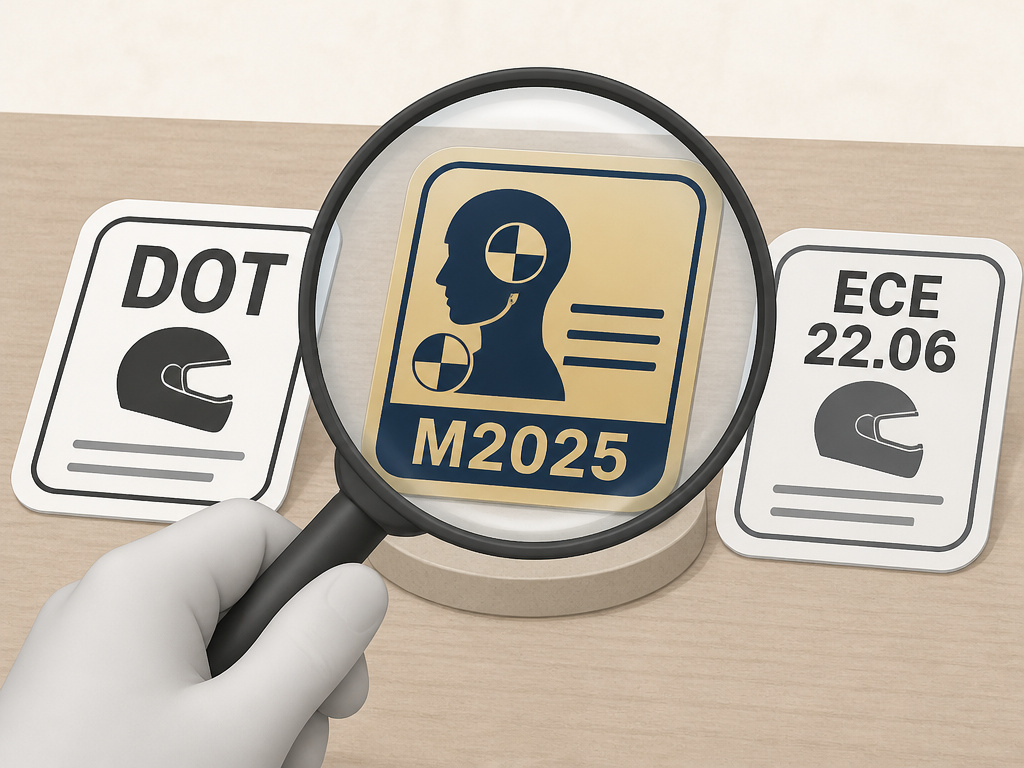
Most riders see three acronyms: Snell, DOT, and ECE. Understanding their roles is crucial. The Snell Foundation positions government standards like DOT and ECE as “government minimal standards that rely mostly on helmet manufacturers to police themselves,” contrasting its own role as an independent, continuous testing organization.
Here’s how they stack up on critical points:
| Aspect | DOT (FMVSS 218) | ECE 22.06 | Snell (M2025) |
|---|---|---|---|
| Legal Status | Mandatory for US street use. | Mandatory in Europe & many other countries. | Voluntary worldwide. |
| Certification Method | Self-certification by manufacturer. | Batch testing by approved labs. | Prototype & random production testing by independent Snell lab. |
| Impact Test Severity | Lower impact energy. Single test temperature. | Moderate impact energy. Tests at high, low, and wet conditions. | Higher impact energy. Tests at ambient, high, low, and wet conditions. |
| Oblique/Rotational Impact | No requirement. | Yes, required. | Yes, required (as of M2025). |
| Post-Market Surveillance | Rare spot-checks by NHTSA. | Ongoing batch testing by technical services. | Active random sampling from retail shelves by Snell. |
The real-world takeaway? A DOT sticker alone is a manufacturer’s claim. An ECE label means a sample from a production batch was tested. A Snell label means that specific model passed Snell’s prototype tests and remains subject to random checks from store shelves. For a detailed look at the details, see our comparison of DOT, ECE, and Snell helmet standards.
How to Verify a Helmet is Snell Certified
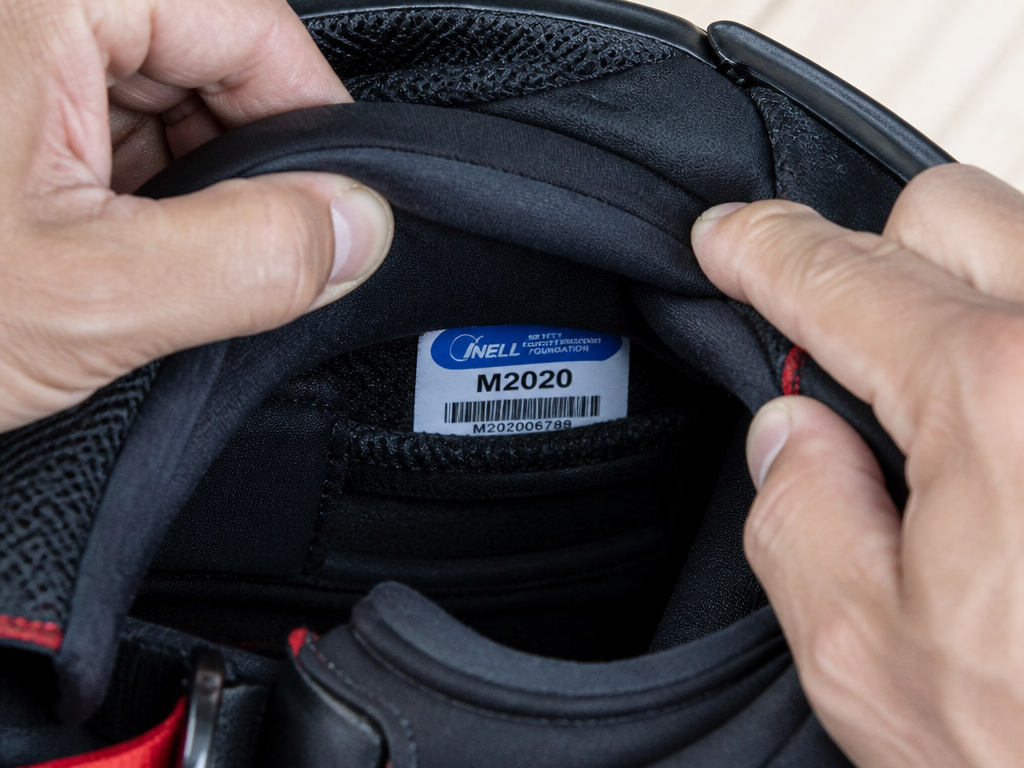
You cannot trust a logo on the outside. Verification happens inside the helmet. Each Snell-certified helmet contains a permanent internal label sewn into the liner or comfort padding. According to the Snell helmet certification FAQ, this label has:
- A unique barcode for tracking.
- A color specific to the standard (e.g., blue for M2020).
- The effective year of the standard (e.g., M2025).
This is different from the loose, often plastic, DOT sticker that can be, and often is, slapped onto non-compliant “novelty” helmets. I’ve handled those novelty helmets. They are often very light with minimal energy-absorbing liners. A real Snell-certified helmet will have a permanent internal label sewn into the liner.
You can also consult the official Snell certified helmets list on the Foundation’s website. This is the only authoritative source. Retailer filters or marketing copy saying “meets Snell standards” are not substitutes for the actual certification label inside.
Where this goes sideways: Installing an aftermarket accessory like a camera or Bluetooth comms unit. The Snell Foundation states this can invalidate certification unless done by knowledgeable professionals following procedures that don’t compromise the shell’s integrity. That glued-on mount might be the weak point in a crash.
Common Myths and Practical Realities
A few persistent questions come up whenever Snell certification is discussed. The official sources have clear, often overlooked, answers.
Does Snell certification expire?
No, the certification itself does not expire. A helmet certified to the M2020 standard is still a Snell-certified helmet. However, Snell recommends replacing a helmet every five years of use, based on a study of used California Highway Patrol helmets. They call this a “judgement call” for normal wear and tear. Crucially, they also state that unused helmets stored in good condition do not automatically expire after five years. The certification is forever; the helmet’s materials are not.
Are modular/flip-up helmets Snell certified?
Almost none are. The Snell Foundation has been inviting manufacturers to submit modular helmets for 20 years. They demand modular helmets meet the same testing requirements as full-face helmets. The Foundation’s FAQ states: “Unfortunately, almost all the prototype modular flip-up helmets tested in the Snell lab have not been able to meet all of the standard requirements consistently.” The complexity of the latch mechanism often compromises impact protection.
Is Snell necessary for street riding?
This is the core rider’s dilemma. Snell’s standards are undeniably more stringent, born from a motorsports safety legacy. For track use, many organizations require or recommend Snell certification. For the street, the answer is less absolute.
A Snell-certified helmet is designed to meet performance thresholds that exceed government minimums. But it’s not a magic shield. The Foundation itself says certification doesn’t specify materials or design. A perfectly fitted helmet is crucial for safety, regardless of the certification. My stance has always been that fit is the essential first layer of safety. A certified helmet that moves on your head won’t perform as the lab tested it.
Frequently Asked Questions
Are all motorcycle helmets Snell certified?
No. Snell certification is voluntary and rigorous. Many helmets meet only the mandatory DOT or ECE standards. High-performance helmets from brands like Arai, Shoei, and Bell often have Snell-certified models, but you must check for the internal label to be sure.
Is ECE 22.06 better than Snell M2025?
“Better” is the wrong frame. They are different. ECE 22.06 is a mandatory regulatory standard with oblique impact tests. Snell M2025 is a voluntary, higher-severity standard that also includes oblique tests. A helmet can be designed to meet both, but it must be certified under Snell’s specific M2025R standard to prove it. For most street riders, a well-fitted helmet with a strong ECE 22.06 standard rating is excellent protection.
Which motorcycle helmets are Snell approved?
The Snell Memorial Foundation publishes an updated list on its website. As of the M2025 standard, look for models explicitly certified to M2025D or M2025R. Many helmets certified under the previous M2020 standard are still available and provide excellent protection, though they lack the newer oblique impact test validation.
What is the safest certification for motorcycle helmets?
There is no single “safest” certification. Safety is a combination of the standard’s rigor, the helmet’s design quality, and, most critically, how well it fits your head. A multi-faceted approach is best: choose a helmet that meets a strong regulatory standard (ECE 22.06 or DOT from a reputable brand), check its independent rating from a program like SHARP helmet testing, and ensure it has a Snell certification if you want that extra layer of verified high-energy impact management. The safest helmet is the one that fits you perfectly and you wear every ride.
The Bottom Line
Snell certification is a badge of proven, excess capability. It tells you a helmet has been smashed, pulled, and shot in an independent lab and passed thresholds beyond what governments require. The new M2025 standard’s oblique impact tests bring it in line with modern brain injury science and other advanced standards like FIM homologation.
But don’t let a sticker decide for you. Use Snell as one filter among several. To understand its priorities, you can read the Snell M2020 helmet safety standard. Then, prioritize fit above everything. A Snell-certified helmet that floats on your head or pinches your temples is a compromise, and in safety gear, compromise is the starting point of failure. The best helmet is the one that meets a high standard, fits your head like it was molded for it, and has a chin strap you’ll actually tighten every single time you ride.
