
FIM Homologation for Motorcycle Helmets Explained: Track
This post contains affiliate links. As an Amazon Associate, we earn from qualifying purchases.
FIM homologation for motorcycle helmets explained: FRHPhe-01 covers road racing until December 2025. FRHPhe-02 expands to all disciplines except trial, pedelec, SSV, and streamliner riders from January 2026. It requires an accepted base standard, FIM tests, and a sewn chin-strap label.
The chin-strap label is a control point. Technical stewards scan its QR code to check the model, size, and championship eligibility before a rider is allowed on track. FIM homologation is a competition entry requirement separate from road-helmet approval.
What follows: the standards, the test changes, the label check, and the practical call for street riders.
Key Takeaways
- FRHPhe-02 applies to all FIM disciplines except trial, pedelec, SSV, and streamliner riders from January 2026.
- A valid helmet needs an eligible base standard, FIM testing, and a sewn chin-strap label.
- FRHPhe-01 remains for road racing only until December 2025, so check your championship rules.
- Sources differ on test counts: FIM says four samples per size for FRHPhe-02, while MCN describes ten helmets per size for FIM 1.
- For road-only riders, ECE 22.06 plus fit and retention beats chasing a race label.
FIM Homologation for Motorcycle Helmets Explained: What It Covers
FIM homologation is a certificate for helmets used in FIM competition. It sits on top of a road or race base standard, then adds FIM testing and a label. Labels matter. The purpose is to make technical control faster and to push helmet makers beyond minimum legal approval.
FIM Racing Homologation Programme for Helmets grants recognition to helmets meeting the FIM Helmet Standard. Eligible base standards include DOT FMVSS 218 with Snell M2015, M2020R, or M2020D; JIS T8133 2015 Type 2 Full face; or ECE 22.06 Type P. FIM impact and penetration tests follow before homologation in competition.
The FIM says the programme gives helmets a homologation certificate and labels. Those labels become a prerequisite for access to several competitions. ECE 22-05 Type P is not valid for FRHPhe-02, and was not valid for sale after 31 December 2023.
Who Actually Needs an FIM Helmet?
Race rules decide this. The sticker records the result. If you compete in a FIM event that requires homologated helmets, you need the model and size on the list. Street riders have no FIM requirement. Track days use event rules. The FIM list covers FIM competition use.
- You need it if your championship rules require FRHPhe-01 or FRHPhe-02.
- You should want it if you race national events and the FIM label helps technical control.
- You can skip it for road-only use when the helmet already meets ECE 22.06 and fits well.
I check the championship rules first, then the list. The FIM says FRHPhe-01 is for road racing only until December 2025, but sources differ on its initial introduction date for MotoGP. FRHPhe-02 is for all disciplines as of January 2026, except trial, pedelec, SSV, and streamliner riders. FIM EWC also says FRHPhe-02 was strongly recommended from 2025 and becomes mandatory from 2026 for FIM riders.
The FRHPhe-01 manual gives the 2019-to-2021 season window for specified World Championships. For FIM Endurance, it gives the 2019-2020 to 2021-2022 window.
For circuit work, read our best racing helmets notes before you assume a street lid qualifies. The base layer still matters, and DOT vs ECE vs Snell explains why FIM adds a separate step beyond base certification.
MCN reported 18 homologated circuit helmets and 11 off-road helmets, with more expected.
How Do You Verify a FIM Helmet Before You Race?
You arrive at technical control with a helmet that has a chin-strap label. The steward scans the QR code, checks the model and size, then confirms the helmet is allowed in that championship. That is the practical value of the label.
Before you start: Check the chin strap before every session. A loose retention system can let the helmet shift during impact. Inspect the shell after any crash. A cracked or detached part can injure the rider. Verify the label and QR code before technical control. An unreadable label can stop entry.
What the QR Code Shows
The QR code links to helmet pictures, homologated accessories, and eligible championships. The steward also saves rider information in the software. Fit still happens on your head.
- Find the label sewn on the chin strap. The manufacturer sews the FIM label only on the chin strap during production. If it is a sticker, it fails the check.
- Scan the QR code. The steward uses it to pull the helmet pictures, homologated accessories, and eligible championships. If the code is damaged, the check stalls.
- Match the model and size. FIM grants homologation for a model and size. A correct model in the wrong size is outside the approved combination.
- Check the accessories. Aerodynamic devices, ventilation appendices, and other listed parts must match the homologated combination. If a part is absent, the helmet is outside the approved combination.
- Confirm the discipline list. The QR data tells the steward which FIM Championships or Cups the helmet can compete in. If your event is absent, the label fails the check.
I scan the QR code before I trust a seller’s screenshot. The FIM list is model and size specific. A helmet may have DOT or Snell, but no sewn FIM chin strap.
If a helmet lists Snell, read what Snell certification means before you treat it as race-ready. I also compare SHARP ratings when another safety rating enters the conversation.
Where FRHPhe-02 Changes the Test
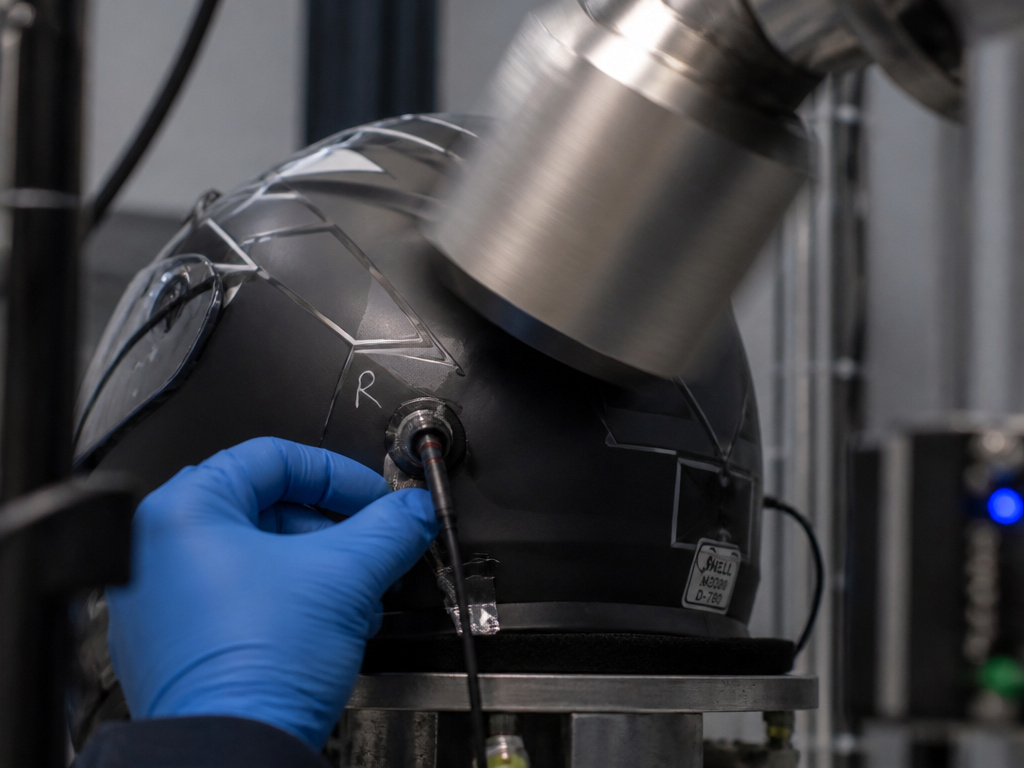
The test map changes. FIM says FRHPhe-02 goes above UN ECE 22.06, Snell M2020, and JIS T8133. It also goes above FRHPhe-01. The added elements include oblique and hemispherical anvil tests, a quick-removal cheek pad test, and the Skull Fracture Criterion (SFC).
| Feature | FRHPhe-01 | FRHPhe-02 |
|---|---|---|
| Scope | Road racing only | All disciplines except trial, pedelec, SSV, streamliners |
| Mandatory timing | MotoGP 2019; other circuit 2020 | Recommended 2025; mandatory 2026 |
| Samples per size | 10 helmets per size (MCN) | Four samples per size (FIM) |
| Added criteria | Linear, oblique, penetration | SFC, cheek pads, oblique, penetration |
Skull Fracture Criterion and Oblique Impacts
The SFC is a new threshold requirement in FRHPhe-02. The oblique test looks at rotational acceleration, which FIM says reflects a common real-world crash scenario. According to the FRHPhe-02 manual, impacts are placed randomly in 9 to 13 of 22 locations, while Motorcycle News reports impacts on 17 random points.
The Red Strap and Quick Removal
FRHPhe-02 cheek pads must incorporate a quick release system, identified by a red strap. That red strap is a visual cue: pull it and the pad should release. The acceptance criteria also require the shield or visor to remain closed. That applies during the lower face cover test and the first oblique impact. The acceptance criteria also say the helmet must show no dangerous breakage or deformation.
The FIM says it has one laboratory, the Impact Laboratory at the University of Zaragoza, to keep results consistent. FIM also says it has had to test up to seven times for a single size of one helmet model to get it to pass. Many manufacturers started the FRHPhe-02 homologation process from September 2025. Arai introduced a FRHPhe-02 circuit racing helmet in 2023. LS2 introduced FRHPhe-02 off-road models in 2023, and 6D introduced FRHPhe-02 off-road models in 2024.
MCN says FIM lowered certain circuit limits from <208g to <170g. That is a real change.
When Sources Disagree on the Numbers
A buyer can find both 17 random points and 9 to 13 of 22 locations in the coverage of FIM 2. The FRHPhe-02 manual uses the 9-to-13-of-22 wording. Motorcycle News says FIM rates impacts at higher speeds on 17 random points.
| Question | FIM or FRHPhe-02 Manual | Motorcycle News | Practical Read |
|---|---|---|---|
| Impact points | 9 to 13 of 22 locations | 17 random points | Use the current rulebook |
| Samples per size | Four samples per size | 10 helmets per size | Confirm FIM 1 or FIM 2 wording |
| MotoGP start | First helmet June 2019 | Mandatory in 2019 | Same year, different wording |
Sources differ. The FIM documents and secondary reports use different wording. A seller’s claim needs a source. I let the rulebook settle the count. A marketing page cannot do that.
The eligible European standard named in the FRHPhe-02 rules is ECE 22.06, and the UNECE reference document is ECE 22.06.
Street Riders, Track Days, and Fit

I used to judge helmets mostly by how light they felt in my hands. A two-hour ride changed that. A light helmet felt unbalanced and tugged at my neck in the wind. Now I judge balance on the road.
A buddy swore he hated riding long because of helmet noise. Earplugs and a small neck-roll adjustment changed that. He now rides about four hours at a stretch. Fatigue was a gear problem in his case.
Homologation and fit are separate jobs. A helmet can pass FIM tests and still move on your head. The chin strap, shell shape, and padding decide fit. Your head size decides if the lab result transfers to the street or track.
I won’t trust a helmet just because it has a race label. If it moves on my head, the test data is a fiction.
Do you actually need a race label for road use? For road-only riders, the sensible move is an ECE 22.06 helmet that fits. Chasing a FIM label is a separate decision. Motorcycle News says road-only riders with an ECE 22.06 helmet have no reason to chase FIM 2. For racing, it says FIM 2 is where it’s at.
If you ride sportbikes, compare sportbike helmets against the FIM list before spending on race homologation. For road use, full-face helmets with ECE 22.06 cover the job. Convenience features such as a drop-down sun visor or communication fit are separate from homologation. The chase costs money and attention.
What to Check Before You Buy
- Fit: the shell should stay still when you nod.
- Retention: the chin strap should feel firm under the jaw.
- Crash history: a dropped helmet is suspect, even if the label looks fine.
Easy to miss: The QR code registers the helmet. After a crash, FIM declares it crashed and blocks reuse during a FIM race.
See it on Amazon. Current reviews on Amazon will tell you if the graphics matter.
How does FIM homologation compare to ECE, Snell, or DOT?
FIM homologation is not a replacement for other standards but an additional certification for competition use. To even be eligible for FRHPhe-02 testing, a helmet must first be approved to one of several base standards. These include ECE 22-06 type P for Europe, specific Snell M standards for the USA, and JIS T 8133 2015 Type 2 Full face for Japan. The older ECE 22-05 type P is not valid. The FIM programme then adds its own layer of testing on top of this foundation, making it a more stringent requirement focused on the extreme conditions of racing.
What are the key impact tests for FIM homologation?
The FRHPhe-02 test protocol involves a series of rigorous impact assessments. Impacts are conducted at random on a selection of pre-established locations across the entire helmet surface. For full-face helmets, the shield or visor must remain closed during specific tests, including the lower face cover test and the first oblique impact. The helmet must withstand these impacts without exhibiting any breakage or deformation considered dangerous to the rider. The goal is to evaluate performance under a variety of realistic impact scenarios that could occur in competition.
What are the prerequisites for a helmet to be FIM tested?
Before a helmet can undergo FRHPhe-02 homologation testing, it must meet several foundational requirements. It must already hold a valid approval from a recognized base standard, such as ECE 22-06 type P. The helmet must be a full-face model with a one-piece outer shell construction. The retention system must use a double-D ring fastener. The cheek pads must also have a quick-release system, marked by a red strap. These prerequisites ensure the helmet has a solid safety foundation before facing the specific demands of FIM testing.
Frequently Asked Questions
What is the main purpose of the sewn chin-strap label on an FIM helmet?
The label serves as a critical control point for technical stewards at FIM-sanctioned competitions. By scanning its unique QR code, officials can instantly verify the helmet’s specific model, size, and eligibility for that championship. This digital check ensures compliance before a rider is permitted on track, streamlining the technical inspection process.
Can I use an ECE 22.05 certified helmet for FIM competition under the new rules?
No, ECE 22.05 is not an eligible base standard for FRHPhe-02 homologation. This older standard also could not be sold after December 31, 2023. To qualify, a helmet must first meet an accepted base standard like ECE 22.06 Type P, DOT with specific Snell certifications, or JIS T8133 2015, before undergoing the additional FIM testing.
If I only ride on the street, should I specifically seek out an FIM-homologated helmet?
For exclusive street use, pursuing an FIM label is generally unnecessary. A helmet that meets the latest road-legal standards like ECE 22.06, combined with a proper fit and secure retention system, offers excellent protection. The FIM programme is designed for competition, and its requirements do not equate to being inherently “better” for public road riding.
Why are there different reported numbers for how many helmet samples are tested?
The discrepancy in test sample counts, such as four versus ten per size, arises from different sources referencing separate phases or iterations of the FIM programme. It likely reflects an evolution in the testing protocol between the earlier FRHPhe-01 standard and the newer, broader FRHPhe-02 standard that takes full effect in 2026. Always consult the official FIM documentation for the current specifications.
The Bottom Line
Before you buy, separate three jobs: base certification, FIM homologation, and fit. A helmet can carry both labels and still be wrong on your head. The label gets you through technical control. The strap, padding, and shell shape get you through a real impact.
Confirm the model. Check the size. Match the accessories. Confirm the championship. If any are missing, stop. Rely on the QR code. A seller’s screenshot fails the check.
For street-only riders, skip the chase and spend time on fit. If you want FIM homologation for motorcycle helmets explained in one line: check the label, then check the fit.
