
SHARP Motorcycle HELMET Safety RATINGS Explained
This post contains affiliate links. As an Amazon Associate, we earn from qualifying purchases.
Sharp motorcycle helmet safety ratings explained: SHARP gives 1 to 5 stars after 32 impact tests on at least 7 samples, using 6.0, 7.5, and 8.5 m/s speeds to predict fatality risk. Fit and chin strap still decide whether that rating protects you.
The 32-test protocol helps differentiate the level of protection among helmets that all meet legal minimums. Real crash data weights those results. That’s why the star count reflects predicted fatality risk.
The star bands come next. The latch score gets its own place. Then comes a buying check that starts with fit. You’ll use it before you buy.
Key Takeaways
- A 5-star band means predicted fatalities under 155 in a 7087 population.
- A single flat-anvil hit at 300g or more can drop a 5-star result to 4 stars.
- Flip-front latch scores are shown, but they sit outside the star rating.
- Try on helmets first, then pick the highest SHARP rating among those that fit.
- SHARP states price and star rating have no connection.
How SHARP Turns 32 Impacts Into Stars
SHARP’s lab drops each helmet model onto flat and kerb anvils. The test page records 32 impacts per model, using at least 7 samples in different sizes.
SHARP runs 32 impact tests per helmet model, using at least 7 samples in different sizes. Linear tests hit flat and kerb anvils at 6.0, 7.5, and 8.5 metres per second. Two oblique tests measure shell friction linked to rotational injury risk. Results are weighted by real crash data before conversion to stars.
The 8.5 m/s top speed matters. UN ECE 22.05 requires 7.5 m/s, and UN ECE 22.06 requires 8.2 m/s. SHARP goes above both.
That extra speed is where a helmet’s EPS liner and shell design show their limits. The EPS liner is the foam that absorbs impact energy.
The Transport Research Laboratory runs the testing. The SHARP testing programme page ties the programme to COST 327, reported in 2001.
It’s dense, but it’s useful.
A survey found 70% variances in protective capability at selected impact sites. SHARP buys helmets from retailers, the same way riders do.
COST 327 found the side and rear commonly impacted. The side of the head is also particularly vulnerable. That’s why crash data matters.
Sharp Motorcycle Helmet Safety Ratings Explained: What Each Star Means
It’s a predicted fatality score. SHARP grades protection above the legal minimum, while regulatory approval itself (e.g., ECE 22.05/22.06) is a binary pass/fail assessment.
The star bands and the 300g trap
The rating calculation procedure uses a predicted fatality score from a modelled group of 7087 riders.
| Predicted fatalities | SHARP stars | Practical meaning |
|---|---|---|
| Less than 155 | 5 stars | Highest predicted protection in the model. |
| Less than 230 | 4 stars | Strong protection, but below the top band. |
| Less than 305 | 3 stars | Better than the legal minimum, not top. |
| Less than 380 | 2 stars | Legal protection with a smaller margin. |
| More than 380 | 1 star | Lowest SHARP grade among rated helmets. |
One extra rule can drop a 5-star result to 4 stars. If any valid flat-anvil linear test records 300g or more, SHARP modifies the rating.
That 300g trap is why a helmet can sit just below the top band.
I keep the safest motorcycle helmets list open while I shortlist models, but I’ll still try each one on.
For my narrow head, a very snug helmet created a sharp forehead pressure point within an hour.
I won’t let a 5-star sticker carry the whole buying decision. If the helmet moves on my temples, the lab result doesn’t matter.
That’s my rule.
Where SHARP and Legal Approval Disagree
Two common assumptions collide with SHARP’s own wording.
Pass/fail versus graded protection
The SHARP star ratings FAQ grades extra protection. All helmets rated by SHARP already meet the legal minimum for sale in the UK. Regulatory approval itself is binary, so the two questions are different.
That’s where riders get confused.
| Question | SHARP position | Other position |
|---|---|---|
| Is the star rating pass/fail? | It grades extra protection above the legal minimum. | ECE approval is a binary pass/fail. |
| Does price predict stars? | Price and star rating have no connection. | Some riders assume cost equals safety. |
| Does the latch score change stars? | The latch score is shown separately. | Flip-front buyers need it for chin bar security. |
SHARP says price and star rating have no connection. The MCN inside story gives a clear example.
That pair breaks the cost-equals-safety habit. It’s a hard habit to break.
New helmets on the market must meet ECE 22.06. The rule took effect in January 2024. The regulation update is the first in over 20 years.
A UK-legal UN ECE 22.06 helmet has a fabric label sewn to the chin strap.
Before you mix labels, comparing helmet standards helps you see why DOT, Snell, and FIM marks stand apart from SHARP stars. Don’t mix them.
Easy to miss: a flip-front can show a low latch score and still keep its star rating. If the chin bar unlatches during the 30 linear impacts, that extra risk sits outside the star number.
SHARP explains the latch score with a simple example: if the chin bar stays closed in all 30 impacts, the score is 100%. If it opens nine times, the score is 70%.
It’s a clear way to see the gap.
Price versus protection
A shiny premium lid and a plain budget lid can both carry five stars. That’s the short answer. SHARP states price and star rating have no connection.
Does a Higher Price Mean a Safer Helmet?
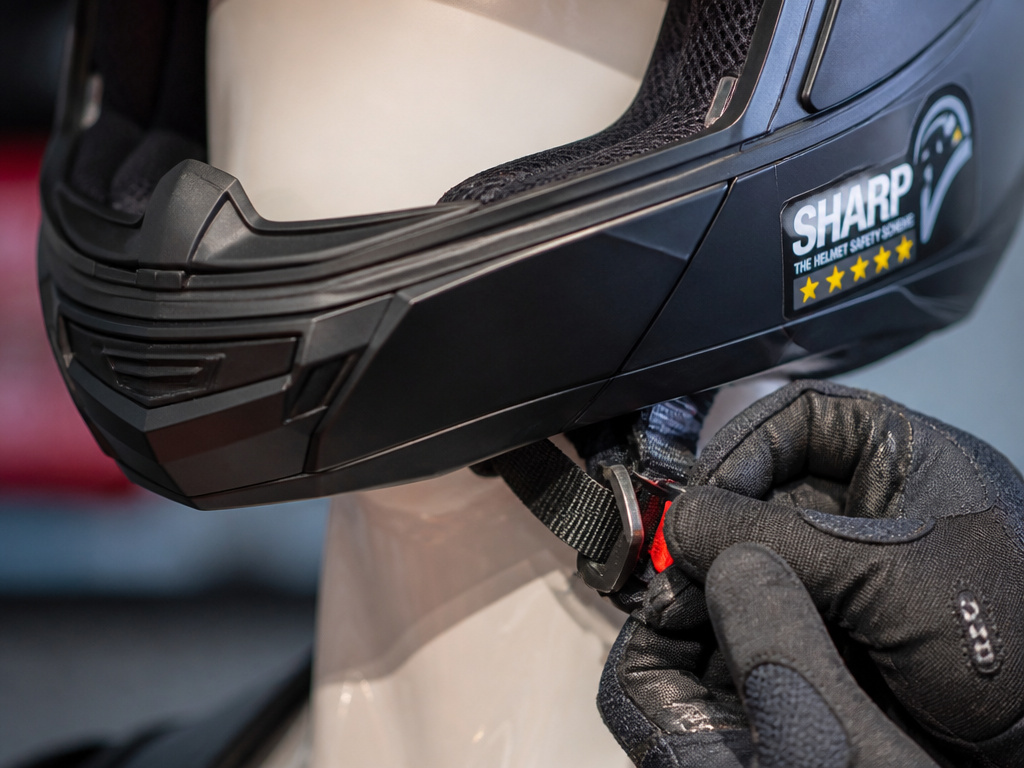
The programme has rated over 500 models. That means riders should be able to find a 3 to 5 star helmet in any price range. The scheme targets 30 helmets per year.
I’d buy it only after trying it on.
What SHARP does not score:
- chin strap as a separate feature.
- MIPS as a separate star.
- quietness as a safety score.
SHARP’s oblique test looks at shell friction. That friction is linked to twisting injury risk. A MIPS system may matter, but SHARP’s star number combines all linear and oblique results.
I wouldn’t pay much more for MIPS if the fit is wrong.
A loose chin strap allows the shell to move, and you can feel the liner sliding against your temples. Try it on.
How to Use SHARP Without Getting Fooled
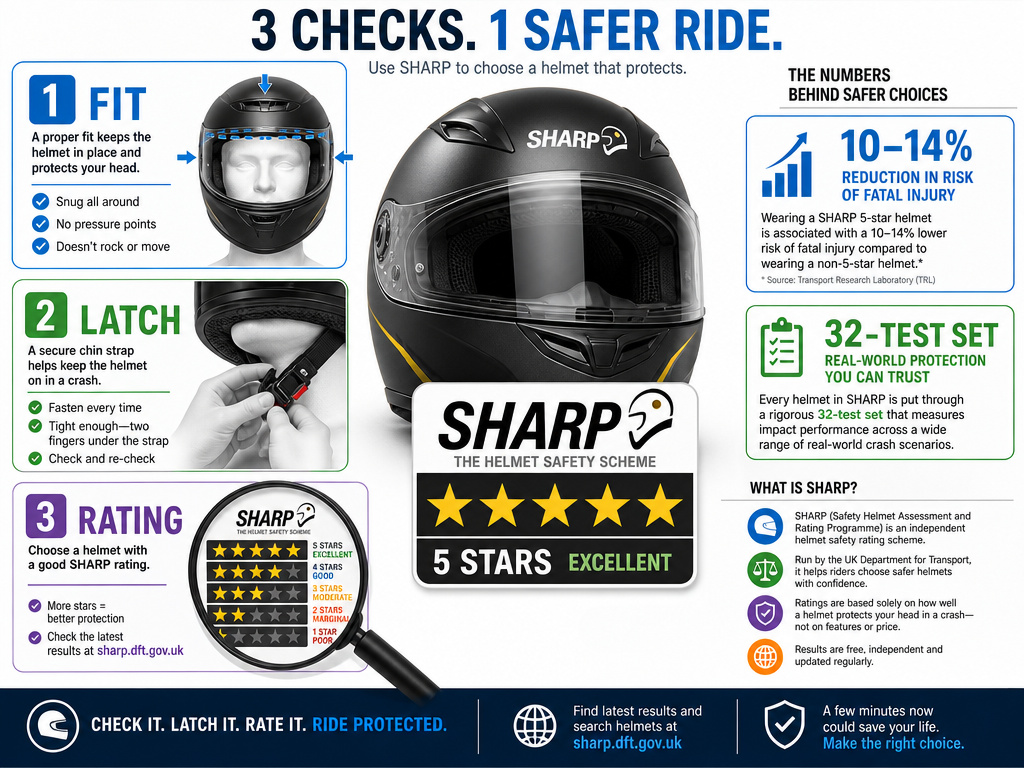
Three checks matter: fit, latch, and rating band.
Studies estimate that between 10% and 14% of deaths result from a helmet coming off in a crash.
Before you start: an unsecured chin strap can come off even at slow speeds; a helmet that presses one forehead spot can distract you within an hour; a loose shell can rock and shift the liner. Do up the strap tight enough to open your mouth, try on several head shapes, and wear the shortlist for 10 minutes.
A SHARP helmet ratings guide is available on their website.
Some riders ask whether Snell certification replaces SHARP. It can’t, because SHARP’s star band comes from its own 32-test set.
If you’re also checking best Snell helmets, remember that fit still controls the result.
If you compare independent gear programs, Motocap ratings are another reference point, but they stand apart from SHARP’s predicted fatality model. Don’t mix them.
I stopped treating star ratings as the whole answer after too many highly rated pieces fit nothing like the reviews suggested. That’s still my rule.
The 5-step buying check
- Set your budget first, then list helmets in that range. Skipping this leads to a pretty lid that fits poorly.
- Try on as many helmets as you can. A helmet that rocks on your temples will fail to sit as tested.
- Check the star band and the latch score if it is a flip-front. Ignoring the latch score hides chin bar risk.
- Wear the shortlist for 10 minutes in a noisy place. A helmet that feels fine for 2 minutes can become unbearable on a real ride.
- Do up the strap tight enough to open your mouth. A loose strap is a common cause of head injury.
What to check on the SHARP page:
- star rating, which shows predicted protection above the legal minimum.
- latch score, shown as a percentage for system helmets.
- helmet type, because adventure lids are listed as full-face or modular.
A five-star helmet with a bad fit is like a fine steak cooked in a rusty pan. It’s a bad result.
Fit first, features second.
How does SHARP compare to DOT, Snell, and FIM standards?
SHARP uses a different approach from regulatory standards like DOT or UN ECE 22.05/22.06, which are pass/fail tests. SHARP’s star rating is a graded scale, ranking helmets that have already met legal minimums. Its highest impact test velocity is 8.5 metres per second, exceeding the 7.5 m/s requirement of ECE 22.05 and the 8.2 m/s of ECE 22.06. SHARP also includes 32 impact tests per model, using both flat and kerb shaped surfaces, and two oblique impact tests to assess rotational forces. Unlike regulatory standards, SHARP provides a separate latch reliability score for flip-front helmets, though this score is not factored into the star rating.
How to use the SHARP website to look up a helmet
The SHARP website is a free public database. You can search for a specific helmet model or browse by brand, type, or star rating. Each helmet’s page shows its overall star rating from one to five stars. For system helmets, you will also see a separate percentage score for chin bar latch reliability. The site explains that all rated helmets meet legal safety standards and that there is no connection between a helmet’s price and its SHARP star rating. With over 500 models tested, the guidance is to first find helmets that fit and are comfortable, then select the one with the highest safety rating within your budget.
What do the impact zone diagrams and color maps show?
The SHARP test results often include impact zone diagrams or color maps. These visuals show how protection varies across different areas of the helmet shell. Research underpinning SHARP found the side and rear of the helmet are commonly impacted in real-world accidents, with the side being particularly vulnerable. The testing programme subjects each helmet model to 32 impacts at various locations. The color-coded results highlight stronger and weaker protection zones, demonstrating that a helmet’s protective capability can vary significantly at different impact sites. This helps you see where a specific model performs best.
Frequently Asked Questions
What does the SHARP rating on a motorbike helmet mean?
It’s a 1 to 5 star grade showing how much protection a helmet gives beyond the legal minimum. SHARP derives it from impact tests weighted by real crash data. It never replaces fit.
Which motorcycle helmet has the highest safety rating?
SHARP lists many 5-star models, so no single helmet is highest for every head. The Shoei NXR2 and HJC C70 are 5-star examples SHARP lists. The best model is the highest-rated one that fits you.
Are ECE 22.05 and ECE 22.06 better than DOT?
SHARP’s test anvils are specified in UN ECE 22.05, and new helmets on the market must meet ECE 22.06 since January 2024. DOT is a separate label, so the marks stand apart. Don’t mix them.
Does a 5-star SHARP helmet stay safe forever?
Rating covers the tested model under lab conditions. A worn liner, cracked shell, or loose chin strap can change the real-world result. Replace a helmet after a hard impact or if the retention system is worn.
Should I pay more for MIPS?
SHARP tests shell friction linked to twisting injury risk, but the star number combines linear and oblique results without a separate MIPS score. If MIPS adds cost and hurts fit, skip it. I wouldn’t pay much more.
The Bottom Line
The clearest way to use sharp motorcycle helmet safety ratings explained is to start with fit, then check the star band. That’s the rule.
If a flip-front shows a low latch score, such as 63%, treat it as a warning sign. SHARP says risk increases with lower latch reliability, but the score sits outside the star number. That’s the part I watch.
This changes if you have a narrow head. A 5-star lid that creates a sharp forehead pressure point within an hour is a poor choice for me. It won’t work for me.
I’d skip a premium lid that fits worse than a plain 5-star helmet. SHARP says price and stars have no connection.
