
Motorcycle Helmet EPS Liner Explained: How It Works
This post contains affiliate links. As an Amazon Associate, we earn from qualifying purchases.
To understand a motorcycle helmet EPS liner, know that Expanded Polystyrene is the stiff foam layer that crushes in one impact to slow head acceleration. ECE R22.05 safety standard caps peak head acceleration at 300 g and prevents 150 g from lasting beyond 15 ms.
That crush is the job. The foam doesn’t spring back, so a liner that has absorbed a hard hit has already spent its useful deformation.
What follows: the liner stack, hidden damage checks, replacement rules, and care habits that keep the foam honest.
Key Takeaways
- Check for hidden drop damage after any hard fall, even when the shell looks fine.
- Compare DOT and ECE checks before trusting a sticker, because NHTSA ties DOT, the U.S. Federal safety standard, to weight, thickness, and protrusion rules.
- Store the lid away from sunlight and solvents, because heat and petrol residue can damage the shell and EPS.
- Wear a new helmet for 30 to 45 minutes before riding, because pressure points can grow into pain.
- Follow the maker’s rule: Alpinestars says 5 years after first worn, while Leatt says replace when wear signs appear.
Motorcycle Helmet EPS Liner Explained: The Crush Zone
The EPS liner is the sacrificial core of the helmet. It sits between the hard shell and your head, and it manages the energy that the shell can’t move away.
Expanded Polystyrene works through controlled crushing. The foam cells collapse under load, lengthening the time over which head speed drops. ECE R22.05 caps peak head acceleration at 300 g and prevents 150 g from lasting beyond 15 ms. A shell spreads the hit, while the EPS liner manages the energy inside that window.
EPS is a cellular plastic. The Leatt MOTO 2.5 technical file lists Expanded Polystyrene as the liner material, paired with a polycarbonate shell. The helmet shell and foam have separate jobs. The shell handles penetration and spread. The foam handles deceleration.
Leatt says the liner is essential to intended performance. It also says don’t modify the outer shell, inner EPS liner, or chin strap. Leatt warns that no helmet can protect against all impacts.
Alpinestars warns that high-pressure water jets and strong solvents can cause visible and invisible damage to the shell and the EPS liner. I treat that as a hard stop for cleaning shortcuts.
No shortcuts.
How the Liner Stack Works: Shell, EPS, and Comfort Pads
Why would a helmet need more than one foam layer? Because a head isn’t one shape, and an impact isn’t one event.
Shell and EPS in Real Models
Some helmet models may use a dual-density EPS liner and a polycarbonate blend shell. PC-ABS is a shell plastic blend. The Military Motorcycle Helmet II manual lists a liner made from high-density polystyrene foam and slow-recovery foam laminated with moleskin fabric.
The Leatt file also lists certified weight ranges from 1070 +/- 50 g for XS/S to 1340 +/- 50 g for XL/XXL. The Leatt MOTO 2.5 technical file is the spec sheet I study first. Retailer product pages can show current purchasing options.
Helmet shells can be manufactured using various processes, including injection molding. EPS is a cellular foam, and these manuals list material names rather than molding steps.
Multi-Density and Secondary Layers
Multi-density EPS puts different foam stiffness in different zones. Some helmet models use multi-density EPS liners. The Leatt MOTO 2.5 adds a secondary layer of viscous-elastic polymer, a rubber-like material, as Turbine 360 buttons between the head and the EPS liner. Leatt’s file says these buttons slow low-speed impacts and let the head rotate slightly inside the helmet. They sit outside the EPS liner, not instead of it.
The peer-reviewed helmet liner study discusses various materials used in helmet liners. It says density is adjusted for energy absorption. Different liner materials have different properties regarding impact performance.
Research into helmet liners explores a variety of materials and structures. Helmet liner research examines various structural designs. Advanced manufacturing techniques are being explored for helmet liners.
I compare safety standards before I trust a sticker, especially after the motorcycle helmet eps liner explained the key metrics. The ECE R22.05 safety standard caps peak head acceleration at 300 g and keeps 150 g from lasting beyond 15 ms. The FIM racing federation conditions helmets at 25 C for at least 4 hours before testing. The FIM test protocol adds oblique impacts to look at rotational acceleration.
NHTSA says some makers provide replaceable cheek pads and liners to adjust fit. Altering the inside beyond those swaps will likely void warranty and compromise integrity.
I don’t chase stickers.
- The outer shell spreads and deflects.
- The EPS liner crushes to slow the head.
- Turbine 360 buttons add low-speed management in the Leatt MOTO 2.5.
- Comfort pads affect fit, not the main crush.
Did a Drop Ruin the EPS Liner?
A hard drop can spend the liner before any crack appears. I learned that a short fall can leave the shell pretty and the foam spent.
Before you start: A cracked shell can cut your skin, a worn chin strap can fail under load, and a spent liner won’t manage impact energy. Stop riding, inspect the helmet on a flat surface, and replace it if any fault shows.
Stop riding.
- Press the edge of the EPS liner. A healthy liner feels firm. A crushed liner leaves a thumbprint, and that means the foam has already taken a hit.
- Look for damage on the shell rim and liner seam. A hairline crack can open under the next impact, so don’t ride with it.
- Check the chin strap and rivets. NHTSA says DOT helmets have sturdy chin straps with solid rivets, and a loose strap can let the helmet move when it matters.
- Smell the padding. A faint petrol smell is a warning, because Alpinestars says chemicals or petrol residue from gloves can damage the inner lining.
- Wear the helmet for 30 to 45 minutes. NHTSA says this reveals pressure points, and a hot spot can grow into pain before a crash even happens.
| Symptom | Likely cause | Action |
|---|---|---|
| Soft spot at liner edge | crushed EPS | stop riding |
| Chalky crumble on rim | foam damage | replace helmet |
| Faint petrol smell | solvent residue | remove and inspect |
| Loose fit after wear | liner compression | check maker rule |
I keep a helmet drop damage note in my garage because owners ask after every short fall. The NHTSA motorcycle helmet guide also says unsafe helmets are less than 1 inch thick and usually lack a stiff foam inner liner. It also says the DOT standard doesn’t allow anything to extend further than 0.2 inches from the helmet surface.
When Should You Replace an EPS Helmet?
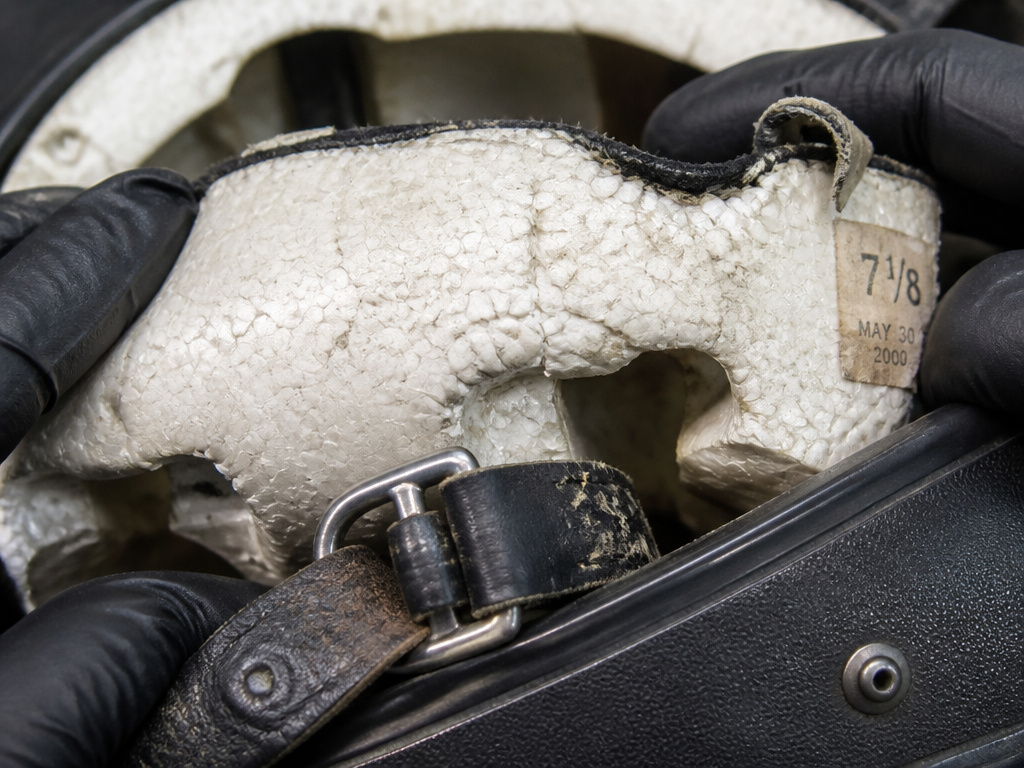
The Alpinestars Supertech R7 manual sets a clock. It says replace the helmet 5 years after it is first worn. The Leatt Moto 7.5, 8.5, and 9.5 manual gives no fixed period. It says the helmet has a limited lifespan. Replace it when wear shows, such as change of fit, cracks, rust, or fraying.
I check manuals first.
That gap in helmet lifespan advice is why I check the maker’s manual first. The manuals don’t agree, so I don’t pretend one rule covers every foam.
| Source | Rule | Watch for |
|---|---|---|
| Alpinestars Supertech R7 | Replace 5 years after first worn | date of first wear |
| Leatt Moto 7.5, 8.5, 9.5 | Replace when wear shows | fit change, cracks, rust, fraying |
| NHTSA | Check fit after buying | pressure points after 30 to 45 minutes |
I treat the fixed date as a floor and the wear signs as a trigger. If either one hits, the helmet is done.
Cleaning and Storage: Keep Solvents Away
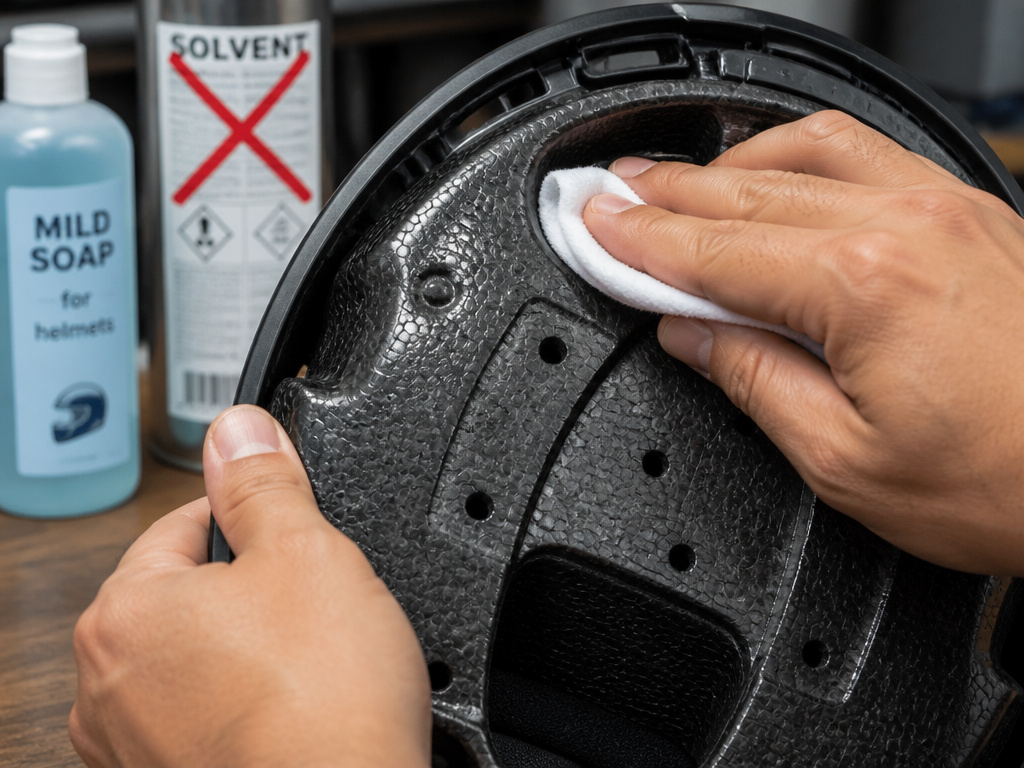
Set the helmet on a bench. Check the bag. This is where hidden damage starts.
I clean the liner with a damp cloth and mild soap, then let it dry fully. Alpinestars says use only a clean damp cloth and mild soap for the shell, and neutral soap and water for the shield. It also says to keep the interior fresh with a water-based upholstery cleaner on the cheek pads and comfort padding.
Leatt warns that paint, adhesive stickers, cleaning fluids, or other solvents can severely reduce protection. Certain paints, thinners, and adhesives can do permanent damage to the shell, EPS liner, or shield, per Alpinestars. These sources don’t cover EPS recycling.
- High-pressure water jets can damage the shell and EPS liner, so skip the car wash.
- Strong solvents and solvent vapor, including petrol, can harm the shell, liner, and shield.
- Stickers can leave adhesive that damages the shell.
- Gloves stored inside can transfer chemicals or petrol residue to the lining.
Easy to miss: A helmet left in a hot car can suffer heat damage. Alpinestars says store it in a cool, dry place, preferably inside the original helmet bag.
The Alpinestars Supertech R7 manual is the one I pull out for care rules (yes, I checked it twice). Current reviews on Amazon can show fit complaints before you buy. If you want a removable-pad route, check the ICON Airflite manual. It shows dual-density EPS and a polycarbonate PC-ABS shell. Check availability if you want the current spec sheet.
Why Does Fit Matter More Than a Sticker?
A perfect EPS liner fails on a loose head. NHTSA says a correctly sized helmet should feel a little tight, with even pressure and no uncomfortable pressure points. Leatt’s warning says the helmet must fit closely and be securely fastened.
Fit first, features second. The chin strap is the part I watch hardest. A loose strap can let the helmet shift, and a shifted helmet won’t match how the lab tested it.
The Chin Strap Is the Quiet Failure
NHTSA says helmets meeting DOT generally weigh about 3 pounds. The MMH II manual says earcup pressure should be 2-3 pounds. Those numbers aren’t universal, but they show how tightly a protective helmet should sit.
I once picked a helmet a size too big because it felt roomy in the shop. At highway speed it shifted and roared with wind noise. The helmet should feel snug, with the cheek pads gently pressing.
Do you trust a sticker more than your own fit check? I don’t.
I rank safest helmets by fit first, then by certification. Several helmet brands are known for their focus on fit and safety.
Comparison of EPS with other foams like EPP
Helmet liners primarily use expanded polystyrene (EPS) foam for energy absorption. For example, the Military Motorcycle Helmet II uses a combination of high-density polystyrene and a slow-recovery foam.
Helmet fit and break-in related to the liner/comfort pads
A proper fit is crucial for safety and comfort. Always replace the helmet if the liner shows any signs of damage or wear.
Advanced liner materials and structures (honeycomb, bionic, additive manufacturing)
It does mention a helmet using a secondary layer of viscous-elastic polymer buttons between the head and the main EPS liner, which is an example of an advanced design feature aimed at managing energy. Helmet liner designs vary to improve impact performance. These designs aim to better manage impact forces across a wider range of speeds and angles. When considering such helmets, review the manufacturer’s technical information to understand how these features contribute to the helmet’s overall safety profile.
Frequently Asked Questions
What is an EPS liner in a helmet?
An EPS liner is the Expanded Polystyrene foam layer inside a motorcycle helmet. It crushes to slow head acceleration during an impact. The Leatt MOTO 2.5 technical file lists EPS as the liner material.
Is EPS foam good for helmets?
Yes, as a crush layer. The peer-reviewed helmet liner study lists EPS as a common synthetic cellular material used in helmet cushions. Its job is energy absorption, not comfort.
Can you clean an EPS liner?
You can clean the removable comfort padding with a water-based upholstery cleaner, per Alpinestars. Don’t use strong solvents or high-pressure water on the EPS liner. Leatt says solvents can reduce protection.
How long does an EPS helmet liner last?
The sources disagree. Alpinestars says replace the Supertech R7 5 years after first worn. Leatt says replace when wear signs appear. I treat both as triggers.
What is the 2 2 2 rule for motorcycle helmets?
The sources reviewed here don’t define a 2 2 2 rule. Use the maker’s replacement rule and your own wear check.
Is ECE 22.05 better than DOT?
The sources don’t rank them. ECE R22.05 caps head acceleration at 300 g and keeps 150 g from lasting beyond 15 ms. NHTSA’s DOT checks look at weight, thickness, and protrusion. Fit decides which one helps you.
Before You Go
A motorcycle helmet EPS liner explained in one line: it is the crush layer that buys time. The shell spreads the hit. The foam slows the head. Once the foam has crushed, it can’t undo that work.
Check the liner after any hard drop, and check the fit before any long ride. If the manual gives a fixed interval, use it. If it gives wear signs, trust the wear signs.
Skip a helmet that moves on your head, no matter what the sticker says. The best lid is the one that fits, stays fastened, and gets retired when the foam has spent itself.
