
What Is MIPS in Motorcycle Helmets: How to Choose
This post contains affiliate links. As an Amazon Associate, we earn from qualifying purchases.
MIPS in a motorcycle helmet is a low-friction plastic liner, called a slip plane, designed to let the helmet shell rotate 10–15 mm independently from your head during an angled impact. The goal is to reduce rotational forces on the brain, a key cause of concussions and severe brain injury. It is a licensed design feature, not a safety certification, and adds 20–45 grams of weight.
The mechanism is simple in theory but took decades of biomechanical research to perfect. The real question isn’t whether it works in a lab, but where it fits in your actual helmet-buying decision, which leads many to ask: what is MIPS in motorcycle helmets?
What follows is a breakdown of the science, a look at the data from a key 2022 study, and a practical guide on when MIPS should be your tie-breaker, and when you should ignore it entirely.
Key Takeaways
- MIPS is a licensed safety system, not a certification like DOT or ECE 22.06. A certification is verified evidence; MIPS is a design approach.
- A 2022 peer-reviewed study found the MIPS low-friction layer reduced Peak Rotational Acceleration by 31.2% compared to conventional helmets in oblique impacts.
- Never sacrifice proper helmet fit for MIPS. A loose helmet with MIPS is more dangerous than a perfectly fitting one without it.
- Check the manufacturer’s instructions before removing the interior liner for cleaning; the MIPS layer is a moving part that can be damaged.
- If choosing between a DOT-only helmet with MIPS and an ECE 22.06 helmet without it, the certified helmet is the safer bet.
What Is MIPS and Where Did It Come From?
MIPS stands for Multi-directional Impact Protection System. It’s a proprietary technology owned by the Swedish company Mips Protection AB and licensed to helmet manufacturers worldwide. You’ll recognize it by the small yellow logo inside the helmet.
The idea was born from a question a neurosurgeon asked in 1995, which is a different origin than the common what is mips in motorcycle helmets query. Hans Van Holst, working at Stockholm’s Karolinska Institute, questioned why all helmet testing at the time focused on straight, linear impacts. He partnered with biomechanics researcher Peter Halndin to study what happens in the far more common angled or “oblique” crash. Their research led to a system that mimics the protective function of the cerebrospinal fluid between your brain and skull.
The company debuted its first helmet in 2007 for equestrian sports and began licensing to other manufacturers in 2009. Today, you can find it in helmets from over 150 partner brands across cycling, skiing, and motorcycling.
The MIPS test lab evaluates helmets on model heads at a speed of 6.2 m/s at a 45-degree angle, using accelerometers to measure rotational motion. This standardized oblique-impact test is the basis for their performance claims.
How Does MIPS Work? The Slip-Plane Mechanism
Forget complex mechanics. Imagine a hockey puck sliding on ice. The MIPS layer is the ice, a low-friction interface between your head (the puck) and the helmet’s hard outer shell and EPS liner.
In a straight-on hit, the helmet’s job is to crush and absorb energy. In a glancing, angled blow, like when your head scrapes across pavement, the helmet’s outer shell and EPS liner want to grip your skull and spin it. That rotational force is a primary driver of brain injuries like concussions and diffuse axonal injury.
The integrated plastic liner allows the helmet to rotate independently around your head by that critical 10–15 mm. This tiny movement redirects rotational energy away from your brain before the helmet’s retention system fully engages. You can sometimes feel it if you try to twist the comfort liner against the shell; there’s a slight, gritty slide.
The part nobody mentions: This only works if the helmet is snug. A loose helmet will rotate on your head before an impact even engages the MIPS layer, negating the whole system. Fit is the prerequisite.
Does MIPS Actually Work? What the Data Says
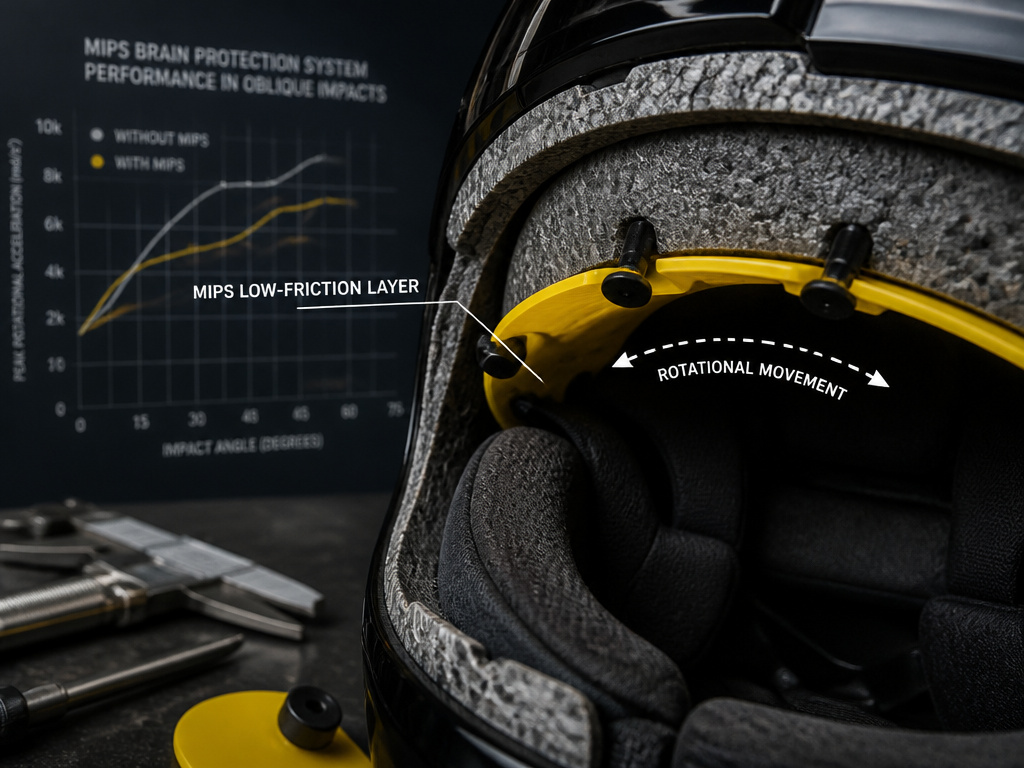
Marketing claims are one thing. Peer-reviewed, comparative data is another, especially when you compare a what is mips in motorcycle helmets explanation to the lab results. A 2022 study published in the Annals of Biomedical Engineering provides some of the clearest numbers we have. Researchers tested helmets in oblique impacts at 8 m/s (about 18 mph) and measured several injury metrics.
The study compared conventional helmets against three rotational-management technologies: MIPS (a low-friction layer), Flex (a multi-layer liner), and ODS (a damper system).
| Technology | Reduction in Peak Rotational Acceleration (PRA) | Reduction in Peak Translational Acceleration (PTA) |
|---|---|---|
| MIPS | 31.2% | 8.5% |
| Flex | 19.3% | Not Significant |
| ODS | Not Effective | Not Effective |
Data sourced from the NCBI study on helmet oblique impact performance.
The MIPS layer was the clear leader in reducing rotational forces. It also provided a small but statistically significant reduction in linear forces. The study is a reality check, not all technologies marketed for rotational protection perform equally.
Common mistake: Citing MIPS as “proven” without context. The 2022 data shows it works well in lab conditions for a specific impact. It does not guarantee injury prevention in the infinite variables of a real-world crash.
This is why understanding helmet safety ratings and broader safety standards is crucial. A SHARP helmet test or an ECE 22.06 certification includes oblique-impact testing, giving you a broader picture of a helmet’s safety.
MIPS vs. Helmet Certifications: Which Matters More?
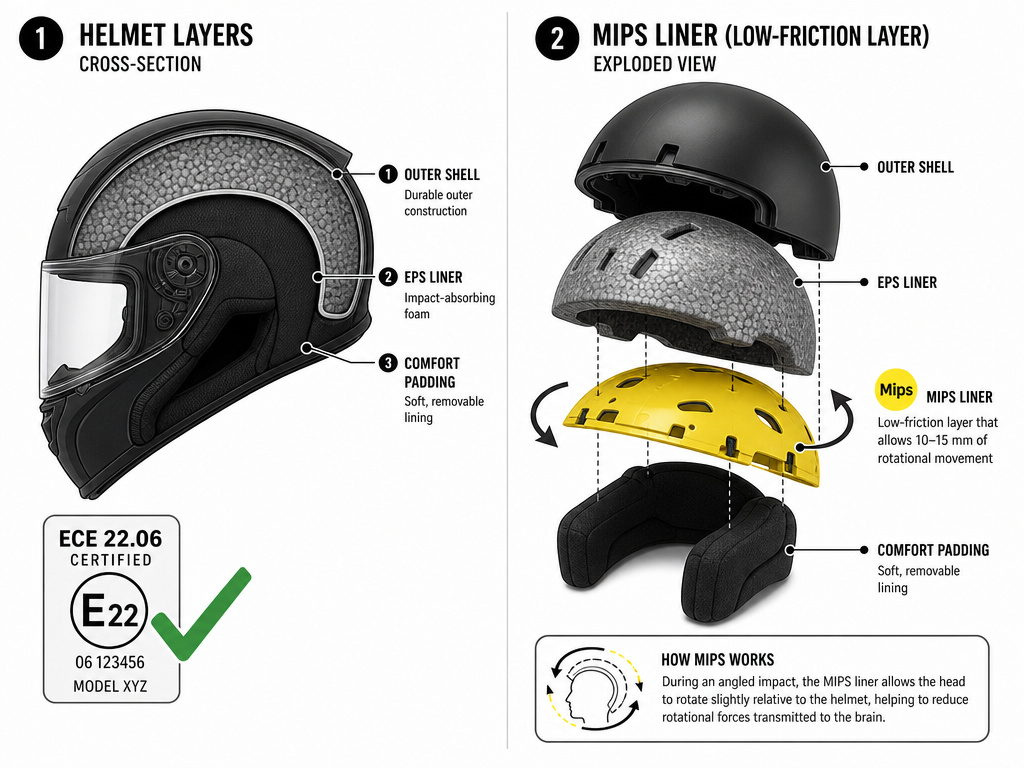
This is the most important practical distinction every rider needs to grasp.
Certifications (DOT, ECE 22.06, SNELL) are test results. An independent lab smashes a sample helmet against a protocol. It passes or fails. The sticker on the back is a verified claim about that helmet’s minimum performance.
MIPS is a design feature. It is a component the manufacturer chooses to include. There is no pass/fail test for the final consumer product from an outside body. Mips Protection AB tests the system generically, but not each individual helmet rolling off the line.
Sources offer different advice: Apex & Armor suggests if choosing between an ECE 22.06 helmet without MIPS and a DOT-only helmet with MIPS, take the tested one. They also state that if two helmets are otherwise equivalent and one has MIPS, that is a reasonable tie-break. The certification is evidence; the feature is an approach.
The latest ECE 22.06 standard actually includes oblique-impact testing in its protocol. So, a helmet with that sticker has already been evaluated for rotational performance, with or without a MIPS liner. Since the ECE 22.06 standard includes oblique-impact testing, some experts argue MIPS may be less critical on such a helmet, while others see it as a beneficial additional feature if the helmets are otherwise equivalent.
Your hierarchy should be: 1. Perfect Fit, 2. Reputable Certification (ECE 22.06 or SNELL), 3. Additional features like MIPS. Never reverse this order.
Practical Considerations: Weight, Fit, and Care
The MIPS layer adds between 20 and 45 grams to the helmet’s weight. The added weight is minimal. You won’t feel it on the scale or on your head.
You might feel the fit. The liner adds a thin, sometimes slightly stiffer layer between your scalp and the comfort padding. For most, it’s indistinguishable. For some riders, the extra layer can create a subtle pressure point or alter the snugness. This is why you must try on a helmet before buying one.
The care instruction is critical. The MIPS liner is a moving part bonded or attached inside.
Before you start: Check the maker’s guidance before pulling the interior out to wash it. Yanking a glued or clipped MIPS layer can detach it, turning a safety feature into a loose rattle. Most brands advise spot-cleaning the liner while it’s still in the shell.
As for the yellow sticker? Peel it off if you want. It serves no functional purpose after purchase.
Alternatives to MIPS and Competing Systems
MIPS is the most common name, but it’s not the only approach to managing rotational force. Some manufacturers use their own proprietary systems, and others rely on advanced shell and liner shaping to achieve similar goals.
| System (Brand) | How It Works | Key Consideration |
|---|---|---|
| MIPS (Various) | Low-friction slip-plane liner. | Widely available; strong lab data. |
| Fidlock® (Shoei) | Magnetic buckle system for quick release. | A retention feature, not an impact system. Often paired with other tech. |
| Aero Ridge (Arai) | Complex channeling in the EPS liner to manage energy. | Part of Arai’s holistic shell/liner design philosophy. |
| Flex (Bell) | Multi-layer liner system with varying densities. | Showed a 19.3% PRA reduction in the 2022 study. |
| 6D ODS | Elastomer dampers connecting two EPS liners. | Did not show significant reduction in the 2022 study. |
The table shows a fragmented landscape. When looking at the best helmets for safety, the presence of any rotational management is a positive sign the manufacturer is thinking beyond basic standards. However, the specific implementation matters, and as the data shows, not all are equally effective.
Your best bet is to consult detailed reviews and complete helmet guides that cut through the branding. Look for tests that measure performance, not just list features.
How to Choose: When MIPS Should Be Your Deciding Factor
Apply all this to the moment you’re holding two helmets, checking your budget, and deciding.
Choose the helmet WITH MIPS if:
- Both helmets fit you perfectly and have the same certification (e.g., both are ECE 22.06).
- One helmet is ECE 22.05 and the other is ECE 22.06 with MIPS. The newer certification plus the feature is a clear step up.
- You are comparing models within the same brand and line (e.g., Shoei RF-1400 vs. RF-1400 MIPS), and the price jump is reasonable.
Ignore MIPS and choose the other helmet if:
- The MIPS helmet doesn’t fit as snugly. This is the rule.
- You’re comparing a DOT-only helmet with MIPS to an ECE 22.06 or SNELL helmet without it. The certification gap is more significant.
- The MIPS version costs significantly more and forces you to compromise on other types of helmets or features you value, like premium ventilation or a photochromic visor.
Think of MIPS as a sophisticated airbag system in a car. It’s excellent to have, but it doesn’t matter if the car’s frame (the helmet’s fit and basic integrity) is compromised. Build from a solid foundation first.
MIPS in Full-Face, Modular, Dirt, and Dual-Sport Helmets
MIPS technology is available across various motorcycle helmet types, from full-face to dual-sport models. The core function remains the same: a low-friction layer designed to allow the helmet shell to rotate slightly independently from your head during an angled impact. This addresses rotational forces, a common cause of brain injury in oblique crashes. The added layer can affect fit, so trying on a helmet is crucial. Never choose a helmet with MIPS if it compromises fit or a fundamental safety certification like DOT, ECE 22.06, or SNELL. For cleaning, always check the manufacturer’s guidance, as the MIPS layer is a moving part. When comparing helmets, MIPS can be a reasonable tie-breaker between two otherwise equivalent models that meet your required safety standards.
Frequently Asked Questions
Are MIPS helmets actually better?
In controlled laboratory oblique-impact tests, yes. The 2022 study showed a 31.2% reduction in Peak Rotational Acceleration for helmets with the MIPS low-friction layer compared to conventional ones. This suggests a meaningful reduction in the forces linked to concussions and brain injury. “Better” in the real world depends on countless crash variables, but the lab evidence is strong.
Is it bad to get a helmet without MIPS?
No. Plenty of excellent, safe helmets do not have MIPS. Many rely on advanced shell design and meet modern certifications like ECE 22.06 that test for rotational performance. Prioritize a helmet that fits perfectly and carries a certification like ECE 22.06 first. MIPS is a beneficial add-on, not a mandatory safety foundation.
Which MIPS motorcycle helmet is the best?
There is no single “best” model. Leading brands like Shoei, Arai, and Bell incorporate MIPS into specific models across their ranges. The best one for you is the Shoei, Arai, or Bell helmet that fits your head shape perfectly. Start your search within well-regarded models from these brands, then narrow down by fit, not by the presence of the yellow logo alone.
Do I leave the MIPS sticker on my helmet?
You can peel it off. The sticker is purely informational for the point of sale. It serves no safety or functional purpose once you own the helmet. Removing it won’t affect the performance of the liner inside.
The Bottom Line
MIPS is a smart, well-researched solution to a real problem in head injury mechanics. The numbers from independent studies are convincing. But in the garage, under the store lights, those numbers are not the first thing you should reach for.
Put the helmet on. Shake your head “no” vigorously. Try to roll it forward off your head with the strap undone. If it moves, it’s wrong. A $300 helmet that fits like a glove is a safer place to be than a $800 helmet that swims on you, regardless of the technology inside.
Once you have two or three helmets that pass the fit test, then look at the stickers on the back. An ECE 22.06 rating is a more concrete piece of safety information than a MIPS logo. If you’re down to a final tie between two perfectly fitting, well-certified lids, and one has MIPS for a few dollars more, that’s the moment to take it. That’s how you use the feature, not get used by it.
