
What Is DOT Motorcycle Helmet Certification? Quick Answer
This post contains affiliate links. As an Amazon Associate, we earn from qualifying purchases.
DOT motorcycle helmet certification means a helmet’s manufacturer claims it meets the U.S. Federal Motor Vehicle Safety Standard No. 218 (FMVSS 218). It is a self-certification system, not a government approval. The helmet must pass impact, penetration, and retention tests, and wear a permanent, specific label on the back. The label’s design changed in 2013 to combat fake stickers on unsafe novelty helmets, which the NHTSA estimates cause dozens of preventable deaths annually.
That self-certification clause is where the confusion starts. Manufacturers test their own helmets and declare them compliant. The National Highway Traffic Safety Administration (NHTSA) doesn’t pre-approve anything; it conducts random audits and can issue recalls if a helmet fails. This honor system is why the label itself became a target for regulation, simple “DOT” stickers were too easy to fake. Understanding what is DOT motorcycle helmet certification is key to seeing why this system is controversial.
What follows: a breakdown of the exact label you need to look for, the brutal physics behind the three main tests, and how to use this standard alongside others like ECE or Snell when you’re actually buying a lid. The goal is to turn a government acronym into a usable tool for your next purchase.
Key Takeaways
- The DOT certification label is a legal document, not a decoration. For helmets made after May 13, 2013, it must list, in order: the precise model, “DOT”, “FMVSS No. 218”, and “CERTIFIED”.
- NHTSA does not pre-approve helmets. Certification is a manufacturer’s claim, backed by random government testing. A recalled model is a failed audit.
- The 400g peak acceleration limit is a violent threshold set by the FMVSS 218 test procedure.
- Novelty helmets with fake DOT stickers are a documented, lethal scam. They often weigh under 3 pounds, lack a thick EPS liner, and have flimsy plastic buckles.
- For most street riders, a dual-certified helmet (DOT and ECE 22.06) offers a stronger, independently verified safety net than DOT alone.
The Anatomy of a DOT Certification Label
That sticker on the back of your helmet is the only visible proof of certification. It’s also the part counterfeiters copy. The federal code specifies its exact layout, wording, and even letter height for a reason.
For any helmet manufactured on or after May 13, 2013, the label must be permanent and contain four lines of information, in this order from top to bottom:
- The precise model designation.
- The symbol “DOT”.
- The term “FMVSS No. 218”.
- The word “CERTIFIED”.
The “DOT” letters must be at least 0.38 inches (1.0 cm) high. The “FMVSS No. 218” and “CERTIFIED” text must be at least 0.09 inches (0.23 cm) high. The horizontal centerline of the “DOT” symbol must be located between 1 and 3 inches (2.5 and 7.6 cm) from the bottom edge of the posterior portion of the helmet.
Common mistake: Assuming any sticker with “DOT” on it is legitimate. The full, four-line format is mandatory for new helmets. A lone “DOT” decal, especially one that feels like a cheap sticker, is a major red flag.
I handle a lot of helmets. The label on a certified one feels like part of the shell, sewn into a fabric patch or under a clear coat. On the novelty helmets I’ve checked, the “DOT” marking was often a vinyl sticker you could peel off with a fingernail, sitting on top of paint that was too glossy. The helmet itself was suspiciously light, and the foam liner looked thin enough to see through.
Here’s how to verify the label is real, not just present:
| Check For | Legitimate Label | Fake/Novelty Label |
|---|---|---|
| Text Format | Four lines: Model, DOT, FMVSS No. 218, CERTIFIED. | Often just “DOT” alone, or with misspellings. |
| Permanence | Feels embedded, under clear coat, or on a sewn-in patch. | A vinyl sticker applied on top of the finish. |
| Letter Height | “DOT” is noticeably large (over 1 cm). | Letters are often small and poorly printed. |
| Location | Centered on back, 1-3 inches from bottom edge. | May be placed crooked or in an odd location. |
If the label fails any of these checks, you are likely looking at a fake DOT helmet. The NHTSA calls these “novelty helmets” and states they are unsafe. They exist because the old, simple “DOT” label was easy to counterfeit. The 2013 rule change adding “FMVSS No. 218” and “CERTIFIED” was a direct attempt to make faking it harder.
How DOT Helmets Are Tested: The Three Brutal Trials
The FMVSS 218 regulatory text details every test. It’s not a gentle process. Helmets are conditioned in extreme environments, frozen, baked, soaked, then subjected to impacts, stabs, and pulls. The goal is to simulate the worst-case scenarios of a crash.
The Impact Attenuation Test (The Big Hit)
This is the core of the standard. A helmeted headform is dropped onto steel anvils. The accelerometer inside the headform must show three things:
- The peak acceleration cannot exceed 400 g.
- Accelerations over 200 g cannot last more than 2.0 milliseconds cumulative.
- Accelerations over 150 g cannot last more than 4.0 milliseconds cumulative.
What does 400g mean in practice? It’s a violent stop. Research indicates sustaining a peak acceleration of 400g dramatically increases the risk of severe, life-threatening brain trauma. The standard isn’t looking for comfort; it’s drawing a bright line below catastrophic failure. The test uses two anvil shapes: a hemisphere (simulating a curb or rock) and a flat plate (simulating the road). The minimum drop heights are 54.5 inches for the hemispherical anvil and 72 inches for the flat anvil.
The Penetration Test (The Sharp Object)
A pointed, weighted striker is dropped onto a stationary, helmeted headform. The rule is simple: the striker must not contact the headform’s surface. This test checks the shell’s ability to resist punctures from debris like stones, bolts, or broken bits of pavement. It’s a pass/fail test, any contact is a failure.
The Retention System Test (The Strap Hold)
This test often gets overlooked. A weight is attached to the helmet’s chin strap, which is fastened to a dummy head. The system must hold under a static load without breaking, and the adjustable portion of the strap cannot stretch or slip more than 2.5 cm. A helmet can have a perfect shell, but if the strap breaks or stretches too much on impact, the helmet comes off. Every time I see a rider with a loose double-D ring, I think about this test.
Where this goes sideways: Assuming a helmet that passed once is forever certified. The foam liner compresses permanently after a major impact, even if the shell looks fine. The standard says to destroy and replace a helmet after a severe blow.
The official NHTSA FMVSS 218 test procedure manual runs over 80 pages. It covers everything from calibrating the drop tower to conditioning helmets in a water bath at 77°F (25°C) for 12 hours before testing. This level of detail is what separates a real standard from a marketing claim.
DOT vs. Other Major Helmet Standards
DOT is the U.S. Legal minimum. But it’s not the only benchmark. The two other major players are Snell and ECE. Understanding the differences is key to making an informed choice, not just a compliant one, when you compare a what is dot motorcycle helmet certification.
| Standard | Certification Process | Key Test Differences | Philosophy |
|---|---|---|---|
| DOT (FMVSS 218) | Self-certification by manufacturer. NHTSA does random compliance testing. | Two anvil types (flat & hemisphere). 400g peak acceleration limit. | Legal Minimum. Designed to be enforceable and reduce severe trauma. |
| Snell (M2020) | Voluntary. Independent, paid testing by the Snell Memorial Foundation. | Multiple anvil types (including edge). Lower g-thresholds, multiple impacts on same site. | Performance Maximum. Seeks to protect in high-energy, multi-impact racing scenarios. |
| ECE 22.06 | Type-approval. Batch testing by independent labs accredited by European governments. | Includes oblique impact test for rotational forces. Broader range of test speeds and conditions. | Holistic Safety. Mandatory in >50 countries. Focuses on a wider array of real-world crash dynamics. |
The self-certification model of DOT is its most controversial aspect. A brand tests its own helmets and declares them compliant. The NHTSA’s role is reactive, it buys helmets from the market and tests them. If they fail, a recall is issued. This is different from the ECE 22.06 certification system, where independent labs must approve a helmet before it can be sold.
So, which is better? The ECE standard’s mandatory independent testing is a robust check on the DOT’s honor system. The Snell certification is excellent for track use, but its stricter, multiple-impact criteria can sometimes lead to a stiffer, heavier shell than necessary for a single-impact street crash.
A NHTSA analysis of fatal crashes from 2000-2002 found that an average of 35% of helmeted riders who died suffered a head injury, compared to 51% of non-helmeted riders who died. The helmet was the difference.
The Problem of Novelty Helmets and Fake Labels
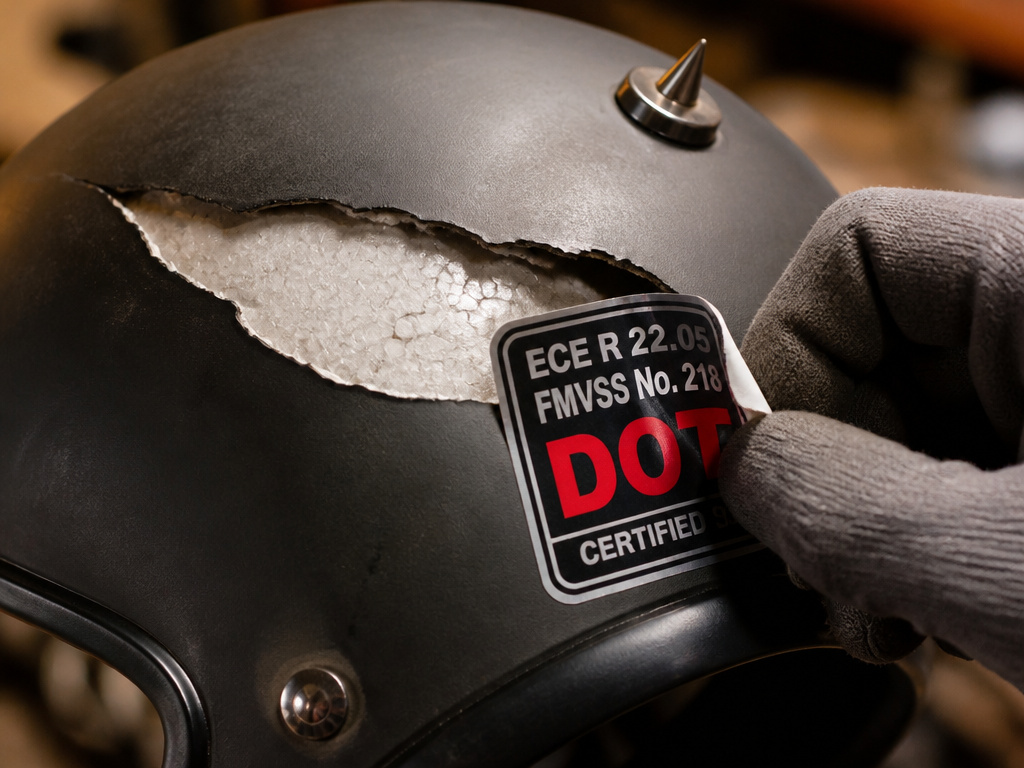
This is the dark side of the DOT ecosystem. A novelty helmet is a shell designed to look like a motorcycle helmet but built with no intention of meeting any safety standard. They are cheap, light, and dangerously inadequate.
The NHTSA states that novelty helmets do not meet FMVSS 218 and are unsafe. The market for fake DOT labels exists to glue onto these shells, creating the illusion of compliance. As the Federal Register helmet rulemaking notice from 2011 explains, sellers even claim the “DOT” on these fake stickers stands for “Doing Our Thing” to avoid legal liability.
You can spot a novelty helmet with a quick physical check. The NHTSA provides a list of tells:
- Weight:
- Liner: The inner foam will be less than 1 inch thick.
- Straps:
- Projections: It may have rigid spikes or decorations extending more than 0.20 inch from the shell, which the standard prohibits.
The agency estimated that getting 5% to 10% of novelty helmet users to switch to compliant helmets could save 22 to 75 lives. That’s not a trivial number. It’s the stakes of understanding that a $50 “helmet” from a flea market is not a bargain.
A Practical Guide to Choosing and Using a DOT Helmet
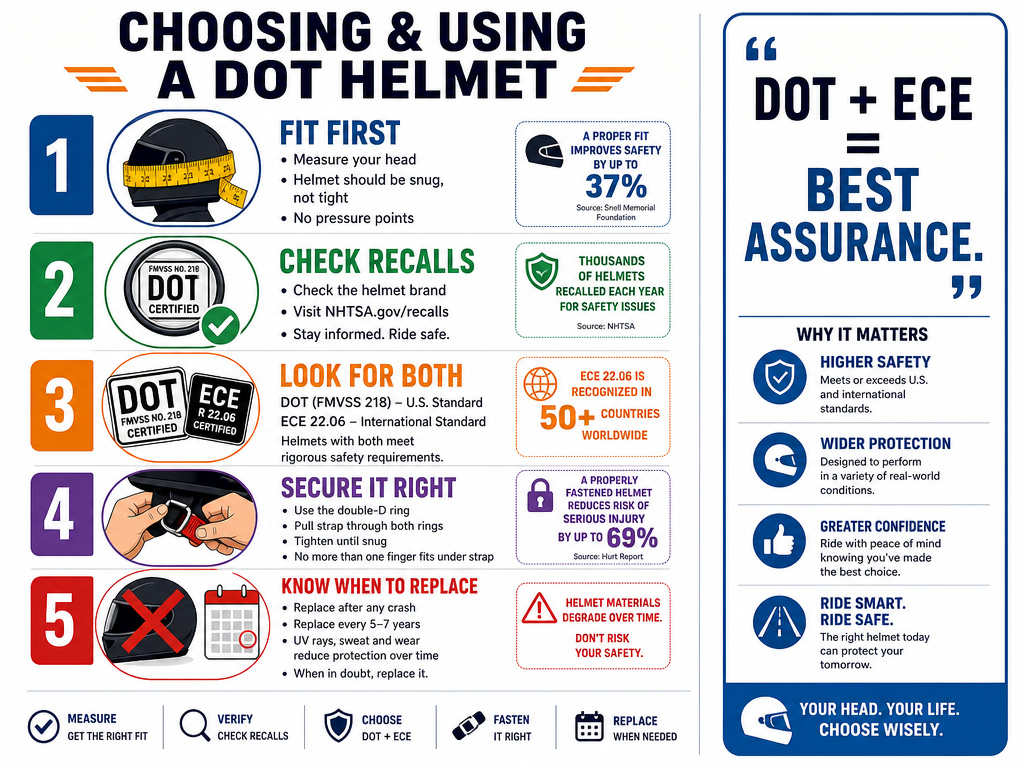
Knowing the standard is one thing. Applying it in a store is another. Here’s the short list of what to do after you’ve verified the label.
1. Fit Over Everything.
A certified helmet that doesn’t fit is a worthless helmet. The shell can rotate on your head in a crash, exposing areas that weren’t tested. Your first job is to find your head shape (round oval, intermediate oval, long oval) and get a size that is snug without painful pressure points. A well-fitted, mid-priced DOT helmet will outperform a loose, premium one every time.
2. Check for Recalls.
Since certification is self-declared, recalls happen. Before you buy, or if you own a helmet already, search the NHTSA’s recall database using the model name from the DOT label. A recalled helmet has failed compliance testing and should not be used.
3. Consider Dual Certification.
For most street riding, I recommend starting your search with helmets that carry both DOT and ECE 22.06 labels. This gives you the legal requirement for U.S. Roads plus the assurance of an independent testing regime. Many of the best motorcycle helmets for safety on our lists carry both.
4. Use the Retention System Correctly.
A double-D ring strap that’s left loose is a common mistake. That strap is part of the certified retention system. Tighten it until you can only fit one or two fingers between the strap and your chin. If the strap is frayed, cut, or the hardware is damaged, replace the helmet.
5. Know When to Retire It.
The standard’s warning label says it clearly: “If helmet experiences a severe blow, return it to the manufacturer for inspection, or destroy it and replace it.” This means any drop onto a hard surface from height, or any involvement in a crash. Don’t try to guess if it’s okay.
I won’t recommend a DOT-only helmet if you can afford the step up. The incremental cost for ECE 22.06 dual certification buys you independent verification. For peace of mind on the road, that’s worth the price of a tank of gas.
Frequently Asked Questions
What does it mean when a motorcycle helmet is DOT certified?
It means the helmet’s manufacturer declares it meets all the requirements of Federal Motor Vehicle Safety Standard No. 218. The manufacturer self-tests the helmet for impact absorption, penetration resistance, and strap strength, and permanently attaches a specific certification label to the back. The NHTSA can later test randomly purchased samples and recall the model if it fails.
How can I tell if my motorcycle helmet is DOT-approved?
Look on the back lower center of the shell for a permanent label. On helmets made after May 13, 2013, it must have four lines: the exact model name, “DOT”, “FMVSS No. 218”, and “CERTIFIED”. Check that the “DOT” letters are large (over 1 cm tall) and the label feels like part of the helmet, not a sticker stuck on top. Also, weigh the helmet; if it’s around 3 pounds and has a thick, rigid inner liner, it’s likely legitimate.
Which is better, DOT or Snell?
They are designed for different purposes. DOT is the U.S. Legal minimum for road use, focusing on preventing severe injury in a single major impact. Snell is a voluntary, stricter standard often sought for motorsports, testing for multiple impacts on the same spot. For street riding, a DOT-certified helmet is legally sufficient. Riders and experts often debate the merits of different standards; some prefer Snell for its rigorous independent testing, while others find a well-fitted DOT/ECE dual-certified helmet to be a practical and well-rounded choice for the street.
Are DOT-approved helmets safe?
Yes, when they are legitimate, properly fitted helmets from reputable manufacturers. Data shows they significantly reduce head injuries and fatalities. The key is avoiding “novelty helmets” with fake DOT stickers, which are not safe. A real DOT-certified helmet has undergone standardized testing to manage the extreme forces of a crash and is a critical piece of protective gear.
Is a helmet still DOT approved if the sticker falls off?
No. The label itself is a required part of the certification. If it falls off, the helmet is no longer verifiably compliant for law enforcement or for your own knowledge. The NHTSA states that a label that falls off is “an apparent noncompliance with the standard.” Furthermore, a sticker that peels off easily suggests it may have been a counterfeit label on a novelty helmet to begin with.
The Bottom Line
DOT certification is your baseline, not your finish line. It’s the government’s enforceable definition of a motorcycle helmet, built around a self-certification system that demands scrutiny of what is dot motorcycle helmet certification. Trust the label, but verify it against the physical specs, weight, liner thickness, strap quality. Then, make fit your absolute priority.
The smart move for any rider buying a new helmet is to look past a single standard. Use the DOT label to ensure legal compliance, then seek out models that also carry the ECE 22.06 certification for independent verification. Finally, check resources like SHARP helmet safety ratings for model-specific performance data. This layered approach turns a regulatory minimum into a informed, practical safety decision.
One rule most guides skip: if you’re looking at a helmet and anything feels off, the price is too good, the label looks wrong, it’s suspiciously light, walk away. The few dollars you save are not worth the lives the NHTSA estimates are lost to novelty helmets every year. Buy a real helmet from a dealer. Your head is the only one you get.
