
What Is EN 13634 Motorcycle Boot Standard: A Rider’s Guide
This post contains affiliate links. As an Amazon Associate, we earn from qualifying purchases.
EN 13634 is the European safety standard for motorcycle boots, specifying minimum requirements for protection, ergonomics, and mechanical durability. It tests the whole boot for transverse rigidity and bond strength, and its components for abrasion, cut resistance, and chemical safety. A boot with a CE mark and EN 13634 label has passed these verified tests, giving you a known baseline of crash protection that regular footwear lacks.
That baseline is the whole point of understanding what is en 13634 motorcycle boot standard. It’s a verified minimum, not a marketing claim. Without it, you’re trusting a brand’s word on safety.
What follows is a walk through what the standard actually tests, what the four-digit code on the label means, and the optional properties that separate a basic certified boot from a great one. By the end, you’ll be able to read any boot’s spec sheet and know exactly what you’re buying.
Key Takeaways
- The CE mark on a motorcycle boot means it complies with EN 13634, providing a verified baseline of abrasion, cut, and impact protection that street shoes do not.
- Look for the four-digit code (e.g., 1.1.2.2) inside the boot; the first two numbers indicate performance levels for basic abrasion and impact resistance.
- Level 2 certification (second digit = 2) requires a higher level of abrasion resistance than Level 1, a meaningful upgrade for street riding.
- Optional properties like Impact Protection (IPA) and Water Resistance (WR) are listed after the main code and indicate specific, tested extra features.
- The standard includes tests for chemical safety (Chromium VI, pH) and boot integrity (upper-to-sole bond strength), which generic work boots may not cover.
What Does EN 13634 Actually Test?
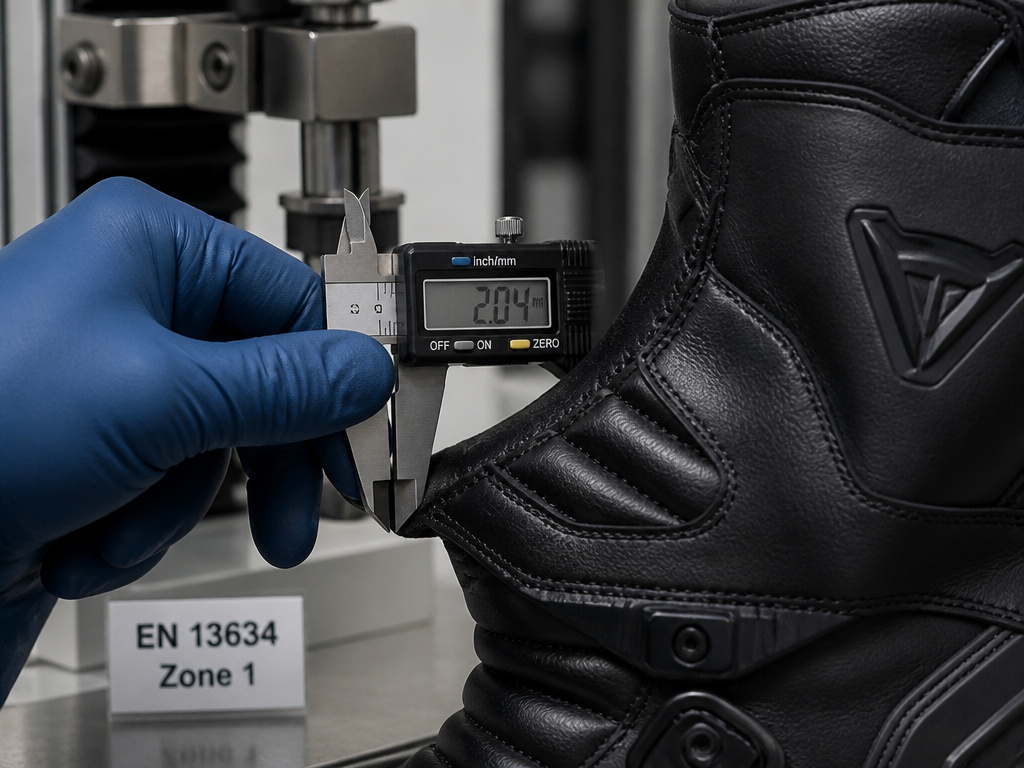
Most guides list the protection zones and stop, but the answer to what is en 13634 motorcycle boot standard goes deeper into how a boot is put together and whether its materials are safe to wear all day. According to the official scope from the Swedish Institute for Standards, EN 13634:2017 applies to protective footwear for on- or off-road motorcycle use and specifies requirements for protection, ergonomic characteristics, innocuousness, mechanical properties, marking, and test methods.
The testing breaks down into three layers: the boot’s overall construction, each individual component, and specialized protective performance.
The whole boot must pass a transverse rigidity test and have its upper-to-sole bond strength measured. Components like leather are checked for pH value and harmful Chromium VI, while linings and insoles are tested for abrasion and water absorption. The outsole is tested for abrasion and, if polyurethane, for hydrolysis resistance.
That’s the difference between a CE-marked motorcycle boot and a sturdy work boot, which is central to what is en 13634 motorcycle boot standard. The work boot might be tough, but EN 13634 verifies it won’t fold sideways in a crash, its sole won’t delaminate, and its leather won’t irritate your skin.
The Four Protection Zones and Performance Levels
The core of EN 13634 is testing four key areas of the boot for abrasion and impact resistance. The performance in these zones determines the boot’s classification as Level 1 or Level 2.
| Protection Zone | What’s Tested | Level 1 Requirement | Level 2 Requirement |
|---|---|---|---|
| Zone 1 (Ankle) | Abrasion Resistance | Withstands abrasion for a minimum duration. | Must withstand abrasion for more than twice as long as Level 1. |
| Zone 2 (Shin) | Impact & Abrasion | Passes basic impact energy attenuation and abrasion tests. | Higher impact absorption and longer abrasion resistance. |
| Zone 3 (Malleolus – ankle bone) | Impact Resistance | Protects against a standard impact force. | Protects against a higher impact force. |
| Zone 4 (Foot & Toe) | Compression & Abrasion | Resists a standard compression load and abrasion. | Resists a higher compression load and longer abrasion. |
The jump from Level 1 to Level 2 isn’t incremental; it’s substantial. For the critical abrasion tests, Level 2 requires the boot material to last significantly longer before failure than Level 1. If you ride regularly on pavement, Level 2 is the target.
The Hidden Tests: Chemical Safety and Boot Integrity
This is the part most riders never see but should know about. The SATRA summary of the standard details component-level tests that address daily wear and chemical safety.
- Innocuousness: Any leather must be tested for pH value and the presence of Chromium VI, a skin irritant. All materials are checked for colour fastness to water (so dye doesn’t run onto your socks).
- Integrity: The bond between the upper and the outsole is mechanically tested. The entire boot is tested for transverse rigidity, essentially, how much it resists sideways bending. A boot that collapses sideways in a crash offers little ankle support.
- Durability: Linings are abraded, and insole boards are tested for water absorption and desorption (how well they dry out).
These tests explain why a certified motorcycle boot often costs more than a similar-looking fashion or work boot. You’re paying for verified construction, not just style.
How to Read the EN 13634 Label Inside Your Boot
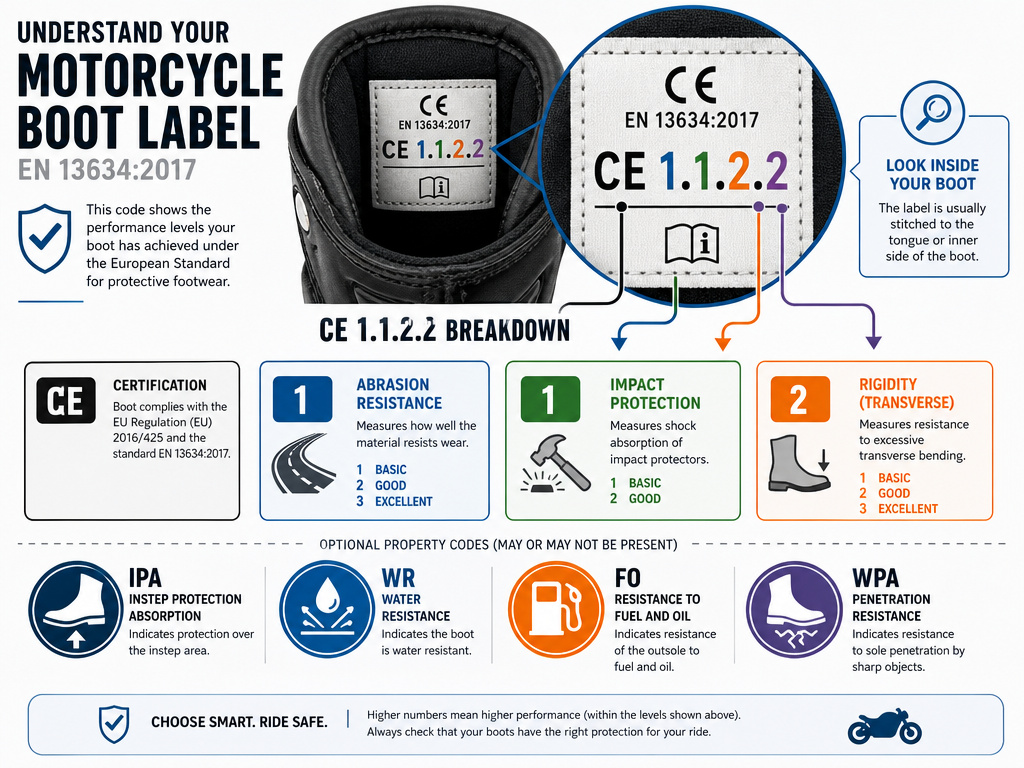
The label is your cheat sheet. It’s usually stitched into the tongue or side lining. A typical code looks like this: CE 1.1.2.2 followed by icons like a shield or raindrop.
Let’s break down CE 1.1.2.2:
- CE: The boot conforms to European PPE (Personal Protective Equipment) Regulation 2016/425. The EN 13634 standard is harmonized under this regulation, providing the legal basis for the CE mark.
- First Digit (1): Certification Level. 1 = Level 1 (Basic), 2 = Level 2 (Higher Performance).
- Second Digit (1): Abrasion Resistance Level for Zone 1. Again, 1 or 2.
- Third Digit (2): Impact Resistance Level for Zone 3 (ankle bone). 1 or 2.
- Fourth Digit (2): Transverse Rigidity Level. 1 or 2.
A code of 1.1.2.2 indicates a Level 1 boot with Level 1 ankle abrasion resistance, but Level 2 impact protection at the ankle bone and Level 2 transverse rigidity. It’s a mixed-bag boot, better in some areas than others.
Cracking the Optional Property Codes
After the four digits, you might see abbreviations like IPA, IPS, WR, FO, or WPA. These are optional, tested properties the manufacturer has chosen to certify. They’re a sign of a more thoughtfully designed boot.
- IPA (Impact Protection Ankle) / IPS (Impact Protection Shin): The boot has additional, certified impact protectors at the ankle or shin beyond the standard requirement.
- WR (Water Resistance): The entire boot has been tested and proven to resist water penetration. This is different from a “waterproof” marketing claim.
- FO (Fuel Oil Resistance): The outsole resists degradation from contact with fuels and oils, a real concern at gas stations or if you have a leak.
- WPA (Water Vapour Permeability of Upper): The upper material allows sweat vapour to escape, improving comfort.
If you’re comparing two Level 2 boots and one has WR and IPA codes while the other doesn’t, the first offers more verified protection for your money. For a complete guide on deciphering all the symbols, see our article on how to read motorcycle gear labels.
EN 13634 vs. Other Standards: What’s the Difference?
Riders often see CE marks on work boots and wonder if they’re just as good. They’re not. Different standards solve different problems.
EN 13634 vs. EN 20345 (Safety Footwear for Work):
EN 20345 is for industrial hazards: toe-crush protection, slip resistance, and electrical insulation. It doesn’t test for the specific abrasion, lateral rigidity, or ankle impact of a motorcycle crash. A steel-toe work boot might save your toes from a falling tool but could shred and twist in a 60-mph slide.
EN 13634 vs. EN 13594 (Motorcycle Gloves):
These are sibling standards under the same PPE regulation. EN 13594 uses a similar approach, testing gloves for abrasion, impact, and seam strength, but is tailored for the hand’s anatomy and dexterity needs. Your gear should ideally meet its specific standard: EN 13634 for boots, EN 17092 for jackets, and so on.
The takeaway is simple: wear gear designed for the crash forces of motorcycling. The detailed look at how motorcycle gear abrasion resistance is tested shows why material made for sliding on asphalt is essential.
Finding and Fitting EN 13634 Certified Boots
A certification is useless if the boot doesn’t fit. The standard includes an Annex A for ergonomic and size testing, but fit is still highly personal.
Where to Look:
Start with reputable motorcycle gear retailers or direct manufacturer sites. The CE mark and EN 13634 reference should be clear in the product specifications, not buried. If you can’t find the certification, assume it’s not certified. Our curated list of the best motorcycle boots is a practical starting point for models that meet or exceed the standard.
The Fitting Reality:
Certified boots often have thicker liners, internal armor, and stiffer construction, which can affect fit compared to regular street shoes.
- Try boots on with the riding socks you’ll actually wear.
- Your toes should not be jammed at the end. There should be no painful pressure points on the ankle bone or instep.
- The heel should be held firmly with minimal lift when you walk.
- The boot should feel snug but not circulation-cutting when new; it will break in slightly.
Remember, a well-fitted Level 1 boot is safer than a poorly fitted Level 2 boot you leave in the closet. For a broader look at your options, from adventure to sport boots, check out our guide to the different types of motorcycle boots.
The Global Picture: Regional Adoptions and Versions
EN 13634:2017 is a European Norm, but its influence is global. Different regions adopt it with their own designations and timelines, which can cause confusion.
- GCC States: The Gulf Standard Organization adopted it as GSO EN 13634:2023, approved on May 3, 2023. This is the standard for boots sold in those markets.
- Netherlands: The Dutch standardization body (NEN) lists NEN-EN 13634:2017 as withdrawn as of January 1, 2018, replaced by NEN-EN 13634:2018. This highlights how national administrative updates can vary.
- United States: There is no direct US equivalent. The DOT regulates helmets but not riding apparel. American riders should look for the European CE mark to ensure a verified baseline of protection.
This patchwork is why the core four-digit code is so important. It’s a universal language for protection levels, regardless of the national prefix on the standard.
What specific tests are performed on motorcycle boots?
The standard uses a series of specific tests to evaluate a boot’s construction and protective qualities. Whole boot tests check the bond strength between the upper and the outsole and assess the boot’s transverse rigidity. Tests on individual components include evaluating the tear strength of materials, abrasion resistance for linings, and tests for insole boards. Leather components are assessed for pH value and the presence of chromium VI. For specialized protection, the boot’s upper is tested for impact cut resistance and abrasion resistance using methods from EN 13595. The outsole is tested for abrasion resistance, and if made from polyurethane, for hydrolysis resistance. All materials must also pass a colour fastness to water test.
Why is it hard to find detailed boot ratings from manufacturers?
While the EN 13634 standard requires clear marking and user information, manufacturers are not always transparent about the specific test results their boots achieved. The standard defines the test methods and the requirements boots must meet, but the detailed performance data, such as exact abrasion duration or force measurements, is typically not published on product tags or in consumer marketing. This information is part of the technical documentation held by the manufacturer and the testing laboratory. When shopping, you may only see the CE mark and the standard number, indicating conformity. To get more details, you often need to consult the manufacturer’s technical datasheets directly or rely on third-party reviews that have accessed this information.
Frequently Asked Questions
What’s the difference between CE Level 1 and Level 2 motorcycle boots?
Level 2 boots offer significantly higher performance, particularly in abrasion resistance. For the critical ankle and shin zones, Level 2 materials must last significantly longer in abrasion tests before failing compared to Level 1. If you can afford it, Level 2 is the better choice for street riding.
Are motorcycle boots with EN 13634 actually safer than regular boots?
Yes, in a motorcycle-specific crash. Regular boots, including work boots, are not tested for the transverse rigidity (sideways collapse) or the prolonged abrasion resistance of a slide on pavement. EN 13634 certifies the boot for those exact scenarios. The difference in protection is detailed in our comparison of motorcycle boots vs regular boots.
How do I know if my motorcycle boots are certified?
Look inside the boot for a permanent label showing the CE mark and a four-digit code like “1.2.2.1”. The product description or owner’s manual should also state compliance with “EN 13634:2017”. If this information isn’t readily available, the boots likely aren’t certified.
Is EN 13634 the same as CE certification?
Not exactly. CE marking is the general declaration that a product meets all relevant European health, safety, and environmental regulations. For motorcycle boots, the specific “relevant regulation” is tested by applying the EN 13634 standard. You can learn more about the broader system in our guide to CE marking on motorcycle gear.
Do adventure or touring boots have to meet EN 13634?
Any motorcycle boot sold in the European Economic Area that is marketed as protective equipment for riders must comply with the PPE Regulation, which typically means meeting EN 13634. The standard applies to boots for “on or off road activities,” so it covers adventure and touring styles. The specific types of motorcycle boots will determine the focus on optional properties like water resistance.
The Bottom Line
EN 13634 isn’t a gold star. It’s a verified minimum. When you see that label, you know the boot has been tested to resist specific crash forces that street shoes ignore. Focus on the four-digit code, aim for Level 2 if your budget allows, and pay attention to the optional properties like WR and IPA that match your riding.
One final, practical rule: if you’re buying boots for street riding and the product page doesn’t mention EN 13634 or show a clear CE label with a code, move on. You’re looking at fashion or casual footwear, not certified riding gear. Your ankles and shins are worth the distinction.
