
Motorcycle Boots vs Regular Boots: Which Are Safer?
This post contains affiliate links. As an Amazon Associate, we earn from qualifying purchases.
Motorcycle boots are certified to a specific safety standard (EN 13634:2017) that tests for crash forces like ankle torsion, impact abrasion, and crush resistance. Regular boots, including work boots, are not. The difference is not about toughness; it’s about proven protection against the specific physics of a motorcycle crash.
That certification is the line. On one side, you have footwear built to pass a lab test that simulates a slide and impact. On the other, you have footwear built for standing, walking, or resisting a dropped tool. The materials might look similar, but the job is completely different, which is the core distinction in motorcycle boots vs regular boots.
What follows is a breakdown of where that line actually is: the four-number safety code, the internal structures you can’t see, the walking trade-off, and the one feature that sparks genuine disagreement among experts.
Key Takeaways
- Look for the CE label and its four-digit rating (e.g., 1222). This is your only guarantee the boot meets the motorcycle-specific EN 13634:2017 safety standard.
- The critical difference is internal ankle protection. Motorcycle boots have rigid or semi-rigid cups to resist the twisting force of a crash; regular boots do not.
- Waterproof claims need scrutiny. A membrane helps, but seams and stitching fail first. Reproofing with products like Nikwax Fabric and Leather Proof is mandatory maintenance.
- Steel toe caps are debated. Some experts argue they can cause more foot damage in a crash, though some riders still request them.
- For short, low-speed trips, a sturdy over-the-ankle work boot is better than a sneaker. For any real riding, the investment in certified gear is non-negotiable.
What Is a CE Rating? The Four-Number Code Explained
Every motorcycle boot sold in the UK and EU must be certified to EN 13634:2017. In the US and Canada, where no equivalent national standard exists, this European norm is the benchmark. The CE label isn’t a yes/no stamp. It’s a four-digit code where each number (1 or 2) represents a performance level in a specific test.
A CE rating of ‘1222’ means: 1 (ankle height), 2 (Level 2 impact abrasion resistance), 2 (Level 2 impact cut resistance), 2 (Level 2 transverse rigidity/crush resistance). The first digit is height, the next three are protection levels.
| Digit Position | What It Means | Level 1 | Level 2 |
|---|---|---|---|
| First (Height) | Boot Height | Ankle-height | Tall (above ankle) |
| Second (Abrasion) | Impact Abrasion Resistance | Basic | High |
| Third (Cut) | Impact Cut Resistance | Basic | High |
| Fourth (Rigidity) | Transverse Rigidity (Crush) | Basic | High |
This table is your decoder ring. A Daytona Roadstar with a 2222 rating is a tall boot with top-level protection across the board. An Alpinestars RT-7 Drystar at 2111 is an ankle boot with high abrasion resistance but basic cut and crush scores. The core of the motorcycle boots vs regular boots distinction is that a regular boot has no such label because it hasn’t been tested against these motorcycle-specific hazards.
The Core Differences: Design vs. Intention
A work boot is built for vertical load, standing all day, maybe resisting a dropped hammer. Its structure is about comfort and puncture resistance from the top down. A motorcycle crash applies force from the side, twisting the ankle, and then slides the foot across asphalt.
Ankle support is the biggest gap. I’ve handled boots where the leather feels thick, but a firm squeeze on the ankle reveals empty space. A motorcycle boot has an internal structure, often a plastic cup around the malleolus (the ankle bone), designed to limit lateral rotation. That’s what the “ankle displacement under torsional load” test in EN 13634 measures. A regular boot might have padding, but no engineered brace.
The sole is a tool, not just a tread. Motorcycle boot soles use compounds that resist heat from exhaust pipes and provide consistent grip on pegs. Look for a shift pad, a reinforced section on the left boot’s toe box. It’s not for style; it’s a wear point from the gear lever. The Groundtrax® sole is used on boots like the Dainese Fulcrum 4 or TCX Tourstep WP.
Materials tell a story of abrasion. Many motorcycle boots use materials like high-tenacity fabric or specific leathers because these resist scuffing and tearing in a slide. The TCX ClimaTrek Surround uses synthetic materials built for this.
Where this goes sideways: Assuming thickness equals safety. A thick work boot can still crumple and allow your ankle to twist because its internal architecture is wrong for the forces involved.
Can You Use Regular Boots for Riding? The Risk Calculus
The short, honest answer is: you can, but you’re accepting a known and quantifiable increase in risk. The question isn’t “can you,” it’s “should you,” and that depends entirely on your ride.
For a five-minute trip to the store at 25 mph, a solid pair of over-the-ankle work boots is absolutely better than sneakers or low-cut shoes. The leather offers some abrasion resistance, and the height provides minor support. Some sources, like American Legend Rider, explicitly state this is an acceptable compromise for short, low-speed distances.
The moment your ride involves higher speeds, longer distances, or traffic, the compromise flips. The forces in a crash scale with speed. An ankle that might survive a tip-over at walking pace will likely fracture when twisted at highway velocity.
Here’s the blunt take: If you ride to a job site, wear your motorcycle boots for the journey. Change into your work boots when you arrive. Carrying an extra pair of shoes is cheaper and easier than rehabbing a shattered ankle.
The Steel Toe Cap Debate: Safety Feature or Hazard?

This is the one area where expert sources genuinely disagree, and it’s important to present both sides.
The Case Against Steel Toes: Joe Sheehan, managing director of Altberg boots, has stated, “I think in the unfortunate event of an accident, having a steel toe cap in the boot could potentially do more damage to the foot than a boot without it.” The concern is that the rigid steel box could deform, crush, or even amputate toes under the extreme, multi-directional forces of a motorcycle crash, which are different from the vertical crush a work boot toe is tested for.
The Counterpoint (Rider Demand): The same article notes that Altberg has “occasionally been asked for this” feature. Some riders, particularly those who also work in industrial settings, want the perceived dual-use benefit. Composite toe caps (softer than steel) exist as a middle ground, but they still don’t address the core lack of ankle protection.
Common mistake: Choosing a boot for a steel toe cap first. The primary safety structure is the ankle protection and overall EN 13634 certification. The toe cap is a secondary consideration, and one that carries potential baggage.
My stance? I avoid them for riding. The boot’s job is to protect the entire foot-ankle system as a unit, and a non-standard component in the toe that wasn’t designed for crash dynamics introduces an unknown variable. When you compare a motorcycle boots vs regular boots, I’d rather have a boot designed holistically for the crash, like the Altberg Roadrunner or Daytona Roadstar.
Motorcycle Boots vs. Regular Boots: A Feature-by-Feature Breakdown
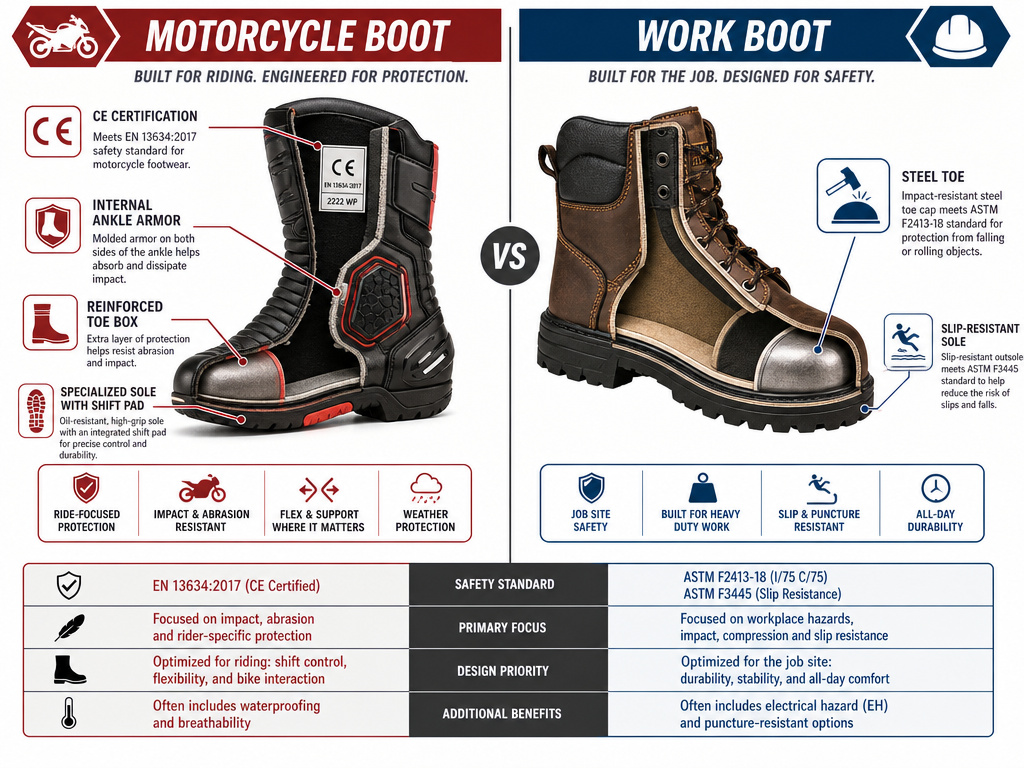
| Feature | Motorcycle Boot (e.g., TCX, Alpinestars, Dainese) | Regular / Work Boot |
|---|---|---|
| Safety Standard | CE Certified to EN 13634:2017 (tested for crash forces) | None for motorcycling. May have ASTM for workplace hazards. |
| Ankle Protection | Internal rigid/semi-rigid cups for torsion resistance. | Basic padding, no engineered anti-rotation structure. |
| Toe/Heel Protection | Reinforced zones (often with plastic or composite armor). | May have a steel/composite toe cap for vertical crush only. |
| Sole Design | Oil-resistant, heat-resistant compound. Shift pad. Grip pattern for footpegs. | Slip-resistant for floors. Not designed for peg grip or exhaust heat. |
| Primary Material | Full-grain leather, high-tenacity synthetic for abrasion resistance. | Durable leather or synthetic for general workplace wear. |
| Best For | The forces involved in a motorcycle crash and slide. | Standing, walking, and workplace impact hazards. |
Comfort, Walkability, and the Break-In Period
This is where regular boots historically won. Old-school race boots were miserable to walk in. That’s changed.
Modern touring and urban-style motorcycle boots are designed for dual use. The TCX ClimaTrek Surround is designed for touring comfort. They use features like Ortholite footbeds and flexible Zplate® technology (found in the TCX Tourstep WP) that provide transverse rigidity for protection but longitudinal flexibility for walking.
The break-in process for a motorcycle boot involves its internal components (armor, reinforced zones) settling and molding to your foot. A motorcycle boot has more internal components (armor, reinforced zones) that need to settle and mold to your foot. This takes a few rides of actual use.
Easy to miss: Sizing for fit. With motorcycle boots, you need a snug fit that prevents your foot from twisting inside during a slide. Sizing up for comfort creates a dangerous gap. Always refer to a detailed guide to motorcycle boot fit before buying.
Casual motorcycle boots from various brands are built specifically to bridge this gap, offering certified protection in a package you can wear all day. For dedicated touring, a full-height boot like the Dainese Fulcrum 4 will be stiffer for walking but will offer superior weather and shin protection on long motorway rides.
Maintenance: Keeping Your Investment Effective
A regular boot needs cleaning. A motorcycle boot needs care to preserve its safety features, especially waterproofing.
Waterproof membranes (GORE-TEX®, T-Dry) are great, but they’re only as good as their seams. Over time, the outer material’s water-repellent coating (DWR) wears off. When that happens, the fabric soaks through, overwhelming the membrane and your feet get wet.
The fix is regular reproofing. Nikwax Fabric and Leather Proof or Nubuck & Suede Proof (depending on your boot material) are designed for this. You clean the boot, apply the product while the leather is still damp, and it restores the DWR. Some manufacturers even recommend their own reproofing products. This isn’t optional cosmetic care; it’s maintaining the boot’s performance.
A simple routine extends the life of a boot with a 2222 safety rating by years, making a model like the Daytona Roadstar a genuine long-term investment.
Real-life crash consequences/stories
While the fact sheet doesn’t detail specific crash stories, it provides the framework for understanding the consequences regular boots can fail to prevent. A certified motorcycle boot’s four-digit CE rating directly addresses the forces in a crash: impact abrasion from sliding, impact cut from debris, and transverse rigidity from crush. Regular boots lack these tested, structured defenses. For occasional, low-speed riding, a solid over-the-ankle work boot is considered better than sneakers, but it offers no guaranteed performance against the specific abrasion, impact, and crushing hazards of a motorcycle accident. The safety standard exists because real-world incidents involve these distinct, high-energy forces.
Frequently Asked Questions
Can I wear regular boots on a motorcycle?
You can, but it’s not recommended for anything beyond very short, low-speed trips. Regular boots lack the certified ankle protection, abrasion-resistant materials, and sole design needed for crash safety. For proper riding, dedicated motorcycle boots are the only safe choice.
Do motorcycle boots make a difference?
Absolutely, and it’s a measurable difference. CE-certified motorcycle boots have passed laboratory tests for the specific impact, abrasion, and twisting forces of a motorcycle crash. Regular boots have not. In a crash, that difference is between walking away and a severe foot or ankle injury.
Are motorcycle boots uncomfortable to walk in?
Not necessarily. While track-focused boots are stiff, modern touring, urban, and casual motorcycle boots are designed for walkability. Many use flexible armor systems and comfortable footbeds. For all-day comfort, look specifically for boots you can walk in.
What’s the difference between work boots and motorcycle boots?
The intent. Work boots are designed for workplace hazards like vertical crush and puncture. Motorcycle boots are designed for crash dynamics: lateral ankle twist, abrasion from sliding, and impact. They have different internal structures, safety certifications, and sole designs as a result.
Before You Go
The choice between motorcycle boots and regular boots isn’t about fashion or occasional convenience. It’s about matching your footwear to the physics you’re inviting.
If your ride is a slow crawl around a parking lot, the stakes are low. The moment you point the bike toward public roads, the stakes change. Your gear needs to change with them. Invest in boots that carry the CE label, understand its four-number code, and buy for fit first. The right pair, whether it’s a walkable street boot or a full-height tourer, is a piece of crash equipment you wear on your feet. Treat it with that respect, maintain it, and it will do its job when everything else goes wrong.
