
Types of Motorcycle Boots: Which Is Right for You?
This post contains affiliate links. As an Amazon Associate, we earn from qualifying purchases.
Types of motorcycle boots break down into seven core categories defined by riding style, protection level, and materials. Sport boots prioritize rigid ankle and shin protection for high-speed crashes, while touring boots balance waterproofing and all-day comfort. Adventure boots add off-road ankle support, motocross boots are nearly knee-high and supremely stiff, and cruiser boots focus on classic style with reinforced leather. Urban boots look casual but need a certification label, and short ankle boots offer minimal protection, often a false economy for serious riding.
That certification label is your first filter. The EN 13634 standard is the European law for motorcycle footwear, and its four-number code tells you exactly what you’re buying. The first number is boot height, the next three are performance levels for abrasion, cutting, and crushing forces. Two boots can both be “CE certified” but have completely different protective capacities. A touring boot with a Level 1 transverse rigidity rating handles a different kind of impact than a sport boot at Level 2.
What follows is a walk through each boot type with its real specs, heights, weights, and intended failures. We’ll decode the EN 13634 label, settle the manufacturer versus real-world replacement debate, and name the brands that consistently get the job done in each category. By the end, you’ll match a boot to your bike and your risk.
Key Takeaways
-you must find the EN 13634 label inside any boot you consider, a generic “CE” tag without this specific code is not certified for motorcycle use.
- Sport and motocross boots are the most protective but trade off walking comfort and shift feel; they’re for focused riding, not commuting.
- Boot height directly influences protection. University of Lyon research found knee-high or ankle boots reduced foot and ankle fracture risk.
- Full-grain leather boots last 5 to 10 years with care, while synthetics often wear out in 2 to 3 seasons, calculate cost per year, not sticker price.
- Replace boots after any crash or visible damage, and inspect for sole delamination and worn closures before every ride, regardless of age.
The 7 Types of Motorcycle Boots, Defined by Job
Ever wondered why a boot built for a Harley looks nothing like a boot built for a Ducati? It’s not about fashion. It’s about the specific forces each riding style puts on your feet and what kind of accident that style predicts.
A sport rider leaning at 45 degrees needs a boot that won’t let the ankle twist when the footpeg catches pavement. A tourer on an eight-hour slog needs a boot that won’t soak through or cramp. An adventure rider picking through rock beds needs a boot that stops a 300-pound bike from crushing a foot sideways. The categories exist because the failure modes are different.
Sport & Racing Boots
These are the race cars of footwear. Built for hard pavement at high lean angles, their entire design resists twisting and grinding. These boots feature external sliders on the toes and ankles, rigid plastic shin guards, and often a hinged ankle system that allows up-and-down movement for shifting while preventing sideways motion.
They’re tall and stiff. That stiffness is the protection, it transfers impact forces around the ankle bones instead of through them. The downside is walking. You’ll do a penguin waddle in a parking lot, and rear brake feel is muted. Brands like Alpinestars (the Supertech R) and Sidi (the Vertebra) dominate here. They’re for track days, aggressive street riding, and riders who accept the trade-off.
Where this goes sideways: Buying a short sport-style boot for daily use. The low cut removes the critical shin protection, leaving you with a stiff, uncomfortable shoe that still can’t stop a lateral crush.
Touring Boots
If sport boots are race cars, touring boots are luxury sedans. The priority is distance comfort, weather sealing, and enough protection for highway-speed incidents. They’re also usually between 10 and 14 inches tall, but the materials are softer.
Look for a Gore-Tex or SympaTex waterproof membrane, reinforced ankle cups (often internal, not external plastic), and oil-resistant soles. The Alpinestars Andes V2 Drystar is a benchmark here. Touring boots weigh 2.5 to [3.5 lbs], a pound or more lighter than a full sport boot, and they break in for walking. The protection is real but tuned for a different accident profile, a slide, not a high-energy impact.
Adventure & Dual-Sport Boots
This category splits the difference. It needs the weatherproofing and walking ability of a touring boot plus the lateral stiffness and ankle protection of an off-road boot. The sole is aggressive for grip on loose surfaces, and the ankle area is reinforced against rocks and roost.
Height varies, but many sit around the 12-inch mark. They use tougher, often synthetic materials on the outside to handle brush and mud. The closure is designed for a secure fit. For serious off-road work, brands like Forma and TCX offer models like the Terra Evo. For more road-biased adventure touring, the Alpinestars Toucan series hits the spot.
I’ve come around on synthetic materials for this category. On a two-week ADV trip through mud and river crossings, my leather boots never dried out. A quality synthetic adventure boot with a good membrane dried overnight and was ready to go.
Motocross & Off-Road Boots
These are the tanks. Modern motocross boots are nearly knee-high, about 16 inches, and exist to turn your lower leg into a single, protected unit. They are incredibly stiff, with a hinged system at the ankle that only allows forward flex for operating the brake and shifter.
The goal is to prevent hyperextension and crushing in a high-side or a bike landing on your foot. Walking is very difficult. They’re mandatory for motocross but overkill for street use, the lack of brake feel introduces its own risk on pavement. Brands like Alpinestars Tech 10 and Sidi Crossfire are the gold standard.
Cruiser Boots
Style drives this category, but protection shouldn’t be an afterthought. Classic mid-calf cruiser or engineer boots are typically 8 to 10 inches tall and weigh a substantial 3 to 4 pounds per boot. The look is the point: Goodyear welted construction, round or square toe, often with harness straps.
The protection comes from thick, full-grain leather and a structured toe box. They provide abrasion resistance. What they lack is the rigid ankle and shin protection of a technical boot. They’re for riders on cruisers and choppers who prioritize the traditional aesthetic but still want a layer of toughness. Harley-Davidson and Chippewa make iconic models here.
Urban & Commuter Boots
These try to look like regular shoes or fashion boots while hiding motorcycle-specific protection. They’re often ankle-height or just above, with discreet armor in the ankles and toes. The challenge is balancing low-profile looks with actual safety.
The absolute rule here: it must have an EN 13634 label. Many “motorcycle-style” boots don’t. An urban boot must have an EN 13634 label. They are for commuting and urban riding.
Short Ankle Boots
This is the controversial one. Short boots that cut below the ankle bone are popular for their look and feel. The problem is physics. In a crash, foot and ankle injuries can occur. A boot that doesn’t cover and support the ankle does little to prevent that.
University of Lyon research is clear: “knee-high or ankle boots […] reduced foot and ankle fracture risk.” A short ankle boot offers less coverage. Some consider them a false economy. If you choose one, ensure it is certified.
What the EN 13634 Label Actually Means
That little tag stitched inside the boot is the only thing separating certified safety gear from a marketing claim. We can ignore the exaggerated claims.
EN 13634:2017 is the European standard for protective motorcycle footwear. It is a European standard. The boot is a Category 2 PPE (medium-risk) product under EU regulation. The label shows a motorcycle icon, the code “EN 13634:2017”, and four numbers. Each number is a separate test result.
The EN 13634 label consists of four numbers in sequence: 1) Upper height (Type), 2) Impact abrasion resistance level, 3) Impact cut resistance level, 4) Transverse rigidity level. Each test is graded individually as Level 1 or Level 2. A boot is not all Level 1 or all Level 2, it’s a mix.
Here’s what each number represents:
| Label Number | What It Tests | Level 1 Performance | Level 2 Performance |
|---|---|---|---|
| 1 (Type) | Upper Height | Type A: Ankle-high boot | Type B: Above-ankle boot |
| 2 (Impact Abrasion) | Resistance to grinding on pavement | Resists abrasion for 5 seconds at 2.0 m/s | Resists abrasion for 12 seconds at 2.0 m/s |
| 3 (Impact Cut) | Resistance to sharp object penetration | Max knife penetration of 25 mm at 2.8 m/s | Max knife penetration of 15 mm at 2.8 m/s |
| 4 (Transverse Rigidity) | Resistance to sideways crushing force | Sole endures a force of 10 kN | Sole endures a force of 12.5 kN |
The “Type” is straightforward: A for ankle, B for taller. The performance levels are where you see the difference. A Level 2 abrasion rating means the boot material lasts more than twice as long in a slide. Level 2 cut resistance means a sharp object penetrates 10mm less. That’s significant.
Transverse rigidity is the crush test. 10 kN is about 1,000 kilograms of force; 12.5 kN is 1,250 kg. Level 2 is for higher-risk scenarios, like sport riding or off-road, where a bike landing on your foot is a real possibility.
Boots can also pass optional tests for features like impact protection, water resistance, or breathability.
The essential requirement: If the label doesn’t say “EN 13634”, it’s not certified motorcycle footwear. A generic “CE” tag without the EN 13634 code may not certify the boot for motorcycle use. This is your first and most important check when evaluating any motorcycle boots vs regular boots.
How Long Do Motorcycle Boots Last? (The Manufacturer vs. Reality Split)
You’ll find three different answers to this question, and they’re all right in their own context. This is where the rubber meets the road, or wears away from it.
First, the certification itself has a shelf life. CE certifications for boots are valid for five years. That’s the testing body’s guarantee that the model, as submitted, meets the standard. It doesn’t mean your specific pair expires in five years.
Second, the manufacturer’s advice. Leatt Corporation recommends replacing boots every three years under normal use conditions, while other sources state CE certifications are valid for five years or that a full-grain leather boot can last 5 to 10 years with care. They also say to replace them immediately after a collision or if damage is visible. This is a conservative, liability-aware stance.
Third, the material’s natural lifespan. A full-grain leather boot lasts 5 to 10 years with basic care. Synthetic boots wear out faster, typically 2 to 3 seasons of regular riding. This is based on the physical degradation of the materials, not a calendar.
So which one is right? They all are. Your decision point is a physical inspection, not a date. Here’s what to look for every season:
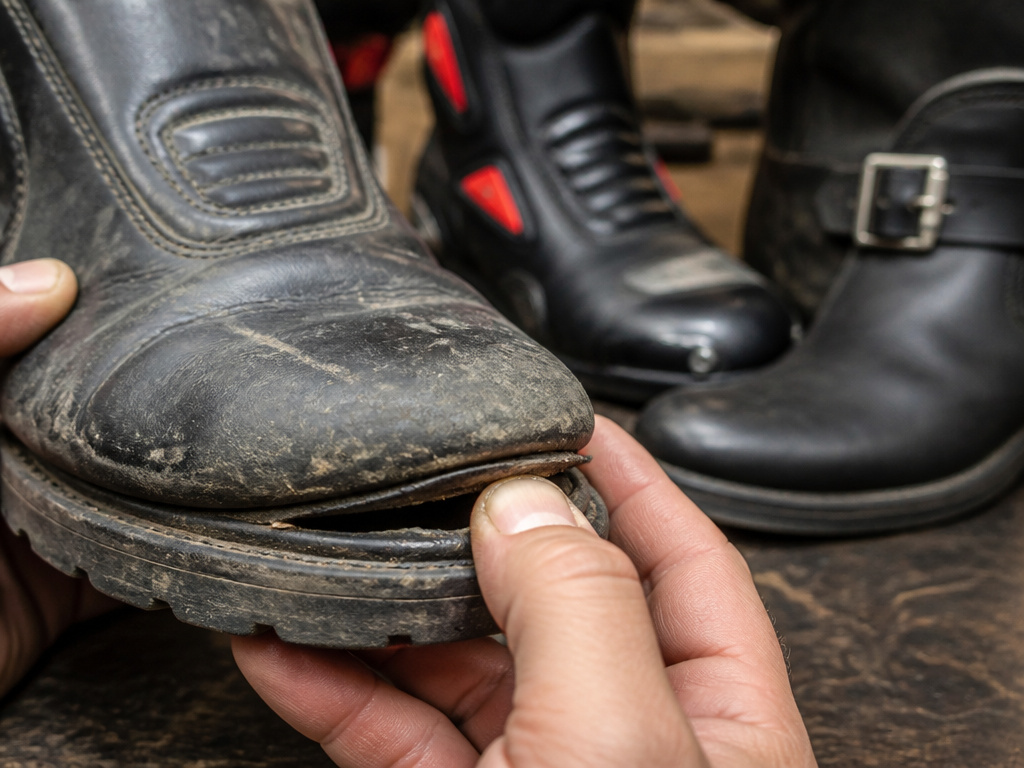
- Sole Delamination: Is the sole starting to separate from the upper? Press on the toe area. Any lift or gap means water will get in and the bond is failing.
- Closure System Failure: Are the zipper teeth bending or skipping? Do the buckles latch securely? A boot that won’t stay closed is useless.
- Compromised Stitching: Is thread fraying or breaking, especially at stress points like the ankle flex area? This is a primary failure mode.
- Visible Perforation or Cracking: Check the leather or synthetic for deep cracks, especially at creases. This is where abrasion resistance plummets.
A boot with perfect stitching, a solid sole bond, and intact closures after four years is likely still safe. A synthetic boot with cracked plastic armor after two seasons is not. The three-year guideline is a prompt to do this deep inspection, not a death sentence.
This is why investing in a resoleable boot from a brand like TCX or a Goodyear welted cruiser boot pays off. You can replace the worn part (the sole) and keep the protective part (the upper) for another five years.
Matching Boots to Your Bike and Riding Style
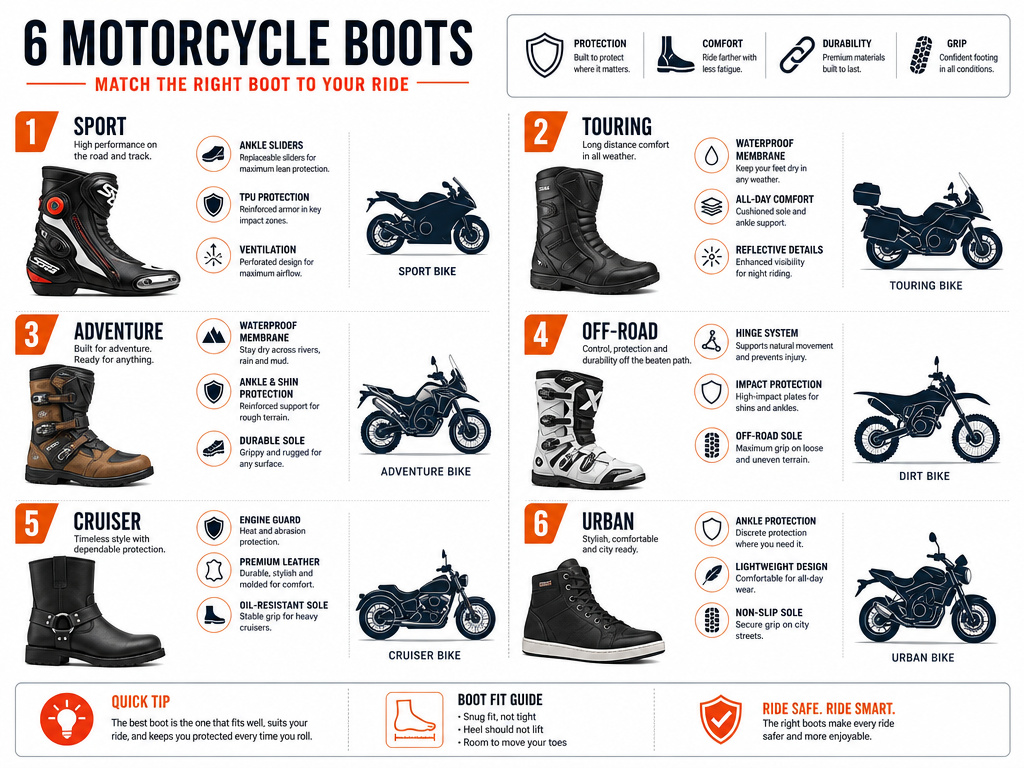
This is the practical choice. Your bike and how you ride it dictate the boot’s job. A mismatch here is how you end up with gear you never wear because it’s uncomfortable or inappropriate.
| Your Riding Style | Primary Boot Type | Why It Works | Key Feature to Prioritize |
|---|---|---|---|
| Sport Bike / Aggressive Street | Sport/Racing Boots | Maximum lateral rigidity and ankle protection for high lean angles and crash impacts. | Level 2 Transverse Rigidity, external ankle sliders. |
| Touring / Long-Distance | Touring Boots | All-day comfort, waterproofing, and enough protection for highway slides. | Gore-Tex/SympaTex membrane, oil-resistant sole, internal ankle armor. |
| Adventure / Dual-Sport | Adventure Boots | Lateral support for off-camber terrain, weather sealing, and decent walkability. | Combination strap/buckle closure, aggressive lug sole, reinforced ankle. |
| Off-Road / Motocross | Motocross Boots | Complete lower-leg immobilization to prevent hyperextension and crushing. | Full hinge system, knee-high height, replaceable buckles. |
| Cruiser / Custom | Cruiser Boots | Traditional style with heavy leather abrasion resistance for low-speed tip-overs. | Full-grain leather, Goodyear welt, structured toe box. |
| Daily Commuting / Urban | Urban Boots | Discreet protection that allows normal walking at your destination. | EN 13634 certification, low-profile design, reinforced heel. |
For new riders, the temptation is to buy a “do-it-all” boot. That boot doesn’t exist. A motocross boot is terrible on a sport bike. A sleek urban boot is dangerous off-road. Be honest about where you’ll spend 80% of your saddle time and buy for that. You can always add a second, specialized pair later as your riding evolves.
If you’re moving between styles, say, from street to adventure riding, the transition guide in our article on motocross vs adventure boots breaks down the trade-offs in protection and control.
The Fit, Care, and Break-In Reality
A perfectly certified boot that doesn’t fit is a liability. A well-fitted boot that you destroy with neglect is a waste of money.
Fit is critical. Buy boots with the socks you actually ride in. A winter thermal sock can take up a half-size. The boot should be snug but not pinch, especially across the instep and the ball of your foot. Your toes should not jam the front when you’re in a riding position, sit on a bike or mimic the posture in the shop.
Common mistake: Sizing up for comfort. A boot that’s too long lets your foot slide forward under braking, and your heel can lift inside during a slide, defeating the ankle protection. Get the length right, then solve width issues separately.
For wide feet, the struggle is real. Most riding boots are built on a narrow last. Don’t just buy a longer size; look for brands known for wider fits like some Thorogood models, or explore round-toe cruiser styles. Our guide on how boots should fit dives deeper into width solutions and the “pull test” to check security.
Break-in is a physical process, not a weekend. Most full-grain leather boots break in fully within 2 to 4 weeks of regular wear. Wear them around the house first, then on short rides. The leather will mold to your foot. Don’t use heat or chemicals to speed it up, you risk damaging the stitching and waterproof layers.
Care is what gives you those 5-10 years. For leather, use a dedicated conditioner (not all-purpose polish) to keep the hide supplied with oils. For synthetics, clean with mild soap and water, and let them dry at room temperature, never on a heater. Store them in a cool, dry place out of direct sunlight to prevent material hydrolysis.
The pre-ride inspection takes 30 seconds: check closures, look for new cracks or tears, and make sure the sole isn’t separating. That habit is free and it catches the failures that a calendar reminder misses.
How Tall Should My Motorcycle Boots Be?
The height of a motorcycle boot is directly tied to its classification under the EN 13634 safety standard. This standard defines two primary types by upper height: Type A is ankle-high, while Type B is above-ankle. Research indicates that boots covering the ankle and higher reduce the risk of foot and ankle fractures. In practice, boot heights vary significantly by riding style. Classic cruiser or engineer boots are often 8 to 10 inches tall. Touring and racing boots typically range from 10 to 14 inches. For maximum coverage, modern motocross boots are nearly knee-high at about 16 inches, and police motorcycle boots can extend from 18 to 21 inches. The choice between a shorter or taller boot should align with the protection level your riding demands, as the height is the first number you’ll see on a certified boot’s label.
Frequently Asked Questions
What are the different types of motorcycle boots?
The seven main types are Sport/Racing, Touring, Adventure/Dual-Sport, Motocross/Off-Road, Cruiser, Urban/Commuter, and Short Ankle boots. Each is engineered for a specific riding style’s speed, terrain, and accident risks, balancing protection, comfort, and weather adaptability differently.
What boots should you wear on a motorcycle?
You should wear boots certified to the EN 13634 standard. The type depends on your bike and riding: sport boots for sport bikes, touring boots for long trips, adventure boots for mixed terrain, and so on. The absolute minimum is a boot that covers and supports your ankle, as research shows this significantly reduces fracture risk.
Are steel-toe work boots okay for riding?
Generally, no. Work boots are PPE for static crush protection (like a falling toolbox). They are not certified to EN 13634 for motorcycle-specific impacts, abrasion, or cutting. Their flexible sole can be a risk in a crash, allowing toe injury or friction burns. For riding, use purpose-built motorcycle boots vs regular boots.
How do I know if my motorcycle boots are still safe?
Ignore the age and inspect the boot. Check for sole delamination, worn or broken closures, compromised stitching (especially at stress points), and visible cracks or perforations in the material. If the structure is sound, the boot is likely still safe. Replace immediately after any crash or impact.
What’s the difference between waterproof and water-resistant boots?
Waterproof boots have a sealed membrane (e.g., Gore-Tex) that blocks water from entering, even in sustained rain. Water-resistant boots have a treated outer layer that sheds light rain but will soak through in a downpour or extended wet ride. For all-weather touring, waterproof is worth the investment.
Can I wear motorcycle boots for walking?
Yes, but it varies drastically by type. Touring, adventure, and urban boots are designed with walkability in mind. Sport and especially motocross boots are very stiff and awkward for extended walking. Our roundup of the best motorcycle boots for walking lists the most comfortable options.
The Bottom Line
Start with the label. If it doesn’t say EN 13634, put the boot back. That’s your baseline for real protection.
From there, match the boot’s design to your motorcycle’s demands. A Gold Wing asks for a different foot soldier than a KTM 450. Don’t buy for a fantasy riding life, buy for the miles you actually log. For most street riders, that means a dedicated touring boot or a sport boot if you ride hard, not a compromised hybrid.
Invest in materials that age with you. Full-grain leather costs more now but divides that cost over a decade. Synthetics are a short-term bargain that often ends in a second purchase within three years. And whatever you choose, fit it right. A size too big is a safety gap you can’t see until it’s too late.
Your feet are your connection to the bike and your first point of contact in a fall. Gear that protects them isn’t an accessory. It’s the part of the machine you wear.
