
Motocross Boots vs Adventure Motorcycle Boots
This post contains affiliate links. As an Amazon Associate, we earn from qualifying purchases.
In the motocross boots vs adventure motorcycle boots choice, motocross boots deliver maximum ankle and shin protection with a stiff, flat sole for precise peg feel, while adventure boots sacrifice some rigidity for a more flexible, lugged sole you can walk in. For example, the Alpinestars Tech 5 boots weigh 3,100–3,580 grams per pair, while a single Sidi Adventure 2 Gore-Tex Mid boot weighs about 2.3 pounds (1.04 kg).
That weight difference is a symptom of the deeper design split. One boot is built for crashes on a groomed track. The other is built for a day where you might cross a stream, push your bike, and walk into a gas station.
This guide walks the three specs that decide the trade-off in the motocross boots vs adventure motorcycle boots choice: sole design, ankle mobility, and waterproofing. We’ll name the boots that get each part right and the one mistake that makes the wrong pair feel like a prison sentence.
Key Takeaways
- MX boot soles are not made for hiking. Per BTO Sports, they are thin, stiff, and relatively flat for peg feel. A lugged adventure boot sole is thicker and softer for traction on dirt and rock.
- Waterproofing is almost never a feature on a dedicated MX boot. Adventure boots like the Sidi Adventure 2 Gore-Tex Mid or Alpinestars Corozal V2 use membranes (Gore-Tex, Drystar) for stream crossings and rain.
- A Level 2 CE rating (like the Fox Ranger ADV’s) is serious protection. Don’t assume a more flexible adventure boot is “unprotected”, the certification verifies impact abrasion and cut resistance.
- Fit decides comfort. Some brands, like Fox, use the same last for their adventure and motocross boots (e.g., the Ranger ADV); other adventure boots often have roomier footbeds for all-day wear.
- The break-in period is real, especially for MX boots. The leather and plastics need a few rides to mold. Forcing it with heat can damage the materials.
The Core Design Trade-Off: Protection vs. Walkability
This isn’t about good boots and bad boots. It’s about two tools engineered for different jobs, which is the heart of the motocross boots vs adventure motorcycle boots debate. A motocross boot is a cast for your lower leg. An adventure boot is a hiking boot with armor.
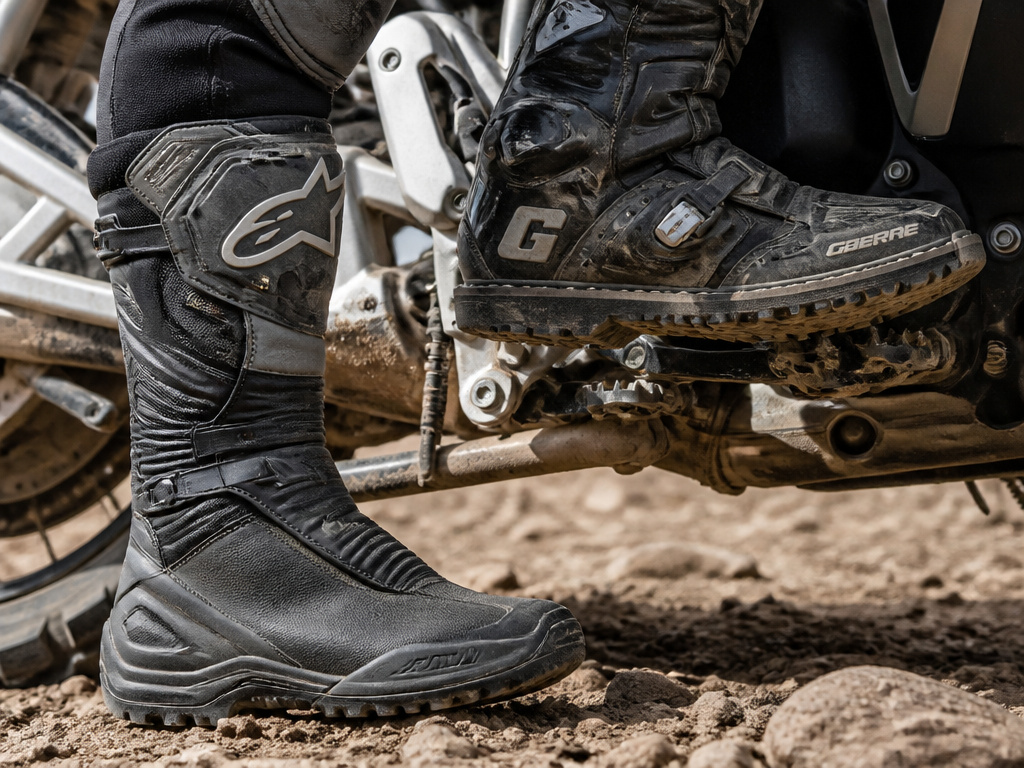
The sole tells you everything. Look at the bottom of an Alpinestars Tech 5. It’s nearly flat, with a hard rubber compound. That’s for feeling the footpegs through the boot, every shift in weight, every dab for balance on a track. Now look at a Sidi Adventure 2. The sole is lugged, like a hiking boot. That’s for gripping mud, rock, and loose gravel when you’re off the bike.
Where this goes sideways: Choosing an MX boot for a trail ride because it looks tougher. The stiff sole won’t grip uneven ground. You’ll slip trying to push your bike up a hill, and your ankles will fight the restricted movement all day.
Here’s the honest take. If your riding involves more than brief walking, the adventure boot wins. The MX boot’ protection is superior, but only if you stay on the pegs. The moment you step onto a rocky slope, that advantage flips into a liability.
Sole Design: The Peg vs. The Path
The difference here is mechanical, not cosmetic.
| Boot Type | Sole Design Priority | Material & Pattern | Real-World Consequence If Mismatched |
|---|---|---|---|
| Motocross (MX) | Precise peg feel | Thin, stiff, flat hard rubber. | Slippery on off-camber terrain; walking feels unstable. |
| Adventure (ADV) | Traction for walking | Thicker, softer, aggressive lug pattern. | Reduced “feedback” through the pegs on technical dirt sections. |
BTO Sports, an industry retailer, states it plainly: MX boot soles are not made for hiking. An adventure boot sole is thicker, softer, and lugged like a hiking boot sole. This is the first and most essential filter. Pick the wrong one, and you’re buying a problem.
Ankle Mobility: Locked vs. Controlled
Protection isn’t a binary. Both boots have it. The question is how they provide it.
A premium MX boot like the Alpinestars Tech 10 Supervented uses a hinged system. It locks your ankle against hyperextension, the kind that happens in a hard landing, but still allows forward flex for operating the pegs. Lateral movement (side-to-side) is nearly zero.
An adventure boot, even a protective one like the Fox Ranger ADV, allows more of that lateral movement. You need it to navigate a rocky trail on foot or to maintain balance when paddling through a deep sand section. The trade-off is less absolute lockdown in a high-side crash.
Most MX boot designs include a hinged ankle system that locks out hyperextension while allowing forward flex. Trail/enduro boots allow more lateral ankle movement than MX boots. – BTO Sports Industry Guide
This is the second filter. If you ride technical, slow-speed terrain where you’re constantly putting a foot down for balance, the adventure boot’s controlled flex reduces fatigue over a long ride. If you ride motocross or hard enduro where crashes are sudden and violent, the MX boot’s lockdown is what you’re buying.
Waterproofing and Weather: The Dry (and Not-So-Dry) Truth
This one splits cleanly. You will almost never find a waterproof membrane in a pure motocross boot. Why would you? Track dirt is groomed, and races are stopped for heavy rain. Adventure riding is different.
The Sidi Adventure 2 Gore-Tex Mid uses a Gore-Tex liner. The Alpinestars Corozal V2 Adventure Drystar uses a Drystar membrane. These are not marketing terms. They are physical barriers built into the boot.
Common mistake: Assuming a boot is waterproof because it’s tall. The Fox Ranger ADV boots, for example, do not claim to be waterproof and lack a membrane. They’ll keep feet dry in a shallow puddle, but water above the tongue seam gets in.
The technology works. Gore-Tex contains over 9 billion pores per square inch that are 20,000 times smaller than a water droplet but 700 times larger than a water vapor molecule. It keeps rain out while letting sweat vapor escape. But it adds weight, cost, and can reduce breathability on hot days.
For pure dirt riders, the lack of waterproofing in MX boots is a feature. It keeps the boots lighter and often cooler. Some MX boots have ventilation, but they are not designed for sustained wet conditions. But they’re not designed for a stream crossing.
| Boot Type | Typical Waterproofing | Best For | Compromise |
|---|---|---|---|
| Motocross (MX) | None / Minimal | Track days, dry conditions. | Lightweight, breathable. Fails in sustained wet. |
| Adventure (ADV) | Integrated Membrane (Gore-Tex, Drystar) | All-weather touring, stream crossings. | Added weight, potential for reduced breathability. |
Weight, Materials, and the Feel on the Foot
The numbers from the spec sheets tell a clear story. The Alpinestars Tech 5 boots weigh between 3,100 and 3,580 grams per pair. The Sidi Adventure 2 Gore-Tex Mid boots weigh about 2.3 pounds (1.04 kg) each. That’s a noticeable difference when you’re lifting your foot to shift all day.
MX boots are heavier because of the dense protection: the one-piece TPU-injected dual-compound foot shell with internal metal shank in the Tech 5, the high-modulus polymer shin plate, the multiple buckles. They’re built to absorb and distribute massive impacts.
Adventure boots use different materials to shave weight while retaining protection. The Sidi Adventure 2 uses full grain microfiber material, a synthetic leather that’s lighter than the real thing. The Fox Ranger ADV uses a Microban antibacterial-treated mesh liner to manage moisture and smell.
The feel follows from the materials. An MX boot feels like a piece of solid equipment. An adventure boot feels more like rugged footwear. Which is fine. You just need to know which feeling matches your ride.
The 4-Part Fit and Sizing Reality Check
Fit is where theory meets your foot. Get it wrong, and the best boot in the world is useless.
- MX Boots Often Run True to MX Size. Fox uses the same last to size the Ranger ADV boots as it does for its motocross boots. If you know your MX size in that brand, start there. They’re built for a snug, race-fit.
- Adventure Boots Can Be Roomier. Some adventure boots have roomier footbeds designed for all-day wear.
- Height Matters. A tall MX boot cuff protects more of your shin. On boot height and ankle protection, sources disagree: Brett Kacs argues that low or mid-height adventure boots sit too low to offer adequate protection from a rolled ankle, while products like the Sidi Adventure 2 Gore-Tex Mid are marketed for adventure use. Choose height based on your terrain risk.
- Break-In Is Non-Negotiable. The leather and plastics need to mold to your ankle and flex points. The leather and plastics in new boots need time to break in. Don’t rush it with artificial heat. Wear them around the house, then on short rides.
Specific Boots in the Wild: How the Trade-Offs Play Out

We will use real models as examples. These aren’t the only good boots, but they perfectly illustrate the categories.
The MX Benchmark: Alpinestars Tech 10 Supervented
This is the top-shelf choice. It has a ventilated shinplate, perforated padding, and mesh sections for cooling, and an extended honeycomb sole design. The protection is unparalleled. The trade-off? The price, the weight, and the fact you won’t want to walk any significant distance in them. It’s for riders who live at the track.
The Adventure All-Rounder: Sidi Adventure 2 Gore-Tex Mid
Here’s the compromise king. CE rating: 2-2-2-2 WR. Gore-Tex liner. Removable arch support pads. It’s protective, waterproof, and relatively walkable thanks to the microfiber construction and lugged sole. It’s the boot for the rider who does 80% dirt roads, 15% single-track, and 5% pushing through a mud hole.
The Protective Hybrid: Fox Ranger ADV
This boot blurs the line. It’s rated Level 2 in impact abrasion resistance, impact cut resistance, and transverse rigidity per CE certification, serious protection. Yet, it’s not waterproof. It uses the same last as Fox motocross boots, so the fit is racy. It’s for the rider who wants near-MX protection but also needs to walk from the parking lot to the diner without looking like a robot.
The Entry-Level MX Workhorse: Alpinestars Tech 5
This is where many start. CE certified to EN 13634:2017. Dual-compound, replaceable outsole. It has all the core MX features, the stiff shell, the shin plate, the buckles, at a more accessible point. It’s a fantastic first pair of real dirt boots.
Can You Use MX Boots for Adventure Riding?
The owner review for the Leatt GPX 5.5 on ADV Rider answers this directly. The rider used them for European travel, the Trans Euro Trail, and a three-day rally. They “spent hours walking around a rally bivouac in them.”
So, yes. You can.
But should you? It depends on your pain tolerance and your ride mix. If your adventure riding is 90% on the pegs on challenging terrain, the MX boot’s protection may outweigh its walkability penalty. If your ride includes any significant hiking, exploration on foot, or town stops, the adventure boot is the sane choice.
The industry guide from BTO Sports and the lived experience from the ADV Rider owner are in direct disagreement here. That tells you the answer is personal, not universal.
How much do motocross and adventure boots cost?
Your budget should align with your riding’s demands. A high-end motocross boot like the Alpinestars Tech 10 Supervented invests in advanced hinged ankle systems and specialized ventilation for intense track use, where protection and heat management are critical. Adventure boots like the Sidi Adventure 2 or Alpinestars Corozal V2 incorporate cost factors like waterproof Gore-Tex or Drystar membranes and lugged, hikeable soles. Consider that a dedicated motocross boot typically omits waterproofing, which can affect its price. The value is in matching the boot’s specialized construction to your primary riding environment to avoid paying for features you won’t use or lacking ones you need.
How should motocross and adventure boots fit?
Fit is critical for control and protection. Motocross boots are built on aggressive, performance-oriented lasts that often run narrow to hug the foot and ankle tightly within the rigid shell and hinged system. Adventure boots generally offer a more accommodating volume to suit walking, but models vary. For instance, Fox uses the same last for its Ranger ADV boots as it does for its motocross line, suggesting a similar fit profile. Always try boots on with the socks you ride in. Your heel should be locked down without lift, and there should be no painful pressure points across the instep or toes, as the stiff materials will not break in significantly in width.
Frequently Asked Questions
What is the main difference between MX and ADV boots?
The sole and the ankle. MX boots have a stiff, flat sole for peg feel and a locked ankle for crash protection. ADV boots have a softer, lugged sole for walking and allow more lateral ankle movement for off-bike mobility.
Are adventure boots safe for real off-road riding?
Yes, when they are properly certified. A boot like the Sidi Adventure 2 Gore-Tex Mid has a CE rating of 2-2-2-2 WR, meaning it meets Level 2 standards for impact abrasion, cut resistance, and transverse rigidity. They are less rigid than MX boots, but they are not “unprotected.”
How much heavier are motocross boots?
Significantly. A pair of Alpinestars Tech 5 boots weighs between 3,100 and 3,580 grams (6.8 to 7.9 lbs). A single Sidi Adventure 2 Gore-Tex Mid boot weighs about 2.3 lbs. You feel that difference with every shift over a long day.
Can I make my MX boots waterproof?
Not really. You can treat the exterior with a spray, but without an integrated membrane like Gore-Tex, water will eventually find a seam or the tongue. MX boots are designed for performance in dry or damp conditions, not submersion.
Which type is better for a dual-sport rider?
The adventure boot is the default for true dual-sport use. You need the walkability for when you’re off the bike and the weather resistance for street miles in the rain. If your dual-sport riding is extremely aggressive and mostly off-road, a protective hybrid like the Fox Ranger ADV is a strong contender.
Before You Go
The choice between motocross boots and adventure motorcycle boots comes down to a single question: How much do you walk?
If the answer is “almost never,” the motocross boot’s superior protection is the clear winner. Look at the Alpinestars Tech 5 or Tech 10.
If the answer is “more than just from the truck to the track,” the adventure boot’s versatility pays for itself by lunchtime. The Sidi Adventure 2 Gore-Tex Mid covers most riders.
One rule most guides skip: if you buy MX boots for mixed use, commit to the break-in. Wear them on short, local rides first. Forcing a long trip on day one is how you end up with a pair of expensive boots you never wear again.
