
Types of Motorcycles: The 8 Core Categories Explained
This post contains affiliate links. As an Amazon Associate, we earn from qualifying purchases.
Motorcycles fall into eight main categories: Standard, Cruiser, Sport, Touring, Sport Touring, Off-Road, Dual-Sport, and Scooter. Each is engineered for a specific balance of comfort, performance, and terrain. The right type for you depends on your primary riding environment, commuting, touring, or off-road recreation, and your physical size.
That “engineered for a specific balance” clause is the part riders miss first. You cannot tour effectively on a dirt bike, and a sportbike is agony in stop-and-go traffic. The categories exist because the physics of riding, weight distribution, suspension travel, and seating posture dictate the purpose of the different types of motorcycles.
What follows is a breakdown of each category, the regulatory frameworks that define them, and the one question that decides which type you should look at first.
Key Takeaways
- Choose a standard or naked bike for your first motorcycle; its neutral riding position builds core skills without punishing your back or wrists.
- Sport bikes sacrifice comfort for handling and speed, with a forward-leaning posture that strains the back and neck on rides over an hour.
- Adventure and dual-sport bikes are not the same: adventure bikes are heavy, road-biased tourers, while dual-sports are light, off-road capable machines that tolerate drops.
- Regulatory definitions hinge on speed, displacement, or power thresholds, not market categories, as seen in standards like China’s GB/T 5359.1-2019.
- Electric motorcycles are defined as a distinct category in modern standards like GB/T, which also details classifications for plug-in hybrid electric motorcycles.
What Are the 8 Main Types of Motorcycles?
Forget brand marketing and lifestyle imagery. A motorcycle’s type is a direct map of its intended use, written in its geometry, seat height, and suspension. Wikipedia’s entry on the subject notes there is no single universal system for classifying all types, though regulatory bodies like China (GB/T 5359.1-2019) and the FIM provide their own formal definitions. Get this distinction wrong, and you buy a bike that fights you every mile.
Here is how they break down, with the pros, cons, and the rider each one fits.
| Type | Best For | Key Trade-Off |
|---|---|---|
| Standard / Naked | New riders, urban commuting | Jack-of-all-trades, master of none |
| Cruiser | Laid-back street riding, style | Limited cornering clearance, heavy |
| Sport / Sportbike | Aggressive cornering, track days | Uncomfortable riding position, high insurance |
| Touring | Long-distance highway miles | Size and weight make low-speed handling clumsy |
| Sport Touring | Sporty handling on long trips | Complex electronics, expensive |
| Off-Road / Dirt | Trails, motocross tracks | Not street-legal, punishing on pavement |
| Dual-Sport | Mixed on/off-road exploration | Compromised on both surfaces, tall seat height |
| Scooter | Urban errands, low-speed mobility | Limited power and highway stability |
1. Standard Motorcycles (Naked Bikes / Roadsters)
This is the blank canvas. Standards, also called naked bikes or roadsters, have an upright riding posture, neutral handlebar placement, and no bodywork fairings. The Honda CB500F or Yamaha MT-07 are classic examples. They are often recommended for new riders because they do not force you into a specialized posture. You learn the fundamentals of braking, shifting, and cornering without fighting the bike’s ergonomics.
The catch: they excel at nothing. They are not as comfortable as a tourer, not as agile as a sportbike, and not as capable off-road as a dual-sport. For a detailed look at this versatile category, see our guide to the advantages of standard motorcycles.
2. Cruiser Motorcycles
Styled after American bikes from the 1930s to 1960s, cruisers prioritize low-slung style and relaxed cruising. Riders sit low with feet forward and hands high. Think Harley-Davidson Sportster or Indian Scout. The riding experience is about presence and torque, not flicking through corners.
Where this goes sideways: The low seat height and forward foot controls limit cornering lean angle. Touch a footpeg to pavement in a turn, and the bike will stand up abruptly, a scary moment for a new rider. These bikes are heavy, and that weight is carried low, making them feel stable in a straight line but a handful at walking speeds.
They are a poor choice for technical roads but perfect for boulevard rides. For more on custom styles in this category, check out the differences between bobbers and choppers.
3. Sport Bikes (Sportbikes)
Engineered for maximum cornering performance and acceleration, sport bikes feature a full fairing, rearset footpegs, and low, clip-on handlebars that put the rider in a forward crouch. Models range from entry-level to high-performance sport bikes.
The sport bike versus naked bike debate is central here. A naked bike offers similar performance with a more comfortable posture; a sport bike delivers razor-sharp handling at the cost of comfort. Your back and wrists will complain after an hour. Insurance costs are also significantly higher.
4. Touring Motorcycles
These are the luxury coaches of the two-wheeled world, built for eating highway miles in isolation-booth comfort. They come with large windshields, integrated hard luggage, stereo systems, and plush seats. The Honda Gold Wing is the archetype.
The trade-off is mass. A full-dress touring bike can be very heavy. That weight provides sublime stability at 80 mph but demands respect in parking lots and on uneven surfaces. For a complete analysis, read our breakdown of the pros and cons of touring motorcycles.
5. Sport Touring Motorcycles
This hybrid aims to blend sport-bike agility with touring-bike comfort and luggage capacity. Bikes like the BMW R 1250 RS or Kawasaki Ninja 1000SX have semi-upright ergonomics, adjustable wind protection, and mounting points for hard cases.
I tested it so you do not have to guess: the sport touring compromise works, but it is complex. You get capable suspension and strong brakes, but also a dashboard full of ride modes and electronic aids that can be distracting. It is a category for experienced riders who know exactly what they want from a multi-day, twisty-road trip.
6. Off-Road Motorcycles (Dirt Bikes)
These are single-purpose tools: light, powerful, and built for unpaved terrain. They feature long-travel suspension, high ground clearance, knobby tires, and minimal bodywork. Models like the KTM 350 XC-F are not street-legal from the factory.
The distinction that matters: Within off-road, you have motocross bikes (for closed-course racing), enduro bikes (for trail riding with lighting), and trail bikes (milder, beginner-friendly). Their seating position is tall and forward, putting weight over the front wheel for control in loose terrain.
7. Dual-Sport & Adventure Motorcycles
This is where the most confusion lies, and clarifying it is a key gap this article fills.
- Dual-Sport: A street-legal dirt bike. Lightweight, tall, with long-travel suspension and large front wheels. The Honda CRF300L is a prime example. It is capable on trails and tolerable on pavement. It is an underrated fantastic first bike because it is forgiving of drops and teaches balance.
- Adventure Bike (ADV): A touring bike with off-road styling. Heavy, packed with technology, luggage, and comfort features. The BMW R 1250 GS defines the category. It is brilliant on pavement and gravel roads but a handful on actual technical trails.
Choosing between a dual-sport and an adventure motorcycle comes down to a simple question: do you want to travel to the dirt, or travel on the dirt?
8. Scooters
Defined by their step-through frame, floorboard, and continuously variable automatic transmission (CVT), scooters like the Honda PCX or Vespa Primavera are unmatched for low-speed urban mobility. They are fuel-efficient, easy to ride, and offer under-seat storage.
Their limitations are power and stability. Most have limited top speed and highway stability due to their small wheels and design. They are a tool, not a lifestyle.
How Regulatory Bodies Define a “Motorcycle”
Market categories are one thing. Legal and engineering definitions are another, and they control licensing, registration, and safety standards. These definitions do not care if a bike is a cruiser or a sport tourer; they care about numbers.
The GB/T 5359.1-2019 Chinese national standard provides a clear example. It defines a motorcycle as a road vehicle with two or three wheels where any one of these conditions is met:
- Maximum design speed > 50 km/h, OR
- Engine displacement > 50 mL (for internal combustion), OR
- Motor maximum continuous rated power > 4 kW (for electric).
A “moped” under the same standard must have a speed ≤ 50 km/h AND (displacement ≤ 50 mL OR power ≤ 4 kW). This logical framework, using “OR” for motorcycles and “AND” for mopeds, creates distinct regulatory classes for the various types of motorcycles. The standard also formally defines electric motorcycles and plug-in hybrid electric motorcycles, classifications absent from older regulations.
Common mistake: Assuming a 49cc scooter is a “motorcycle.” Under rules like GB/T, it is a moped, which often means lower licensing requirements, different insurance rules, and restrictions on highway use.
Sport governing bodies like the Fédération Internationale de Motocyclisme (FIM) use different categories for competition. Their Construction Technical Regulations state the term “motorcycle” covers all vehicles with less than four wheels, propelled by an engine, and designed to carry at least one rider. They then break machines into groups like “Solo Motorcycles” (Group A) and “Motorcycles with Sidecars” (Group B) for racing. This is why a competition sidecar rig is governed differently than a road-going one.
Electric & Hybrid Motorcycles: A Growing Category
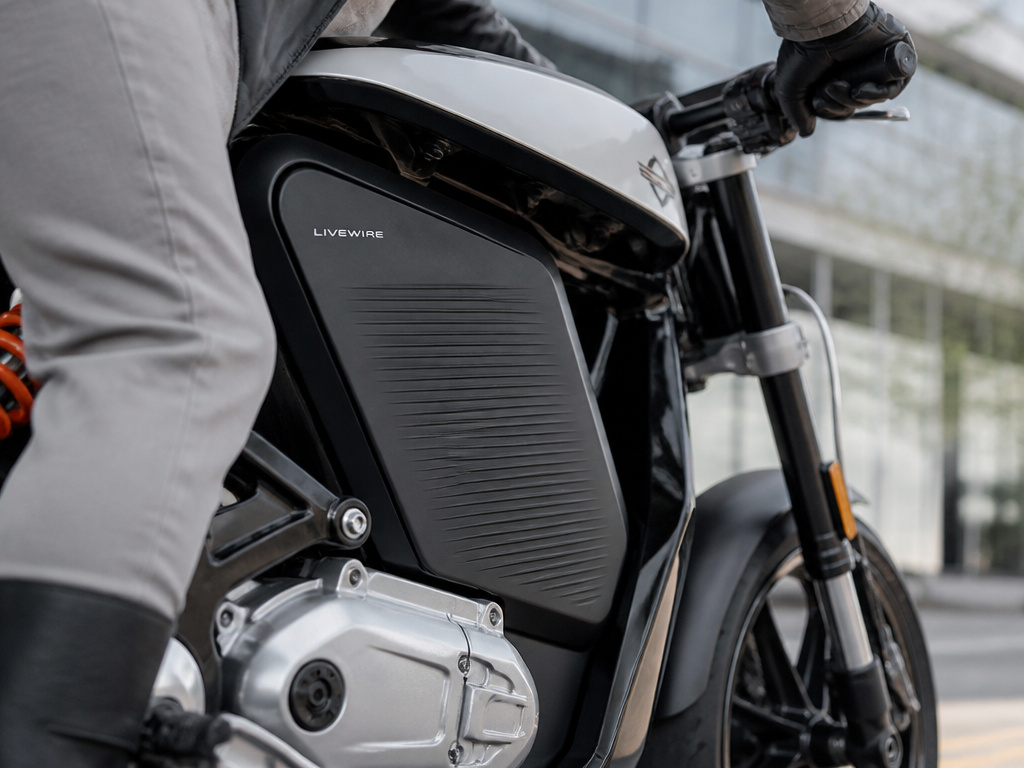
Electric propulsion is not just a powertrain swap; it creates a distinct vehicle class with its own rules. Modern standards like GB/T 5359.1-2019 explicitly define “electric motorcycles” and go further to define “plug-in hybrid electric motorcycles” and “extended-range hybrid electric motorcycles.”
This matters because the performance characteristics are unique. Instant torque, single-speed gearboxes, and heavy battery packs change the riding dynamics and the maintenance schedule. An electric Zero SR/F shares a standard naked bike’s riding posture, but its weight distribution and silent operation place it in its own niche. As adoption grows, understanding these formal classifications will become as important as knowing engine displacement.
Motorcycle Types Compared: A Decision Framework
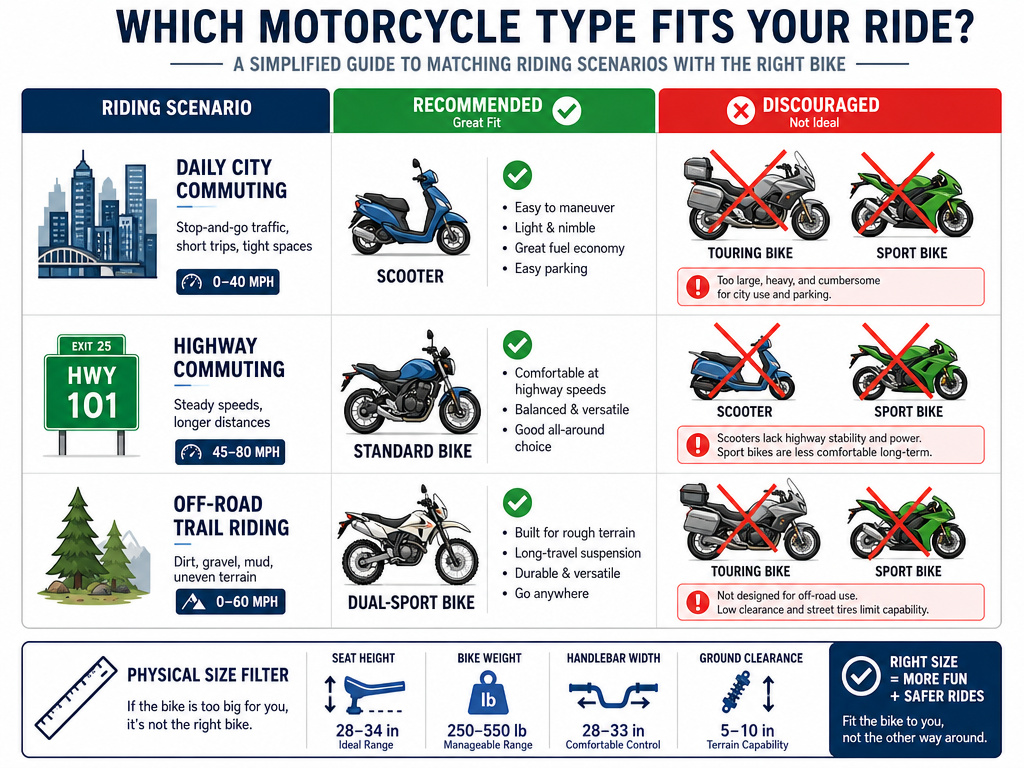
You have the list. How do you choose? This table maps rider scenarios to the one or two categories that make objective sense. It is a starting point, not the final answer.
| If your primary use is… | Prioritize these types | Avoid these types |
|---|---|---|
| Daily city commuting < 10 miles | Scooter, Standard | Touring, Off-Road |
| Highway commuting > 20 miles | Standard, Sport Touring, Adventure | Sport Bike, Off-Road, small Scooters |
| Weekend backroad carving | Sport, Sport Touring, Naked | Cruiser, Touring, Scooter |
| Long-distance touring (500+ mile days) | Touring, Adventure, Sport Touring | Sport Bike, Off-Road, Standard |
| Off-road trail riding | Off-Road, Dual-Sport | Cruiser, Sport Bike, Scooter |
| Mixed pavement and fire roads | Dual-Sport, Adventure | Sport Bike, Cruiser |
Your physical size is the final filter. A 5’4″ rider will struggle with the 35-inch seat height of a dual-sport but fit perfectly on a cruiser. A 6’2″ rider will be cramped on a sportbike but have room to spare on an adventure bike. Always sit on the bike before you commit.
For a step-by-step guide that incorporates budget, experience, and physique, our article on choosing a motorcycle walks you through the process.
What is a Bagger motorcycle?
A bagger is a sub-type of cruiser motorcycle, distinguished by its integrated luggage. While the core definition of a motorcycle from regulatory bodies focuses on its two or three-wheeled form and power source, the bagger’s purpose is long-distance comfort and storage. These are heavy, stable machines designed for highway travel, with wind protection from a fixed front fairing and hard-sided saddlebags mounted directly to the frame. The rider posture is typically relaxed and upright. Their design prioritizes carrying capacity for touring without the full bulk of a dedicated touring motorcycle, making them a popular choice for riders who want a cruiser style with practical luggage for extended trips.
What are Café Racer and Scrambler motorcycles?
Both café racers and scramblers are sub-types that modify the standard motorcycle for a specific character. A café racer is built for speed and a minimalist, retro sport aesthetic, often featuring low, clip-on handlebars and a solo seat that forces a forward-leaning riding posture. A scrambler, in contrast, is styled for light off-road capability, with higher-mounted exhausts, knobbier tires, and a generally more upright riding position. They are derivatives of standard or roadster bikes, which are noted for their neutral, upright posture. These styles are about customization and ethos rather than a formal regulatory category, reflecting a rider’s desired blend of classic looks and intended use.
Frequently Asked Questions
What is the most versatile type of motorcycle?
The standard/naked bike is the most versatile for street riding. The adventure bike is the most versatile if you need genuine off-road capability. The standard wins for simplicity and cost; the adventure bike wins for range and technology at the expense of weight and complexity.
Are three-wheeled vehicles like the Can-Am Spyder considered motorcycles?
It depends on the jurisdiction. Under the FIM’s broad definition, yes. Under many road-legal regulatory frameworks, three-wheeled vehicles often fall into a specific “three-wheeled motorcycle” or “autocycle” category with unique licensing rules. Always check your local vehicle code.
What is a supermoto motorcycle?
Supermoto is a distinct, fun-focused subtype. It starts with a dual-sport or dirt bike frame and fits it with 17-inch street wheels and sportbike tires. This creates a lightweight, hooligan machine that excels at cornering on pavement. Learn more in our dedicated article on supermoto motorcycles.
What was the Honda owner’s manual recall about?
In January 2018, Honda issued an emission recall (NHTSA 18V-000) for several 2017 models including the CBR600RR and CRF1000L Africa Twin. The owner’s manuals had a printing error that omitted critical maintenance schedule symbols. The concern was that owners might skip required maintenance, leading to excessive emissions. This highlights that official documentation, even for recreational vehicles, is part of a regulated system.
How do I know if a bike is a good first motorcycle?
Choose a standard/naked bike, a small cruiser, or a lightweight dual-sport in the 300-500cc range. Avoid high-performance sport bikes and heavy touring models. The right first motorcycle feels manageable when you walk it around a parking lot, not just when it’s moving.
The Bottom Line
The “best” motorcycle type is the one that matches the riding you will actually do 90% of the time. Use the market categories to understand ergonomics and intent, but remember the legal definitions, based on speed, power, and displacement, are what the DMV and your insurer use. Start with a standard or a small dual-sport to build skill without intimidation. Everything else is a specialization you can grow into. Fit beats price tag every time.
