
Standard Motorcycle Pros and Cons: Which Should You Buy?
This post contains affiliate links. As an Amazon Associate, we earn from qualifying purchases.
A standard motorcycle, also called a naked bike or roadster, combines an upright riding position, minimal bodywork, and versatile performance. Its pros are excellent urban agility, low-speed control, and a natural riding triangle that reduces fatigue. The cons are a lack of wind protection, limited storage, and less comfort for multi-hour highway rides. For most new riders and urban commuters, a standard is the best all-around starting point.
That balance between control and comfort is the whole game. Every other motorcycle type, cruisers, sportbikes, tourers, takes that balance and pushes it toward one extreme. Standards sit in the middle, which makes them the default choice for a reason. A key part of choosing any bike is weighing the standard motorcycle pros and cons.
What follows is the real-world breakdown most articles skip: the specific costs that sneak up on you, the models that actually hold value, and the moment you’ll know it’s time for something else. We’ll cover the five strengths, the three real weaknesses, and who wins in a head-to-head against the other major types.
Key Takeaways
- Standards excel at city riding and low-speed maneuverability thanks to a neutral weight distribution and wide handlebars.
- The upright riding position offers the best all-around visibility and control, a key factor for beginners learning to handle a bike in traffic.
- For a first bike, target a model with forgiving power and enough performance for the highway, such as the Honda CB500F or Suzuki SV650.
- Resale value stays strong for clean, popular models, making a used standard one of the few motorcycle purchases that isn’t a total financial sinkhole.
The 5 Defining Strengths of a Standard Motorcycle
The standard motorcycle isn’t a compromise. It’s a deliberate design focused on the rider’s connection to the bike and the road. Forget the brochure language about “pure essence.” The strengths are mechanical and immediately obvious the first time you ride one in traffic.
A standard motorcycle prioritizes a neutral riding triangle: the rider’s hands, feet, and seat form a relaxed, upright posture. This geometry, combined with a moderate seat height and wide handlebars, provides optimal leverage for low-speed control and maximizes the rider’s field of vision in urban environments. The design typically foregoes full fairings, reducing weight and complexity.
You see everything. The upright position puts your head on a swivel. Your field of view isn’t blocked by a tall windshield or limited by a hunched-over sportbike crouch. In city traffic, where the hazard is the distracted driver in the next lane, this is your primary defense. You can check mirrors, scan intersections, and spot pavement hazards without contorting your neck.
The controls feel natural. Your wrists aren’t bearing weight. Your knees aren’t bent at an extreme angle. This is the riding position human bodies understand instinctively. For a new rider, that means less mental bandwidth spent on “how do I hold this thing” and more on “what’s that car about to do.” The wide handlebars give you excellent control for steering. A slight press turns the bike; you’re not wrestling it through a corner.
Weight works for you, not against you. Standards typically have a moderate seat height and a central weight bias. The engine is positioned low in the frame, and the fuel tank sits between your knees. This makes the bike feel planted and predictable at walking speeds and in parking lots, the two places new riders drop bikes most often. The sensation is one of sitting in the motorcycle, not perched on top of it.
They’re cheap to run. Less bodywork means fewer plastic pieces to crack in a tip-over. The mechanicals are usually straightforward, shared across a manufacturer’s lineup, so parts are common and labor times are lower. The Suzuki Address 110 owner’s manual recommends unleaded gasoline with an octane rating of 91 or higher, a common spec for many small to mid-size standards. You aren’t paying for exotic materials or complex aerodynamic shrouds.
Modification is straightforward. The naked chassis is a blank canvas. Want a different handlebar? Four bolts. Adding a luggage rack or a phone mount? The frame tubes are right there. This accessibility is a huge part of the standard’s culture. Unlike a fully-faired sportbike where every change requires removing bodywork, you can tweak a standard to fit you in an afternoon with basic tools.
The 3 Real Weaknesses (And How to Mitigate Them)
The trade-offs are physical. When you strip a motorcycle down to its essentials, you remove the parts that make long distances and bad weather tolerable. These aren’t deal-breakers, but they are budget items and comfort concessions you must plan for.
Where this goes sideways: Assuming a standard is ready for a four-hour highway trip straight from the dealer. Without a windscreen, sustained speeds over 65 mph become a workout as you fight windblast. Your lower back and neck will ache within an hour, and the constant noise is fatiguing.
Wind protection is non-existent. This is the single biggest complaint from new standard owners. At highway speed, your chest becomes a sail. It’s tiring. A universal-fit windscreen is the first upgrade most owners make, and it makes the bike much better for longer rides. It doesn’t need to be huge; a small “bikini fairing” that deflects air to your shoulders makes a 70-mph ride manageable.
Storage is what you carry. You have a fuel tank and maybe a small helmet lock under the seat. That’s it. Compared to a touring motorcycle with integrated saddlebags, you’re living out of a backpack or strapping on soft luggage. This affects your daily utility. Running errands means wearing a motorcycle backpack or adding a motorcycle top case. Factor that cost into your purchase.
Long-distance comfort has limits. The seat is often a compromise, firm enough for support, but not plush. The suspension is tuned for agility, not for soaking up miles of potholed interstate. After a while, you’ll be looking for an exit ramp to stretch. This is the polar opposite of a dedicated sport touring motorcycle, built specifically to eat miles in comfort.
| Weakness | The Consequence | The Mitigation (Cost Range) |
|---|---|---|
| No Wind Protection | Fatigue, upper body strain on highways | Add a windscreen ($100 – $300) |
| Minimal Storage | Inconvenient for errands, grocery runs | Tank bag + tail bag or top case ($150 – $500) |
| Firm Seat & Suspension | Discomfort on rides over 2 hours | Aftermarket seat upgrade ($300 – $600) |
Standard vs. The Field: Which Type Wins Your Ride?
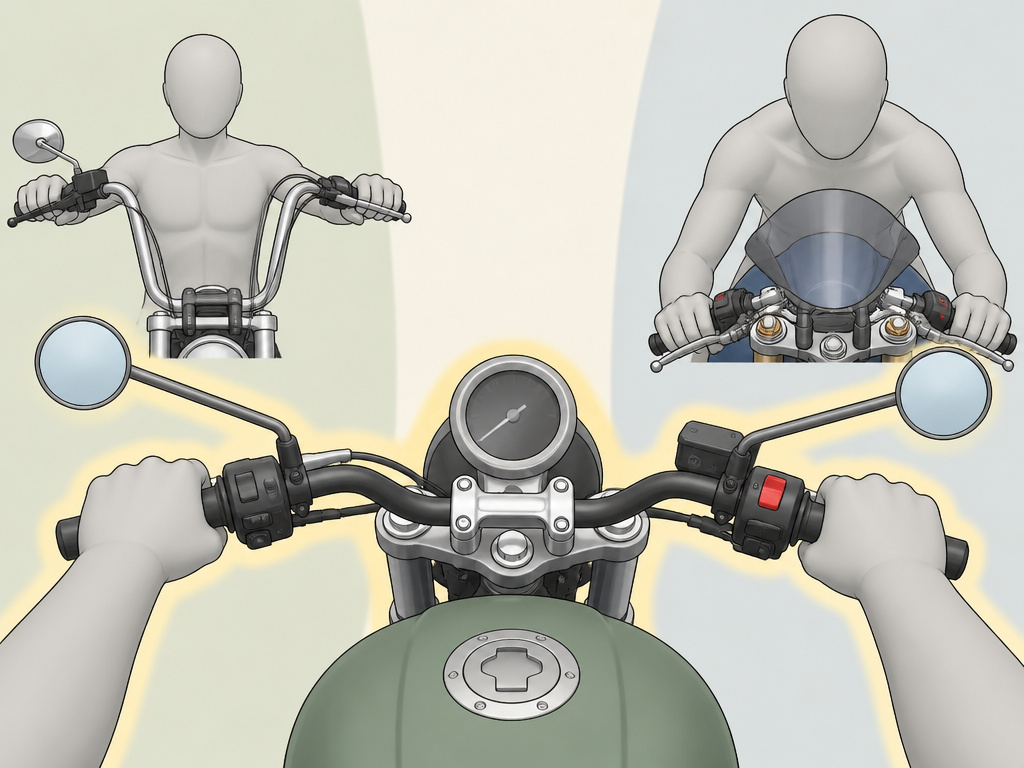
You don’t choose a motorcycle in a vacuum. The choice is always “standard versus something else,” a direct comparison of standard motorcycle pros and cons against other types. This is where the standard’s balanced nature becomes its greatest strength or its fatal flaw, depending on what you actually plan to do.
Standard vs. Cruiser: It’s about control versus style. A cruiser motorcycle puts your feet forward and your hands high, a relaxed posture that sacrifices cornering clearance and low-speed maneuverability. Standards handle twisty roads and tight parking spots with ease; cruisers excel at straight-line comfort. If your riding is 90% city with occasional backroad fun, the standard wins. If your priority is a low seat height and a classic look for boulevard cruising, the cruiser is your pick.
Standard vs. Sportbike: This is the daily rider versus the weekend rocket. Sportbikes demand a committed, forward-leaning posture that strains wrists and necks in traffic. Their power is explosive at high RPMs, twitchy at low speeds. A standard’s power delivery is linear and manageable. For learning, commuting, or any ride under an hour, the standard is the sane choice. The sportbike only makes sense if your primary goal is aggressive cornering on known canyon roads.
Standard vs. Adventure Bike: The adventure motorcycle is the Swiss Army knife, tall, heavy, and capable on gravel, but a handful in an urban environment. Standards are lighter, lower, and nimbler in traffic. If you never plan to leave pavement, the adventure bike’s height and weight are penalties, not benefits. The standard is the more efficient tool.
Standard vs. Scooter: This often gets overlooked. The motorcycles vs scooters debate boils down to performance versus pure utility. Scooters have step-through frames and automatic transmissions, perfect for quick errands. Standards offer more power, stability at highway speeds, and the engagement of a manual transmission. If your riding includes regular highway use or you enjoy the mechanics of riding, the standard is the only choice.
Who a Standard Motorcycle Is Actually For (And Who Should Skip It)
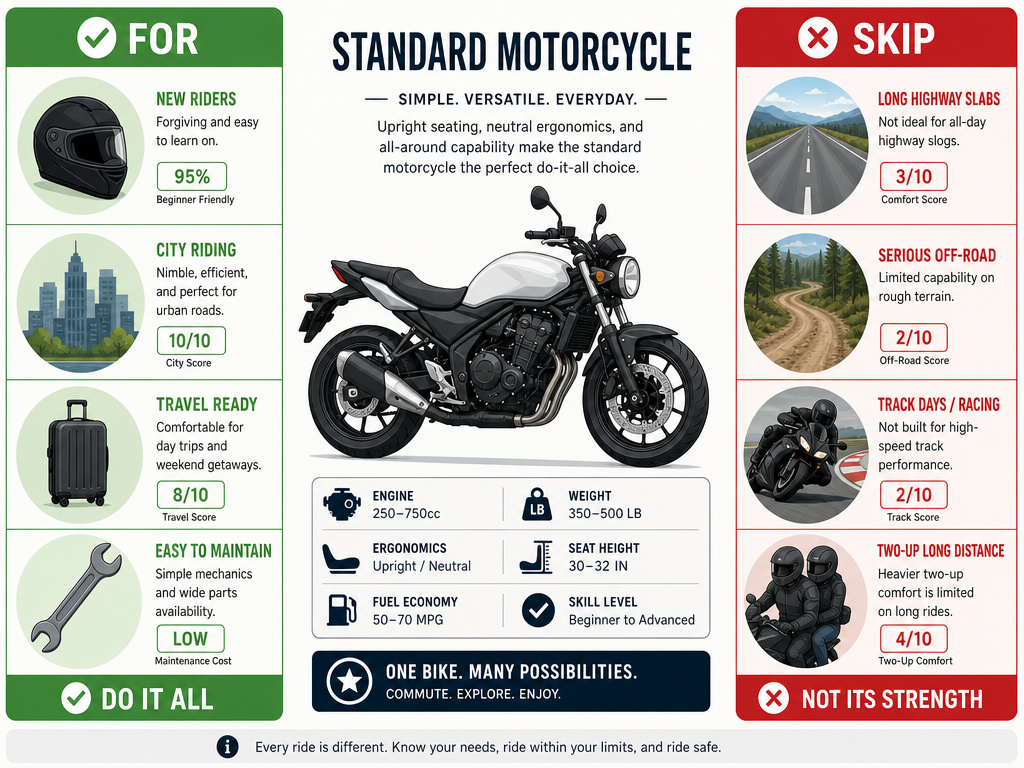
The best bike is the one that fits your actual life, not the fantasy version, which is why a clear look at standard motorcycle pros and cons is essential. Be honest about your typical week.
Buy a standard motorcycle if:
- You are a new rider. The forgiving nature, manageable power, and excellent visibility are the ideal learning platform.
- Your primary riding is urban commuting. Filtering through traffic, navigating tight streets, and dealing with stop-and-go conditions are where standards dominate.
- You want one bike that can do a bit of everything: commute, weekend backroad fun, and the occasional longer trip (with added luggage).
- You enjoy customizing and working on your bike. The simple, exposed layout invites tinkering.
Skip a standard motorcycle if:
- Your main goal is long-distance touring. The lack of wind protection and storage will frustrate you, and you’ll quickly wish for a dedicated touring bike.
- You prioritize off-pavement exploration. While some standards can handle light gravel, an adventure bike or dual-sport is built for it.
- You crave maximum cornering performance and are willing to sacrifice daily comfort for it. That’s the sportbike domain.
- You primarily ride with a passenger. Standards often have small, thinly-padded passenger seats not designed for multi-hour comfort.
Safety & Practical Considerations You Won’t Find in the Brochure
Safety isn’t just about brakes and tires; it’s about how the bike’s design influences your riding. The standard’s upright posture is a significant but often unmentioned safety feature.
Your posture is a defensive tool. Sitting upright makes you more visible to other drivers. More importantly, it gives you the best possible body position to react to hazards, you can shift your weight easily, turn your head to check blind spots, and brace for evasive maneuvers. The federal motorcycle safety standard FMVSS No. 122 defines requirements for brake systems, but the rider’s ability to see and react is the first layer of prevention.
Common mistake: Adding bulky accessories that change the bike’s handling. The Suzuki owner’s manual warns that improper installation of accessories may cause changes in handling which could lead to an accident. A heavy top box or poorly mounted fairing can make a light standard bike feel unstable at speed.
Braking performance is rider-dependent. Standards typically have competent but not exceptional brakes. The upright posture means your body is not braced against the tank as on a sportbike. Under hard braking, you must actively use your legs and core to keep from sliding into the handlebars. This is a skill to learn, but it means maximum braking force is limited by your body position, not just the calipers.
Weather hits you directly. Without fairings, you feel every drop of rain and every gust of wind. This isn’t just uncomfortable; it affects control. As noted in a manufacturer manual, braking distances double on a rainy day. On a standard, you’re also dealing with direct rain on your visor and chest, which can be distracting. Good rain gear is not optional.
The Bottom Line
Forget the idea of a “do-it-all” motorcycle. No bike truly does. The standard motorcycle does the most important things for the most people: it gets you through a city efficiently, teaches you how to ride properly, and delivers fun without intimidation.
If you are standing in a dealership wondering which direction to go, start with a standard. Sit on a Honda CB500F, a Yamaha MT-07, or a Suzuki SV650. Feel the neutral posture. Recognize that the blank canvas in front of you is an invitation to build the bike you actually need, not the one a marketing department imagined.
You’ll know it’s time to move on when your rides consistently exceed your comfort limits or you find yourself staring longingly at luggage systems. That’s not a failure; it’s a sign you’ve outgrown the beginner’s tool and are ready for a more specialized machine. Until then, the standard is the smartest money you can spend on two wheels.
What is the engine size range for a standard motorcycle?
Engine size directly shapes the riding experience. A smaller engine offers a lightweight, manageable feel ideal for city streets and new riders. These bikes are straightforward to handle and can be very forgiving. Moving up to a mid-range engine provides a noticeable boost in power for highway merging and more spirited riding, without becoming overwhelming. The largest engines deliver substantial torque and power for effortless high-speed travel and two-up touring. Your choice should balance the performance you want with the level of control you’re comfortable maintaining in various traffic conditions.
Pros: Fuel efficiency
Fuel efficiency is a major practical advantage for many standard motorcycles. Their relatively lightweight and simple design, compared to fully-faired sport bikes or heavy touring models, means the engine doesn’t have to work as hard to move the bike. This leaner mechanical profile can lead to fewer stops at the pump. For example, a large touring cruiser like a Harley-Davidson Electra Glide Standard has an estimated fuel economy of 43 miles per gallon, though specific numbers for standard motorcycles vary widely by engine size and riding style. While specific numbers vary widely by engine size and riding style, the general efficiency of the standard motorcycle platform keeps running costs predictable and low.
Frequently Asked Questions
What is a standard type motorcycle best for?
Standard motorcycles are best for urban commuting, new riders, and versatile backroad riding. Their upright position offers great visibility in traffic, their manageable power builds confidence, and their neutral handling is forgiving. They are the default recommendation for a first bike because they teach foundational skills without the extremes of other styles.
Are standard motorcycles good for beginners?
Yes, they are widely considered the best type of motorcycle for beginners. The upright riding position provides control and visibility, the power delivery is typically linear and predictable, and the lighter weight (compared to cruisers or tourers) makes low-speed maneuvers easier to learn. Starting on a standard builds good habits.
What are the main disadvantages of a standard motorcycle?
The three main disadvantages are a lack of wind protection at highway speeds, minimal integrated storage, and limited long-distance comfort due to firm seats and suspension tuned for agility. These are trade-offs for the bike’s simplicity, agility, and low cost. Most disadvantages can be mitigated with aftermarket accessories.
How does a standard compare to a naked bike?
They are the same thing. The terms “standard” and “naked bike” are used interchangeably to describe a motorcycle with an upright riding position, minimal or no bodywork (fairings), and a focus on versatile performance. “Naked” often refers to the exposed engine and mechanicals, while “standard” references the classic, non-specialized riding posture.
