
Types of Motorcycle Tires: Which One Matches Your Ride?
This post contains affiliate links. As an Amazon Associate, we earn from qualifying purchases.
Your motorcycle’s performance, safety, and feel are decided by the two patches of rubber on the pavement. The main types of motorcycle tires are Sport, Sport-Touring, Touring/Cruiser, Adventure (ADV), Dual-Sport, Off-Road/Motocross, and Racing/Track tires. Each type uses a specific rubber compound, tread pattern, and construction, radial or bias-ply, to match a riding style, from highway commuting to dirt trails.
That choice between a sticky sport compound and a long-mileage touring one is a trade-off written in physics. A softer rubber grips better but wears faster; a harder one lasts longer but offers less ultimate traction. The sidewall isn’t just branding, it’s a legal and engineering document that tells you exactly what the tire is built to handle, down to the load and maximum speed.
What follows is a breakdown of all seven tire categories, the real-world models that define them, and the critical specs, like load index and speed symbol, that you must match to your bike. We’ll also cover the storage rules manufacturers disagree on, the hard limits on tire repairs, and how to read a date code so you never mount hardened, old rubber.
Key Takeaways
- Match front and rear tires from the same brand and model line for predictable handling, as the Motorcycle Safety Foundation advises.
- After a tread puncture repair, the MSF states a repaired tire should never be used over 80 mph, while the TSD 119 endurance test uses a baseline speed of 80 km/h (about 50 mph).
- For long-term storage, Michelin says store tires vertically on a shelf; Continental warns conventional tires must never be stored below 32°F.
- A tire’s load index and speed symbol (like 56P) are mandatory ratings; the ISO standard uses specific inflation pressures (225 kPa to 330 kPa) to measure them.
- Replace tires after 10 years of use regardless of tread depth, as aging rubber loses elasticity and grip.
The 7 Main Types of Motorcycle Tires
Your bike came with tires engineered for a specific job. Putting a knobby off-road tire on a sportbike isn’t just wrong, it’s dangerous. Here’s what each category is actually built to do.
Sport & Superbike Tires
These are for aggressive street riding and canyon carving. The rubber compound is soft, often a multi-mix like Michelin’s Power or Pirelli’s Diablo Rosso, with a focus on warm-up time and edge grip. The tread pattern is minimal to maximize the contact patch when leaned over. They wear quickly. You feel every pavement imperfection. They’re overkill for straight-line commuting and will square off fast.
Sport-Touring Tires
This is the sweet spot for riders who want performance but also need mileage. Think Michelin Road 6 or Bridgestone Battlax T32. They use a dual-compound tread: a harder center strip for highway longevity and softer shoulders for cornering grip. The tread pattern includes more sipes (small grooves) for wet weather traction. They handle the weight of luggage better than pure sport tires and typically offer longer mileage than pure sport tires.
Touring & Cruiser Tires
Built for maximum mileage, load capacity, and comfort over thousands of highway miles. Examples include the Michelin Commander or Metzeler Cruisetec. The compound is harder, and the profile is often more rounded to promote even wear. They prioritize stability under heavy loads (bike, rider, passenger, gear) and dampen vibration. The trade-off is less outright grip when pushed hard in corners, but for a bagger on an interstate, that’s not the point.
Adventure (ADV) & Dual-Sport Tires
These tires bridge the gap between pavement and dirt. They’re categorized by their on-road/off-road ratio (e.g., 50/50, 70/30). A 50/50 tire like the Mitas E-07 has aggressive, spaced knobs for dirt traction but will buzz on pavement and wear quickly. A 70/30 tire like the Continental TKC 70 has a more road-biased tread pattern with blocky elements that still clear mud. The sidewalls are reinforced for lower pressures when riding off-road.
Off-Road & Motocross Tires
These are for dedicated dirt bikes. The knobs are tall, sharp, and widely spaced to dig into soft terrain. The rubber is a softer, more flexible compound to conform to obstacles. They have no place on pavement, the knobs flex and tear, leading to rapid wear and unpredictable handling. They are often tube-type due to the need for very low air pressure and the higher risk of rim damage.
Racing & Track Day Tires
These are not street-legal. Compounds are ultra-soft (like Pirelli’s Diablo Supercorsa SC) and require tire warmers to reach operating temperature. Tread is either slick or has minimal grooves for wet conditions. They offer phenomenal grip but have a very short lifespan. Street pressures will make them greasy and unpredictable on track, as they’re designed to operate at specific hot temperatures.
Scooter & Commuter Tires
Often overlooked, these are designed for smaller wheels, lower speeds, and the constant stop-start of city riding. The tread pattern is optimized for wet pavement and channeling water. They prioritize puncture resistance and longevity over sporty handling. Using a scooter tire on a larger motorcycle rim is unsafe and violates design specifications.
The part nobody mentions: According to ISO 5751-2, the assignment of tread patterns to service types (like “highway” or “off-road”) is at the sole discretion of the tire manufacturer. A knobby-looking tread could be certified for highway use if the maker says so, don’t judge a tire by its tread pattern alone.
How to Decode a Tire’s Sidewall
The sidewall is a tire’s birth certificate and legal contract. The string of numbers and letters isn’t random; it’s a globally standardized code defined by organizations like the International Organization for Standardization (ISO).
A standard metric tire size looks like this: 120/70 ZR 17 M/C (58W).
- 120: The nominal section width in millimeters.
- 70: The aspect ratio, the sidewall height is 70% of the section width.
- ZR: The ‘Z’ indicates a speed rating above 149 mph, and the ‘R’ means radial construction. A ‘B’ would indicate bias-belted, and a ‘-‘ indicates diagonal (bias) ply.
- 17: The rim diameter in inches.
- M/C: Mandatory marking confirming it’s for motorcycle use.
- (58W): The service description. 58 is the load index (236 kg), and W is the speed symbol (168 mph).
The ISO standard provides a precise example: a tire marked 100/90 R 18M/C 56 P has a 100mm width, 90% aspect ratio, radial construction, fits an 18-inch rim, has a load index of 56 (224 kg), and a speed symbol of P (150 km/h).
| Code Element | What It Means | Why It Matters |
|---|---|---|
| Section Width (e.g., 120) | Tire’s width in millimeters. | Must fit your rim and swingarm clearance. |
| Aspect Ratio (e.g., 70) | Sidewall height as % of width. | Affects handling profile and ride comfort. |
| Construction (R, B, -) | Radial, Bias-Belted, or Diagonal Ply. | Determines tire flexibility, weight, and stability. |
| Rim Diameter (e.g., 17) | Wheel size the tire fits. | Non-negotiable—must match your wheel. |
| Load Index (e.g., 58) | Numerical code for max load capacity. | Exceeding it risks tire failure. |
| Speed Symbol (e.g., W) | Letter code for max sustained speed. | Exceeding it causes overheating and failure. |
Standards also define specialized terms like centrifugal radius. The Chinese standard GB/T 2983-2015 defines this as “the permissible maximum dynamic radius for a grown high-speed motorcycle tyre under centrifugal force at its maximum speed.” This means the tire physically grows at high speed, a factor engineers account for in clearance design, but most riders never consider.
For a detailed explanation of every marking, see our guide on how to read motorcycle tire codes.
Radial vs. Bias-Ply: The Construction Choice
This isn’t just marketing. The internal architecture of a tire, how its fabric plies are laid, fundamentally changes how it behaves.
Bias-Ply (Conventional) Construction: Cords crisscross the tire at a 30 to 40-degree angle. This creates a stiff, robust carcass that transmits more road feedback. They’re often found on classic cruisers, some off-road bikes, and are generally less expensive. The stiff sidewall can make them feel more resistant to turning input.
Radial Construction: Cords run radially from bead to bead (90 degrees), with a stabilizing belt wrapped around the circumference under the tread. This allows the sidewall to flex independently of the tread. The result is a larger, more stable contact patch when leaned over, better heat dissipation, and often less rolling resistance. Most modern sport, touring, and sport-touring tires are radial.
The performance difference is real. A radial tire will typically offer more predictable cornering feel and better stability at high speeds. The debate between radial and bias-ply construction is worth understanding before you buy.
The Critical Details Most Riders Miss
You’ve picked the type. Now you need to get the specifics right, or you’re buying a safety problem.
Matching Front and Rear Tires
The Motorcycle Safety Foundation is blunt: the front and rear tires should match each other by being from the same brand and model line. Mixing a sport front with a touring rear can create unpredictable handling because the profiles, compounds, and flex characteristics are engineered to work together. It might work, but when you need maximum traction in an emergency maneuver, the mismatch could be the difference between catching it and losing it.
The Real Limit on Tire Repairs
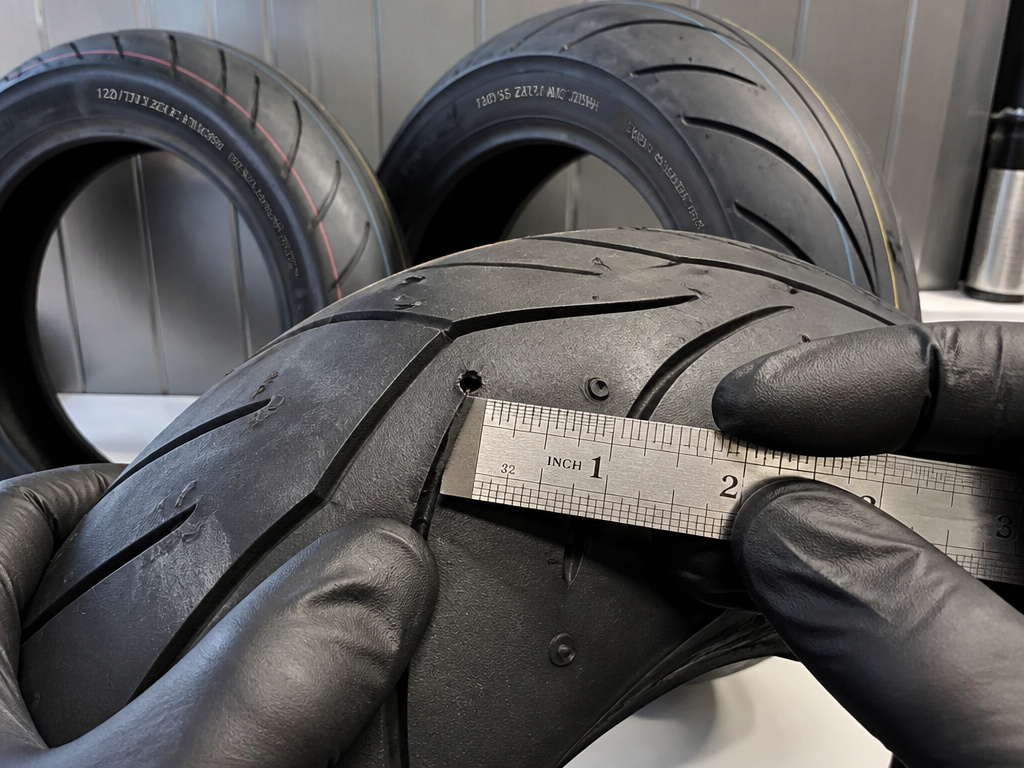
Got a nail in your tread? The MSF’s guide states repairs should be limited to a combination plug/patch on tread punctures no larger than 1/4 inch on a demounted tire. Repairs to the sidewall are not permitted.
Where this goes sideways: The MSF states a repaired tire should never be used over 80 mph. Contrast this with the Canadian TSD 119 endurance test, which runs motorcycle tires at only 80 km/h (about 50 mph). The takeaway? Even a perfectly executed repair significantly reduces the tire’s high-speed safety margin. Treat it as a temporary get-you-home fix.
The Storage Conflict No One Talks About
How you store a spare tire matters. Michelin says store in a cool, dry place below 95°F, and for long-term storage, place them vertically on shelves. However, Continental states conventional tires must NOT be stored below 0°C / 32°F, and race tires must not go below 10°C / 50°F. Taking a cold tire into service may cause cracks. This highlights a key area where manufacturer guidance differs. Michelin specifies a maximum storage temperature (below 95°F), while Continental specifies minimum storage temperatures (not below 32°F for conventional tires). When sources conflict, the conservative play is to follow the stricter rule for the tire brand you own.
| Storage Factor | Michelin Guidance | Continental Guidance | Safe Compromise |
|---|---|---|---|
| Temperature | Below 95°F. | Not below 32°F (0°C) for conventional tires. | Keep between 40°F and 80°F. |
| Long-Term Orientation | Store vertically on shelves. | Not explicitly stated for orientation. | Store vertically, away from floor. |
| Lifespan for Sale | Replace after 10 years of use. | Can be sold as new up to 5 years from production if stored correctly. | Check date code; 5+ years old is a deal-breaker. |
Tire Age vs. Tread Depth
Tires harden with age due to oxidation, losing grip long before the tread wears out. Michelin advises that after 10 years of use, tires should be replaced. Continental says an unused, correctly stored tire can be sold as new for up to five years after its production date. Find the DOT date code (a four-digit number like “3524” for the 35th week of 2024). Deep tread on a 7-year-old tire is not a good thing.
Choosing the Right Tire: A Decision Matrix
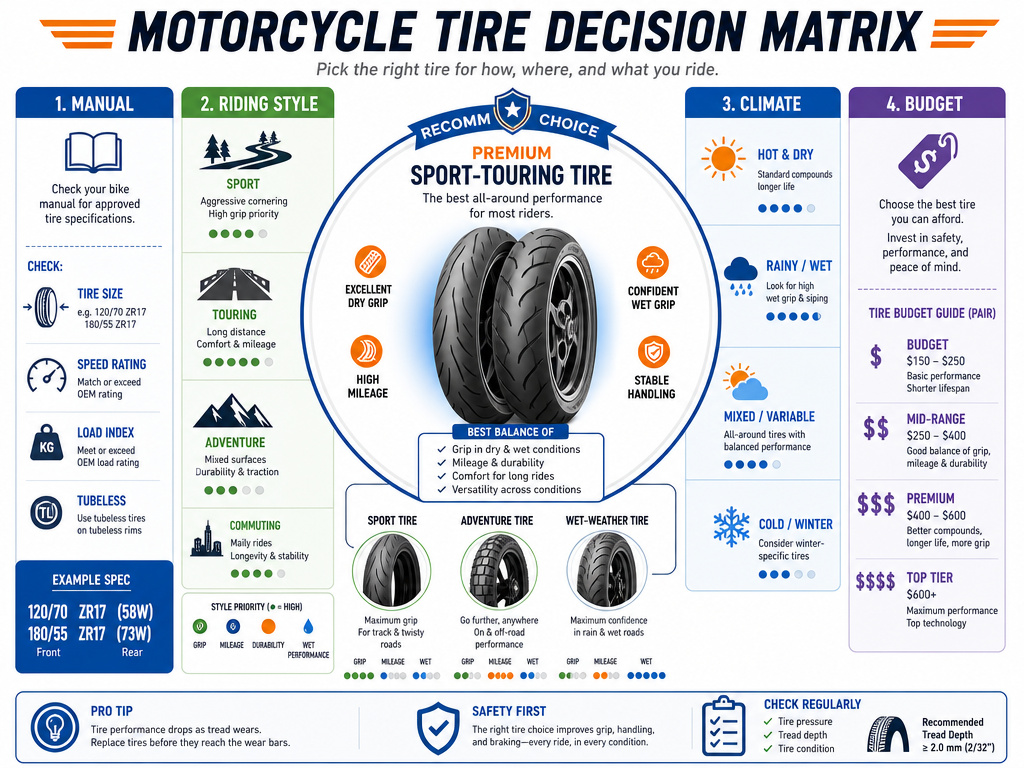
Stop overthinking it. Your bike’s manual, your riding style, and your local climate make the choice for you.
- Check Your Manual: It specifies tire size, construction (radial/bias), and load/speed ratings. This is your starting point.
- Audit Your Riding: Be honest. Is it 90% highway commuting? A sport-touring or touring tire is your answer. Weekend backroad exploration? Look at sport or sport-touring. Fire roads and camping? You need an adventure motorcycle tire with the right on/off-road ratio.
- Consider Your Climate: Riders in wet regions need tires with strong wet-weather siping (like the Michelin Road 6). Those in hot, dry areas can prioritize dry grip and longevity.
- Set a Budget: Include installation. Sticky race replicas cost more upfront and wear out faster, increasing your cost per mile.
For most riders on modern standard, sport, or touring bikes, a premium sport-touring tire offers the best balance of grip, mileage, and wet weather performance. It’s the default smart choice.
If you’re comparing specific categories, see our detailed look at sport vs. Sport-touring tires to weigh the trade-offs.
Frequently Asked Questions
What are the four main types of motorcycle tires?
While there are seven detailed categories, the four main families are: Sport (maximum grip, short life), Touring (maximum mileage, high load capacity), Adventure/Dual-Sport (mixed surface capability), and Off-Road (dedicated dirt performance). Cruiser and scooter tires are sub-types of the touring and commuter families, respectively.
Can I put a car tire on my motorcycle?
No. The Motorcycle Safety Foundation states it is unsafe to install passenger car tires on motorcycle rims. The flat tread profile doesn’t allow for proper leaning, and the bead seat is incompatible, which can lead to sudden pressure loss or a bead explosion.
How long do motorcycle tires typically last?
Lifespan varies wildly by type. A soft sport tire may have a relatively short lifespan. A sport-touring tire often reaches 8,000-12,000 miles. A hard-compound touring tire can offer a long lifespan. Regardless of tread, manufacturers like Michelin recommend replacement after 10 years due to rubber aging.
What is the difference between tube-type and tubeless tires?
Tube-type tires require an inner tube to hold air and are common on older bikes, dirt bikes, and some classic styles. Tubeless tires form an air seal directly against the rim. You can sometimes use a tube in a tubeless tire (a “tubeless tire with a tube”), but Pirelli cautions that if you do, you must use their specific tube and the maximum speed for a V-rated tire drops to 230 km/h.
Are more expensive tires worth it?
Usually, yes, within a category. A premium tire from Michelin, Pirelli, or Bridgestone invests in advanced rubber compounds (like dual-compound technology) and tread designs that offer better grip, especially in the wet, and more predictable wear. The price jump from a budget to a mid-tier tire buys significant safety. The jump from mid-tier to ultra-premium often buys marginal performance gains for street riding.
Before You Go
The right tire is the one that matches your bike’s requirements and your actual riding, not your aspirational riding. Check your sidewall codes against your manual, and never ignore the date stamp. Pressure is a weekly check, a tire 5 psi low changes everything.
When manufacturers disagree on something as basic as storage temperature, it tells you the environment is everything. A tire stored wrong is compromised before it’s even mounted. Finally, remember that differences between tubeless and tube-type tires are more than just convenience; they’re about safety and performance options.
Your tires are your only connection to the road. Choose them with the same care you choose your helmet. For a curated list of top performers across all categories, see our picks for the best motorcycle tires available right now.
