
Dual Compound Motorcycle Tires Pros and Cons
This post contains affiliate links. As an Amazon Associate, we earn from qualifying purchases.
Dual compound motorcycle tires use two different rubber formulas in one carcass: a harder, more durable compound in the center for straight-line mileage and a softer, grippier compound on the shoulders for cornering traction. For riders who split time between highway commuting and weekend twisties, this technology offers a tangible compromise that can delay squaring off. However, the transition between compounds can create a distinct wear ridge and handling feel that not every rider prefers.
The mechanism is straightforward, but the real-world performance is where opinions split. Manufacturers design these tires to solve a specific physics problem, uneven wear, but the solution introduces its own variables in feel, temperature sensitivity, and cost. Understanding the dual compound motorcycle tires pros and cons is key to evaluating that trade-off.
This guide walks through the mechanics, the verified pros and cons from owner experience and recall data, and ends with a clear verdict on who should buy them and who should skip them after weighing the dual compound motorcycle tires pros and cons.
Key Takeaways
- The harder center compound resists squaring off from highway miles, but the softer shoulder compound can wear faster if you ride aggressively in corners.
- In wet conditions, the compound transition zone can be a weak spot for braking traction if the tire is under-inflated or significantly worn.
- Ignore the date code at your peril. A five-year-old dual compound tire will have hardened rubber regardless of tread depth, negating the soft shoulder’s intended benefit.
- For most street riders doing a mix of commuting and spirited riding, a dual compound tire is the default, sensible choice.
- Check pressure weekly with a gauge. A reduction from your street cold pressure is a typical starting point for track use, but never guess, measure it hot.
What Is a Dual Compound Motorcycle Tire? (Mechanism & Goal)
A dual compound tire concerns rubber density, not terrain. Picture a single tire carcass where the strip of rubber running down the middle is formulated to be more resistant to abrasion and heat. The rubber on the left and right shoulders, the parts that contact the pavement when you’re leaned over, is formulated to be softer and stickier.
A dual compound motorcycle tire employs two distinct rubber formulations within a single carcass. A harder, more durable compound is used in the center tread to resist squaring off from straight-line travel, while softer, grippier compounds are placed on the shoulders to provide increased traction during cornering. This construction is a direct engineering response to the uneven wear patterns generated by different riding disciplines.
The goal is to give you two performance profiles in one purchase. You get longer life from the part of the tire that does the most mileage (the center) and better grip from the parts that need it most when you’re pushing (the shoulders). It’s a compromise, not magic. The harder center won’t feel as planted under hard braking as a full-soft sport tire, and the soft shoulders won’t last as long as a full-hard touring tire.
Where this goes sideways: Riders confuse “dual compound” with “dual sport.” One is a rubber formulation (for street tires); the other is a tread pattern design (for on/off-road use). Buying a knobby dual-sport tire expecting dual-compound longevity on pavement is a fast way to be disappointed.
The Verified Pros: Where This Technology Shines
The advantages are measurable, particularly for a specific riding profile, not marketing fluff.
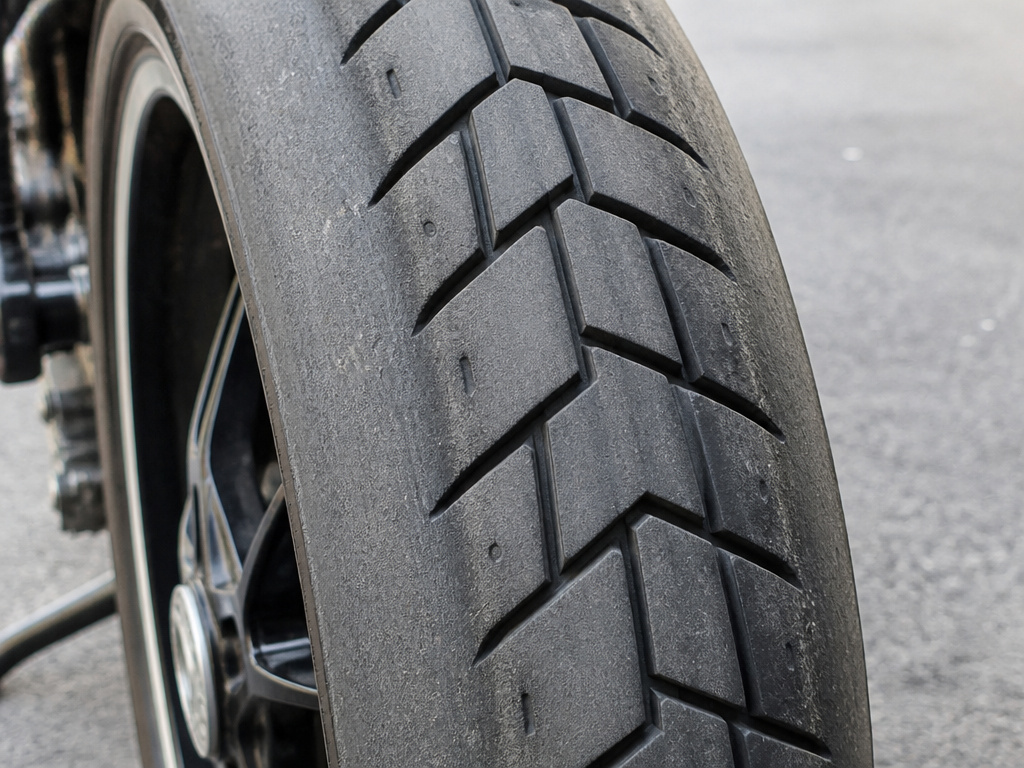
Extended Centerline Life. This is the headline. The harder center compound resists the abrasive, flattening effect of highway miles. Where a single-compound sport tire might develop a noticeable flat spot, a “squared-off” profile, after a few thousand miles of commuting, a dual-compound tire maintains a rounder profile for longer. This directly translates to more miles before replacement and more consistent handling throughout the tire’s life.
Improved Shoulder Grip for Cornering. When you tip the bike into a turn, you’re now on the softer rubber. That softer compound heats up faster and provides a higher coefficient of friction than the hard center. For a rider who commutes during the week but attacks backroads on the weekend, this means confidence in the corners without switching to a dedicated, fast-wearing sport tire.
A Balanced Performance Compromise. For most street riders, who ride neither at the track nor on cross-country tours, this balance is the sweet spot. This explains why models like the Michelin Road 6 and Bridgestone Battlax T32 have become default recommendations. They deliver very good performance across the widest range of real-world conditions.
The part nobody mentions: That softer shoulder compound is a wear indicator. When the distinct tread blocks on the edge start to look noticeably more rounded and shallower than the center tread, the tire is telling you its peak cornering performance is declining, even if the center still looks legal.
The Real Cons and Drawbacks (Backed by Data)
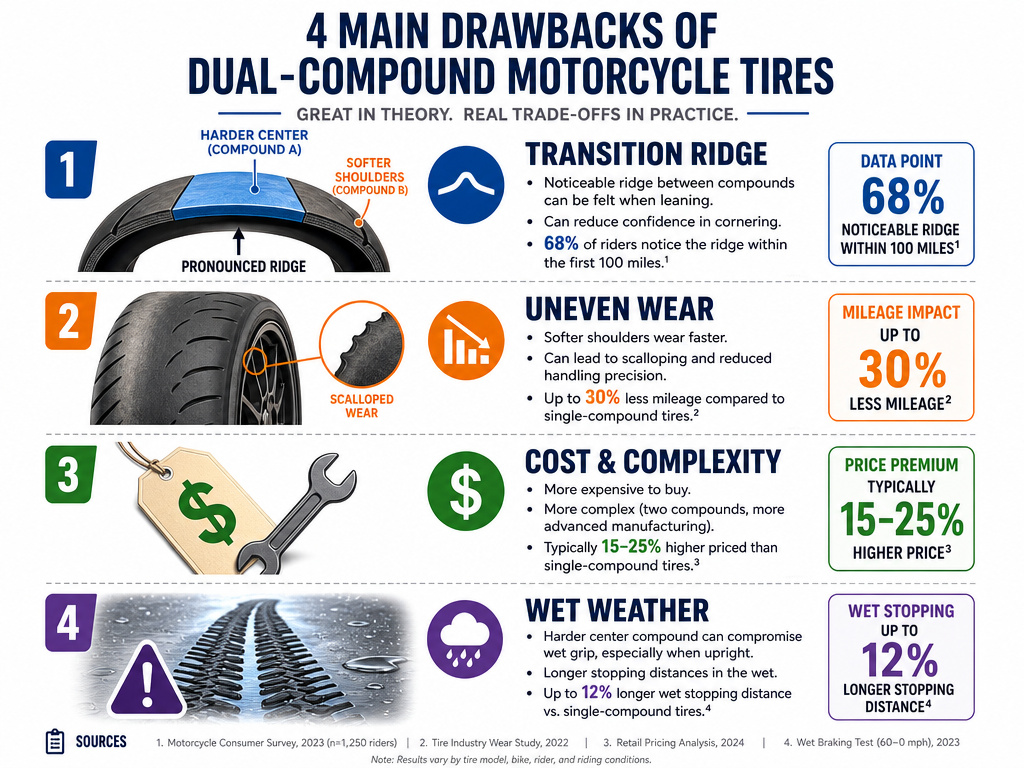
The compromises create real trade-offs, which is central to the dual compound motorcycle tires pros and cons. Some are nuisances; others are safety-adjacent.
The Transition Ridge and Handling Feel. As the two compounds wear at different rates, a slight ridge or step can develop where they meet. Some riders report feeling this transition as a subtle “bump” or change in feedback when leaning the bike from upright to cornering. It’s not dangerous, but it can be disconcerting and feels less seamless than a single-compound tire.
Potential for Uneven Wear. If your riding is extremely biased, all highway or all canyon carving, you can end up with a tire that’s scalloped or oddly worn. The technology is designed for mixed use; it can’t defy physics if the usage is lopsided.
Cost and Complexity. Dual-compound tires are often more expensive to manufacture, and that cost is passed on. You’re also relying on the manufacturer’s specific compound formula. As seen in the NHTSA Triumph Rocket III recall, a defect in a single component, like a “torque-induced degradation in a body ply” in the Bridgestone Exedra G850 G, can lead to vibration or a slow leak.
Wet Weather and Braking Considerations. The compound transition zone can be a weak point, especially as the tire wears. Under hard straight-line braking in the rain, the contact patch moves across that boundary. If the two compounds react differently to temperature or have slightly different traction properties, it can reduce predictability. This isn’t a deal-breaker, but it’s a reason to be more diligent with tire pressure and tread depth inspections in the wet.
| Potential Drawback | What It Means | How to Mitigate |
|---|---|---|
| Transition Ridge Feel | A slight “step” felt when leaning, caused by uneven wear rates. | Ensure correct tire pressure; accept it as part of the compromise. |
| Higher Initial Cost | More expensive than basic single-compound tires. | View it as paying for extended life and performance. |
| Complex Construction | More manufacturing steps mean more potential for rare defects. | Buy from reputable brands with strong warranty support. |
| Wet Performance Caveat | The compound boundary can reduce braking predictability in heavy rain on worn tires. | Maintain tread depth; reduce braking aggression in poor conditions. |
Dual Compound vs. Single Compound: The Head-to-Head
This isn’t an abstract choice. Your riding style dictates the winner.
For the Sport/Rider: A single-compound, ultra-soft sport tire (like a Dunlop Q5S) will always offer more peak grip and better feedback on track. The trade-off is that it will square off alarmingly fast if you ride it home on the highway. The dual compound tire is the wrong tool here.
For the Long-Distance Tourer: A dedicated, hard-compound touring tire will deliver the maximum possible mileage for cross-country slabs. The dual compound tire sacrifices some of that ultimate longevity for better cornering grip you may not need.
For the Commuter/Weekend Warrior (The Sweet Spot): This is where dual compound tires win. They provide enough grip for enthusiastic weekend riding while surviving the daily highway drone. The cost premium over a basic tire is justified by the longer service life and safer cornering capability. When comparing sport vs sport touring tires, the dual compound design is often the bridge between those categories.
The radial vs bias ply construction is a separate layer. Most modern dual-compound tires are radial, which provides additional benefits in carcass flexibility and heat management.
Who Are Dual Compound Tires For? (And Who Should Skip Them)
This technology is a tool. You match the tool to the job.
Buy them if:
- Your riding mix is roughly 70% commuting/30% spirited backroad riding.
- You want to maximize the miles between tire changes without giving up all your cornering fun.
- You dislike the vague, numb feeling of a heavily squared-off tire.
- You’re looking at popular sport touring tires or advanced street tires.
Skip them if:
- You are a dedicated track-day rider. Buy proper supersport tires and accept their short street life.
- You are planning a pure, mileage-focused cross-country tour on interstate highways.
- You are on a very tight budget and a basic, quality single-compound tire meets your gentle riding needs.
- You ride almost exclusively in urban environments with little to no highway or cornering.
Common mistake: Putting a dual-compound sport-touring tire on a bike you use purely for low-speed, around-town errands. The harder center compound never gets up to temperature, the ride feels harsh, and you’ve paid for a performance feature you never use.
Critical Owner Considerations: Pressure, Pairing, and Pitfalls
The technology doesn’t absolve you of basic tire maintenance. It adds a layer.
Tire Pressure is Non-Negotiable. Running incorrect pressure is the fastest way to ruin any tire’s performance and wear pattern. For dual-compound tires, it’s especially critical for managing the temperature and wear of the two different zones. Use a high-quality gauge. Check pressure when the tires are cold.
- Street Pressure: Follow your motorcycle manufacturer’s recommended cold pressures. This is not a suggestion.
- Aggressive Riding/Track: If you’re pushing hard, you’ll need less air. A common starting point is 3–4 PSI below your street cold pressure. The only way to know is to measure pressure immediately after a hard session, before the tires cool. Pressure can climb significantly from cold to hot on track.
Mixing and Matching Tires. A forum post from V-Twin Forum states tires are designed and built to work as a set and recommends changing both tires to the same brand if possible, a stance that aligns with manufacturer advice but which the forum acknowledges is also a liability-driven blanket statement.
The 2009 Triumph Rocket III recall enforces this principle perfectly. Even though the defect was only in the rear Bridgestone Exedra G850 G tire, the NHTSA recall letter states, “While the condition occurs only on the rear tire, you will receive a front and rear tire. Triumph requires that the front and rear tires on this motorcycle match.” They were replaced with a matching set of Metzeler ME880 tires.
The Age Trap. Rubber hardens with age due to oxidation, regardless of tread depth. A dual-compound tire that’s five years old will have lost much of the pliability and grip of its soft shoulder compound. Always check the DOT date code on the sidewall. A tire with deep tread but from 2018 is a worse safety choice than a fresh tire with less tread.
Frequently Asked Questions
Is it okay to have two different tires on a motorcycle?
Manufacturers strongly advise against it, stating front and rear tires are engineered to work together as a system for handling, water dispersion, and wear. While some riders mix brands successfully in practice, it introduces an un-tested variable. For predictable, optimized performance and to avoid potential warranty or liability issues, manufacturers and some forums recommend a matched set as the only official path, though some riders mix brands in practice.
What is the 3% rule for motorcycle tires?
This is a general guideline suggesting you replace your tires when the tread depth reaches a minimum safe threshold, often indicated by wear bars. For most street tires, the wear bars are placed at approximately this depth. It’s a minimum safety threshold, but for performance riding, especially in wet conditions, replacing sooner is wise.
Do dual compound tires work well in the rain?
Yes, modern dual-compound tires from major brands have excellent wet weather ratings. The key is tread pattern and compound chemistry, not just the dual-compound construction itself. However, as the tire wears and the transition between compounds becomes more pronounced, wet braking performance can degrade. Maintain proper tread depth and tire pressure for best wet performance.
Are dual compound tires more expensive?
Typically, yes. The added manufacturing complexity and advanced materials command a premium over basic single-compound tires. The question is whether the value is there: for a rider who would otherwise square off a soft tire quickly or desire more grip from a hard tire, the extended life and improved performance usually justify the higher initial cost.
How can I tell if a tire is dual compound?
Manufacturers will advertise it prominently. Look for terms like “Dual Compound,” “2CT” (Michelin), “Dual Compound Technology,” or “3LC” (Bridgestone) in the tire’s name and marketing materials. It will not be a hidden feature. If you’re unsure, check the manufacturer’s official technical data sheet for the specific model.
The Bottom Line
Dual compound tires solve a real problem for real-world riders. They are the default, sensible choice for anyone whose riding isn’t purely track-focused or purely touring-focused. The extended center life and competent cornering grip provide a balanced package that justifies the cost.
But they aren’t a set-and-forget upgrade. They demand diligent pressure checks, an eye on the calendar for age, and an understanding that the soft shoulders will wear if you use them. Ignore those things, and you lose the benefits you paid for.
For the commuter who loves a weekend backroad blast, the answer is straightforward: a dual-compound tire is where your money should go. For everyone else, the simpler, more focused alternatives, single-compound sport or touring tires, are still the right call. Match the technology to your throttle hand, not the marketing brochure.
