
Adventure Motorcycle Tire on Road Off Road Ratios Explained
This post contains affiliate links. As an Amazon Associate, we earn from qualifying purchases.
Adventure motorcycle tire ratios like 50/50 or 80/20 represent the manufacturer’s intended balance of on-road versus off-road performance. The first number is the pavement percentage, the second is for dirt. A 90/10 tire is a street tire that can handle hard-packed dirt, while a 10/90 is a DOT-legal knobby for connecting trails.
These numbers are a starting point, not a guarantee. Your actual grip and wear depend on three harder variables: tire pressure, rubber compound, and tread block spacing. A 50/50 tire ridden at street pressure on sand will fail just as a 10/90 tire leaned hard on a wet curve will slide. The concept of an adventure motorcycle tire on road off road ratios explained is key to interpreting these numbers.
What follows is a breakdown of how ratios translate to real-world grip, the critical pressure adjustments that make or break them, and the one spec on the sidewall that matters more than any marketing percentage.
Key Takeaways
- Treat ratios as a rough guideline, not a performance contract. Michelin describes the Anakee Adventure as 70/30 and also within an 80/20–70/30 range, while retailers like TwoTyres UK call it an 80/20 tire—the real test is how its tread clears mud.
- Tire construction dictates your pressure floor. Michelin states tubeless adventure tires can run as low as 15 PSI off-road; tube-type tires must stay higher to avoid pinch flats.
- Mileage varies wildly within the same ratio. One rider’s 50/50 tire lasts 3,000 miles; another’s lasts 8,000. The difference is usually pavement speed and tire pressure discipline.
- Always match front and rear tires from the same brand and model line. Mixing ratios or brands unpredictably changes handling, especially under braking.
- Check your tire’s DOT date code. The last four digits are the week and year of manufacture. Old rubber hardens and loses grip long before the tread wears out.
What Do 50/50, 80/20, and Other Ratios Actually Mean?
The numbers are a manufacturer’s intent, not a physics equation. An 80/20 tire is engineered to deliver 80% of its optimized performance on pavement and 20% on dirt. The trade-off lives in the tread.
An 80/20 tyre focuses primarily on road use (80%) with light off-road capability (20%), whilst a 50/50 tyre splits performance equally between both surfaces. — Michelin
The tread pattern tells the real story. Road grip needs a continuous, stable contact patch. Dirt and mud traction need spaced-out knobs that can bite and self-clean. A 90/10 tire has shallow sipes and tightly packed blocks. A 50/50 tire has pronounced, separated knobs. A 10/90 tire looks like a motocross knobbie with a DOT stamp.
Fit beats price tag. I see riders choose a rugged-looking 50/50 tire for a bike that never leaves pavement because they like the aesthetic. The bike will handle vaguely, wear the knobs unevenly into flat spots, and vibrate on the highway. The right tire for the actual job is usually one ratio category tamer than you think.
| Ratio Range | Pavement Focus | Off-Road Capability | Common Tread Character | Example Tire |
|---|---|---|---|---|
| 90/10 – 100/0 | Maximum stability, wet grip, mileage | Hard-packed gravel, smooth dirt paths | Tight siping, near-continuous center rib | Michelin Road 6 |
| 70/30 – 80/20 | Confident touring, good wet weather | Gravel roads, forest trails, easy off-road | Aggressive pattern but with connected blocks | Michelin Anakee Adventure |
| 50/50 – 60/40 | Acceptable highway manners | Rough trails, sand, rocky paths | Clearly defined, spaced knobs | Heidenau K60 Scout |
| 40/60 – 10/90 | Connection between trails | Mud, deep sand, technical single-track | Large, widely spaced knobs, moto-like | Continental TKC80 |
How Tread Design and Compound Dictate Real-World Grip
The ratio points to the design, but your boot slides on the rubber. Two tires labeled 50/50 can feel completely different because of their compound and knob flexibility.
A softer compound grips better on both road and dirt, especially when cold. It also wears faster. Most DOT-legal adventure tires use a harder, longer-lasting compound than a pure race tire, which is why they can feel wooden on a chilly morning. The knob design matters more off-road. Knobs need to flex to conform to rocks and roots. If they’re too stiff, the tire skates. If they’re too flexible, they squirm dangerously on pavement corners.
The rear tire carries more load and deals with drive forces, so its design often differs from the front. Many balanced dual-sport tires like the Continental TKC70 or Heidenau K60 Scout use a continuous center block on the rear for highway stability, with stepped shoulders for cornering grip. The front tire uses a more open pattern for steering precision in loose stuff.
Where this goes sideways: Choosing a tire based on the rear tread pattern alone. The front tire dictates steering feel and wash-out resistance off-road. A mismatched front can make the bike tuck unexpectedly on loose gravel, even with a perfect rear.
Wet pavement is the great equalizer. Those big, open knobs that excel in mud channel water poorly. The bike can feel like it’s floating on a damp road. This is why the Motorcycle Industry Council warns that tread pattern dramatically affects wet-weather handling. A 90/10 tire will instill more confidence in a rainstorm than a 50/50 tire, full stop.
The Critical PSI Swap: Pressure for Pavement vs. Dirt
Your tire’s performance is about 50% tread design and 50% pressure, a critical factor after the adventure motorcycle tire on road off road ratios explained. Running the wrong pressure for the terrain neuters even the best tire.
On pavement, higher pressure creates a firm, predictable contact patch; one retailer suggests 36 PSI front and 42 PSI rear for large adventure bikes. It reduces rolling resistance and squirm. Lower tire pressure on dirt allows the tire to mold to the terrain, which expands the contact patch and improves traction. It also acts as crude suspension, absorbing small bumps.
The allowed pressure drop depends entirely on your tire’s construction.
| Tire Type | Typical Road Pressure | Safe Off-Road Low | Key Risk |
|---|---|---|---|
| Tubeless Adventure | 36-42 PSI | As low as 15 PSI (1 bar) | Running road sections at low pressure causes instability |
| Tube-Type (for spoked wheels) | 36-42 PSI | Stay above minimum to avoid pinch flats | Pinch flat from rim striking rock |
| Bib Mousse (NHS) | N/A (solid foam) | Equivalent to 13 PSI | Not for highway use; degrades after 6 months |
Tubeless adventure tires can typically run quite low (as low as 1 bar / 15 PSI in some conditions) without risk of the tire coming off the rim. Tube-type tires need to be kept above a minimum pressure to avoid pinch flats. — Michelin Canada
This rule is essential: if you lower pressure for off-road riding, you must re-inflate the tires before returning to pavement. Running road sections at off-road pressure creates dangerous understeer and handling instability on pavement. Carry a portable inflator. The five minutes it takes to air up are cheaper than a tow.
There’s a debate about modern “advanced” knobbies like the Metzeler Karoo 3 or Pirelli Scorpion Rally. Michelin advises lowering pressure for off-road use, while some retailers claim for these tires ‘you really don’t need you to drop the pressures while riding off-road.’ The improvement in control is immediate and tangible.
Decoding Sidewall Marks: NHS, DOT, TT, and Date Codes
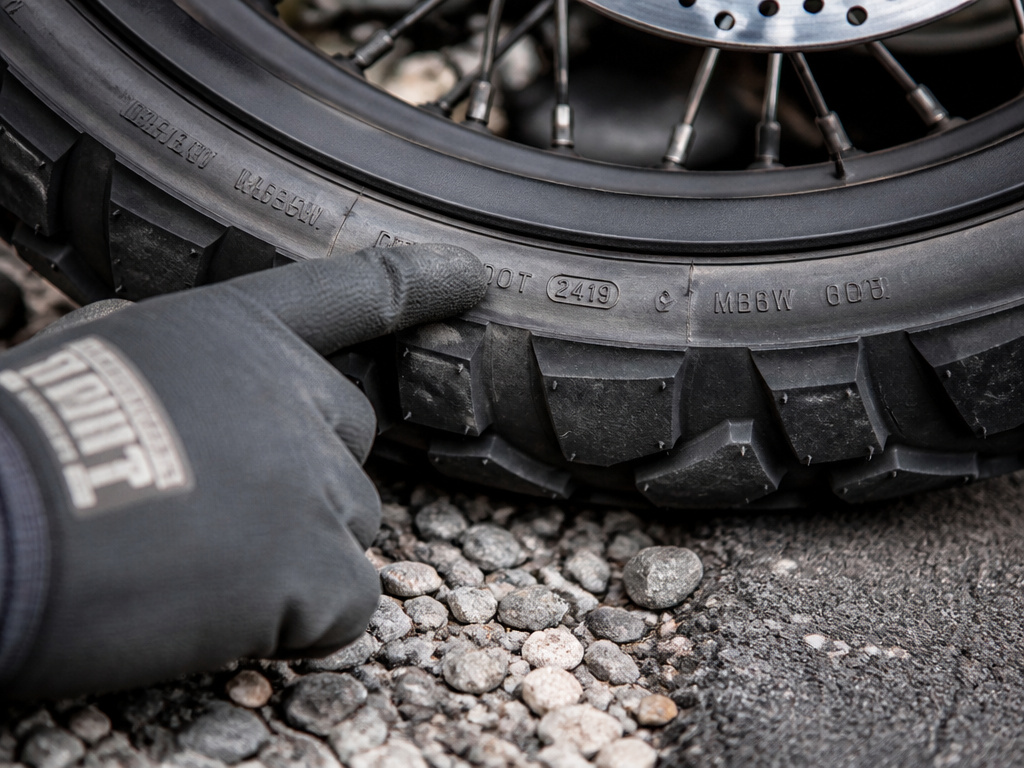
The ratio might be on the marketing sheet, but the law is on the sidewall, extending the discussion beyond the adventure motorcycle tire on road off road ratios explained. These marks tell you what the tire is legally allowed to do.
- DOT: The tire is certified for street use in the U.S. And Canada. All adventure tires and dual sport tires must have this to be road-legal. Pure off-road knobbies lack it.
- NHS (Not for Highway Service): This tire is for competition or closed-course use only. The Michelin Bib Mousse foam insert carries this mark. Riding an NHS tire on public roads is illegal and voids insurance.
- TT (Tubetype): This tire requires an inner tube. It’s common for spoked wheels. Never run a TT tire tubeless.
- Directional Arrow: The tire must rotate in this direction. Mounting it backward ruins water evacuation and handling.
The most critical mark is the date code. The Motorcycle Tire Co. Explains that the last four digits of the DOT code are the week and year the tire was made. “2419” means the 24th week of 2019.
Common mistake: Buying a new-old-stock tire with deep tread. Rubber hardens with age due to oxidation. A tire from 2019 will have less grip in 2025 than a fresh one, regardless of tread depth. Rubber hardens with age due to oxidation, reducing grip regardless of tread depth.
I once fitted a “great deal” on a set of 50/50 tires that were already three years old when I bought them. The bike never felt planted in the wet, and the rear stepped out on a damp manhole cover at a tame lean angle. I replaced them with fresh rubber a season later and the difference was night and day. Trust the date, not just the tread.
Choosing Your Ratio: A Realistic Assessment of Your Riding

Forget aspirational riding. Be honest about your last 1,000 miles. Was it 950 miles of highway and 50 of dirt road? You are a 95/5 rider. Buy accordingly.
- The 90/10 to 80/20 Rider (The Pavement Tourist): You tour on pavement and encounter the occasional graded gravel road or construction zone. Your priority is mileage, wet-weather confidence, and stable handling. You want an adventure touring tire like the Michelin Anakee Adventure or Continental Trail Attack 3. The knobby looks are for show, but the performance is all road.
- The 60/40 to 50/50 Rider (The Weekend Explorer): Your rides deliberately include forest service roads, riverbeds, and technical trails. You need genuine off-road traction but still have to ride highways to get there. You need a true 50/50 motorcycle tire like the Heidenau K60 Scout. You accept shorter lifespan and more road noise.
- The 40/60 to 10/90 Rider (The Dirt Connector): You view pavement as a necessary evil to connect epic trails. You ride technical single-track, sand, and mud. You need a knobby tire like the Continental TKC80. You will change tires often and ride cautiously on wet roads.
Easy to miss: The bike itself dictates the ratio. A 600-pound adventure bike will never handle like a dirt bike, regardless of tire. A super aggressive 10/90 knobby on a heavy bike can be more dangerous than a 50/50 tire, as the chassis can’t react quickly enough to the tire’s feedback.
Tubeless vs. Tubed: How Your Wheel Choice Changes the Game
Your wheel type often decides your tire system, which changes your repair strategy and pressure flexibility.
Michelin notes that tubeless tyres are standard on most modern adventure motorcycles. They allow you to run lower pressures safely and can often be repaired on the trail with a plug kit. A puncture usually leaks slowly. The downside: they require an airtight rim, which most traditional spoked wheels are not.
Michelin states that tubed tyres are essential for spoked wheels. They are more resistant to pinch damage from sharp impacts because the tube can deform. Repairs in the field are more involved but possible with basic tools. The critical rule: you must keep sufficient pressure in a tube-type tire to avoid a pinch flat, where the rim pinches the tube against a rock.
For riders who venture remote, the reliability of a tubed system with a heavy-duty tube and a spare is hard to beat. For everyone else, the convenience and safety of tubeless wins.
How to read motorcycle tire markings
Your owner’s manual is the first stop for the correct tire size, construction, and speed rating. The sidewall itself holds the key details. Pirelli notes that tires marked ‘TT’ are tubetype and must have a tube installed. Pirelli states that motorcycle tires marked ‘NHS’ are only for racing or off road purposes and cannot be used on public roads. The Motorcycle Industry Council advises that tires must be mounted so the sidewall arrows correspond to the direction of travel. For age, find the DOT code; the last four digits show the week and year of manufacture.
Basic tire repair and maintenance for adventure riding
Check your tire pressure when the tires are cold, at least once a month and before any long trip. If you lower pressure for off-road sections, reinflate to road pressure before hitting pavement, as running low pressure on road causes dangerous handling. The Motorcycle Industry Council notes that some manufacturers advise against repairing holes more than ¼” in diameter, repairing radial tires or sidewall punctures, or using liquid sealants. The Motorcycle Industry Council states that speeds should not exceed 50 mph for the first 24 hours after a repair and a repaired tire should never be used over 80 mph. Michelin recommends replacing the valve cap after checking pressure and changing the valve assembly and cap each time you remove/replace the tire.
Frequently Asked Questions
Can I mix ratios, like a 50/50 front with an 80/20 rear?
You can, but you must understand the handling change. A more aggressive front tire will want to turn in quicker off-road, while a tamer rear may break traction sooner under power. This mismatch can create unpredictable handling. The Motorcycle Industry Council (MIC) recommends that front and rear tires should match each other by being from the same brand and model line. If you experiment, do it cautiously on familiar, easy terrain first.
How long do 50/50 tires really last?
The range is enormous. Anecdotal reports show a wide range, such as around 3,000 miles from some 50/50 tires ridden aggressively on pavement to over 8,000 miles from others used mostly for touring. Your right wrist and tire pressure discipline are the biggest factors. Riding a knobby tire hard on hot asphalt melts rubber.
Do I need to balance adventure tires?
Yes. The Motorcycle Tire Co. Notes that an out-of-balance wheel vibrates more as speed rises and wears the tread unevenly. Any quality shop will balance them during installation. If you’re changing tires yourself, a static balance is the bare minimum.
Are tire pressure monitoring systems (TPMS) worth it for adventure riding?
For riders who frequently adjust pressure, they are invaluable. A TPMS that shows live temperature and pressure readings removes uncertainty about when to add air. It’s a luxury that becomes a useful tool when you’re miles from pavement and need to monitor a slow leak.
What’s the deal with Michelin Bib Mousse?
Bib Mousse is a foam insert that replaces the air in a tire. It gives a consistent, low pressure (equivalent to 13 PSI) and is puncture-proof. It’s marked NHS (Not for Highway Service) and is not for road use. It also has a limited lifespan—Michelin says it can be used for a maximum of 6 months after fitting and degrades in heat. It’s a pure competition tool for enduro and rally.
The Bottom Line
The ratio is a useful filter, but your tire pressure gauge is a more important tool. A 50/50 tire at street pressure is a 90/10 tire in the dirt. A 90/10 tire at dirt pressure is a crash waiting to happen on pavement.
Before you buy, do the math on your actual riding. Then, look at the tire’s DOT date code and sidewall construction (Tubeless vs. TT). Finally, commit to checking pressure weekly with a gauge. That discipline will keep you upright more faithfully than any marketing percentage ever could.
