
How to Read Motorcycle Tire Sidewall Codes: Step-by-Step
This post contains affiliate links. As an Amazon Associate, we earn from qualifying purchases.
Your motorcycle tire’s sidewall is its spec sheet, its birth certificate, and its expiration notice, all molded into the rubber. To read it, start with the tire size (like 180/55ZR17), find the DOT date code (a four-digit week/year), and match the load index and speed rating (like 73W) to your bike’s requirements. Never exceed the maximum pressure on the sidewall, and replace tires when treadwear indicators are visible or the DOT code shows an age over six years for warranty or ten years for safety.
That alphabet soup tells you everything about what the tire is built for and when its time is up. Ignore it, and you’re guessing about the single most important safety component on your bike. Understanding how to read motorcycle tire sidewall codes is therefore essential.
What follows is a walk through every stamp on that black circle. We’ll crack the size, date, and load codes, point out where the official manuals disagree, and show you how to use this info when you’re eyeing a used bike or a set of take-offs, which is a key part of how to read motorcycle tire sidewall codes.
Key Takeaways
- The DOT date code is a four-digit week/year stamp (e.g., 2523 for the 25th week of 2023); tires over six years old are past Michelin’s “legal life” for warranty, and over ten years should be replaced regardless of tread.
- Tire size codes like 180/55ZR17 break down to width (180mm), aspect ratio (55%), construction (ZR for radial), and rim diameter (17 inches); mismatching front/rear sizes or types destabilizes your bike.
- The load index and speed rating (e.g., 73W) are mandatory; a “W” alone means a 168 mph maximum, while a “(W)” in parentheses denotes a different, higher test standard.
- Inflation pressure on the sidewall is a maximum, not a recommendation; for the correct PSI, check your bike’s owner’s manual or the sticker on the swingarm or frame.
- Treadwear indicators are horizontal bars flush with the tread at 1/32 of an inch; when they’re visible across the groove, Michelin defines the tire’s ‘usable tread’ as ended and Harley-Davidson states it must be replaced immediately.
Anatomy of a Sidewall: What You’re Looking At
Look at the side of your tire. You’ll see brand names, model logos, and a block of raised letters and numbers that looks like a government form. That’s the data you need. The main clusters are the tire size and type, the DOT Tire Identification Number with the date code, and the service description (load and speed rating). Everything else, like the “M/C” for motorcycle use or “TL” for tubeless, confirms it’s the right product for the job.
The DOT Tire Identification Number (TIN) is a series of letters and numbers beginning with “DOT” that certifies the tire meets U.S. Department of Transportation safety standards. The last four digits are the date code; the previous characters identify the manufacturer and plant.
Decoding the Tire Size and Construction
This is the big one, usually the most prominent code. A metric size like 180/55ZR17 M/C 73W tells a complete story, which is central to how to read motorcycle tire sidewall codes. We will examine it step by step.
Width, Profile, and Rim Diameter
The first number is the section width in millimeters. It’s the distance from the widest point of one sidewall to the other, measured on a specified rim. A 180 is a 180mm wide tire.
The second number is the aspect ratio. This is the sidewall height expressed as a percentage of the section width. A 55 means the sidewall height is 55% of 180mm. A lower number (like a 55-series) gives a shorter, stiffer sidewall for quicker steering response. A higher number (like a 70-series) gives a taller, more flexible sidewall, often for a plusher ride.
The letter(s) after the aspect ratio indicate construction and speed capability. An “R” means radial construction. A “ZR” means it’s a radial tire with a speed rating above a certain threshold (often indicated by a subsequent letter like W or Y). You might also see a “B” for bias-belted construction. The final number is the rim diameter in inches. A 17 needs a 17-inch wheel.
Where this goes sideways: Mounting a bias-ply tire on one end of your bike and a radial on the other. The Motorcycle Industry Council (MIC) states front and rear tires should match in brand, model line, and construction. Mixing them changes how each tire deflects under cornering loads, which can make the bike feel unpredictable.
The “M/C” stamp is critical. It means the tire is certified for motorcycle use. Never mount a passenger car tire on a motorcycle rim. The MIC guide is blunt: the flat profile and bead design are “incompatible with the dynamics of a vehicle that leans as it corners.”
Construction Types: Radial vs. Bias-Ply
Your choice between bias-ply and radial tires affects handling, wear, and cost. This isn’t just marketing.
| Construction Type | How It’s Built | Best For | Trade-Off |
|---|---|---|---|
| Bias-Ply (B) | Cords run diagonally across the tire, crisscrossing at angles. | Classic cruisers, some off-road bikes, often lower cost. | Heavier, runs hotter, stiffer ride, slower steering. |
| Radial (R) | Cords run straight from bead to bead, perpendicular to the tread, with a stabilizing belt under it. | Sport bikes, sport-touring, modern standards. | Lighter, runs cooler, better grip, quicker steering. Can be more expensive. |
Radials flex more independently, the sidewall bends while the tread face stays stable. That’s why they generally offer better grip and less heat buildup. If your bike came with radials, stick with them. Switching to bias-ply to save a few dollars changes the bike’s character in a way you might not like.
The DOT Date Code: Your Tire’s Birthday and Expiration
This is the most important code for safety. The date tells you how old the rubber is, and rubber hardens with age.
The date code is the last three or four digits of the DOT Tire Identification Number. For tires made after 2000, it’s a standard four-digit code: the first two digits are the week of manufacture (01-52), and the last two are the year.
- DOT XXXX 2523 = Manufactured in the 25th week (mid-June) of 2023.
For tires made between 1990 and 1999, Michelin uses a three-digit code marked with a triangle (◀) pointing to it. The first two digits are the week, the last is the year of the decade. “025” with a triangle is the second week of 1995.
Common mistake: Assuming a tire with deep tread is safe. A tire with a date code of 3515 (September 2015) is nine years old. Even with 80% tread left, the rubber has hardened through heat cycles and chemical aging. It won’t grip like it should, especially when cold.
The MIC states tires with only three numerals and no triangle “were made before 2000 and should be discarded.” If you find a three-digit code without a triangle, you can’t decode it from the sidewall. Michelin advises consulting a tire technician.
How Old Is Too Old?
Here’s where the official sources don’t perfectly agree. You need to know both numbers.
| Source | Replacement Threshold | Context / Reason |
|---|---|---|
| Michelin (Warranty Manual) | 6 years from purchase or when tread wears to wear bars. | This is the “legal life of the tire” for warranty coverage. After this, all warranties expire. |
| Michelin (Dealer Guide) | 10 years from date of manufacture. | “After 10 years of use, tires should be replaced.” This is a general safety guideline. |
| Harley-Davidson (Service Manual) | When wear bars are visible or only 1 mm (1/32 in) of tread remains. | Does not specify an age limit, focuses on wear. |
The practical rule: For safety, consider Michelin’s warranty ‘legal life’ of six years from purchase and their general safety guideline to replace tires after ten years of use. When you check tire tread depth, you’re checking for wear; the date code tells you about aging.
Load Index and Speed Rating: The Weight and Pace Limits
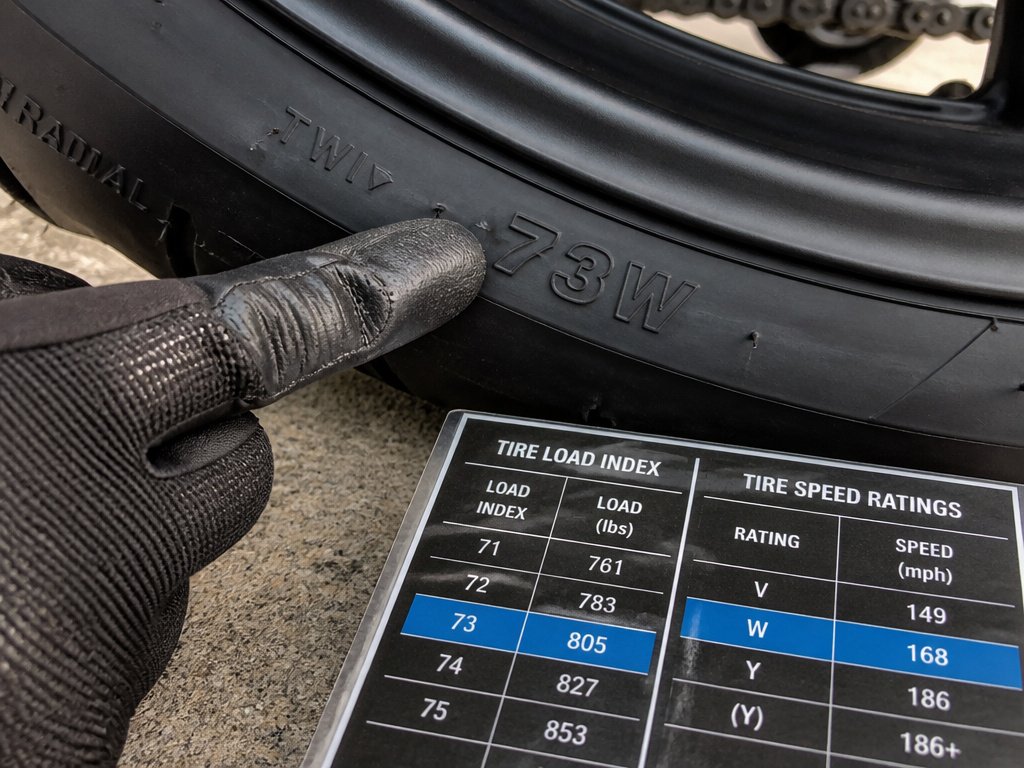
Right after the size, you’ll see a number and a letter, like 73W. This is the service description.
The Load Index is a numerical code that corresponds to a maximum load capacity in kilograms. You need a chart to decode it. A load index is a numerical code that corresponds to a maximum load capacity; you need a chart to decode it. You must use a tire with a load index that meets or exceeds your bike’s requirements, especially when loaded with gear and a passenger.
The Speed Rating is a letter indicating the maximum speed the tire can sustain under its load rating. It’s not a recommended cruising speed.
| Common Speed Symbols | Maximum Sustained Speed | Typical Use |
|---|---|---|
| H | 130 mph (210 km/h) | Many sport-touring tires |
| V | 149 mph (240 km/h) | High-performance sport |
| W | 168 mph (270 km/h) | Ultra-high-performance |
| Y | 186 mph (300 km/h) | Track-focused hypersport |
There’s a nuance. A “W” listed alone (as in 73W) has one rating. A “W” in parentheses, (W), has a different, often higher, speed rating. Some high-speed tires may have a “Z” in the size designation (e.g., ZR) along with a high-speed rating letter.
Never install a tire with a lower speed rating than your motorcycle is capable of. It’s a built-in safety margin you don’t want to erase.
Critical Safety Markings: PSI, Arrows, and Wear Bars
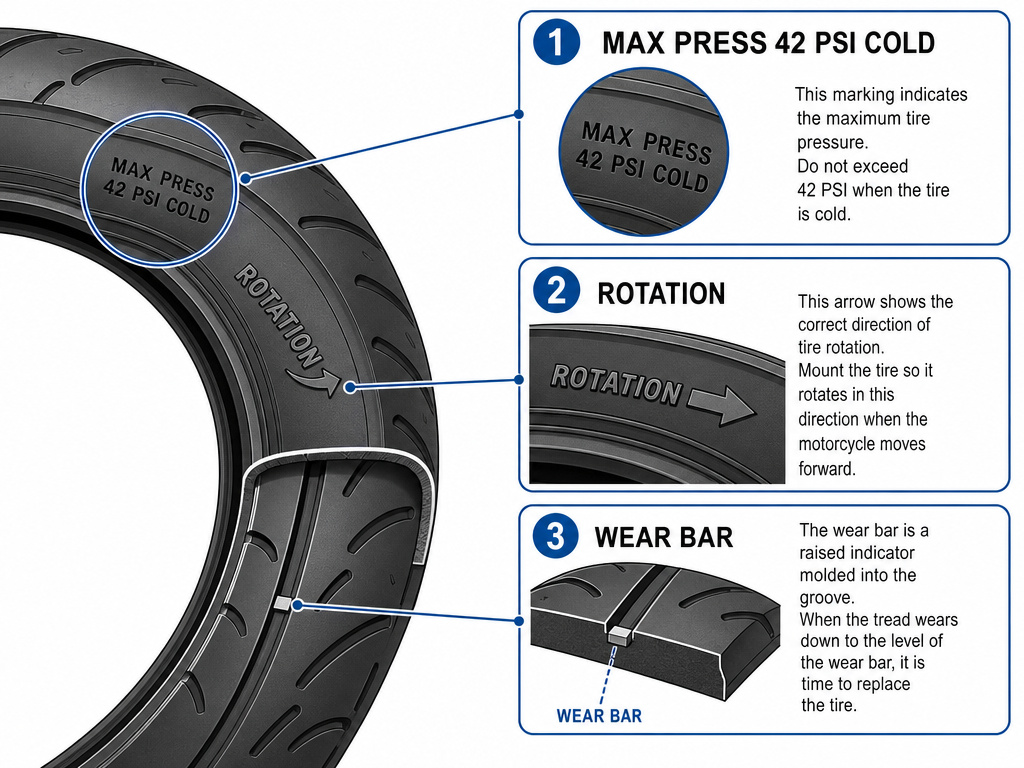
These markings are your final pre-ride checks.
Maximum Pressure: You will see a stamp like “MAX PRESS 42 PSI COLD.” This is the absolute maximum the tire’s structure can handle. It is not the recommended pressure for your bike.
For replacement tires, the correct inflation pressure will be provided by your tire retailer; if not, refer to the vehicle decal. These inflation pressures must be maintained as a minimum. However, do not exceed the maximum pressure rating indicated on the tire sidewall. – Michelin Motorcycle Tire Owner’s Manual
Your correct tire pressure is on a sticker on your bike’s swingarm, frame, or in the owner’s manual (per Michelin). Harley-Davidson’s manual provides a specific method with detailed tables adding pressure for ambient temperature and whether the bike was recently ridden. For a cold tire (not ridden for 2+ hours) at 68°F (20 °C), consult your motorcycle manufacturer’s recommended pressure, such as the values in Harley-Davidson’s Table 1. At 88°F (31 °C), Harley-Davidson’s manual specifies adding pressure according to its Table 2.
Rotation Arrow: A directional tire will have an arrow on the sidewall labeled “ROTATION.” It must point in the direction of forward travel. Mounting it backwards ruins water evacuation and handling.
Treadwear Indicators (Wear Bars): These are small horizontal bars of rubber at the bottom of the tread grooves. When the tread wears down to be flush with these bars, you have 1/32 of an inch of tread left. The tire is legally worn out in most U.S. States. Michelin’s warranty and Harley-Davidson’s service manual both define the end of “usable tread” at this 1/32” point. The MIC’s penny test (Lincoln’s head at 2/32”) is a quick tread depth check.
Tube Type vs. Tubeless: Look for “TL” (Tubeless) or “TT” (Tube Type). You can put a tube in a tubeless tire if needed (like for a spoked wheel), but you should never run a tube-type tire without a tube. The bead and casing aren’t designed to hold air seal-tight.
How to Use This When Buying Used Tires or a Bike
Now you can be a detective. Before you buy a used motorcycle or a set of “like-new” take-off tires, do this three-step check.
- Find the Date Code. Immediately reject any tire with a date code over six years old, or any pre-2000 tire. Age is the one thing you can’t fix.
- Verify Size and Ratings. Match the size, load index, and speed rating to the bike’s OEM specs. A mismatched set is a red flag about the previous owner’s maintenance.
- Physical Inspection. Look for dry-rot cracks in the sidewall, any bulges, deep cuts, or uneven tire wear like cupping. Spin the tire and look for wobble. A perfect-looking tread with sidewall cracks is garbage.
This process makes deciding when to replace tires straightforward. It’s not a mystery, the tire tells you.
What is the Balance Dot on a Motorcycle Tire?
You might see a small colored dot on the sidewall of a new tire. This is a balance dot, a mark used during the manufacturing process to indicate the tire’s lightest point. When a tire is mounted, this dot should be aligned with the wheel’s heaviest point, which is typically where the valve stem is located. Proper alignment during mounting helps minimize the amount of weight needed to balance the tire and wheel assembly. While not all tires have this mark, it’s a useful guide for your technician to achieve a smoother ride with less balancing weight.
Frequently Asked Questions
What does 67H mean on a motorcycle tire?
The “67” is the load index, a code for the tire’s maximum load capacity. The “H” is the speed rating (130 mph max). Together, “67H” is the service description, telling you the tire’s weight and speed capabilities. You must match or exceed these numbers for your motorcycle.
How do you read a 3-digit DOT date code?
Three-digit DOT code usually means the tire was made before 2000. If it has a triangle (◀) pointing to it, it’s a Michelin tire from the 1990s: the first two digits are the week, the last digit is the year (e.g., “025◀” is the 2nd week of 1995). If there’s no triangle, the code is ambiguous and the tire should not be used. The Motorcycle Industry Council recommends discarding pre-2000 tires.
What is the difference between ZR and R?
The “R” stands for Radial construction. “ZR” indicates a radial tire that also has a speed rating above 149 mph (often W, Y, etc.). You’ll see it in high-performance sizes like 180/55ZR17. The “Z” is tied to the speed symbol, not the construction.
Can I put a tubeless tire on a tube-type rim?
Generally, no. A tubeless tire requires a rim bead seat designed to form an airtight seal with the tire’s bead. A tube-type rim lacks this design. You can sometimes use a tubeless tire with a tube on a spoked wheel, but the rim must be designed to accept tubeless tire beads and you must use a correct tube. Consult a professional.
Is the max PSI on the sidewall what I should use?
No. The “MAX PRESS” on the sidewall is the tire’s structural limit, not the recommendation for your bike. Using that pressure will make your ride harsh and reduce the contact patch. Always use the motorcycle manufacturer’s recommended cold pressure, found on the bike’s placard or in the owner’s manual.
The Bottom Line
The sidewall isn’t decoration. It’s a legal document written in rubber. The date code gives you a hard expiration, six years for warranty, ten for absolute safety. The size and load numbers tell you if it even fits your bike’s job. And that max PSI stamp is a warning, not a target.
Before your next ride, take two minutes. Find the DOT code and do the math. Check that the pressure matches your manual, not the sidewall. That’s the difference between trusting your tires and hoping they hold. Hope isn’t a strategy when you’re leaned over.
