
How to Be More Visible on a Motorcycle: Step-by-Step
This post contains affiliate links. As an Amazon Associate, we earn from qualifying purchases.
To be more visible on a motorcycle, you must manage three layers: active lighting (headlights on at all times), passive conspicuity (bright/reflective gear that contrasts with your environment), and strategic positioning (avoiding blind spots and controlling your lane). A systematic review in the NIH database found that conspicuity-related crashes account for about 26% of motorcycle fatalities, making this a data-driven safety priority, not just a suggestion.
That 26% figure is the stake in the ground. It means over a quarter of fatal crashes happen because someone didn’t see the rider. The official handbooks from New Zealand, Ontario, Georgia, and Mississippi all agree on the core tactics, but they also reveal where the standard advice has limits—like bright clothing that blends into a desert background, or a single headlight getting lost in a wet-night traffic jam. This is why learning how to be more visible on a motorcycle is critical.
What follows is the layer-by-layer breakdown: the essential rules from transport agencies, the science on what actually works, and the specific riding moves that put you in the driver’s sightline before they even think about turning.
Key Takeaways
- Ride with your headlight on dip (low beam) at all times; a Georgia DDS study notes this makes you twice as likely to be noticed during the day.
- Choose high-visibility gear that contrasts with your environment; a white helmet and jacket improve a truck driver’s judgment of your arrival time, per an NIH review, but a yellow vest can disappear against fall foliage.
- Never linger in another vehicle’s blind spot; actively shift your lane position to be seen in side mirrors, especially when approaching intersections where most car-motorcycle collisions occur.
- Use your signals early and often, and consider a pre-brake light flash before slowing; your motorcycle’s horn is not as loud as a car’s, so never rely on it alone.
- More than half of all crashes involve riders with less than five months of experience on their motorcycle, according to the Mississippi Motorcycle Operator Manual—new riders must double down on these visibility fundamentals.
The Headlight: Your First and Most Important Tool
Your headlight isn’t just for night. It’s your primary active signal. The Georgia Department of Driver Services states that keeping your headlight on at all times is the best way to help others see you, and studies they cite show it makes you twice as likely to be noticed during daylight.
The rule isn’t universal, but the direction is. The New Zealand Transport Agency mandates headlight use on dip or daytime running lamps for bikes made on or after 1 January 1980. In the U.S., Georgia notes that new motorcycles sold since 1978 automatically have the headlights on when running. The takeaway is simple: if your bike has a switch, turn it on. Every ride.
A motorcycle with its headlight on is detected faster by other drivers, especially against cluttered urban backgrounds. Research in the TRL PPR638 report found that headlight use reduced reaction times for detecting a motorcycle in video clips, and
But there’s a documented edge case that changes the calculus. The Ontario Ministry of Transportation handbook warns about riding at night in a group of vehicles on wet roads. In that specific scenario, the reflection of many headlights off the wet pavement can make it hard for a driver ahead to pick out your single light from the glare behind you. The headlight is essential, but it’s not an invisibility cloak. In those conditions, your lane position and speed become even more critical.
Where this goes sideways: Assuming “headlight on” is enough in all conditions. The Ontario Ministry of Transportation handbook warns about riding at night in a group of vehicles on wet roads, where the reflection of many headlights can make it hard for a driver ahead to pick out your single light. Your solution is to increase following distance and use the left portion of your lane to separate your light from the pack.
The Gear That Actually Gets Noticed
Your body is half of the visible surface area of the rider-motorcycle unit. That’s not an opinion; it’s from the Georgia DDS manual. What you wear isn’t about fashion—it’s about square inches of detectable surface.
The standard advice on how to be more visible on a motorcycle from agencies like NZTA and Ontario MTO is to wear bright colors: white, orange, yellow, and red, which they list as the most easily seen. However, research from the NIH systematic review and the TRL report adds a crucial, often-missed clause, emphasizing that the effectiveness of colored clothing is highly context-dependent and requires contrast with the background. A bright yellow vest is fantastic against a grey highway or a dark forest. It’s nearly useless against a field of dry grass or a sunset sky.
This is why a high-visibility helmet is underrated. Your helmet is the highest point on your bike, and it’s often the first thing a driver’s eye tracks. The NIH review specifically noted that motorcyclists wearing a white helmet and white outfit improved truck drivers’ judgment of the motorcycle’s time-to-arrival. It’s a simple, high-contrast block of color that moves predictably.
Reflective materials are crucial for night-time visibility. They don’t create light; they bounce it back, turning a car’s headlights into a spotlight on you. The Ontario MTO recommends considering a reflective vest at night and adding reflective tape to your helmet and clothing. This isn’t just for jackets. A strip of reflective tape on the sides of your helmet or on your saddlebags creates a recognizable shape from angles your tail light can’t cover.
| Gear Choice | Best For | The Caveat (What the Data Says) |
|---|---|---|
| Solid Bright Color (Yellow/Orange Jacket) | Daytime, overcast conditions, urban clutter | Loses effectiveness if it blends with the environment (e.g., autumn leaves). |
| White or Bright Helmet | All conditions, especially for improving other drivers’ depth perception | Most effective as part of a head-to-toe contrasting outfit. |
| Reflective Vest/Tape | Night, dawn, dusk, and low-light conditions | Does nothing without an external light source shining on it. |
| Black or Dark Gear | (Not recommended for visibility) | Reduces your visible surface area, making you harder to see and judge. |
The bottom line on gear is contrast. Don’t just buy a hi-vis jacket. Think about the roads you ride most. Then build an outfit that pops against that backdrop. Sometimes that means a white helmet over a dark jacket, or reflective panels on the sides of a neutral-colored touring suit.
Positioning: Don’t Just Be Seen, Be Predictable
You can have the brightest gear and the strongest lights, but if you’re riding in a driver’s blind spot, you’re a ghost. The NZTA road code is blunt: don’t ride in another driver’s blind spots. This is active riding, not passive hoping.
Most collisions between motorcycles and other vehicles happen at intersections. The two leading causes are drivers having a hard time seeing a motorcycle coming toward them, and a vehicle turning left across the rider’s path. Your lane position within your lane is your primary tool for the how to be more visible on a motorcycle challenge.
When approaching an intersection, as a general rule, keep to the right of your lane where you can more easily be seen by drivers coming from your left. This moves you closer to the line of sight of a driver waiting to turn left from the opposite direction. You’re no longer hidden behind the car in front of you. You become a separate, distinct object.
Common mistake: Riding in the center of the lane at all times. While it keeps you away from oil slicks, it also hides you behind the car ahead. In an intersection, shift to the side of the lane that puts you in the sightline of the most threatening traffic.
In a blind curve, where you can’t see all the way around, the Ontario MTO advises moving to the side of the lane where you can see as much as possible of the road ahead. This does two things: it improves your view, and it makes you more visible to oncoming traffic that might be drifting over the center line.
This is where visibility combines with defensive riding techniques. Strategic lane positioning isn’t just about being seen; it’s about creating space and time to react. If an oncoming vehicle seems ready to turn across your path, the NZTA protocol is specific: slow down, move left in your lane (in right-hand drive), check where the driver is looking, and watch the vehicle’s wheels for early movement. The wheels turn before the car moves.
Signals, Brakes, and the Horn: Your Communication Toolkit

Your turn signals, brake light, and horn are how you talk to other drivers. Use them clearly, early, and always. The Georgia DDS manual stresses using turn signals anytime you plan to change lanes or turn, “even when you think no one else is around.” That last part is key. It builds the habit so you never forget when it matters.
When entering a freeway, a blinking turn signal helps drivers approaching from behind see your intent and make room. Your brake light is another critical signal. The Georgia DDS points out that a motorcycle’s horn isn’t as loud as a car’s. Their advice: if the situation permits, flash your brake light before you slow down. That extra flash can be the difference between a normal stop and a rear-end collision.
Then there’s the horn. The Georgia DDS includes a vital, honest note: a motorcycle’s horn isn’t as loud as a car’s. Use it, but don’t rely on it. In an emergency, your best bet is usually to brake or swerve while using the horn, not to expect the horn alone to clear your path. Your primary escape route should never be another driver’s reaction to a sound they might not hear.
The 26% Mindset: Integrating It All
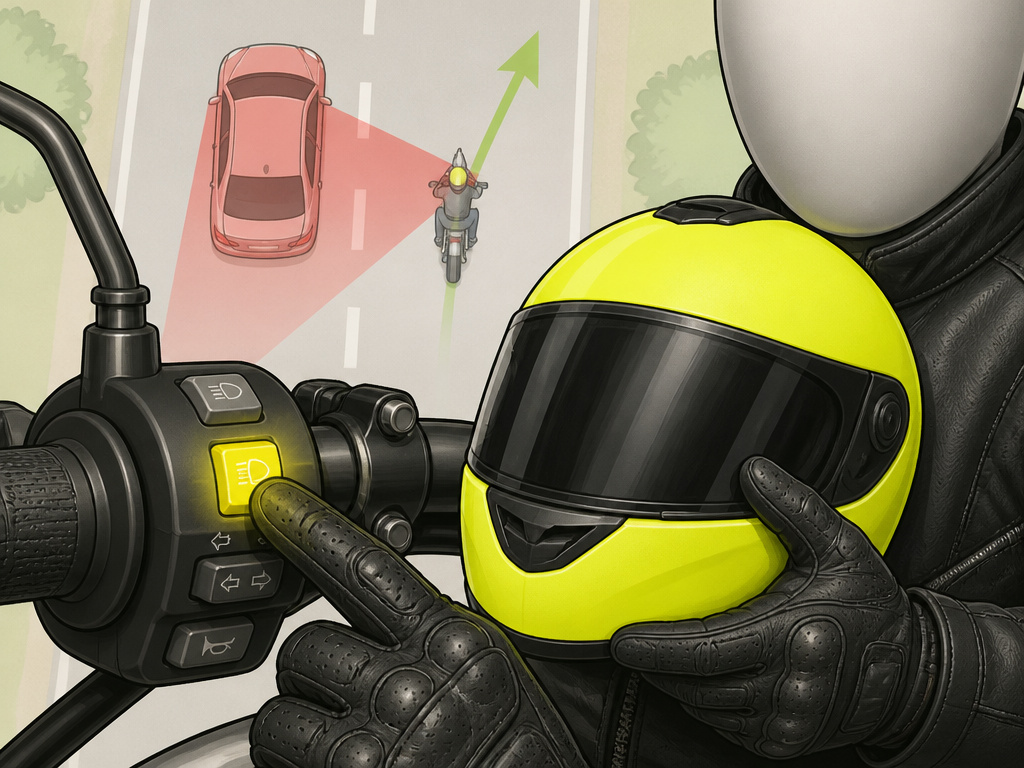
The PMC systematic review on motorcycle conspicuity frames the 26% statistic not as an inevitability, but as a target for intervention. The goal is to shrink that number every time you ride. It’s not about one magic trick; it’s about layering multiple systems so that if one fails, the others have your back.
Start with the legal baseline from your local authority, like the Georgia DDS traffic laws section or the Mississippi Motorcycle Operator Manual. Then, apply the scientific nuance: lights are always good, but gear needs contrast. Finally, execute with the riding techniques that put those tools to work.
This means treating visibility as a core skill, as fundamental as braking or cornering. It’s the reason you check your headlight with the ignition. It’s why you choose a helmet color with more thought than a T-shirt. It’s the conscious decision to leave a blind spot instead of lingering in it. When you integrate this mindset, you’re not just hoping to be seen. You’re systematically reducing the odds that you’ll ever become part of that 26%.
How to use your brake light to signal drivers
Your brake light is a critical communication tool for traffic behind you. A steady red light tells drivers you are slowing, but an early flash can grab their attention before you begin to brake. If the situation permits, flashing your brake light before you slow down helps others notice your intention. Since research notes a general lack of effective conspicuity interventions at the rear of a motorcycle, using your brake light dynamically adds an active layer to your visibility strategy.
Why clean visors and lights are crucial for visibility
Your ability to see and be seen depends on clear optics. A dirty or scratched visor scatters light, reducing your own vision in low sun or at night, and makes it harder for others to see your face or helmet. Similarly, grime on headlights and taillights drastically cuts their intensity. Studies confirm that motorcycles with headlights on are more conspicuous, but a dim, dirty light loses that effect. Keeping lights and your visor clean ensures your active signals shine at full strength and you maintain the best possible view of the road.
Frequently Asked Questions
What is the single best thing I can do to be seen on my motorcycle?
Turn your headlight on and leave it on. This is the most consistently supported action across all official road codes and research. It works day and night, in all weather, and requires no extra gear or training. For bikes without automatic lights, make the “light check” part of your ignition routine.
Does the color of my motorcycle really matter?
It can, but it’s a secondary factor. A bright motorcycle is easier to see than a dark one, but your own gear and your headlight have a far greater impact on your conspicuity. A rider in black on a yellow bike is still a low-contrast silhouette. Focus first on what you wear and how you ride.
Are flashing brake lights or headlight modulators legal and effective?
Laws vary significantly by state and country. Some jurisdictions allow headlight modulators and certain types of flashing brake lights, while others prohibit them. The NIH review found modulating headlights increase conspicuity. However, their effectiveness can be negated if they annoy other drivers, causing them to look away. Always check your local regulations before installing any modified lighting.
I wear a black leather jacket. Is adding reflective tape enough?
It’s a significant improvement for night riding, but it does nothing during the day. Reflective tape requires a direct light source to work. For full-spectrum visibility, you need both daytime contrast (a bright color or a white helmet) and nighttime reflection. Consider a high-visibility vest over your jacket, or upgrade to a jacket with integrated reflective panels and bright colors.
