
Does Motorcycle Helmet Color Affect Visibility?
This post contains affiliate links. As an Amazon Associate, we earn from qualifying purchases.
Yes, motorcycle helmet color measurably affects visibility and crash risk. Peer-reviewed data shows a white helmet is associated with a 24% lower risk of crash-related injury than a black helmet. The effect interacts with headlight use and rider clothing, but helmet color alone is a statistically significant factor in real-world crash outcomes.
That 24% figure comes from a specific, real-world study. The answer isn’t a simple “bright is better.” It’s a question of contrast, context, and how the human eye picks out a moving target against a cluttered background. A bright helmet works because it creates a high-contrast silhouette against typical road scenery and sky, giving a driver’s brain the extra split-second to register “motorcycle.” A key question is: does motorcycle helmet color affect visibility?
What follows is a breakdown of the two key studies that give us hard numbers, a look at where the research disagrees, and practical advice on how to use color — along with lights and gear — to build a visibility system that works for where you actually ride.
Key Takeaways
- A white helmet is linked to a 24% lower injury risk than a black helmet in real-world crash data.
- Modulating headlights are detected at the greatest distance in simulator studies, but their effect interacts with rider color.
- The protective benefit of high-visibility clothing strengthens as light fades, but the study found no significant link between frontal clothing color and crash risk alone.
- Aim for contrast with your environment; a bright helmet against a grey sky or a dark helmet against a bright desert are both effective.
- Population attributable risk calculations suggest that if all riders wore white helmets, up to 18% of crash-related injuries could be prevented.
What the Auckland Case-Control Study Found
This is the heavyweight study. Researchers in Auckland analyzed real crash data from 1993 to 1996, comparing injured riders (cases) with riders who weren’t in crashes (controls). They weren’t running simulations; they were counting actual injuries and what the riders were wearing.
The numbers are specific. Wearing any reflective or fluorescent clothing was associated with a 37% lower risk of a crash-related injury. Using your headlight during the day was linked to a 27% lower risk. And crucially, wearing a white helmet versus a black helmet was associated with a 24% lower risk.
The population attributable risk for wearing a non-white helmet was 18%. This means that if every rider in the study population had worn a white helmet, researchers estimate that 18% of the crash-related injuries could have been prevented.
The study also introduced a critical nuance when you compare a does motorcycle helmet color affect visibility: the benefit of high-visibility clothing strengthened with falling light conditions. This tells us that visibility is not a single solution but a set of tools for different scenarios.
One counterintuitive finding? The study found no significant association between the frontal color of a rider’s clothing or motorcycle and crash risk. This finding contrasts with the contention by Hurt et al. (cited in the Auckland study) that the rider’s upper torso, due to its larger surface area, should be the principal contributor to conspicuity. The authors suggest their sample may have had too few riders in light-colored clothing to detect an effect, but the data stands.
The Iowa State Simulator Study: Detection Distance
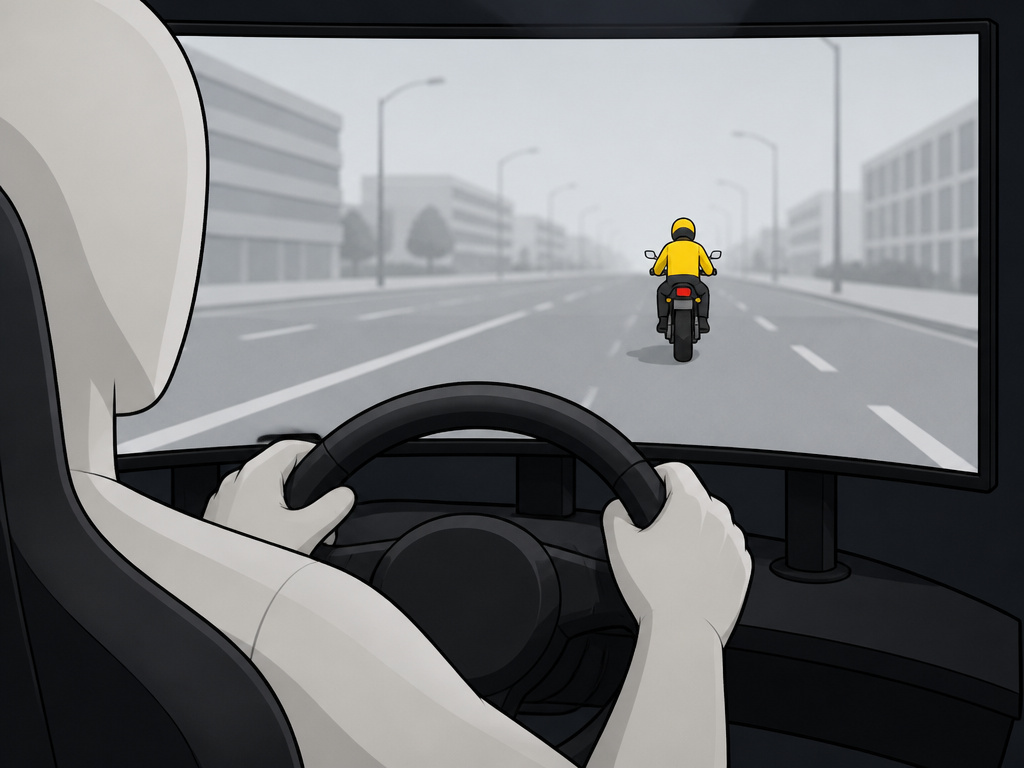
If the Auckland study tells us about real-world outcomes, the Iowa State University research tells us about the “why.” Using a driving simulator with 36 participants, they measured how far away drivers could detect motorcycles under different combinations of rider color and headlight configuration.
The headlight finding was clear: oncoming motorcycles with modulating headlights were detected at the greatest distance, beating both high beams and standard daytime running lights (DRLs). But it’s the interaction that matters. The ability to detect a motorcycle was significantly influenced by the combination of headlight configuration and rider color.
For leading motorcycles (those being approached from behind), the rider’s color had a direct ranking. Motorcycles with riders in bright yellow clothing and helmets were detected at the greatest distance, followed by blue denim, with black in last place. The study also found that motorcycles were detected farther away in urban environments than in rural ones, and that older drivers’ detection distances were influenced differently by these factors.
| Factor | Effect on Conspicuity | Key Insight from Study |
|---|---|---|
| Headlight Type | Modulating > High Beam > DRL | Modulating lights create a moving, attention-grabbing signal. |
| Rider/Helmet Color | Bright Yellow > Blue Denim > Black | Color creates contrast against the road environment. |
| Environment | Urban > Rural | Cluttered urban backgrounds may make a single contrasting element stand out more. |
| Driver Age | Significant interaction with color & environment | Older drivers’ detection is affected differently by rider color based on setting. |
This table shows that the does motorcycle helmet color affect visibility factor doesn’t operate in a vacuum. It’s part of a system that includes your lights and your environment. A bright helmet helps most when it’s the contrasting element in a driver’s field of view.
Helmet Color vs. Your Jacket: Where the Research Disagrees
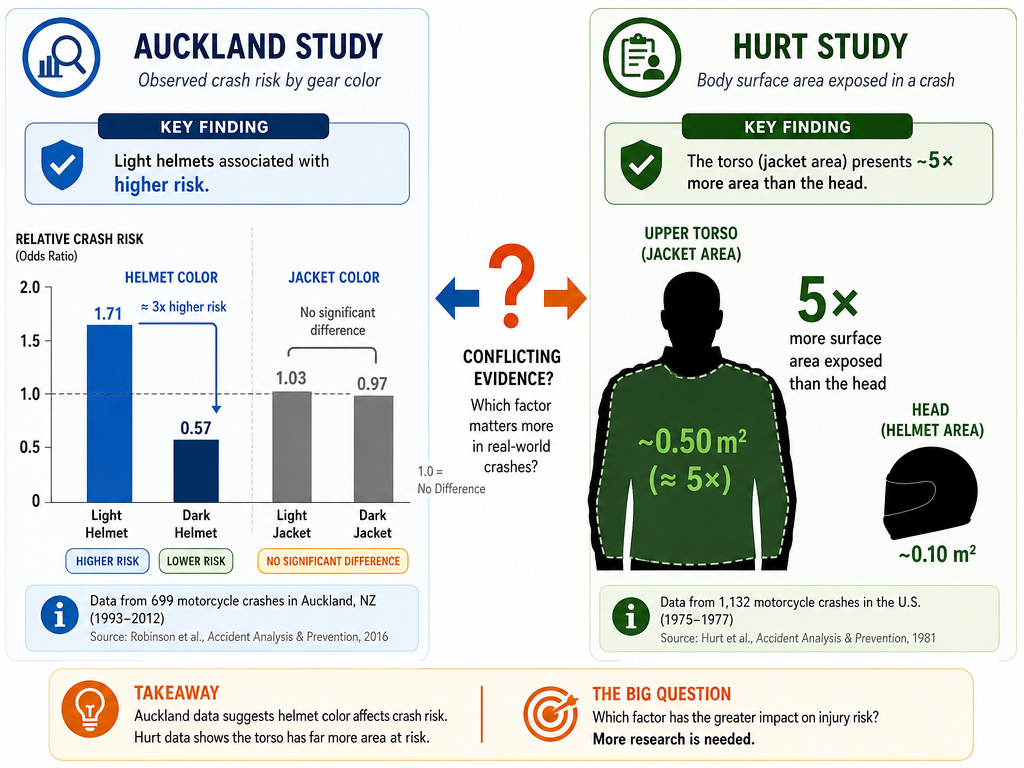
Here’s the live debate, and it’s important to acknowledge it. The Auckland study found a clear helmet-color effect but no significant clothing-color effect. However, that study itself references earlier work by Hurt et al., which contended that the rider’s upper torso presents a much larger surface area (about five times that of a helmet) and thus should be the principal contributor to conspicuity.
So, who’s right? The data from Auckland is what we have. The researchers suggest their study may have lacked the statistical power to detect a clothing-color effect because too few riders in their sample wore light-colored gear. This isn’t a dismissal of bright jackets; it’s an admission of a data limitation. The systematic review of motorcycle conspicuity notes that a high level of color contrast enhances visibility, and other studies support bright attire.
Where this goes sideways: Assuming a bright jacket alone makes you invincible. The Iowa State simulator showed that bright yellow gear improved detection, but the Auckland crash data didn’t single out clothing color. The safest approach is to treat both helmet and jacket as complementary layers of a visibility system, not as an either/or choice.
My take? I’ve ridden with a bright jacket and a black helmet, and vice versa. From a car’s mirror, the helmet is often what I see first on another rider—it’s at eye level and moves independently from the bike’s frame. But that’s perception, not data. The data says control for what you can: a light helmet has a proven association with lower risk.
How to Choose a Color for Where You Ride
Forget “best color.” Think “best contrast.” Your helmet’s job is to break up your silhouette against whatever you’re usually riding in front of.
- Urban/Suburban, Grey Skies: A white or fluorescent yellow-green helmet pops against concrete, asphalt, and overcast skies. This is where the white helmet’s statistical advantage was likely earned.
- Desert, Bright Sun: A dark helmet (black, dark blue) can actually create a sharp silhouette against a bright, washed-out sky and sandy backgrounds. The contrast is what matters.
- Forested/Rural Roads: Go for high-contrast, non-green colors. White, orange, or bright red will stand out against foliage. A matte green helmet is a terrible idea here.
- All-Around Practical Choice: If you ride in varied conditions, white is the default. It’s at the top of the crash study, it contrasts with most backgrounds, and it has a slight advantage in reflecting solar heat.
The ANSI/ISEA 107-2015 standard for high-visibility apparel specifies three colors: fluorescent yellow-green, fluorescent orange-red, and fluorescent red. While not a helmet standard, it’s a guide to what wavelengths the human eye picks up fastest. A fluorescent yellow-green helmet is literally engineered for detection.
Finish matters, too. A glossy white helmet will have a higher reflectivity, creating brighter highlights and potentially more catch-the-eye shimmer. A matte white is more diffuse but still offers strong contrast. For a more subdued look that still gets the safety benefit, matte is fine.
Beyond Color: The Visibility System
Color is your first layer. To build real conspicuity, you need to add active and passive elements that work in different conditions.
- Headlights are essential. Use them day and night. The Auckland study tied daytime headlight use to a 27% lower injury risk. Consider a headlight modulator if legal in your area; the Iowa State study found them most effective.
- Add Reflective Tape. This is your night-time visibility solution. Apply retroreflective tape in strategic stripes on the back and sides of your helmet. It’s cheap, durable, and turns car headlights into a beacon pointing at you.
- Consider a Hi-Vis Vest. If you’re resistant to a bright jacket, a high-visibility vest over your gear is a brilliant compromise. It’s the large surface area the Hurt study emphasized, and you can stow it when you don’t want the look.
- Ride in the Lane Position. Place yourself in the lane where you are most likely to be seen in a car’s side mirror and where your silhouette is not blending with roadside clutter.
I keep a roll of red reflective tape in my garage. Adding a few strips to the back of a dark helmet takes ten minutes and completely changes its nighttime profile. It’s the single cheapest visibility upgrade you can make.
Do white helmets stay cooler than black helmets?
Research indicates that helmet color significantly impacts safety, which can indirectly relate to comfort. A study of real-world crashes found that wearing a white helmet was associated with a 24% lower risk of injury compared to a black helmet, and self-reported light-colored helmets showed a 19% lower risk. This suggests lighter colors, like white, offer a conspicuousness benefit: they are more visible to other drivers, as shown by the association with lower crash risk. Choosing a lighter helmet is a simple choice that addresses both visibility and thermal management.
Are LED lights or modulating headlights effective for visibility?
Active lighting plays a crucial role in making motorcycles stand out. Research shows that daytime headlight operation is associated with a 27% lower risk of crash-related injury. Not all lights are equal, however. A simulator study found that motorcycles with modulating headlights were detected at the greatest distance by other drivers, outperforming standard high beams or daytime running lights. The relationship between lighting and rider color also matters; detection was heavily affected by the mix of headlight setup and whether the rider wore black or bright colors. This means active lighting, especially modern modulating systems, works best as part of a complete visibility strategy that also includes high-contrast gear.
Frequently Asked Questions
What color makes motorcycle helmets the most visible?
According to the Iowa State simulator study, bright yellow clothing and helmets were detected at the greatest distance. For real-world crash outcomes, the Auckland study found white helmets were associated with a 24% lower injury risk than black. Fluorescent yellow-green, as per the ANSI high-vis standard, is scientifically tuned for maximum daytime detection.
What is the 2 2 2 rule for motorcycle helmets?
It emphasizes that a proper, safe fit is the absolute priority over any color or feature.
What is the best color for bike visibility?
For rider gear and helmets, colors that contrast with the road and environment are best. White, bright yellow, orange, and red are top contenders based on the research. The research indicates that the rider’s gear and helmet color often have a larger impact on conspicuity than the bike’s paint, as the human form is a more recognizable shape to other drivers.
What color motorcycle helmet is considered the safest?
Based on the population-based crash data, a white helmet is associated with the lowest risk of crash-related injury. Its safety advantage is quantified: a 24% lower risk compared to a black helmet. This makes it the statistically safest color choice according to the best available evidence.
The Bottom Line
The data is clear enough to act on. If you’re choosing a new helmet and visibility is a priority, a white or bright fluorescent color is a defensible, research-backed choice. It’s associated with a measurable reduction in injury risk.
But don’t stop at color. That 24% lower risk is a compelling statistic, but your headlight, your lane position, and a strip of reflective tape are force multipliers. Think of your helmet color as the foundation of a visibility system, not the entire structure. The goal isn’t to look like a traffic cone; it’s to give the driver who’s glancing at their phone one more clear, contrasting visual cue that you exist.
That cue could be a white helmet against a stormy sky, a flash of a modulating headlight, or a reflective stripe glowing in a headlight beam. Use them all. The research shows each one moves the needle.
