
Reflective Motorcycle Gear Explained
This post contains affiliate links. As an Amazon Associate, we earn from qualifying purchases.
Reflective motorcycle gear uses retroreflective materials, tiny glass beads or prismatic lenses, to bounce light directly back to its source, like a car’s headlights. This creates a bright, localized glow that makes a rider visible at night or in low light from hundreds of feet away, far beyond the reach of normal-colored clothing. The effectiveness is governed by standards like ISO 20471 for visibility and EN 17092 for protective garments, and it degrades predictably with washing and wear.
That last point about degradation is the one most riders miss. The bright glow isn’t permanent. A material like 3M™ Scotchlite™ 8906 is rated to withstand 30 home wash cycles. Other 3M Scotchlite fabrics, such as 8925, 9910, and 9945, are rated for 75, 100, and 100 home wash cycles respectively. This turns gear care from an abstract “take care of your stuff” into a countdown timer. Washing isn’t just cleaning; it’s wearing down the microscopic optical system that makes you visible. This is reflective motorcycle gear explained.
What follows is a breakdown of the physics, the confusing alphabet soup of standards, and the real-world failure modes pulled straight from manufacturer recall reports in this reflective motorcycle gear explained guide. By the end, you’ll know how to read a gear tag, where to place reflective strips for maximum effect, and when to retire a worn-out vest.
Key Takeaways
- Reflective gear works through retroreflection, sending light directly back to the driver’s eyes, not just scattering it.
- The IHVCA reflective safety clothing standard notes performance decreases with every wash; the manufacturer, not a fixed rule, defines the safe wash-cycle limit.
- For maximum recognition, place reflective material on moving body parts (ankles, wrists) and in a broken silhouette pattern to help drivers distinguish a human form.
- Motorcycle-specific protective gear (EN 17092) makes reflective materials optional, while high-visibility workwear (ISO 20471) mandates minimum reflective areas.
- Major brands like Royal Enfield, Honda, and Harley-Davidson have issued NHTSA recalls for reflectors that failed to meet the FMVSS 108 performance standard.
How Reflective Gear Actually Works: Retroreflection Explained
Headlights hit your black jacket and the light scatters in all directions. Only a tiny fraction goes back to the driver’s eyes. That’s why dark clothing disappears at night.
Retroreflective material changes the game. It’s covered in millions of tiny glass beads or precise micro-prisms. When light hits them, the optics bend and bounce the light directly back along the path it came from. To the driver, it looks like your gear is glowing from within.
A retroreflective material with a coefficient of retroreflection (RA) of 500 cd/(lx•m²) has a high level of brightness when measured under standard conditions. 3M™ Scotchlite™ 8906 Silver Fabric Trim has a typical initial brightness of 500 cd/(lx•m²).
That “initial brightness” is key. It’s the measure right out of the package. The glow fades with time. Abrasion from your gear bag, UV exposure, and especially washing grind down the reflective elements. The IHVCA reflective safety clothing standard is blunt: “The retroreflective performance of safety clothing decreases after washing and exposure.”
Where this goes sideways: Assuming a reflective strip is “fine” because it’s not torn. The adhesive can yellow, the surface can glaze over, and the microscopic lenses get clogged with detergent residue. The strip looks intact but reflects at a fraction of its original power.
The Standards That Actually Matter (And What They Leave Out)
Two main families of standards apply here: one for general high-visibility clothing and one for motorcycle-specific protective gear. They overlap, but they’re not the same.
ISO 20471:2013 is the global standard for high-visibility clothing for any risky profession. It classifies garments by the minimum area of visible material. For the lowest-risk Class 1, you need at least 0.14 m² of background material and 0.10 m² of retroreflective material, or 0.20 m² of combined performance material. It’s about pure visibility.
EN 17092 is the European standard for motorcycle protective garments. It covers abrasion resistance, seam strength, and impact protection. The EN 17092 series includes standards for different protection classes, such as AAA (highest), AA, and C. Reflective material is optional under EN 17092. A jacket can be certified for crash protection without a single reflective strip.
| Standard | Primary Purpose | Reflective Material? | Key Metric |
|---|---|---|---|
| ISO 20471 | Visibility for hazard workers | Required | Minimum visible area (e.g., 0.14 m² background for Class 1) |
| EN 17092 | Abrasion & impact protection for riders | Optional | Protection class (AAA highest, C lowest) |
| FMVSS 108 | Vehicle lighting & reflectors (USA) | Required for vehicle-mounted reflectors | Minimum reflective performance |
This reflective motorcycle gear explained gap means you can buy a fully certified, armored motorcycle jacket (EN 17092 AA) that’s matte black. It will protect you in a slide but do nothing to prevent the crash from a driver who didn’t see you. This is why many riders layer a hi-vis vest over their protective jacket, it addresses both needs independently.
Common mistake: Buying gear for only one standard. A construction vest meets ISO 20471 but offers zero abrasion protection. A black leather race suit meets EN 17092 but offers zero daytime conspicuity. For the street, you often need two pieces of gear to solve two different problems.
Gear That Lasts: Why Wash Cycles Are a Countdown Timer
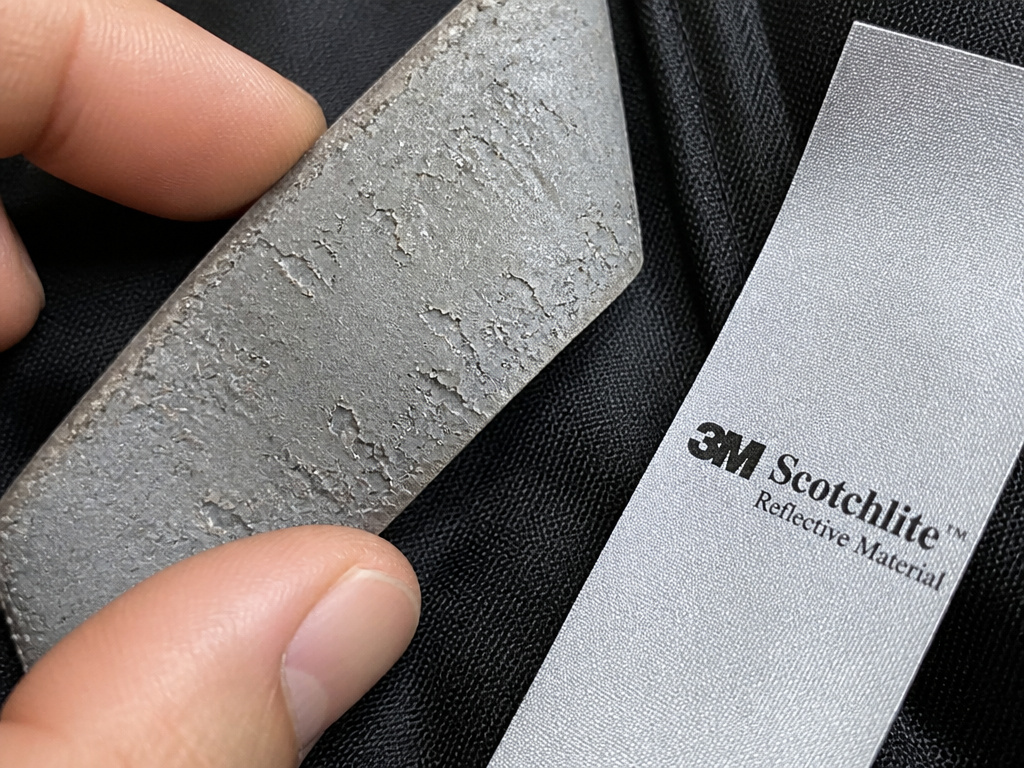
You wouldn’t use a helmet after a major impact. You shouldn’t use reflective gear after it’s washed past its rated life.
Material suppliers are specific. 3M publishes exact durability data for its Scotchlite fabrics:
- 3M™ Scotchlite™ 8906 Silver Fabric Trim: 30 home wash cycles.
- 3M™ Scotchlite™ 8925 Silver Fabric: 75 home wash cycles, 25 dry-cleaning cycles.
- 3M™ Scotchlite™ 9910 Silver Industrial Wash Fabric: 100 home wash cycles, 50 dry-cleaning cycles.
These numbers come from lab tests conducted by the material supplier. Home washing is gentler than industrial laundering, but it still degrades the material. The IHVCA standard explicitly places the burden on the manufacturer to define the allowable washing cycles to maintain performance. If your gear’s tag doesn’t list a wash limit, the company hasn’t defined one, and you have no way to know when it’s no longer safe.
Here’s the honest take. Nobody counts washes. But you notice when a once-bright silver strip looks grey and chalky. That’s your visual cue. Once the material loses its glassy sheen and starts to look porous, its retroreflective performance is already compromised.
Sensory reality check: A brand-new reflective strip feels smooth and almost glassy. After dozens of washes, it can feel rough or fibrous, and the color may shift from bright silver to a dull grey. That’s the tactile sign the surface optics are damaged.
Where to Place Reflective Material for Maximum Effect
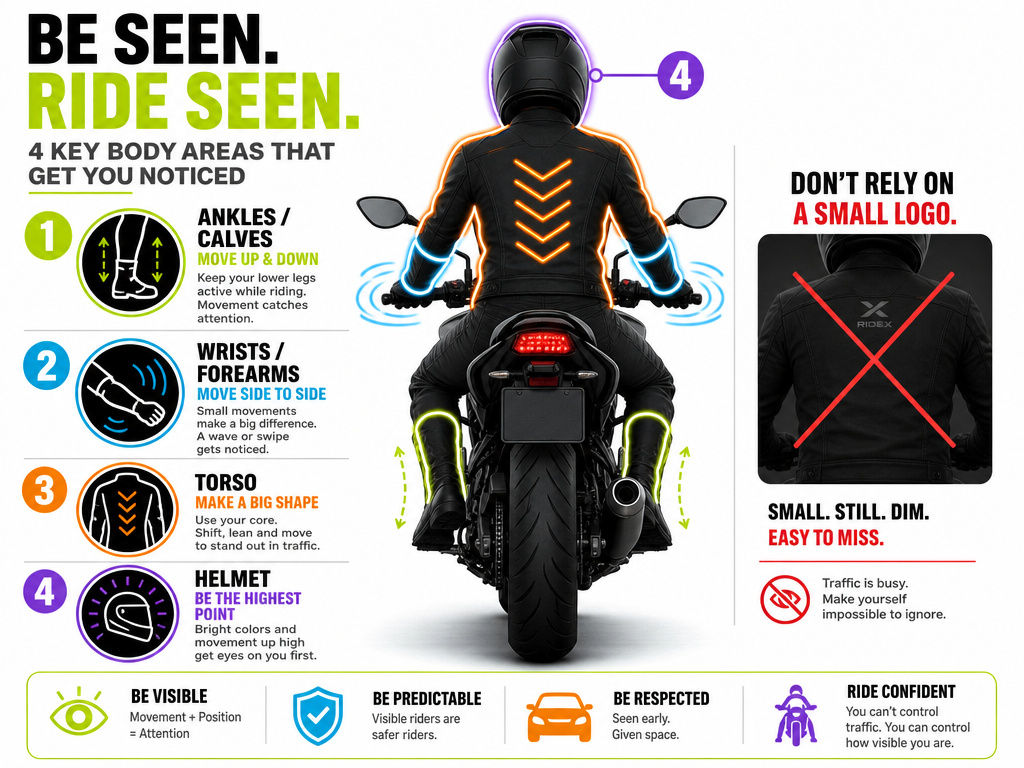
Covering a jacket in reflective panels isn’t the most effective strategy. The goal is to create a recognizable human outline that drivers can process instantly.
For maximum recognition, many safety experts recommend placing reflective material on moving body parts to create a distinct pattern.
- Ankles & Calves: The most effective single location. The up-and-down motion of walking or the position on footpegs creates immediate movement contrast. Reflective boot cuffs or trouser strips work here.
- Wrists & Forearms: Another high-motion area, especially when operating controls. Reflective gloves or jacket cuffs catch light.
- Torso (Chevron Pattern): A classic on vests.
- Helmet: The highest point on a rider.
Contrast this with a common factory placement: a single, small reflective logo on the back. It creates a tiny point of light that’s easily lost in a sea of other lights. It checks a marketing box, not a safety one.
To truly be more visible, think in patterns and motion, not just surface area. A few well-placed strips on limbs can outperform a fully reflective but static vest.
Real-World Failures: What Motorcycle Recalls Teach Us
If you think reflective performance is just marketing, look at the official recall notices. The U.S. National Highway Traffic Safety Administration (NHTSA) forces recalls when vehicle parts, including reflectors, fail to meet the FMVSS 108 standard.
These are real-world failures where factory-installed parts didn’t reflect enough light.
- Royal Enfield (Recall 24V-713): Side and rear reflectors on 2023 models “did not reflect at the required reflective performance.” The defective reflectors were produced from November 1, 2022, to March 31, 2023. The fix was a new reflector marked with an ‘N’ or ’25’.
- Honda (Recall 21V-382): A NHTSA rear reflector motorcycle recall was issued for multiple models because the rear reflector “does not meet FMVSS reflectiveness requirements.” Honda warned it could increase the risk of a rear collision.
- Harley-Davidson (Recall 19V-574): Their Tour-Pak luggage conversion kits (part numbers 53000291, 53000291A, 53000567) shipped without the required replacement reflectors, leaving bikes with no rear reflector after installation, a direct FMVSS 108 violation.
These recalls prove two things. First, reflector performance is quantifiable and regulated. Second, manufacturing defects happen at major brands, turning a safety item into a liability. It’s a solid argument for adding your own independent, high-quality reflective gear, not relying solely on what the factory glued to your bike.
Reflective vs. Illuminated: Where Active Gear Fits In
Reflective material is passive. It needs a light source to work. Active lighting. LED strips or light-up vests, creates its own light.
You’re managing another device that can die.
The strongest approach is layering: use passive reflective material as your always-on baseline visibility. Then, add active lighting for high-risk situations like night riding on unlit roads, heavy rain, or dense fog. One backs up the other.
The part nobody mentions: Some LED vests use cheap, diffuse LEDs that create a blob of light. This can actually reduce recognition compared to a reflective vest that outlines your shape.
Night Riding Risks and Statistics
Riding at night introduces unique hazards. While specific statistics aren’t provided here, the recall data shows a clear pattern: visibility is a critical, regulated component of motorcycle safety. Multiple major manufacturers, including Royal Enfield, Harley-Davidson, and Honda, have issued recalls because side or rear reflectors on their bikes did not meet the required federal performance standard, FMVSS 108. This standard governs all lighting and reflective devices on vehicles. A reflector that fails to perform as intended drastically reduces a rider’s visibility to other drivers in low-light conditions. Installing certain accessory kits, like fairing lowers, can also physically obstruct legally required reflectors, taking the motorcycle out of compliance and increasing risk.
Specific Product Examples or Recommendations
When choosing gear, look for certifications that define performance. For high-visibility clothing, the ISO 20471 standard specifies minimum areas of visible material across three classes. A Class 1 garment, for example, must have a set minimum area of background and retroreflective material. A jacket and trouser ensemble worn together can achieve a higher class rating than the individual pieces. For abrasion protection, the EN 17092 series covers everything from light-duty garments to the highest AAA class. Note that on protective motorcycle garments meeting EN 17092, the use of retroreflective materials is optional. Always check the manufacturer’s care instructions, as the reflective performance of safety clothing decreases with washing and exposure.
Rider Opinions and Community Debate on Wearing Hi-Vis
The debate around high-visibility gear is a perennial one in riding communities. Some riders view it as an essential layer of safety, arguing that any advantage in being seen is worth it, especially given that protective garment standards do not require reflective materials. Others prioritize style or a minimalist aesthetic, believing that proper riding technique and vehicle lighting are sufficient. Practical riders often point out that visibility is not guaranteed under all conditions, as stated by material manufacturers themselves. The discussion frequently touches on standards, with riders noting that a full jacket and trouser combo can meet a higher visibility class, offering a technical compromise between everyday wear and maximum conspicuity.
Frequently Asked Questions
Is reflective motorcycle gear required by law?
No universal law mandates reflective gear for motorcycle riders. However, the motorcycle itself must have reflectors that meet legal standards like FMVSS 108 in the U.S. Some jurisdictions may have rules for riders at night, but gear requirements are far less common than helmet laws.
How long does reflective gear last?
Its effective life is determined by wear and washing, not years. High-quality materials like 3M Scotchlite have tested wash-cycle limits (e.g., 30, 50, or 100 cycles). Once the material appears faded, chalky, or less glossy, its retroreflective performance has degraded. The IHVCA standard states performance decreases with washing and exposure.
Can I add reflective tape to my existing gear?
Yes, and it’s a highly effective upgrade. Use certified retroreflective tape designed for safety apparel.
What’s the difference between “hi-vis” and “reflective”?
Hi-vis (high-visibility) refers to fluorescent colors like lime-yellow or orange that stand out in daytime. Reflective material is the silver or grey strips that glow at night when light hits them. The best high-visibility gear combines both: a fluorescent background for day with retroreflective strips for night.
Do black reflective strips work?
They exist, but they are far less effective. “Black reflective” material looks dark in daylight but contains reflective elements. However, because it absorbs most light, its nighttime reflectivity is significantly lower than silver or white reflective material. For critical visibility, stick with bright silver or the colored fluorescent reflective fabrics.
The Bottom Line
Reflective gear is a consumable safety component with a measurable lifespan defined by wash cycles and wear. Trust the standards. ISO 20471 for visibility, EN 17092 for protection, but understand their limits. A certified protective jacket might have zero reflectivity.
The upgrade path is clear. Start with a solid base of protective gear. Then, add a dedicated hi-vis vest with ample, well-placed reflective material. Treat that vest like a helmet: inspect it for wear, retire it when the reflective strips lose their glassy finish, and replace it without hesitation.
Because the goal is to be seen, not merely to own reflective gear. And that glow has an expiration date.
