
How to Lower Motorcycle Insurance Costs: 10 Key Strategies
This post contains affiliate links. As an Amazon Associate, we earn from qualifying purchases.
To lower motorcycle insurance costs, focus on discounts you can control and coverage you can adjust. The biggest levers are completing a safety course (mandatory discount in Oregon), raising your deductible, and dropping collision on a low-value bike. Shopping quotes from multiple insurers like Dairyland and Progressive can cut your rate by half. For infrequent riders, pay-per-mile insurance from VOOM can save up to 60%.
The savings aren’t theoretical. Your location, bike type, and the specific insurer’s discount formula decide the final number. A clean record matters, but how much it matters can depend on the state you’re in and the company writing the policy. Understanding how to lower motorcycle insurance costs is key to maximizing these factors.
What follows is a breakdown of eight actionable levers, ranked by impact, with the edge cases and state-specific rules that generic guides miss.
Key Takeaways
- Always compare at least five quotes, as the difference between the highest and lowest quote for the same rider can be significant.
- Drop collision coverage on low-value bikes; the premium saved often outweighs the potential payout on a total loss.
- In Oregon, a state-mandated premium reduction for safety courses applies only if the course was completed within the last three years.
- For riders covering less than 2,000 miles per year, pay-per-mile insurance can cut costs by up to 60%.
- Motorcycle insurance costs are 76% lower than auto insurance for minimum coverage and 59% less for full coverage on average, but a DUI violation has the most severe impact on your premium.
The Legally-Mandated Discount You Might Miss
Most riders know to ask about a safety course discount. Few know the discount can have a legal expiration date. Oregon law, specifically ORS 742.480, mandates insurers reduce your premium if you’ve completed a rider education course. The catch: the course must have been finished no more than three years prior to the policy period.
Easy to miss: The Oregon premium reduction applies only if you completed the course within the last three years. After that, the legal mandate expires and the discount is at the insurer’s discretion.
This three-year window is a non-commodity detail most national aggregator sites gloss over. If you took a course five years ago and haven’t re-upped, you’re likely leaving money on the table in Oregon. The law also specifies that if your policy covers both a motorcycle and a car, the discount applies only to the motorcycle portion. These state-specific edges are where real savings hide, not in the generic “ask for discounts” advice.
Your first call after reading this should be to your agent. Ask two questions: “Do you offer a safety course discount?” and “Is there a time limit on when I took the course to qualify?” The answer varies by state and carrier.
Shop It Every Single Year
Loyalty gets you a renewal bump, not a reward. When I last shopped my policy, the spread between the highest and lowest quote for the same bike and coverage was roughly double. The company I’d been with for years was not the cheapest.
The mechanism is simple: insurers use new business discounts to attract customers asking how to lower motorcycle insurance costs, while existing customers often see annual “inflation” increases. You are a retention statistic, not a priority. Shopping resets the clock.
| Insurer | Typical Positioning | Best For |
|---|---|---|
| Dairyland | Often the cheapest base rate | Riders with less-than-perfect records or older bikes |
| Progressive | Wide discount bundling | Multi-policy holders (auto + home) |
| Nationwide | Higher average premiums | Those valuing brand recognition over price |
| Harley-Davidson | Brand-specific programs | Owners of Harley motorcycles |
The table above is a starting point, not a verdict. Dairyland insurance can average $33 per month less than Nationwide, but your mileage will literally and figuratively vary. Get quotes from all of them.
Where this goes sideways: Comparing quotes with mismatched coverage. A “full coverage” quote from one company might have a $500 deductible, while another’s is $1,000. The cheaper one isn’t a deal if it pays out less.
Pull your current declarations page. When you get a new quote, make sure the liability limits (e.g., 100/300/50), deductibles, and add-ons (like roadside) are identical. Only then can you see the true price difference.
Adjust Coverage, Not Just Price
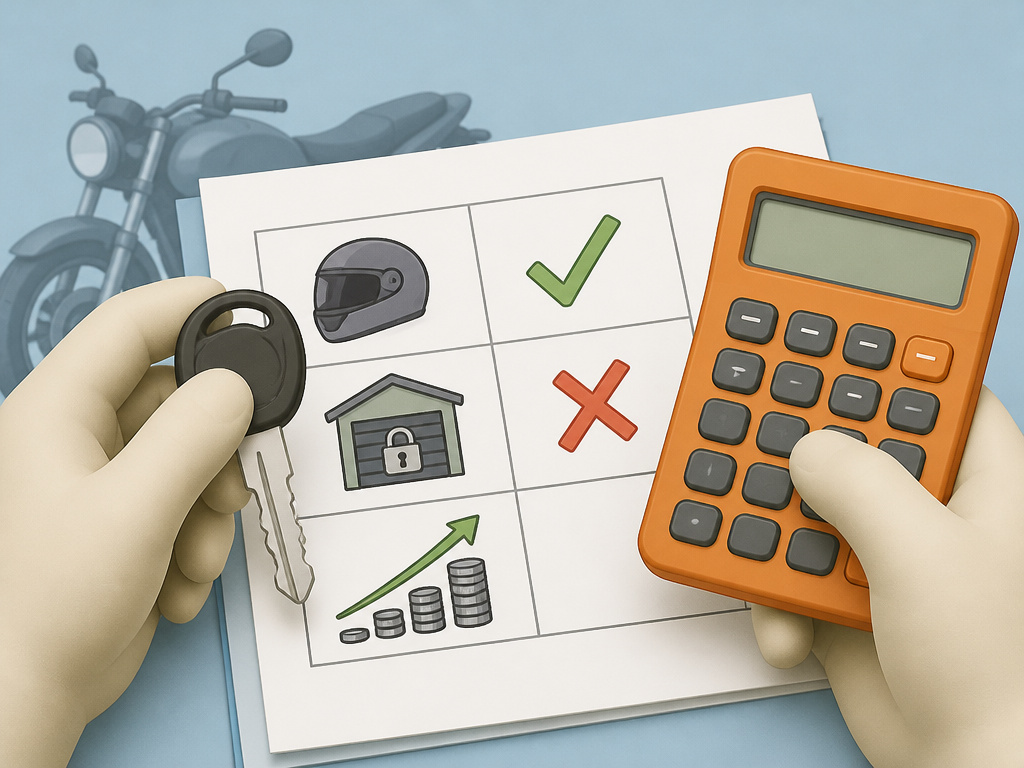
Insurance isn’t a set-it-and-forget-it product. Your coverage needs change as your bike ages and your riding habits evolve. The most powerful lever here is collision coverage.
If your bike’s market value is low, run the math. Dropping collision on an older bike saved me more than any safety-course discount ever did. You pay the premium every year for the chance the insurer will pay the bike’s value if it’s totaled. If that value is small, you might save the equivalent of the payout in just a few years of lower premiums.
Moving from minimum liability to full coverage increases costs by 158%.
Consider this coverage checklist:
- Keep liability and uninsured motorist coverage. These protect you from massive financial loss.
- Review comprehensive (theft, fire) based on your motorcycle storage security situation. A bike in a locked garage is lower risk.
- Calculate the collision breakeven. Divide your bike’s value by the annual collision premium to calculate a breakeven point to help decide if dropping collision is worthwhile.
Another adjustment: raise your deductible. Going from $250 to $1,000 can significantly lower your monthly payment. Just make sure you have that $1,000 set aside. Using a dedicated savings account for your insurance deductible turns a risk into a planned expense.
The Real Cost of Your Record
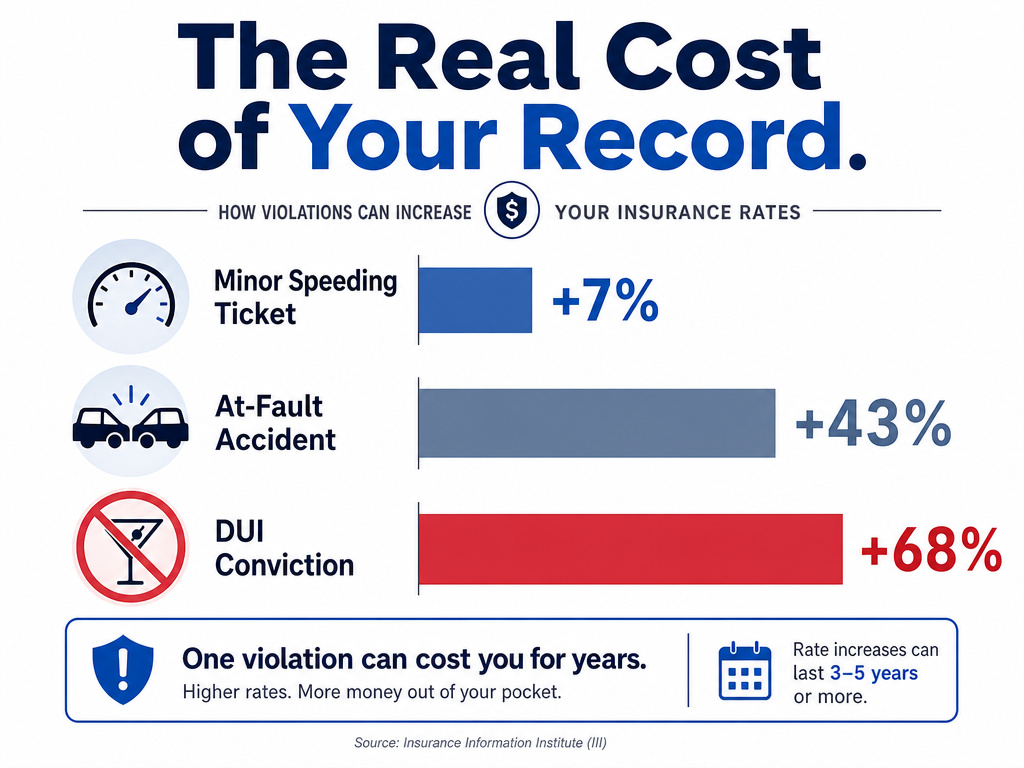
A clean record helps. But how much it helps depends on where you live and who insures you. In a competitive market like Massachusetts post-2008, companies create their own “Merit Rating Plans.” One insurer might surcharge a speeding ticket for three years, another for five.
Common mistake: Assuming a violation impacts all insurers equally. In competitive states, companies have significant discretion in how they weigh your record.
The data shows violations are costly. According to MoneyGeek, rates increase from 7% to 68% depending on the violation. A DUI violation has the most severe impact on motorcycle insurance policy costs. This is where practicing defensive riding techniques pays a direct financial dividend, not just a safety one.
Maintaining a clean record is the best long-term discount. If you have a violation, its impact fades over time, usually three to five years. Ask your insurer or agent for their specific surcharge schedule. Don’t guess.
Location, Bike, and the Storage Question
Insurers price risk. Your ZIP code is a huge risk signal. Urban areas with higher traffic density, theft rates, and accident frequency cost more. States with longer, warmer riding seasons also see higher premiums.
| State | Average Monthly Cost (Full Coverage) | Key Factor |
|---|---|---|
| Florida | $56 | High theft, long season, no-fault insurance |
| Washington | $29 | Lower population density, shorter season |
| Kentucky | $69 | High accident frequency relative to population |
In states like Florida, Arizona, and Texas, costs are at least a third more than the national average. If you’re moving and wondering how to lower motorcycle insurance costs, get a quote for your new address before you go. A cross-town move can sometimes change your rate more than a new bike.
Your bike matters, but less than you think. Sport bikes with high horsepower cost more to insure than cruisers. But the coverage level you choose has a bigger financial impact than the bike type itself. A $10,000 cruiser with full coverage will cost more to insure than a $5,000 sport bike with liability-only.
Where you park it overnight is the final piece. A bike kept in a locked garage is a lower theft risk than one on the street. Always tell your insurer it’s garaged. Some may require proof or an inspection, but the discount is real and ties directly into solid motorcycle anti-theft practices.
Discounts Beyond the Safety Course
The safety course is the headline discount. The bundling discount is the workhorse. But the menu has more items.
- Multi-policy (Bundling): Insuring your bike with the same company that covers your car or home almost always nets a discount. It’s the insurer’s way of reducing attrition risk.
- Multi-bike: Own more than one motorcycle? A single policy covering both usually beats two separate policies.
- Paid-in-Full: Pay your annual premium upfront instead of monthly. Insurers charge fees for installment plans; waiving those fees is an instant saving.
- Association Memberships: Some insurers partner with riding organizations (AMA, BMW MOA) to offer member discounts.
- Anti-Theft Device: A professionally installed alarm or GPS tracker can trigger a discount. It also improves your profile for anti-theft measures.
- Renewal/ Loyalty: Less common, but some companies offer a small discount for consecutive years without a claim.
Ask for a list of all available discounts. Go through it line by line with your agent. If they can’t name them, it’s time to get a quote from someone who can.
Niche Options: Pay-Per-Mile and Seasonal Policies
For the right rider, these are game-changers. Pay-per-mile insurance, like that offered by VOOM, charges a low base rate plus a few cents for each mile you ride. If you ride less than 2,000 miles a year, this can save up to 60% compared to a traditional policy.
It’s perfect for a weekend toy, a second bike, or a fair-weather commuter. The insurer typically uses a plug-in device or a phone app to track mileage. If you’re privacy-conscious, read the fine print on data collection.
Seasonal or “lay-up” policies are for riders in cold climates. You suspend liability and collision coverage while the bike is stored for winter, but keep comprehensive (theft/fire) active. This can significantly reduce your premium for those months. Not all companies offer it, and there may be fees to suspend and reactivate. But if your bike is in storage for four months, it’s worth the phone call.
The Young Rider Penalty (And How to Mitigate It)
Age is a fixed rating factor. An 18-year-old rider pays vastly more than a 35-year-old.
The “why” is statistical: younger riders are involved in more severe accidents. The “how to fight it” is tactical:
- Take the Safety Course: It’s the single strongest signal you can send to mitigate the age penalty.
- Start on a Low-Risk Bike: A small-displacement cruiser or standard is cheaper to insure than a liter-class sport bike.
- Maintain a Flawless Record: One ticket can be catastrophic for a young rider’s rate.
- Get on a Family Policy: If possible, being added as a rider on a parent’s policy can be cheaper than your own standalone policy.
- Choose Liability-Only: If the bike is cheap, skipping collision and comprehensive is a painful but effective cut. Understand that you’re self-insuring for damage to your own bike.
It’s a tough market. The premium drops steadily through your 20s and 30s as you build a riding history. The best strategy is to manage what you can control and re-shop your policy every six months as your situation improves.
How do engine modifications affect motorcycle insurance rates?
Altering your motorcycle’s engine for more power or a different sound directly impacts your premium. Insurers view performance modifications as increasing both the risk of an accident and the potential cost of a claim. A more powerful bike can be harder to control and is statistically more likely to be involved in high-speed incidents, which insurers factor into your rate. Non-standard parts also cost more to repair or replace, increasing the potential cost of a comprehensive or collision claim. Keeping your motorcycle stock, especially the engine, is one of the most straightforward ways to avoid a significant surcharge on your policy.
Frequently Asked Questions
How do I lower my motorcycle insurance?
Focus on factors you control: complete a safety course, maintain a clean record, raise your deductible, and shop your policy annually with at least five different companies. For older bikes, strongly consider dropping collision coverage.
Which motorcycle is the least expensive to insure?
Cruisers and standard motorcycles with smaller engines (under 750cc) are typically least expensive. Sport bikes, especially high-performance models, and custom-built bikes are most expensive. The specific model’s theft rate and repair cost also play a role.
What is the 12-second rule for motorcycles?
The 12-second rule is a defensive riding strategy, not an insurance term. It means scanning the road ahead for at least 12 seconds of travel time to identify potential hazards early. It reduces accident risk, which indirectly helps keep your insurance costs down over time.
Is $20,000 a lot for a motorcycle?
For insurance purposes, yes. A $20,000 bike will have a higher premium for comprehensive and collision coverage because it costs more to replace. It may also be a target for theft. You’ll want full coverage, which means your annual insurance cost will be a significant percentage of the bike’s value. Consider the total cost of ownership, including insurance, before buying.
Before You Go
One rule most guides skip: the impact of your credit history. In most states, insurers use credit-based insurance scores. A higher score often leads to lower premiums. States that restrict this practice include California, Hawaii, Massachusetts, and Michigan. If you’re not in one of those states, your credit report is as important as your driving record.
Lowering your motorcycle insurance isn’t about one magic trick. It’s about systematically working the eight levers here, shopping, adjusting coverage, securing discounts, and managing risk. Start with your current policy. Read it. Then get five new quotes with identical coverage. The difference is your starting budget for better gear or your next tank of gas.
And remember, the best way to lower insurance costs in the long run is to not need it. That starts with the gear you wear every time you ride. Investing in protective gear is an upfront cost that pays dividends in safety and, over a clean-riding lifetime, in premiums you never have to claim.
