
How to Get Motorcycle License in Illinois: Step-by-Step
This post contains affiliate links. As an Amazon Associate, we earn from qualifying purchases.
Here’s how to get motorcycle license in Illinois: hold a valid driver’s license or permit, then finish the free IDOT Basic Rider Course or pass the Secretary of State written and riding tests. Riders 18 and older who finish the course skip both SOS tests. Riders 16 or 17 must take the course and the tests.
That age split shapes every step after it. At 18, the course is a shortcut you choose. At 16 or 17, it’s a legal gate, and the completion card only gets you as far as the testing counter.
What follows: which license class your bike needs, the four free IDOT courses and who each one fits, permit rules by age, the test-only route, the gear the course asks for, and the Driver Services visit that finishes the job.
Key Takeaways
- At 18 or older, the course is optional but worth taking: finish it and the SOS written and riding tests are waived.
- At 16 or 17, you need the course and both SOS tests, plus a parent or guardian at first check-in.
- Anything at 150cc or more needs Class M; Class L stops below that line.
- BRC2 is for experienced riders 18 and up only. Fail to show basic control early and you’re removed with no priority spot in a basic course.
- The ARC doesn’t waive any SOS test, and the three-wheel course card carries a J11 restriction.
Which License Class Does Your Bike Need: L or M?
150cc is the line. Everything about which license you need starts with the engine size printed on the title or spec sheet.
Illinois splits two-wheel licensing at 150cc of engine displacement. A Class L classification covers a motor-driven cycle or scooter under 150cc. A Class M classification covers any motorcycle or motor-driven cycle, so an M holder can also ride Class L machines. A moped that meets all four state moped criteria runs on any valid driver’s license.
The Illinois M class motorcycle endorsement qualifies you to drive any motorcycle or motor-driven cycle, per IDOT. Class L is the narrower license. It works for small scooters and stops there.
IDOT also says more than 20 percent of motorcyclists don’t ride with the proper classification. That’s one in five riders on the road without the right letter on their card.
| Vehicle | License You Need | Source |
|---|---|---|
| Moped meeting all four criteria | Any valid driver’s license | Yorkville city summary |
| Scooter or moped under 150cc | Class L | Yorkville city summary |
| Bike at 150cc or more | Class M | Yorkville city summary |
| Any motorcycle or motor-driven cycle | Class M covers it | IDOT M-class page |
My take: skip Class L unless you’re sure you’ll never ride anything bigger than a scooter. The M covers both, and the course and tests that earn it are the same effort.
Small bikes get outgrown fast. Licenses shouldn’t have to be.
Four Free IDOT Courses and the One That Won’t License You
The Cycle Rider Safety Training Program (CRSTP) is the state’s rider training system, created by statute in 1976. IDOT says it has trained over 400,000 students since then. It’s also the only program the Illinois Secretary of State authorizes to offer a license waiver.
Courses are free to any Illinois resident 16 or older with a valid car or motorcycle license or permit. The Illinois Cycle Rider Safety Training Program FAQ adds that riders under 18 need written consent from a legal guardian. Funding comes from Illinois riders themselves, through part of the endorsement and plate fees.
Who runs it? IDOT says the SIU Motorcycle Rider Program oversees all three CRSTP regions. A press release from State Senator Seth Lewis describes it differently: until SB 2075, Illinois had one official training center, at Southern Illinois University. Both describe the same operator, so they don’t really conflict.
SB 2075 is now signed into law. It gives IDOT authority to write standard curricula and accredit courses. I couldn’t confirm how many new providers exist yet, so check your region’s list before you assume SIU is your only option.
| Course | Length | Who It Fits | Waives SOS Tests? |
|---|---|---|---|
| BRC | About 20 hours | New riders, 16+ | Yes, for 18+ |
| BRC2 | About 10 hours | Experienced riders, 18+ | Yes, for 18+ |
| 3WBRC | About 20 hours | Three-wheel riders, 16+ | Yes, for 18+ (J11) |
| ARC | Not listed | Riders already endorsed | No |
The BRC Is the Default for a Reason
The Basic Rider Course mixes classroom time and on-bike instruction over about 20 hours. The SIU Basic Rider Course details confirm that motorcycles and helmets are provided. You don’t need to own a bike to get licensed this way.
If you’re 18 or older and on the fence, take the BRC. I’d rather a new rider learn clutch control on a borrowed training bike than on their own machine in a parking lot with an examiner watching. And the card it earns is something your insurer will want to see.
BRC2 Is Only for Riders Who Can Already Ride
BRC2 runs about 10 hours and ends with a written and a riding evaluation. You must be 18 on the first day of the course, hold a valid license or instruction permit, and have prior riding experience. IDOT built it for returning riders, dirt riders moving to the street, and people who’ve ridden without a license.
Skip this if: you can’t yet shift, turn, brake, and stop smoothly. IDOT removes riders who can’t show basic control in the first riding sessions, and you get no preferential spot in a basic course afterward.
That’s a lost weekend and a full restart. Overrating yourself here costs real time.
3WBRC and the J11 Restriction
The 3 Wheel Basic Rider Course also runs about 20 hours. Its completion card is stamped with the J11 restriction, which ties the license to three-wheel machines. Plan to ride two wheels later? Take the regular BRC instead.
The Advanced Rider Course is a different animal. You need a valid motorcycle license to enroll, and finishing it doesn’t waive anything at the SOS. It’s training for riders who already have their M.
How to Get Motorcycle License in Illinois at 16 or 17
A 16-year-old has a fresh driver’s license and a used bike sitting in the garage. The bike can’t leave the driveway legally until two systems sign off: IDOT and the Secretary of State.
Public Act 83-820, in effect since January 1, 1984, requires anyone under 18 to complete a training course and examination before getting a Class M. The old statute text in 625 ILCS 5/6-103 matches it: an IDOT-approved course plus the SOS motorcycle exam. No waiver at this age.
Before you start: Three things trip up young riders early. The permit allows daylight riding only, under a licensed rider 21 or older, so evening solo rides are off the table. Illinois doesn’t legally require a helmet, so that decision falls on you and your parents; wear a DOT full-face anyway. And the course requires protective eyewear, so bring glasses you can wear while riding.
Here’s the sequence, in order:
- Get a valid license or permit first. The course won’t enroll you without one, and you’ll lose your seat to the next name on the list.
- Get the liability waiver signed by a parent or guardian before day one. A parent or guardian also has to be present when you check in for the first session. Show up alone and you don’t start.
- Complete the BRC or 3WBRC. BRC2 isn’t open to you until 18, so don’t book it.
- Wait for the completion card in the mail. The card is your ticket to the SOS testing counter; nobody hands it out at the range.
- Take the card to an SOS Driver Services facility and pass the written and riding tests. Skip the tests and the card alone won’t add the M, no matter how well you rode in class.
Parents: block out that first morning. IDOT is clear that you need to be there.
Instruction Permit Rules: Who Gets 12 Months and Who Gets 24?

Ask two sources how long an Illinois motorcycle permit lasts and you’ll get two answers. Both are right. The length depends on your age and the bike, and the sources split it by age group.
| Rider | Permit Length | Key Conditions |
|---|---|---|
| 18 or older, motorcycle | 12 months | Daylight only, supervised |
| Under 18, Class M | 24 months | After driver ed and IDOT course |
| 16 or 17, motor-driven cycle under 150cc | 24 months | After driver ed and written test |
The Yorkville city summary gives all three rows. The older bill text in SB1506 lines up with the 12-month and 24-month figures. Fair warning: that bill text is old, and I couldn’t read the current statute or the SOS site when I checked. Confirm the numbers at the counter before you plan around them.
Supervision has its own catch. The supervising rider must be a licensed operator 21 or older with at least one year of experience, per Yorkville.
Permit limits that apply across age groups:
- Daylight riding only.
- Direct supervision by a licensed rider 21 or older with at least one year of experience.
Daylight-only bites harder than it sounds. A fall commute home after work turns illegal once the sun drops, and in Illinois that happens before most shifts end in November.
Study for the permit test with the Illinois Motorcycle Operator Manual, which Yorkville points to on CyberDriveIllinois. Can you take it online? I couldn’t confirm that from any source I trust. Ask the SOS directly.
Skipping the Course at 18-Plus: The Test-Only Route
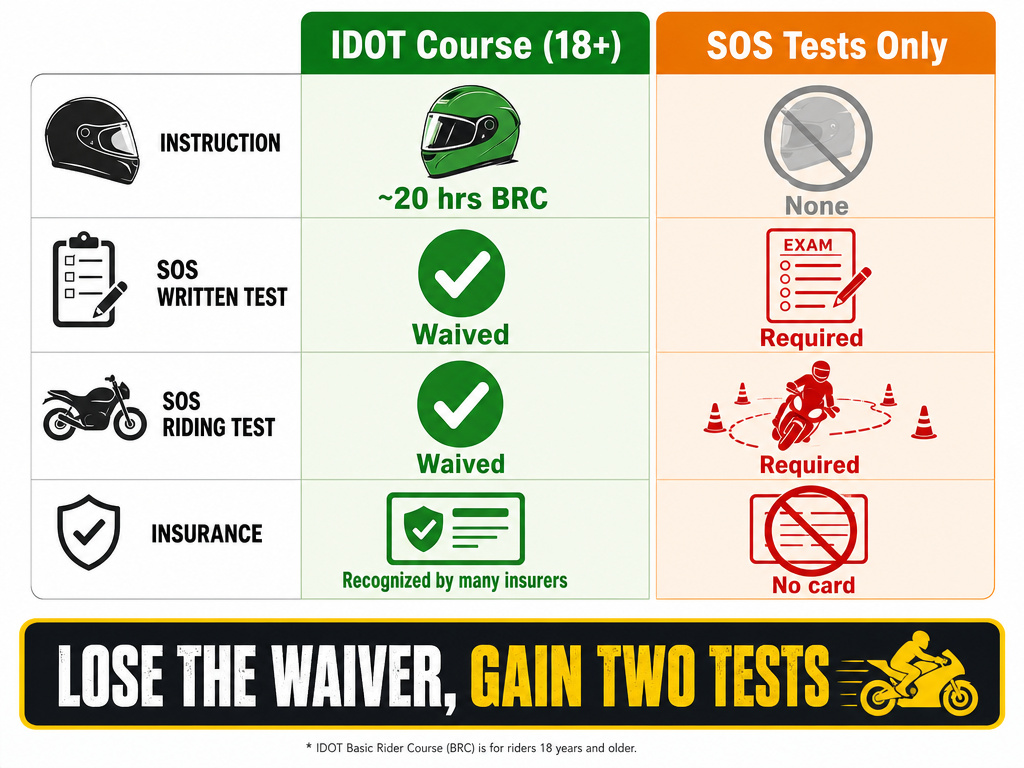
It’s legal. I just wouldn’t pick it. IDOT says that if you’re 18 or older and choose not to take a course, you can get your license at an SOS Driver Services facility by passing a driving and written exam.
What you lose is the waiver. IDOT’s own safety campaign page says the CRSTP’s free courses are the only way to earn a license waiver for motorcycle licensure.
| Factor | IDOT Course (18+) | SOS Tests Only |
|---|---|---|
| Instruction | About 20 hours (BRC) | None included |
| SOS written test | Waived | Required |
| SOS riding test | Waived | Required |
| Insurance | Card recognized by many insurers | No card |
The course wins for nearly everyone. The test-only route makes sense in one case: you’re an experienced rider who can’t get a BRC2 seat in time and you’re confident on your own bike. Even then, I’d at least get on the BRC2 waitlist.
I couldn’t confirm the current SOS riding-test maneuver list, bike requirements, or retake rules. Call ahead and ask what you need to bring, then practice the road skills test basics before you book. Showing up with the wrong paperwork wastes a whole appointment.
Lose the waiver, gain two tests. Bad trade for most riders.
The Gear List for Class Day (Sneakers Don’t Count)
Five things go on your body for the BRC: boots, pants, sleeves, gloves, and eye protection. IDOT supplies the helmet and the bike. Per IDOT’s course page, as summarized in the research I worked from, the list looks like this:
- Over-the-ankle footwear, boots preferred. No cloth or canvas.
- Long, heavy pants with straight legs.
- A long-sleeve shirt or jacket.
- Full-finger gloves.
- Protective eyewear: any glasses you can wear while riding or driving.
The Illinois Basic Rider Course enrollment details also say you can bring your own DOT-approved three-quarter or full-face helmet. I’d do that if you already own one that fits. A loaner that’s a size too big rocks forward when you nod, and you feel the brow pad sliding toward your eyes during low-speed turns.
Where this goes sideways: wearing canvas sneakers because “it’s only a parking lot.” A canvas sole flexes and folds over the footpeg, and laces flap near the shift lever. Riding shoes and sneakers aren’t boots. Buy over-the-ankle boots before class day, not after your first tip-over.
If you’re buying gear for the course, start with a DOT-approved full-face helmet. Fit beats price tag every time. A plain, well-sized lid does the job, and a big spend mostly buys brand and graphics.
Gloves come next. Your hands are the first thing out in a fall, so they matter more than the jacket for a first purchase. Choose full-finger gloves for class day, since the course asks for them.
Judge gloves at the stitching, not the leather. Picking gloves by the hide and ignoring the seams is like judging a drawer by the wood and never checking the joint. For boots, any over-the-ankle pair meets the requirement and keeps working long after class.
From Completion Card to the M on Your License
The completion card arrives by mail, after the course. You walk off the range on the last day with nothing in your hand. Plan on that gap.
Once it arrives, finish the job:
- Take the card to an SOS Driver Services facility. IDOT says there’s a small fee to add the endorsement, and no extra testing if you’re 18 or older.
- Title and register the bike.
- Call your insurer with the card in hand. IDOT says the completion card may be used for insurance discounts.
Illinois requires you to title and register a motorcycle before it rides on public roads, and that includes scooters and mopeds. Do it on the same SOS trip if your paperwork is ready.
The card in your mailbox is the whole waiver. Lose it, and you’re calling the regional center that issued it before anything else can happen.
Active-duty Illinois residents stationed out of state have a separate path. IDOT says the SOS has special provisions for accepting out-of-state Motorcycle Safety Foundation cards for this group. Contact the SOS for the details.
Every state orders its motorcycle licensing steps a little differently. In Illinois, the last step is a counter visit and a small fee. Don’t let the card sit in a drawer.
How do I sign up for a motorcycle rider course in Illinois?
The Southern Illinois University Motorcycle Rider Program oversees all three CRSTP regions, so that is the system you are signing up through no matter where you live. The courses are free to Illinois residents who are 16 or older and hold a valid driver’s license or permit. Funding comes from a portion of motorcyclist endorsement and plate fees.
The fact sheet does not list which community colleges or dealerships host classes, so check the state program’s course listings for sites near you instead of assuming a local shop or school offers one. Pick the course that fits you. The Basic Rider Course runs about 20 hours, and BRC2 runs about 10 hours but requires prior riding experience and you must be 18 on day one.
If you are under 18, get written guardian consent lined up before you register. A parent or guardian also has to be at check-in for the first session with a signed waiver. Helmets and motorcycles are provided, but bring protective eyewear.
Frequently Asked Questions
What do I need to get a motorcycle license in Illinois?
You need a valid driver’s license or permit and Illinois residency. Then either finish an IDOT CRSTP course or pass the SOS written and riding tests. Riders under 18 must do both the course and the tests.
Is the Illinois motorcycle test hard to pass?
No source I found publishes pass rates, so I won’t guess at one. The BRC2 rules hint at the bar: IDOT expects riders to handle straight-line riding, shifting, turning, braking, and stopping. If those feel shaky, take the full BRC first.
Can you take the Illinois motorcycle permit test online?
I couldn’t confirm an online option from any official source. Contact the Illinois Secretary of State before you plan around it. Study the Illinois Motorcycle Operator Manual on CyberDriveIllinois either way.
What size motorcycle can I ride without a motorcycle license?
Moped that meets all four state moped criteria runs on any valid driver’s license. A scooter or motor-driven cycle under 150cc needs a Class L. Anything at 150cc or more needs Class M.
Do I have to wear a helmet in Illinois?
Illinois doesn’t legally require a helmet, per the Yorkville city summary. Wear one anyway. A properly sized DOT full-face is the single best piece of gear you’ll own.
Before You Go
The waiver is the whole reason to take the course at 18 or older. If you’re 16 or 17, the course is mandatory and the tests still apply, so budget time for both.
Your first step this week: pick your CRSTP region and book a BRC seat before you buy a bike. The bikes and helmets are provided, so the course doesn’t depend on owning anything yet. Buying first and training second is backwards.
One honest limit on this guide: the SOS site and the current statute weren’t readable when I checked, and SB 2075 is reshaping who runs training. Confirm permit lengths and test details at the counter.
Bottom line: if you’re 18 or older and asking how to get motorcycle license in Illinois, take the free BRC and skip the SOS tests; only experienced riders who can’t get a course seat should go test-only.
