
How to Find the Racing Line on a Motorcycle: Step-by-Step
This post contains affiliate links. As an Amazon Associate, we earn from qualifying purchases.
One method to find a racing line involves walking the track to find permanent reference points, practicing the “qualifying line” alone, and then using video or data for comparison. A key skill is learning how to find the racing line on a motorcycle. There is no single best line for every rider or bike, but the fastest line for you will make corners as short as possible to maximize straightaway speed. The process hinges on reference points—things like kerbing, paint, or buildings—that you use to consistently hit your entry, apex, and exit.
That gap between theory and your tires on asphalt is where most riders stall. They know about “outside-inside-outside” but can’t translate it to a new corner at speed. The fix is a mechanical search routine you can run on any track.
What follows is that routine: how to physically find your markers, how to build speed safely, and how to spot the two mistakes that burn most of a novice’s lap time.
Key Takeaways
- According to Motorcycling New Zealand, the main objective of the racing line is to make corners as short as possible to make straights as long as possible.
- Build your line using permanent reference points like kerbs or paint, never temporary marks like tire rubber.
- Practice the wide-entry Qualifying Line first when alone; it allows the highest mid-corner speed.
- Use a track walk or bicycle to find markers efficiently before you ever ride the circuit.
- Video or data logging is the fastest way to see if you’re missing your apex by a foot or ten feet.
The Foundation: What a Racing Line Actually Does
Forget “outside-inside-outside” for a second. The core job is simple. According to Motorcycling New Zealand’s training manual, the main objective is to make corners as short as possible to make straights as long as possible. You go fastest on the straights. A good line minimizes your time leaned over and maximizes your exit speed onto that next straight.
There is no single best racing line for motorcycle racing at any racetrack. Different bikes and different riders with different characteristics and skills will be able to utilise different lines around each corner.
That’s the first truth. Your perfect line depends on your bike’s power, your tires, your braking markers, and your comfort with lean angle. A 600cc sportbike might use a different apex than a liter bike or a tuned supermoto. The search for how to find the racing line on a motorcycle is for your fastest, most repeatable line.
This is where a structured cornering technique pays off. The fundamentals of braking, turning, and throttle control are the paintbrushes; the line is the canvas.
The 3-Step Method to Find Your Line
You need a system. Guessing your turn-in point lap after lap is slow and dangerous. This method turns the search into a checklist.
Step 1: The Track Walk or Bicycle Recon
Before your bike ever rolls onto the circuit, walk it. Better yet, ride a bicycle around it. Motorcycling NZ calls this “joining the dots,” where the dots are reference points. Your goal is to find as many permanent, reliable dots as possible.
Look for these, in this order of reliability:
- Kerbing: The red-and-white strips at track edges. They don’t move.
- Track Paint: Start/finish lines, brake zone markings, permanent logos.
- Asphalt Patches or Seams: Changes in pavement color or texture.
- Fixed Objects: Light poles, marshal posts, specific grandstand seats, permanent buildings.
Mark these on a track map or in your phone’s notes. Be ruthless. The manual specifically warns against poor reference points: tyre marks, potholes, small plants, temporary buildings. These can disappear between sessions or even laps. Basing your turn-in on a skid mark from the morning’s crash is a recipe for running wide in the afternoon.
This groundwork directly supports the vision techniques for safer riding you’ll use at speed. You’re programming your brain with where to look.
Step 2: Practice the Qualifying Line Alone
With your reference points noted, your first on-track task is to practice the Qualifying Line. Motorcycling NZ defines this as the theoretical best line for the fastest lap time, used when alone or qualifying.
Its characteristic is a very wide entry, which enables you to carry higher mid-corner speed and get on the throttle earlier for a fast exit. It’s the “default” racing line you see in diagrams.
- Entry: Start from the extreme outside of the track, near the edge.
- Turn-In: Use your pre-identified reference point to initiate the lean.
- Apex: Clip the inside of the corner at the point that sets you up for the widest exit.
- Exit: Drift back to the outside edge of the track as you accelerate.
Practice this slowly at first. Your goal isn’t lap time; it’s accuracy. Can you hit your turn-in marker, touch your apex marker, and exit to the edge consistently? This builds the muscle memory and visual pattern before you add the chaos of other riders.
This solo practice is the best argument for attending a structured motorcycle track day. The open sessions give you the clean track you need.
Step 3: Record and Compare
Your brain lies. You might feel like you nailed the apex. Video doesn’t care about feelings. Mount a camera or, even better, use a data logger with GPS mapping.
After a session, compare your data/video to your plan.
- Did you turn in at your marker?
- Did your front wheel pass within a foot of your apex point?
- Did you use all the track on exit?
A data overlay will show if you’re consistently early or late. An early apex forces you to wait on the throttle or run wide on exit—killing your straightaway speed. This objective feedback loop is what most guides on how to find the racing line on a motorcycle miss. It turns practice from “riding around” into targeted refinement.
How Your Bike Changes the Line
Your motorcycle’s geometry and power change the math. The line that works for a MotoGP bike is often wrong for a street bike, as the optimal line depends on the bike’s characteristics and the rider’s skill. Here’s how to adjust.
| Bike Type | Typical Line Characteristic | Why It Works |
|---|---|---|
| High-Power Sportbike (1000cc+) | Later apex, more “V-shaped” | Manages wheelies and leverages horsepower on exit. A later apex lets you point the bike straighter sooner to unleash the power. |
| Middleweight Sportbike (600-800cc) | Closer to the classic Qualifying Line | Balances corner speed and exit drive. These bikes reward momentum and carrying speed through the corner’s center. |
| Naked/Standard Bike | May require an earlier turn-in | Often has more upright riding position and less lean angle clearance. Getting turned earlier can help manage corner speed. |
| Adventure Bike | Much wider, smoother arc | Higher center of gravity and dual-sport tires demand stability over aggression. A sweeping line minimizes quick direction changes. |
This is where body positioning becomes critical. Hanging off a naked bike enables you to use a sportier line while keeping the bike more upright to clear hard parts.
The Two Most Common Line Mistakes (And How to Fix Them)
You’ve learned the method. Now here’s what will likely go wrong. These two errors account for most slow corners and scary moments.
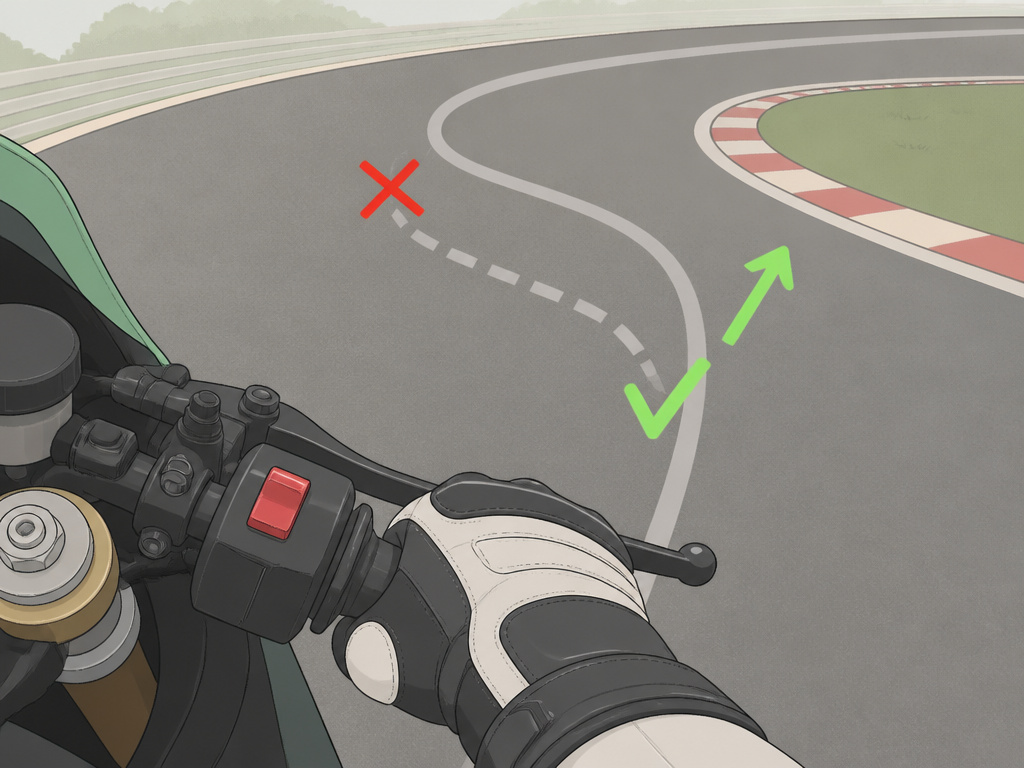
Common mistake: Turning in too early. This forces an early apex, which then pushes you wide on exit toward the grass or wall. You spend the last half of the corner crossed up, waiting to get on the throttle.
The fix is deliberate. On your next track outing, pick one corner. Consciously turn in after your reference point every single lap. It will feel wrong and late. The result will be a later apex, a straighter bike at the exit, and you getting to full throttle earlier. The lap timer doesn’t lie.
Where this goes sideways: Using bad reference points. You subconsciously pick a dark patch of asphalt as your brake marker. Three sessions later, the sun has moved, the shadow is gone, and you’re braking 20 meters too late.
The fix is in Step 1. Only use permanent markers. If you find yourself guessing, pull in after the session and walk that corner again. Find a bolt in the barrier, a specific crack in the kerb—something that will be there tomorrow.
Advanced: Lines for Racing and Overtaking
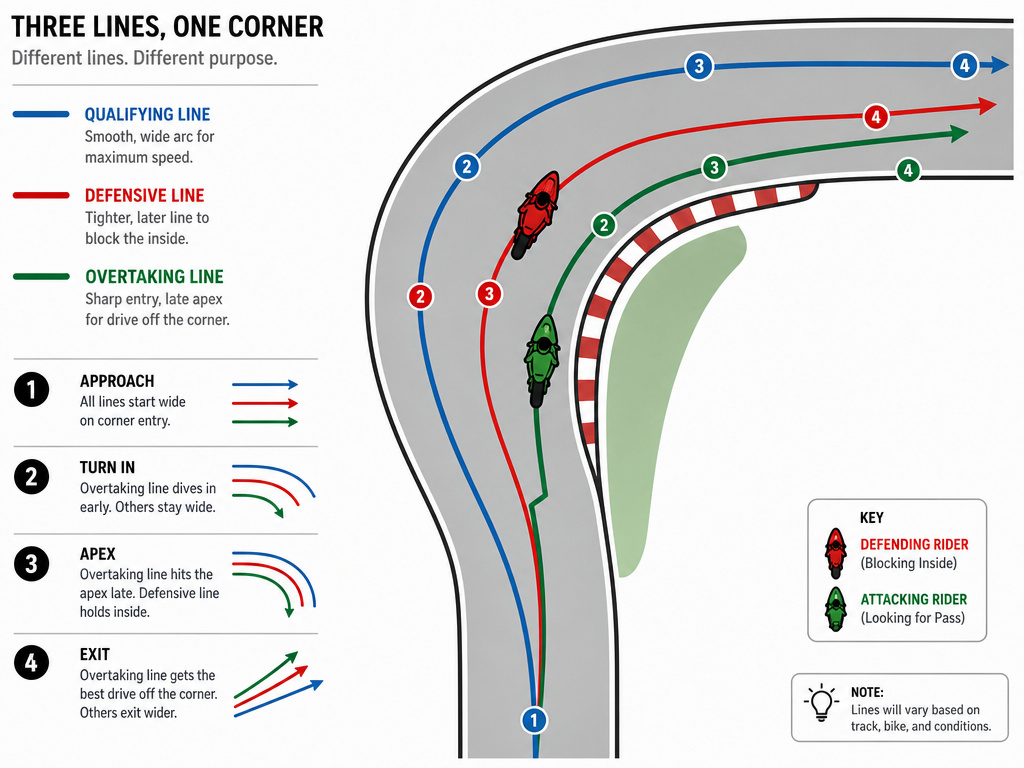
The Qualifying Line is for clean laps. Put another rider in front of you, and it’s often the wrong choice. It leaves the inside door wide open for a pass. You need to practice defensive and overtaking lines before you need them in a race.
A defensive line blocks the inside by taking a later, tighter turn-in toward the apex. It sacrifices your own exit speed to protect position. An overtaking line might involve a later brake dive to the inside, squaring the corner off for a block pass. These are specialized tools. As the Motorcycling NZ manual states, you must practice each type of line before you need it. Trying it for the first time mid-race is a crash invitation.
Mastering these situational lines is a core skill taught at any good motorcycle racing school.
Using Technology to Shorten the Learning Curve
Your phone is a powerful tool. Apps like Harry’s LapTimer or hardware like AIM SmartyCam can overlay your video with data: throttle position, brake pressure, GPS speed, and your exact trajectory on a map.
The most valuable view is the track map. It draws your line as a squiggly worm over the ideal circuit outline. You can see lap-to-lap consistency—or the lack of it. This removes all doubt. Are you widening your line as tires get hot? The map shows it. This objective analysis is what separates deliberate practice from just riding.
How to Prepare Your Bike for the Search
Finding the limit of your line means finding the limit of your machine. A poorly prepared bike will hide your mistakes and then fail. The severe duty of track riding demands more than street maintenance.
For example, the KTM 250/525 RACING owner’s manual explicitly overrides its standard schedule for competition: “15 HOURS SERVICE SHOULD BE CARRIED OUT AFTER EVERY RACE.” While you’re not racing a factory dirt bike, the principle is magnified. Fresh brake fluid, new tires, and tightened critical fasteners are not optional. The Mississippi Motorcycle Operator Manual emphasizes the T-CLOCS pre-ride check for street safety; a track version is even more critical.
New components also need break-in. The BMW manual notes that new brake pads have to bed down before achieving optimum friction and new tyres have a smooth surface that must be roughened by riding in a restrained manner. Your first session discovering lines should not also be the first scrub-in for fresh rubber.
This mechanical prep is a key part of learning how to prepare for your first track day. Showing up with a sorted bike enables you to focus on riding, not worrying.
Late Apex and Squaring Off the Corner
This technique is a key variation from the standard qualifying line. It involves turning into the corner later and more sharply, which straightens your corner exit. According to Motorcycling New Zealand, the main objective is to make corners as short as possible to make straights as long as possible. A late apex can help achieve this by allowing you to get the bike upright and on the gas sooner, maximizing your speed onto the following straight. You must practice each type of line before you need it, as there is no single best racing line for every situation. This line is often used when setting up for a pass or managing a corner that leads onto a very long straight.
Working with Lean Angle and Speed
Managing lean angle and speed is a continuous balancing act. At corner entry, you must find the best point to start the corner, brake the correct amount, select the correct gear, and decide what line to apply. The goal is to carry the highest possible mid-corner speed that still allows for a fast and stable exit. The qualifying line tends to start very wide on corner entry, which can enable higher mid-corner speed. Your ability to work with lean angle depends on your reference points. The more reference points a rider can find, the better they can beat the racetrack. Practice different lines to discover the limits of your lean angle and speed for each corner.
Frequently Asked Questions
How do I know where the racing line is on a new track?
You don’t, until you walk it and then ride it. Use the 3-step method: find permanent reference points on a track walk, practice the wide-entry Qualifying Line slowly for accuracy, then use video to verify you’re hitting your markers. The line reveals itself through this process of measurement and correction.
What is the “danger zone” in a corner?
The “danger zone” is the period of maximum lean angle where you have the least ability to change speed or direction. Your goal with a good racing line is to minimize the time spent in this leaned-over state. A proper line enables you to do most of your braking upright, flick quickly to lean, and then get the bike stood up and accelerating as soon as possible.
Is the racing line different for cars and motorcycles?
Yes, significantly. Cars can brake deeper into a corner and use later apexes because they have four wheels and downforce for grip. Motorcycles must be more gradual with inputs and often use a line that prioritizes a smooth, stable arc to manage lean angle and tire contact patches. A car line on a bike would often be too abrupt.
Can I practice racing lines on the street?
You should not practice track-oriented racing lines on public roads. The principles of vision, smoothness, and trail braking can be honed, but the goal on the street is safety and positioning within your lane, not minimizing lap time. Use track days for real line exploration.
How important is exit speed compared to corner entry speed?
Exit speed is almost always more important. A fast exit onto a long straight gains you time all the way to the next braking point. A blistering entry speed that compromises your exit hurts you for hundreds of yards. The best lines sacrifice a little entry speed to set up a much faster exit.
Before You Go
Here is the honest take. You won’t find your line in an article. You find it by walking the track, picking a curb seam as your turn-in, and then seeing if your front tire passes it within a foot for ten laps straight. The theory is just the map. The riding is the territory.
One rule most guides skip: if you’re consistently missing your target apex, your reference point is wrong or you’re not seeing it. Slow down, find a better marker, and rebuild the corner from there. Speed hides errors. Precision builds speed. Your first goal at any new track is a repeatable one. Everything else follows from that.
