
How to Prepare for Your First Motorcycle Track Day
This post contains affiliate links. As an Amazon Associate, we earn from qualifying purchases.
Preparing for your first motorcycle track day involves three pillars: meeting specific gear requirements, completing a thorough bike inspection and prep, and adopting the right on-track mindset. You need an ACU Gold-approved helmet, 200mm-high boots, and tyres with at least 50% tread life (per Damon Motorcycles) and less than five years old (per British Superbike School). A front brake lever guard is required by most track day providers. The day includes a 7:30 AM sign-on, five or six 20-minute sessions, and starts with three instructor-led sighting laps.
Forget trying to be fast. Your only job is to be predictable, learn the line, and listen to the instructors. The track will expose any mechanical weakness or mental hurry, so preparation is what lets you focus on riding instead of fixing problems. A key part of this is learning how to prepare for your first motorcycle track day.
Key Takeaways
- Your helmet must have an ACU Gold sticker for UK track days, and boots must be a minimum 200mm high.
- Fit a front brake lever guard; it’s been a requirement at most tracks since 2021 and tech inspection will check for it.
- Tyres need at least 50% tread life left and must be less than five years old; check the date code on the sidewall.
- Arrive by 7 AM if you want a chance at a pit garage; sign-on starts at 7:30 AM and the first session is at 9 AM.
- Use only the front brake on track as a novice; the rear is too easy to lock and can cause a crash.
What Gear Do You Need?
The rules are specific, not suggestive. Track day organizers publish their gear requirements because they’ve seen what happens when riders show up with less.
Your helmet is the single most inspected item. In the UK, the widely recognized standard is the ACU Gold sticker. This certification means the helmet has passed a stricter impact and penetration test than the standard road-legal ECE 22.06. The tech inspector will look for this sticker. If your helmet doesn’t have one, you’re not going on track. It’s that simple.
The Technical Snippet: For UK track and race use, an ACU Gold sticker is the accepted highest standard, indicating testing beyond standard ECE 22.06 requirements. Boots must be a minimum of 200mm in height from the sole to the top of the boot shaft and must overlap the calf of your leathers to prevent gap exposure in a slide.
Leathers can be one- or two-piece, but a two-piece suit must have a full-circumference zip connecting jacket and trousers. You need a CE-approved back protector, either integrated or separate. Gloves must cover your wrists and ideally have a reinforced palm and slider material on the knuckles.
The boot rule catches people. Minimum 200mm high isn’t a suggestion, it’s a tape-measure check. The boot must overlap your leathers. Short “commuter” boots that stop at the ankle won’t pass. The logic is direct: in a slide, that gap exposes your ankle bones to the asphalt. I’ve seen tech inspectors send riders back to their vans for this.
Here’s a quick table to keep the specs straight:
| Gear Item | Mandatory Specification | Common Mistake |
|---|---|---|
| Helmet | Full-face, with ACU Gold sticker | Assuming ECE 22.05 is sufficient |
| Boots | Minimum 200mm height, must overlap leathers | Wearing short street boots |
| Gloves | Wrist coverage, reinforced palm | Thin summer gloves without sliders |
| Suit | One-piece or two-piece with full zip | Non-zipped jacket and pants combo |
| Back Protector | CE-approved (Level 1 or 2) | Skipping it or using foam padding |
Beyond the basics, your track day gear needs to be in good condition. Inspect seams for tears and check that armor hasn’t shifted. A back protector that’s cracked or deformed needs replacing.
How Should You Prepare Your Bike?
Bike prep is a core part of how to prepare for your first motorcycle track day, making it safe for you and everyone else. It’s not about adding power. Start with a full mechanical check. If your bike isn’t due for a service, give it a very good clean. You’ll spot leaks, cracks, and loose fasteners you’d miss otherwise.
Fresh brake fluid is the cheapest upgrade you can make. Old, moisture-contaminated fluid boils under the repeated hard braking of a track session. The lever goes soft and creeps toward the bar. Flush the system with a high-quality DOT 4 fluid like Motul RBF 600 or equivalent. Do this a week before, not the night before. That gives you time to fix a weeping seal or a sticky caliper.
Tyres are your only contact with the track. The hard rules: they must have at least 50% of their tread life remaining, and they must be less than five years old. Check the four-digit DOT date code on the sidewall. The last two digits are the year of manufacture. A tyre from 2019 is over the limit for a 2025 track day.
For tyre pressure, sources disagree. The British Superbike School says you can keep road pressures or drop them by a couple of PSI. Ruroc, citing Dunlop, says that’s wrong, track pressure is an operating target that depends on your bike, the specific tyre, track temperature, and your pace. Their advice is better: don’t guess. Speak to the tyre technician in the paddock. Set your cold pressures to their recommendation, then check them hot right after your first session. Adjust from there.
You must fit a front brake lever guard. This has been a standard requirement at most UK tracks since 2021. It prevents another bike’s lever from hooking yours in a close pass, which could lock your front brake. It’s a simple, cheap part. No guard, no track.
Common mistake: Showing up with a loud exhaust and no baffle. You’ll fail noise testing. Track days operate with various noise limits, commonly 105 or 102dB, with some quiet days as low as 98dB. If your exhaust has a removable baffle, fit it. Bring a spare and some exhaust packing just in case.
Remove everything that can fall off: phone mounts, sat-nav mounts, loose trim. Tape over your headlights, tail light, and indicators with painter’s tape. It contains glass if you crash and prevents glare for other riders. Secure your camera mount with a zip tie in addition to its standard lock.
Coolant is a contested point. Damon Motorcycles advises replacing coolant with water because coolant is slippery on track, while Demon Tweeks advises checking levels. The rule that matters is your track day organizer’s rule. Check their regulations.
Finally, prepare your bike for tech inspection. This means safety-wiring the oil drain plug and filler cap. My first attempt was a mess of twisted wire. Using the right tool, safety wire pliers, and 0.032-inch stainless wire cut the job to 15 minutes the second time. Tech inspectors will check these first.
What Does the Track Day Timeline Look Like?
Knowing the schedule eliminates half the first-day stress. It’s a long, structured day. Your goal is to be early for everything.
Get to the circuit by 7 AM. Pit garages are first-come, first-served, and they’re often gone by 7 AM. A garage gives you shade, shelter, and a place to work. If you miss out, you’ll be in the paddock, which is fine, just less convenient.
Sign-on starts at 7:30 AM. You need your full driving licence (or ACU racing licence) and the completed indemnity forms from the organizer. They’ll give you a sticker for your bike and a coloured wristband for your rider group. Put them on immediately.
The riders’ briefing is mandatory. Pay attention. They’ll cover the track flags, passing rules, what to do if you break down, and the schedule. Novices often have a separate mini-briefing afterward. Ask questions if you’re unsure.
The first track session usually starts at 9 AM. This is preceded by three sighting laps led by an instructor. An instructor leads the group at a slow pace with no overtaking. This is your only chance to see the track surface, learn the corners, and find your braking markers. Don’t try to memorize it all, just get a feel for the flow.
After that, your group will be released for a 20-minute session. A track day involves five or six 20-minute sessions, with breaks in between. The physical demand surprises everyone. Wrestling a bike in full leathers for 20 minutes is exhausting.
| Time | Activity | What You Need |
|---|---|---|
| ~7:00 AM | Arrive at circuit | Bike, gear, tools |
| 7:30 AM | Sign-on | Driving licence, indemnity forms |
| ~8:15 AM | Riders’ briefing | Full attention, notepad optional |
| 9:00 AM | Sighting laps (3 laps) | Follow the instructor, no passing |
| Throughout Day | 4-5 more sessions | Water, food, focus on consistency |
The sessions fly by. Your job is to use the breaks wisely. Hydrate. Eat a snack. Let the bike cool down. Check tyre pressures and look for any fluid leaks or loose parts.
What On-Track Mindset Should You Have?
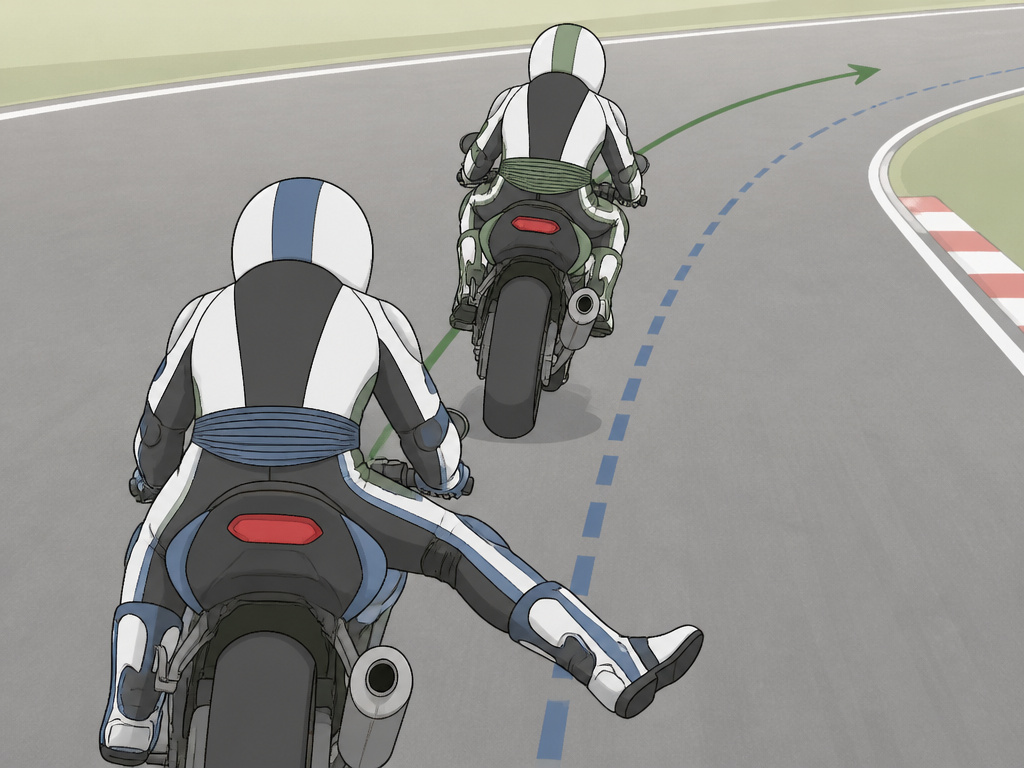
Your goal is not to be fast. Your goal is to be smooth, predictable, and to learn. The fastest way to get slower, or crash, is to try to prove something in the first session.
The number one rule: It is always the overtaking rider’s responsibility to pass safely. There are no mirrors on track bikes. If you’re coming up behind someone, wait for a straight, ensure they know you’re there (a foot off the peg is a common signal), and pass with a wide, clean line. Never pass on the inside mid-corner as a novice.
Where this goes sideways: Chasing a faster rider in your first session. Your brain switches from learning to competing, you ride over your head, and by session three your arms are pumped and your lines are ragged. I did this once. Arm pump arrived halfway through the second session, and so did my humility.
For your first few sessions, ride at about 70% of your perceived limit. Focus on hitting the same braking marker every lap, getting on the gas at the same point, and looking through the corner. Consistency builds speed naturally. The novice group exists so you can learn without pressure. Use it.
Braking is different on track. Use only the front brake. Ignore the rear for now, it’s too easy to lock and can cause a low-side. Squeeze the lever progressively, let the weight transfer forward, then you can apply more force. You’ll be shocked how late and hard you can brake.
Shift your vision. Look as far ahead as you can see, through the corner to the next apex or exit point. Your bike goes where you look. If you stare at the kerb, you’ll hit the kerb.
If your organizer offers coaching, take it. A coach following you for a lap can spot a dozen small errors that are robbing you of speed and safety. It’s the highest-return investment you can make.
What Should You Bring With You?
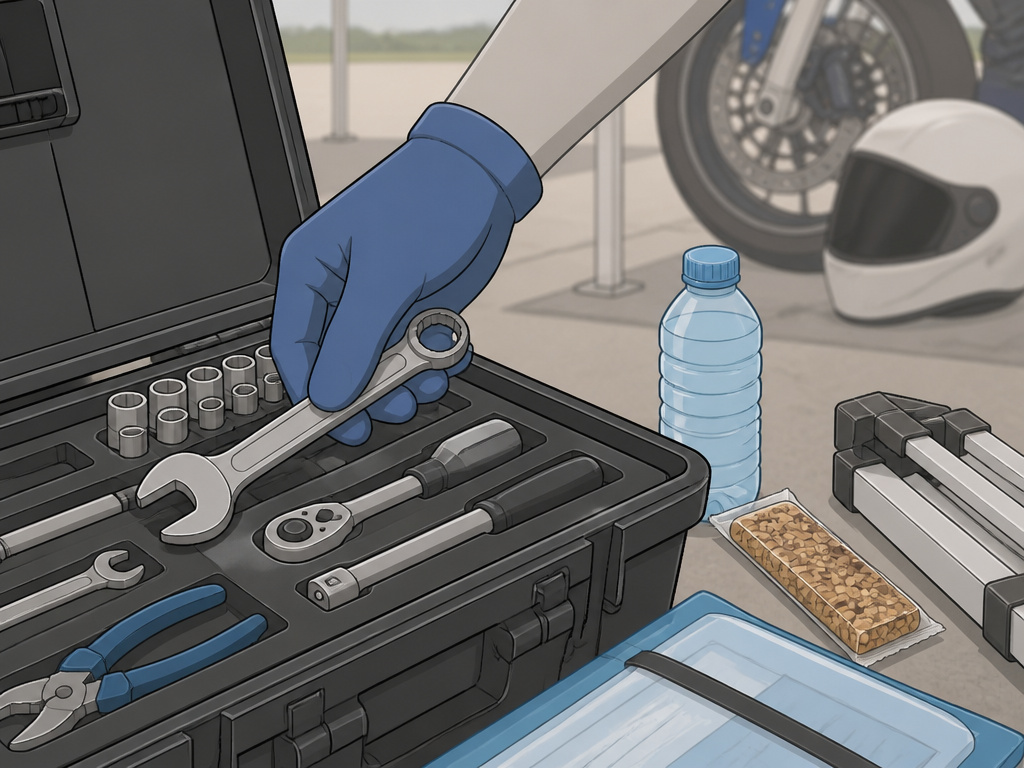
Packing smart makes the day less stressful. You need more than just your bike and gear.
Tools and Spares: Bring a basic toolkit: sockets, hex keys, screwdrivers, and tyre pressure gauge. Pack spare brake and clutch levers, footpegs, and a clutch cable. Bring spare exhaust baffles and packing. Include zip ties, duct tape, and safety wire.
Comfort and Survival: You will get thirsty. Bring a large cooler with plenty of water and electrolyte drinks. Pack high-energy, easy-to-eat food like bananas, granola bars, and sandwiches. A camping chair, a pop-up canopy for shade, and a small table are worth their weight in gold. Don’t forget sunscreen and a hat.
Documents and Admin: Have your driving licence, track day booking confirmation, and any completed indemnity forms in a waterproof folder. Bring cash for fuel, food, and any on-site services.
For You: A change of clothes, a towel, and basic toiletries. You’ll sweat. Having dry clothes for the drive home is a small luxury that feels huge. If you’re prone to riding anxiety, a notepad to jot down goals for each session can help focus your mind.
Think of your pit area as a temporary workshop. Setting it up neatly means you can find what you need quickly between sessions, which means more time to relax and hydrate.
What About After the Track Day?
The work isn’t over when the last session ends. Your bike needs attention before it goes back on the road.
First, let the bike cool completely. Then, remove all the tape from lights and mirrors. Use a adhesive remover to clean off any residue. Re-attach any mirrors you removed.
Check tyre wear. Track riding uses up rubber quickly. Look for unusual wear patterns like cold tearing or excessive shoulder wear. This is valuable feedback on your tire pressure and riding style.
Inspect the bike thoroughly. Look for fluid leaks, especially around fork seals, brake calipers, and the engine. Check all fasteners you safety-wired. Examine brake pads for remaining material. Feel the brake fluid reservoir, if it’s hot, the fluid may have boiled and will need another flush.
Easy to miss: Not checking the chain. The intense load and heat of track riding can stretch a chain and wear sprockets faster than street riding. Lubricate it and check the tension.
If you swapped coolant for water, drain the system and refill with the correct coolant mix to prevent corrosion. This is an essential step if you want your bike to survive the winter.
Finally, be honest with yourself. How do you feel? Track days are physically draining. If you’re riding home, you must be alert. The most dangerous part of your day might be the motorway journey home in fading light. If you’re tired, consider trailering the bike or staying locally. That ride home after my first day was the most focused I’ve ever been on a public road.
Physical preparation and hydration
A track day is physically demanding, involving five or six 20-minute sessions of intense riding. This level of exertion requires you to be in good physical condition and properly hydrated. Avoid drinking too much alcohol the night before to prevent dehydration and fatigue on the day. Drink plenty of water throughout the event to maintain focus and stamina. While the specific requirements for gear and bike preparation can vary, taking care of your body is a universal necessity for safe and enjoyable performance on track.
Crash protection for the bike (sliders, case covers)
Preparing your bike involves more than just performance parts; it includes protecting it in case of a slide. While specific brands or measurements aren’t mandated, fitting crash protection like frame sliders and engine case covers is a highly practical step. These components are designed to take the impact and abrasion instead of your bike’s expensive parts. Always check directly with the track day organiser for any specific rules regarding protection. This preparation helps safeguard your machine, giving you more confidence to focus on your riding.
Differences between street and track riding habits
Track riding requires a different approach than the street. On track, it is always the role of the overtaking rider to take total responsibility for a safe pass. For novice track riding, just use the front brake and ignore the rear brake. Initially, ride as you do on the road but faster, using your usual gears and changing midway through the rev range. Once confident, you can use lower gears and the full rev range, potentially only using three or four gears on road gearing. This shift in technique is key to a safe and progressive track day.
Frequently Asked Questions
What is the 12-second rule on a motorcycle?
The “12-second rule” isn’t a universal track day rule. It’s a teaching concept for road riding about maintaining a 12-second gap to the vehicle ahead for reaction time. On track, the equivalent principle is the overtaking rule: the rider behind is responsible for a safe pass. Always follow the specific passing rules outlined in your track day briefing.
What should I do on my first track day?
Your only jobs are to be predictable, learn the racing line, and manage your energy. Attend the briefing, complete the sighting laps, and spend your first session focusing on consistency, not speed. Hydrate between sessions, use the available coaching, and ignore the temptation to chase other riders. The goal is to finish the day wanting to come back.
What is the 70/30 brake rule for motorcycles?
The 70/30 rule refers to the approximate front/rear brake force distribution under hard braking on a sportbike, with the front providing most of the stopping power. On track, novices are advised to use the front brake only, as the rear is easy to lock. The “rule” is a reminder of where the braking force is, not an instruction to use the rear brake.
What should I bring to my first track day?
Bring all your gear, a well-prepped bike, a basic toolkit with spares (levers, pegs, cable), plenty of water and food, a camping chair, sunscreen, and all required documents (licence, booking confirmation). Pack for a long day outdoors. Consider bringing a friend to help with pit duties and to keep you hydrated.
The Bottom Line
Your first track day is a learning day, not a race day. Get the gear right, get the bike safe, and get your head in the right place. Show up early, listen in the briefings, and use the first sessions to build consistency, not speed.
The one threshold that changes everything: if your brake fluid is old or looks contaminated, change it now. That single, cheap service prevents the lever from going to the bar by lunchtime.
Everything here assumes you’re riding in the novice group on a street-legal bike. If you step outside those bounds, showing up on a dedicated race bike or jumping into the intermediate group, the calculus changes. For a first timer, the standard path is the fastest path to skill.
