
Motorcycle Track Day Flags Explained: The Full Guide
This post contains affiliate links. As an Amazon Associate, we earn from qualifying purchases.
Motorcycle track day flags are a universal visual language for safety, with each color and motion conveying a specific hazard, instruction, or change in track conditions. The core system includes green (go/clear), yellow (caution/no passing), red (session stopped), black (rider penalty or mechanical issue), blue (faster rider behind), and checkered (session end), but national and club variations exist.
The difference between a standing and a waving yellow flag is a critical distinction you need to react to instantly. A stationary flag means a hazard is beside the track; a waving flag means the hazard is on the racing surface. The required action, slow down, no passing, is the same, but the level of danger and your preparedness to stop or swerve is not. This is part of having motorcycle track day flags explained.
What follows is a breakdown of every flag you are likely to see, grounded in official rulebooks from organizations like MotoAmerica and NASA. We will explain the critical disagreements between rule sets, the flags unique to motorcycle events, and the real-world consequences of missing one.
Key Takeaways
- A stationary yellow flag means a hazard is beside the track; a waving yellow flag means the hazard is on the track. Both mean slow down and no passing.
- The meatball flag (black with orange disc) shown with your number means a mechanical problem is endangering you or others. Leave the track immediately, do not complete the lap.
- Red flag procedures vary. Some organizations (NASA) say stop safely off-track; most (MotoAmerica, MNZ) say slow down and return to the pits. Always follow your specific event’s rider briefing.
- Ignoring a black flag directed at you will escalate from a warning to a command to pit, and can result in expulsion from the session or the entire track day.
- Track day rules can differ from professional racing. Always review the flag guide provided at your specific event, as clubs and national bodies use slightly different signals.
The Flag System: Your Primary Communication Link
You are riding at 100 mph, focused on your line and braking marker. The only way race control can communicate a critical, immediate change ahead is with a colored piece of cloth. This is not a suggestion. It is a direct instruction that overrides everything else you are doing on track.
The flag system is the primary communication method between race control and the rider. Identifying flags, understanding their meaning, and taking the correct action are entirely the rider’s responsibility. You must use your peripheral vision to scan for flags at every marshal post.
The system is designed to be simple and instinctive under pressure. Green is good, yellow is caution, red is stop. But the devil is in the details, specifically, in the motion of the flag and the context of the event. A track day at a local club will use a slightly simplified version compared to a MotoAmerica national round. Your first job at any new track is to learn their specific flag protocol, which is the core of having motorcycle track day flags explained.
The Green Flag: Start and Clear
The green flag can mean the track is clear and the session is live (MotoAmerica), or simply that the session is open (NASA HPDE). It signals the end of any previous caution or neutralization. According to the MotoAmerica flag summary, the green must be shown at each marshal post for the first lap of each practice or qualifying session, as well as for the entire sighting lap and warm-up lap. Its most critical function is to mark the point where the no-passing restriction of a yellow flag zone ends.
At a typical track day, you will see the green flag waved on the out-lap to signal the start of open riding. After that, it is only displayed again after an incident has been cleared. If you are under yellow flag conditions, you may not overtake until you pass a station displaying a green flag.
The Yellow Flag: Caution and No Passing
This is the flag you will see most often, and its presentation tells you exactly where the danger is. The universal rule is slow down and no passing. The penalty for passing under a yellow is severe, often an immediate black flag.
What is the difference between a stationary and a waving yellow flag?
| Flag State | Hazard Location | Required Rider Action |
|---|---|---|
| Stationary | Beside the track. A bike or rider is in the runoff area. | Proceed with caution. Be prepared to slow rapidly. No passing. |
| Waving | On or very near the track. Debris, fluid, or a rider may be on the racing surface. | Great danger. Slow down significantly. Be prepared to stop or take evasive action. No passing. |
The MotoAmerica rule is clear: a stationary yellow indicates a “potentially hazardous situation beside the track,” while a waving yellow signals a “serious hazardous situation on track.” The NASA HPDE rulebook defines a motionless yellow as “danger ahead” and a waving yellow as “great danger, be prepared to stop,” but does not specify the hazard’s location relative to the track surface.
Where organizations disagree is on when the passing restriction ends. MotoAmerica states “No passing allowed until the next green flag.” NASA’s rule is more situational: no passing “until completely past the incident, or until past the next manned flag station that is not displaying any Yellow Flag(s), whichever comes first.” This is a key nuance for track day groups with less experienced flaggers, and a vital part of motorcycle track day flags explained.
Common mistake: Braking abruptly at the exact spot you see a yellow flag. This can cause a chain-reaction crash. The flag is warning you of a hazard ahead, not necessarily at the post. Scan ahead, reduce speed progressively, and be prepared for the scene to unfold.
The Red Flag: Session Stopped
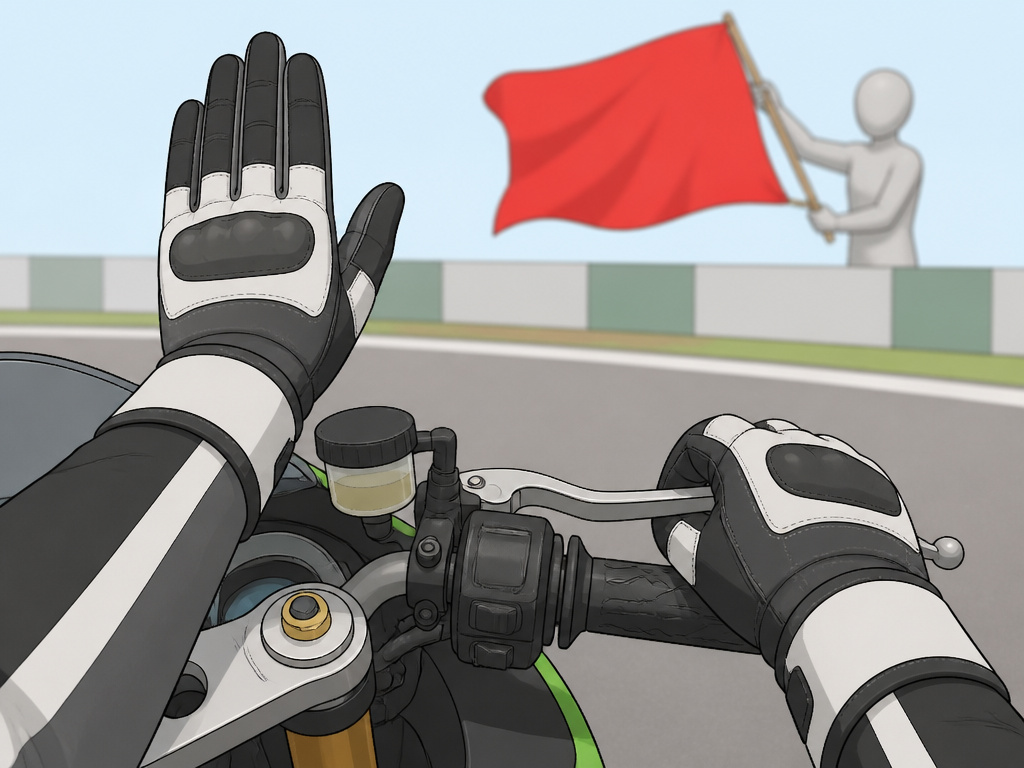
A red flag means the session has been stopped due to a major incident. All riders must immediately cease racing. This is the one flag where official sources give conflicting instructions, so your event’s rider briefing is law.
| Organization | Required Action for Red Flag |
|---|---|
| NASA HPDE | “Come to an immediate and controlled stop on the side of the track in a safe location.” |
| MotoAmerica | “All riders must slow and go to the pits.” |
| Motorcycling New Zealand (MNZ) | “Stop racing immediately and slow down!… Do not stop on track! Return to pit lane.” |
| Tracdayz Briefing | “Reduce your speed, prepare to stop and/or return to the paddock as instructed… Do not stop at the incident.” |
Red flag procedures vary by organization. For motorcycles, NASA HPDE says to stop on the side of the track, while MotoAmerica, MNZ, Tracdayz, and TT Circuit Assen instruct riders to slow down and return to the pits or paddock. Never stop on the racing line to look at an incident.
The Black Flag: Penalties and Problems
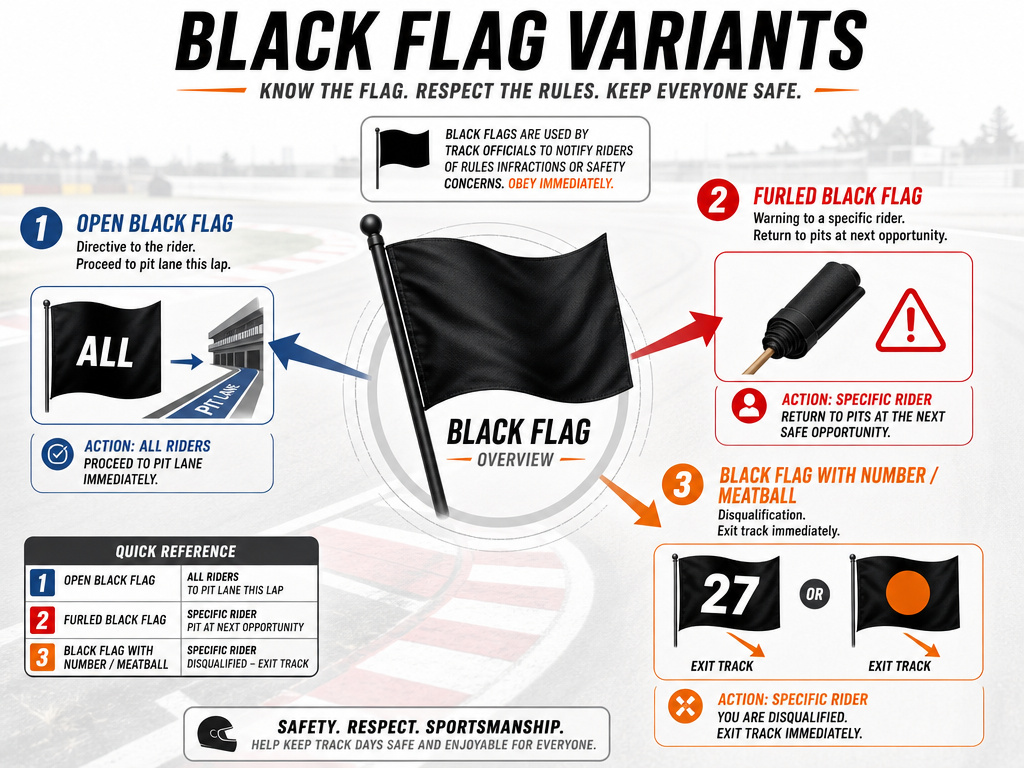
A black flag is directed at you, personally. It signals a problem, and ignoring it guarantees escalation.
- Open Black Flag (General): Shown to all riders or with the word “ALL.” This means the session is being neutralized. All riders must proceed slowly to the hot pits with no passing.
- Furled Black Flag: A warning. You are driving unsafely or have committed a minor infraction (e.g., exceeding sound limits, exceeding track limits repeatedly). Consider it a final warning.
- Black Flag with Your Number: This can have different meanings. For a general black flag with a number (rules/safety infringement), you may need to complete your lap and pit (e.g., Tracdayz). For a meatball flag (black with orange disc) with your number, indicating a mechanical problem, you must leave the track immediately (MotoAmerica, MNZ, TT Circuit Assen). A penalty or lecture awaits.
The most critical black flag variant is the meatball flag.
- MotoAmerica Flag Summary: “The rider must immediately leave the track.”
- Motorcycling New Zealand (MNZ): “Slow down and pull off the circuit to the nearest safe point that is possible. Do not continue around the circuit.”
- TT Circuit Assen: “Technical defect: leave track immediately.”
Continuing for a full lap with a leaking oil line, for example, can oil down the track and cause a massive crash. This flag overrides everything. Acknowledge it to the marshal, signal, and pull off at the next safe runoff or marshal post.
Surface, Rain, and Other Condition Flags
Track conditions change. These flags warn you of a loss of grip, not a physical obstacle.
Surface Flag (Yellow & Red Stripes): Also called the debris or oil flag. It is displayed motionless and indicates a lack of grip from debris, fluid, or contamination (other than rain). The Tracdayz Briefing notes this flag may only be shown for a couple of laps, and when withdrawn it does not mean the condition has resolved.
Rain Flag: Organizations use different flags for rain. MotoAmerica and Tracdayz use a dedicated rain flag. At TT Circuit Assen, a white flag with a red diagonal cross is used for motorcycles. It means rain has started falling on that section of track. This is separate from the surface flag, rain affects the whole track surface, while a surface flag indicates a localized spill.
Blue Flag (with diagonal yellow stripe): A faster vehicle is closely behind you and may attempt a pass. This is not a penalty flag for you. The courteous and safe response is to hold your line and consider giving a clear pass signal on the straight. Do not suddenly change your line or braking points.
The Checkered Flag and Electronic Systems
The checkered flag means the session is over. Complete your current lap cautiously, passing rules still apply, and exit the track via the pit lane. Do not start a new lap.
Modern circuits are increasingly using electronic flag systems (Digiflags). TT Circuit Assen, for example, uses GPS-tracked panels. These systems can introduce flags without a direct physical equivalent, like a purple flag or “Code 60” which mandates a maximum speed of 60 km/h for a full-course neutralization. The principles are the same: the color and symbol on the panel correspond to the traditional flag meaning. Always verify which system your track uses.
National, Club, and Track Day Variations
Not every flag system is global. The Motorcycling New Zealand (MNZ) guide explicitly states, “These are the NZ flags. New flags and/or different use of flags will need to be learned in different countries.” Similarly, the Central Motorcycle Roadracing Association (CMRA) manual notes its signals “may be different from flag signals used at other club meetings.”
This is why the rider briefing is essential. A club track day might not use a meatball flag, opting for a simple black flag with a number for all issues. They may use a double yellow for a full-course caution instead of a special flag. The official MX Safety 38 flagger training manual provides a standardized framework, but local implementation varies. Your safety depends on knowing the local dialect of this universal language.
Consequences of Ignoring Flags
Flags are rules, not recommendations. Enforcement is strict because the stakes are life and limb.
- Yellow Flag Pass: Almost always results in a black flag. You will be pulled from the session. Repeat offenses can lead to expulsion from the event.
- Ignoring a Black Flag (with your number): Officials will continue to display the flag. If you fail to pit, the next step is often a furled black flag followed by an open black flag for all to neutralize the session and retrieve you. You risk being banned from the organizer’s future events.
- Ignoring a Red Flag: This is a grave safety violation. You could be facing immediate expulsion and a report to the sanctioning body.
- Ignoring a Meatball Flag: By continuing with a dangerous mechanical fault, you become a moving hazard. You risk causing a multi-rider crash and will face severe disciplinary action.
The system works on trust and immediate compliance. There is no debate on track. See the flag, obey the flag. The discussion, if any, happens in the pits.
What is a flag-to-flag race procedure?
A flag-to-flag procedure is used when weather changes during a race, allowing riders to swap to wet-weather bikes. The rain flag indicates that rain has started to fall in the section of track where the flag is displayed. A striped red and yellow flag, sometimes called a surface or debris flag, warns of a lack of grip in that sector from oil, water, or gravel. When these flags are shown, the race continues but conditions are deteriorating. Riders may then choose to enter the pits to change motorcycles. The session remains live under green flag conditions unless a red flag is shown to stop it entirely. You must continue to obey all other flag rules, like no passing under yellow, while managing the changing track surface.
Frequently Asked Questions
What does a pink flag mean in motorcycle racing?
There is no standard pink flag. Riders are often referring to the “meatball” flag, which is black with a bright orange disc in the center. From a distance, the orange can appear pinkish. This flag indicates a mechanical problem, and the rider must leave the track immediately.
What is the difference between track day flags and MotoGP flags?
The core colors mean the same thing. The differences are in nuance and additional flags. MotoGP uses FIM-standardized procedures which may include additional flags. Track day organizations often use a simplified subset for clarity, as seen in the NASA HPDE rules.
Do I need to acknowledge every flag?
You must react to every flag. For a yellow or red, your change in speed and behavior is the acknowledgment. For a black or blue flag directed at you, a clear nod or hand signal to the marshal is good practice. This confirms you have seen the instruction.
What happens if I accidentally pass under a yellow?
The moment you realize it, safely raise your hand in apology. Still expect to be black-flagged. When you come in, explain the mistake honestly to the steward. An accidental, single-offense pass might result in a warning or a short hold in the pits, while a blatant or repeated pass will have stronger penalties.
Can flags be displayed with lights instead?
Yes. Most professional circuits and many modern track day venues use a system of colored lights at marshal posts that correspond to the flags (e.g., green light, flashing yellow light, solid red light). The meaning is identical. Always confirm during the briefing whether the event uses flags, lights, or both.
Before You Go
The flag system is not a test. It is your lifeline. Before your first session, walk the track map and mentally note where each marshal post is. During your sighting laps, make a point of spotting them. When you are riding, make scanning for flags part of your visual routine, just like checking your mirrors on the street.
One final, essential rule: The flagger is always right. Even if you think the flag is out for no reason, you obey it. The discussion about why it was displayed happens after you have safely complied. This mindset keeps you, and everyone else on track, safe to ride another day.
