
Do Loud Pipes Save Lives on Motorcycles? The Data Says No
This post contains affiliate links. As an Amazon Associate, we earn from qualifying purchases.
No. The claim that loud motorcycle exhausts prevent crashes is a myth, contradicted by multiple studies and the physics of sound. The 1981 Hurt Report, analyzing over 900 crashes, found no evidence that motorcycles with loud pipes were less likely to be involved in crashes. More recent research shows that even very loud exhausts often cannot be heard inside a car until the bike is dangerously close. Relying on noise for safety creates a false sense of security while damaging the rider’s hearing.
The data is clear, but the belief is stubborn. You’ll hear the phrase in parking lots and online forums, a piece of received wisdom passed between riders, often centered on the do loud pipes save lives on motorcycles question. The problem is, it’s built on a feeling, not facts. The feeling that a roaring engine announces your presence. The data shows that by the time that roar is heard by the driver you need to alert, you’re already in the danger zone.
What follows is a breakdown of the studies, the decibel numbers, and the physics that prove the do loud pipes save lives on motorcycles claim is false. We’ll also lay out the strategies that actually work, backed by the same crash data that debunks the noise myth.
Key Takeaways
- The 1981 Hurt Report, the foundational motorcycle safety study, found no correlation between loud exhausts and reduced crash likelihood.
- Even a 110 dB exhaust, chainsaw loud, cannot be heard inside a modern car until the motorcycle is within 50 feet, per a Romanian MotoMyth study.
- Sound is directed backwards from the exhaust; the majority of collision threats come from vehicles in front of or beside the rider.
- Exposure to sound levels above 100 dB for more than 15 minutes can cause permanent hearing damage to the rider.
- The Hurt Report identified visual conspicuity, being seen, as the primary factor in crash avoidance, not being heard.
What the Research Says About Loud Pipes and Safety
The go-to reference for motorcycle crash causation is the 1981 Hurt Report. It’s not a blog post or an opinion piece; it’s a detailed analysis of over 900 real-world crashes. Its conclusion on noise is blunt: “The modified exhaust system was typical of many accident-involved motorcycles… The modified exhaust is overrepresented in these data.” In plain English, bikes with loud pipes crashed just as often, if not more.
Where this goes sideways: Believing a loud pipe is a safety device. The Hurt Report states the “predominating cause” of crashes is “the failure of motorists to detect and recognize motorcycles in traffic.” A pipe does nothing to fix that failure if the driver never looks.
A more recent study from Romania, often called the MotoMyth study, put numbers to the audibility problem. Researchers tested six motorcycles, with exhausts ranging from 80 to 111 dB(A), at various distances from a car with the windows up and the radio on at a conversational level.
| Motorcycle Position Relative to Car | Could the driver hear it? |
|---|---|
| 50 feet (15 m) behind | No. None of the motorcycles could be heard inside the car. |
| 33 feet (10 m) behind | Barely. Only the single loudest bike (111 dB) was at the limit of audibility. |
| Parked directly in front | No. The motorcycles could not be heard. |
The takeaway is brutal. Even an illegally loud 111 dB system, what the study calls “above the level usually encountered in traffic”, is functionally useless as a warning device until you’re practically on top of the car. At that point, you’re not preventing a crash; you’re already in it.
The Physics Problem: Sound Goes Backwards
This issue concerns direction more than volume. Your exhaust pipes point toward the rear of the bike. Physics dictates that sound energy follows that path, projecting most strongly behind you.
Think about a speaker. If you point it away from someone, they hear it faintly, if at all. Your motorcycle is that speaker. The car you’re trying to alert, the one in front of you at an intersection, or the one about to merge into your lane, has its back to your “speaker.” The sound has to travel around the car, through insulation, glass, and likely music or conversation, to reach the driver’s ears.
A 1976 National Bureau of Standards report (NBSIR 76-1001) noted that at 25 feet, motorcycle sound levels can exceed 90 dB. But that’s the level outside the car. Inside, with all the barriers modern vehicles have, that number plummets.
This is why the MotoMyth study’s results are so definitive. The noise is literally going the wrong way. It might startle pedestrians you’ve already passed or annoy residents, but it does almost nothing to inform the driver whose decision matters most.
How Loud Is “Loud”? Legal Limits vs. Reality
When riders talk about a “loud pipe,” what decibel level are we actually discussing? The legal framework and real-world measurements show a massive gap.
In the United States, the federal noise standard for motorcycles (40 CFR §205.166) sets the limit for street-legal bikes (1983 model year and later) at 70 dB(A). In Europe, the ECE R41.04 standard sets a common limit of 77 dB(A). These are the numbers manufacturers must design to for a bike to be sold as street-legal.
Now, the reality. The MotoMyth study notes that “the vast majority of motorcycles considered noisy have a sound level up to 105 dB(A).” That’s not a slight bump. It’s a 35 dB increase over the U.S. Limit. In acoustic terms, a 10 dB increase is perceived as a doubling of loudness. A 105 dB pipe isn’t just loud; it’s operating at a level eight times louder than what the law allows for a reason.
| Sound Source / Standard | Decibel Level (dB(A)) | Notes |
|---|---|---|
| U.S. Federal Legal Limit (Street) | 70 | For 1983+ model year motorcycles. |
| European ECE R41.04 Limit | 77 | Example: A tested Harley-Davidson Softail measured 75.4 dB. |
| Typical “Noisy” Aftermarket Exhaust | Up to 105 | The MotoMyth study’s upper bound for what’s commonly encountered. |
| Chainsaw / Nightclub | 110 | Level where hearing damage can occur in under 15 minutes of exposure. |
| Threshold of Pain | 130+ | Jet takeoff at close range; no exhaust system reaches this legally. |
The jump from 70 dB to 105 dB is a radical modification that pushes a bike from compliant to profoundly disruptive. And as the data shows, it doesn’t buy you the safety you think it does.
The Real Cost: Your Hearing
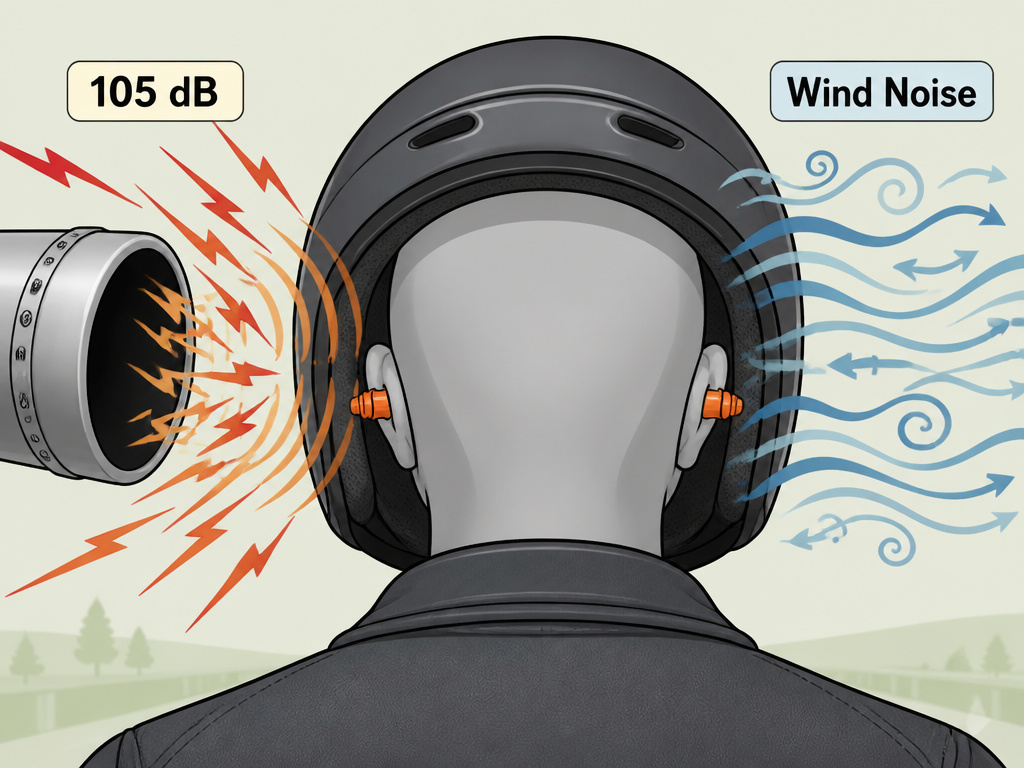
A loud pipe actively harms you instead of saving your life. You are the person closest to the noise, exposed to it for the entire duration of your ride.
The science on hearing damage is not subtle. According to the MotoMyth study, chronic sound trauma is “generated by long-term exposures to noises of intensity of 80-85 dB(A).” Remember, a “noisy” pipe can be 105 dB. Sources such as MotorBiscuit report that exposure to 110 dB for just 15 minutes a day can cause permanent hearing damage.
But it’s not just the exhaust. Once you’re above 25 mph, wind noise overtakes your engine and pipe noise as the primary source of sound hitting your ears. At highway speeds, that wind roar is a constant, hearing-damaging gale. Adding a louder pipe just gives you two sources of damage instead of one.
Common mistake: Relying on a loud pipe without wearing ear protection. You’re trading long-term hearing for a false short-term security blanket. The damage is cumulative and irreversible.
This is why any serious discussion of hearing protection is essential. A good set of ear plugs is a far better investment in your long-term riding health than any aftermarket pipe.
What Actually Works: Strategies That Save Lives
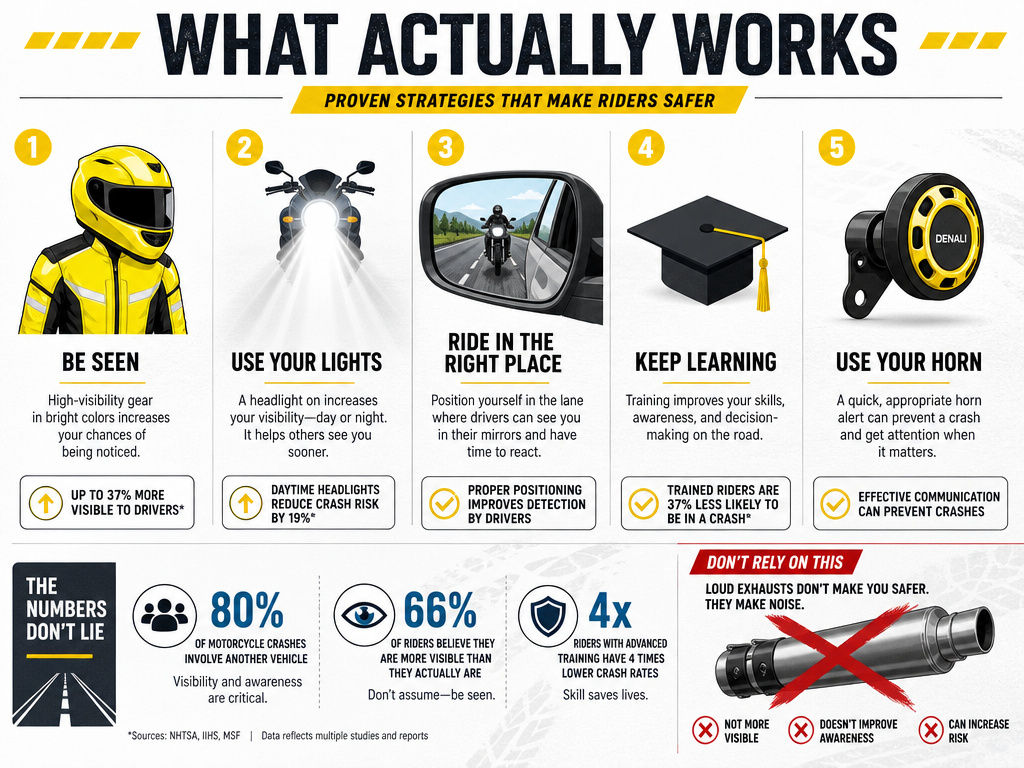
The Hurt Report didn’t just debunk myths; it highlighted what does work. Its findings point squarely toward conspicuity, being seen, and rider training.
As cited by Flannery Safety Consulting, the Hurt Report’s Point 34 states: “Motorcycles equipped with fairings and windshields are underrepresented in accidents, most likely because of the contribution to conspicuity…” It wasn’t the noise; it was the larger, more visible silhouette that made the difference. This is the core of effective motorcycle defensive riding techniques.
Here’s a short list of actions with a much higher return on investment than a loud pipe:
- Wear High-Visibility Gear. A bright helmet, jacket, or vest is the single most effective way to be seen. The human eye is drawn to contrast and color long before it processes sound.
- Ride with Your Headlight On. Always. Modern bikes do this automatically. If yours doesn’t, wire it to be on.
- Practice Lane Positioning. Place yourself in the lane where you are most visible in a car’s side mirrors. Avoid riding directly in a car’s blind spot.
- Get Professional Training. A safety course teaches intersection safety and hazard awareness that no exhaust note can replicate.
- Upgrade Your Horn. A set of loud horns is a directed, intentional sound meant to alert others. It points forward and is designed to be heard inside a vehicle.
These strategies address the actual problem identified in the crash data: the failure of drivers to see you. They form the basis of a real plan for how to be more visible on a motorcycle.
A Safer, Quieter Path Forward
The conversation about exhaust pipes and exhaust system types should be about performance, weight, or aesthetics if you wish. It should not be about safety. The research has settled that question.
The desire to be safe is universal among riders. Channel that desire into actions proven to work. Buy the bright jacket. Take the advanced course. Practice your emergency braking. These are the choices that build real confidence, not the hollow comfort of a roaring exhaust that nobody else hears until it’s too late.
The road is risky enough without clinging to a myth that harms your ears and annoys everyone around you. Be seen. Ride smart. That’s the formula that holds up under scrutiny.
Where did the phrase ‘loud pipes save lives’ come from?
The phrase is a rider community maxim, an anecdotal belief that modifying a motorcycle’s exhaust to be louder improves safety by making the bike more noticeable to other drivers. The justification is that a loud exhaust acts as an audible warning, alerting inattentive motorists to a motorcycle’s presence. This belief persists despite research to the contrary. The foundational Hurt Report, analyzing over 900 crashes, found no evidence that motorcycles with loud pipes were less likely to be involved in crashes. The report noted that modified exhaust systems were typical of many accident-involved motorcycles, meaning they were overrepresented in crash data.
Are loud motorcycle pipes like emergency vehicle sirens?
No, they are not comparable in effectiveness. An emergency siren is a high-frequency sound designed to project forward and cut through ambient noise, alerting traffic ahead. A motorcycle’s exhaust sound is directed rearward. Studies show this sound does not effectively reach drivers in front. Research reported by Hemmings found that with a motorcycle parked 33 feet behind a car, even the noisiest motorcycles tested could hardly be heard inside the car. A study reported by Hemmings found that with a motorcycle parked in front of a car, the motorcycles cannot be heard. Therefore, a loud exhaust lacks the directional projection and frequency characteristics of a siren, making it a poor substitute for alerting the drivers who pose the greatest risk.
Frequently Asked Questions
Do loud pipes save lives on motorcycles?
No. Multiple studies, including the detailed 1981 Hurt Report, have found no evidence that loud exhaust systems reduce crash rates. The physics of sound direction and modern vehicle insulation mean drivers in front of you often cannot hear your exhaust until you are dangerously close.
What is the loudest road-legal exhaust?
“Road-legal” is defined by noise emission standards. In the U.S., the federal limit for street motorcycles (1983+) is 70 dB(A). In Europe, a common limit under the ECE R41.04 standard is 77 dB(A). Any exhaust that meets these certification limits when tested officially is road-legal. Exhausts marketed as “louder but legal” are typically designed to pass a specific stationary test but may be louder in real-world riding.
How loud is too loud for motorcycle exhaust?
From a safety and health perspective, anything that pushes you to need hearing protection is too loud for prolonged exposure. Mechanically, anything that exceeds your local noise ordinances (which are often around 95-100 dB when measured from a specific distance) is too loud and can result in fines. For your own hearing, consistent exposure to levels above 85 dB(A) is considered harmful.
What is a better safety investment than a loud exhaust?
Invest in high-visibility gear (a bright helmet or jacket), professional rider training, and a helmet. The data shows that being seen and being skilled are the most significant factors in crash avoidance. Upgrading your motorcycle’s horn is also a more effective auditory alert than a loud pipe, as it is a directed, intentional sound.
The Bottom Line
While studies like the Hurt Report and MotoMyth study find no safety benefit, the rider community maxim ‘loud pipes save lives’ represents a persistent, though unproven, belief in their effectiveness. It doesn’t work as intended, it damages your hearing, and it alienates the public. The path forward is quieter and brighter. Spend your money on a high-visibility helmet and a track day. Spend your energy on mastering defensive riding and situational awareness. That’s how you build a real margin of safety on the road, backed by decades of data, not decades of dogma.
