
Slip on vs Full Exhaust on a Motorcycle: Key Differences
This post contains affiliate links. As an Amazon Associate, we earn from qualifying purchases.
A slip-on exhaust replaces just the muffler, saving weight and changing sound while keeping emissions equipment intact; a full system replaces everything from the cylinder head back, enabling real power gains but requiring a tune and removing the catalytic converter. For most street riders chasing a better sound, a slip-on is the smarter buy. If you’re after maximum performance and are ready to budget for a tune, a full system is the only path.
That summary hides the real fork in the road. The difference between a slip-on and a full system isn’t just about parts; it’s the core choice of slip on vs full exhaust on a motorcycle. It’s about what you’re actually buying: a new voice for your bike, or a new engine character.
This guide walks through the three costs riders miss: parts, labor, and the inevitable tune. It covers the sound and weight changes you can measure, the power claims you should question, and the legal fine print that determines whether your upgrade is street-legal or track-only. By the end, you’ll know which one fits your garage, your wallet, and the way you ride.
Key Takeaways
- Choose a slip-on for a deeper sound and lighter tail section, often without needing a tune, but expect minimal horsepower gains.
- Choose a full system for measurable power and torque increases, but plan for an ECU tune and know you’re removing emissions equipment.
- The catalytic converter is the line. Keeping it (slip-on) means street legality; removing it (full system) means potential check-engine lights and off-road designation.
- Real power lives in the tune, not the pipe. Budget $250–$400 for a mail-in ECU flash as part of any full system purchase.
- For 600cc sport bikes, a full system with a tune commonly delivers a 5–8 hp change, while owners report slip-on gains in the 0–3 hp range, often nothing at all.
What’s the Core Difference? (Slip-On vs Full System)
The names tell you what gets replaced. A slip-on replaces the muffler and sometimes a short mid-pipe, leaving the factory headers and, critically, the catalytic converter in place. You’re changing the last stage of the exhaust path. A full system replaces everything from the exhaust ports back: headers, mid-pipe, catalytic converter, and muffler. You’re redesigning the entire tract.
A slip-on muffler replaces the end cap and baffle of your stock exhaust while leaving the factory head pipes in place. It is the fastest, cheapest way to change your sound.. TAB Performance Blog
That catalytic converter is the legal and mechanical pivot. It’s a densely packed metal honeycomb that scrubs pollutants, but it’s also a major exhaust restriction and heat generator. Keeping it means your bike likely stays within EPA or EC/ECE noise and emissions standards. Yanking it opens up flow for power but turns your upgrade into a “closed course use only” part in many regions.
Here is the breakdown that decides your next move.
| Component | Slip-On Exhaust | Full System |
|---|---|---|
| Replaces | Muffler & sometimes a short mid-pipe | Headers, mid-pipe, catalytic converter, muffler |
| Catalytic Converter | Stays in place | Removed |
| Primary Goal | Sound, looks, minor weight reduction | Maximum performance & weight reduction |
| Tune Required | Often not required (check model) | Required to run safely & realize gains |
| Street Legal (Emissions) | Usually yes (keeps stock cat) | Usually no (removes cat) |
The choice crystallizes quickly. Want a different note and less weight over the rear wheel on a Saturday afternoon? Slip-on. Willing to retune the engine’s brain for more power everywhere, accepting it’s now a track bike on paper? Full system.
Sound & Volume: The Parking Lot Test vs. The Highway Reality
Sound is the number one reason riders change exhausts. But the character shift between these two upgrades is more than just loud versus louder.
A slip-on works with the factory baffling. The stock headers and cat chamber the pulses and muffle frequencies before they ever reach your new can. The result is a refined, deeper tone. It’s more voice, less shout. For example, a Yoshimura AT2 Slip-On for a CBR1000RR measures 101.2 dB at 5,000 rpm per the J2825 standard, up from a stock 94.1 dB. That’s noticeable, but it’s not the raw blast of an open header.
A full system removes the factory muffling stages. The exhaust pulses travel straight out through tuned headers into a smaller muffler. The sound is sharper, more aggressive, and carries a metallic rasp at high RPM. It’s the race-bike bark. That character is exhilarating for a blast down a canyon road but can become a fatiguing drone on a long highway commute.
The part nobody mentions: heat management. A slip-on leaves the catalytic converter in place. A full system removes the catalytic converter, which is a major heat generator. Your calf notices the difference on a summer ride before your ears do.
Weight Savings: Where the Grams Actually Hide
Both upgrades shed pounds, but the scales don’t lie about where the weight comes off.
A slip-on replaces a steel or cast iron stock muffler with a can made of titanium, carbon fiber, or lightweight stainless. The saving is real, but it’s over the rear axle. An Akrapovič Slip-On Line (Carbon) has a claimed weight of 1.75 kg (3.9 lb) and represents a 23.2% weight reduction from stock. The Yoshimura AT2 Stainless slip-on for the CBR1000RR weighs 4.3 lbs versus a stock muffler at 6.7 lbs.
A full system goes after the big mass. The factory headers, cat assembly, and heavy bracketry are all replaced with thin-wall tubing. The weight saving is more significant and, more importantly, comes from the bike’s center of mass. The Toce Performance Razor Full Exhaust uses aircraft-grade aluminum and thin-walled stainless headers, with a canister assembly under 3 pounds. According to the Unstocked guide, full system weight reduction is typically -8 to -15 lb.
That central weight loss changes handling. The central weight loss from a full system can change the bike’s handling feel. For aggressive street or track riding, the central weight loss from a full system can be a significant handling benefit.
Performance & Power: Hope vs. Measured Reality

This is where marketing meets mechanics, and the gap is wide.
Manufacturers publish dyno charts. For example, Akrapovič claims a specific slip-on model provides a max power gain of +0.5 hp (m) at 11,300 rpm and another +1.2 hp (m) at 6,500 rpm. Yoshimura claims a 2.1% max horsepower increase for its AT2 Slip-On.
The owner consensus, aggregated by sites like Unstocked, reports slip-on power gains in the ~0–3 hp range, often nothing measurable at all. Why the disconnect? The catalytic converter. That factory part is the single biggest restriction in the exhaust tract. A slip-on leaves it in place, so the fundamental airflow bottleneck remains. Any gain is marginal and often sits at a very specific RPM point you might rarely use.
Owners of 600s commonly describe the exhaust-plus-tune combination as a 5–8 hp change, more on liter bikes. The catch every forum learns the expensive way: the gains live in the tune, not the pipe.. Unstocked Guide
A full system removes the cat and optimizes header length and diameter for scavenging, the physics of using exhaust pulses to pull fresh air into the cylinder. This can produce substantial gains across the midrange and top-end. But, and this is the critical clause, these gains only materialize with an ECU tune. A full system on stock fueling usually runs lean, surges at part throttle, and can even lose power in some parts of the rev range.
The performance question boils down to this: are you buying a pipe, or are you buying a pipe and a tune in the slip on vs full exhaust on a motorcycle debate? The first is a slip-on. The second is a full system.
The Install & Tune Reality
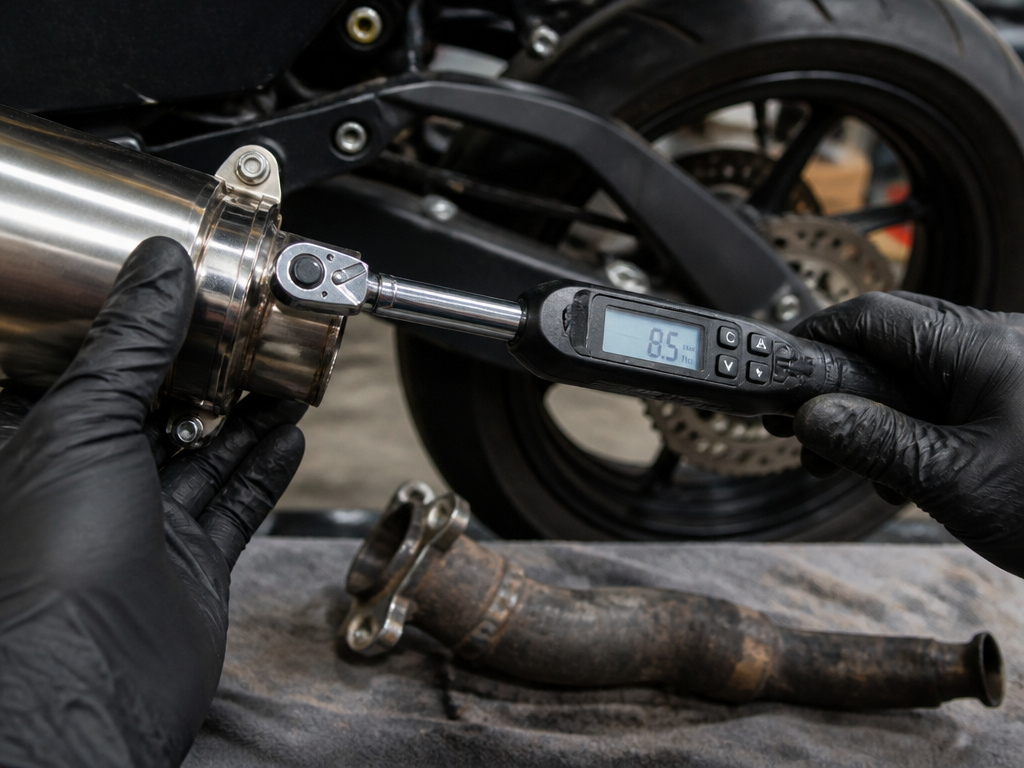
Here is where weekend plans meet torque wrenches.
Slip-on installation is straightforward. It’s often a 30–60 minute job with basic hand tools: wrenches, a socket set, and maybe a rubber mallet. You’re removing a few bolts, swapping the can, and re-torquing to spec. Yoshimura’s manual for the AT2 Slip-On specifies torquing the exhaust clamp to 8.5 Nm (6 ft-lb). It’s a garage-friendly Saturday project.
Full system installation is a different tier. You’re unbolting parts at the cylinder head, which may mean removing radiator shrouds or oil coolers for access. Header bolts can be corroded or over-torqued from the factory. Sealing new header gaskets is critical to prevent dangerous leaks. This job can take a full afternoon or longer, and a motorcycle lift is highly recommended.
Before you start: Let the motorcycle cool down completely. The exhaust system can be extremely hot. Always wear hand and eye protection and properly support the vehicle with a stand.. Yoshimura Installation Instructions
Now, the tune.
Sources disagree on the necessity of a tune for a slip-on. Akrapovič states no remapping is necessary for one model, while other guides suggest a tune is optional or recommended for optimal fueling.
For a full system, a tune is not optional. You’ve radically changed the airflow. The engine will run lean, too much air for the fuel, which raises combustion temperatures. This risks knocking and, over time, can damage pistons and valves. You have several tuning paths, including a mail-in ECU flash, a piggyback fuel controller with dyno tuning, or a custom dyno tune. Budget for this as part of the full system’s total cost.
Budget the tune as part of the full system’s total cost. A $1,500 system plus a $350 flash is a $1,850 upgrade. Thinking of skipping it to save money? That’s how you turn a performance mod into an engine risk.
Legality, Warranty & The Street vs. Track Divide
This is the fine print that can turn an upgrade into a regret.
Emissions Compliance: Some slip-ons, like Yoshimura’s “Street Series,” are explicitly a “Qualified Manufacturer Declared ‘Replacement Part'” for emissions compliance. It’s designed not to tamper with the emissions system and may carry EC/ECE or EPA labels. A full system removes the catalytic converter, a federally mandated emissions device in most countries. That makes it “for closed course competition use only.” Riding it on public roads is technically illegal in many jurisdictions, a fact reflected in the product’s documentation.
Noise Compliance: Local ordinances often have decibel limits for vehicles. For example, an Akrapovič Slip-On Line (Carbon) claims a sound level of 95.2 dB at 5,500 rpm. A full system often produces a different, and typically more aggressive, sound character. Know your local laws; a fix-it ticket for excessive noise is a common and expensive surprise.
Vehicle Warranty: Modifying the exhaust system, especially one that requires an ECU flash, can void portions of your motorcycle’s factory warranty. A dealer can deny a warranty claim on the engine if they can link a failure to the modified fueling or exhaust. Some aftermarket exhaust companies offer limited warranties on their products, but these do not cover the factory bike’s warranty.
Insurance Implications: Modifying the exhaust system, especially with a non-street-legal part, can have insurance and warranty implications worth investigating.
The rule is simple: if you ride primarily on the street and want zero legal or warranty hassle, a street-legal slip-on is your only real choice. If you accept the off-road designation and associated risks for track or private land use, a full system opens up.
Slip-On vs Full System: A Rider’s Decision Matrix
So, which one is for you? This isn’t about budget first; it’s about intent.
| Rider Profile | Upgrade Recommendation | Why It’s the Right Fit |
|---|---|---|
| Street Commuter / Casual Rider | Quality Slip-On (e.g., Yoshimura Street Series) | Wants better sound and looks without tuning, keeps bike street-legal, easy self-install. |
| Canyon Carver / Sport Rider | Slip-On or Full System + Tune | If sound/weight is enough, slip-on. If chasing midrange power for corner exit, full system + tune. |
| Track Day Enthusiast | Full System + Professional Tune | Maximizes power-to-weight, tunable for specific tracks, accepts off-road-only status. |
| Adventure / Touring Rider | Lightweight Slip-On | Saves weight on the tail for luggage handling, improves sound without deafening on long hauls. |
| Harley / Cruiser Owner | Slip-On or 2-into-1 Full System | Slip-on for sound/baffle swaps; 2-into-1 full system for significant low-end torque gains with a tune. |
When considering slip on vs full exhaust on a motorcycle, for the large majority of street riders, a well-made, street-legal slip-on is often the more practical choice. It delivers the sensory change you’re after, the deeper idle, the lighter feel, without the cost and complexity of a tune or the legal gray area. It’s the upgrade you’ll actually appreciate every time you start the bike, not just on a dyno sheet.
Skipping a tune with a full system risks running lean under load, which is hard on an engine and can lead to poor performance.
The Bottom Line: What to Do This Weekend
Stop looking at shiny mufflers online. Answer these three questions in order:
- What’s my primary goal? Write down one word: Sound, Weight, or Power.
- What’s my total budget? If the answer is under a grand, your choice is made. Look at slip-on exhaust systems in your price range.
- Am I willing to tune? If “no” or “maybe later,” stick with a slip-on. If “yes, it’s part of the plan,” start researching full-system options and reputable ECU tuners for your bike model.
Then, and only then, start shopping. Match your choice to how you actually ride, not the fantasy garage build. A slip-on is a finish carpentry job, it makes the whole house sound better. A full system is a foundation upgrade, it changes the structure, and you build everything else on top of it.
Choose the one that fits the bike you have, not the bike in the magazine.
Frequently Asked Questions
Do I need a tune for a slip-on exhaust?
For most modern fuel-injected motorcycles, a tune is optional but recommended for a slip-on that keeps the catalytic converter. The bike’s computer can adjust within a limited range. However, even a slip-on can benefit from a fuel adjustment for smoother throttle response. For a full system, a tune is not optional; it is required for safe operation and to realize any performance gains.
Are slip-on exhausts bad for your motorcycle?
No, a slip-on from a manufacturer that provides clear installation torque specs is not bad for your motorcycle. It is a bolt-on replacement part. Problems only arise from poor installation (exhaust leaks) or using an extremely loud slip-on that encourages aggressive riding. Stick with brands that provide clear installation torque specs, like the 8.5 Nm (6 ft-lb) for the Yoshimura exhaust clamp.
What is better, slip-on or full exhaust?
“Better” depends on your goal. For a deeper sound and lighter weight with minimal hassle and street legality, a slip-on is better. For maximum horsepower, torque, and weight reduction, and if you accept the need for a tune and potential legal/emissions issues, a full system is better. Review the exhaust system comparison to see which aligns with your priorities.
How much horsepower does a slip-on exhaust add?
Manufacturer claims vary widely, from +0.5 hp to +1.2 hp for specific Akrapovič models, to a 2.1% increase for a Yoshimura slip-on. Real-world owner reports consistently show gains in the 0–3 hp range, often at the very top of the RPM band. For meaningful, across-the-RPM power, you need the catalytic converter removal and tuned headers of a full system.
Can I install a slip-on exhaust myself?
Yes, installing a slip-on exhaust is a common DIY project. You typically need basic hand tools, a torque wrench, and about an hour. Always follow the manufacturer’s instructions, let the bike cool completely, and support it securely on a stand. If you’re unsure, having a professional mechanic handle the exhaust installation is a wise investment.
