
How to Prevent Hearing Loss From Motorcycle Riding
This post contains affiliate links. As an Amazon Associate, we earn from qualifying purchases.
To prevent hearing loss from motorcycle riding, you must block wind noise, which reaches 90 dB(A) at 40 mph and climbs to ~120 dB(A) at racing speeds. The three-step plan is essential: wear correctly fitted earplugs on every ride, choose a helmet designed to minimize noise, and limit your high-speed exposure. A 1995 study of Grand Prix riders found 45% had measurable hearing loss, and a 2007 acoustics study showed a standard 30-minute ride can cause a temporary hearing threshold shift of over 15 dB.
The “temporary” part is the trap. That shift happens every ride, and over thousands of miles it becomes permanent. The damage is cumulative and irreversible. A key part of how to prevent hearing loss from motorcycle riding is knowing your helmet is a frequency filter, not a hearing protector, that can actually amplify the damaging low-frequency rumble.
What follows is the data-driven breakdown most riders never see when considering how to prevent hearing loss from motorcycle riding: the exact decibel levels, the one helmet characteristic that makes noise worse, and the simple three-part habit that stops the damage before it starts.
Key Takeaways
- Wind noise hits 90 dB(A) at 40 mph, exceeding the 85 dB(A) over 8 hours occupational safety limit in minutes, not hours.
- A standard helmet acts as a spectral filter, amplifying low-frequency noise by up to 15 dB while only cutting higher pitches.
- After just 30 minutes of riding, studies document a temporary hearing threshold shift over 15 dB; repeated exposure makes it permanent.
- For effective protection, you need properly fitted earplugs, foam, reusable, or custom, worn on every single ride, regardless of duration.
- Combine earplugs with a well-sealed, quiet helmet and awareness of exposure time to build a complete defense.
What Actually Happens to Your Ears?
You feel the wind, but your ears measure it. At 40 mph, the noise hitting your ears is 90 dB(A), according to a 1995 study. That’s the volume of a lawnmower or a shouted conversation. By 100 mph, it’s a screaming 110 dB(A).
The UK Health and Safety at Work Act (1989) defines 85 dB(A) over an 8-hour day as the threshold for occupational noise-induced hearing loss risk. On a bike, you blast past that limit in the time it takes to merge onto the highway. This isn’t an opinion; it’s physics. The energy in those sound waves physically fatigues and damages the delicate hair cells in your inner ear.
A motorcycle helmet does not simply reduce noise; it acts as a frequency-dependent filter. It attenuates sound above 500 Hz but can amplify low-frequency noise (below 500 Hz) by as much as 15 dB.
That’s the critical twist. Your helmet isn’t a perfect barrier. It muffles the higher-pitch whistle but can turn the low-frequency roar and engine drone into a more powerful, body-shaking vibration. This changes the entire game for hearing protection. Standard foam plugs are great at blocking air-transmitted noise, but that low-frequency amplification can still reach your inner ear through bone conduction. That’s why some acoustics researchers argue passive plugs alone are insufficient, while other studies conclude that foam earplugs are effective and abolish temporary threshold shift.
The first sign of trouble is a temporary threshold shift (TTS). After a one-hour ride at 80 mph, a 1993 study (McCombe) found riders suffered a mean maximal Temporary Threshold Shift (TTS) of 11 dB at 1000 Hz. Your hearing is literally dampened. It feels like your ears are stuffed with cotton, and sounds seem muffled. Normally, it recovers overnight. But do that ride every day, and the recovery gets slower, then incomplete. The temporary shift hardens into a permanent notch on your audiogram, usually in the 3000-6000 Hz range, exactly where speech clarity lives.
The 3-Step Rider’s Hearing Protection Plan
This requires a system, and skipping any part of it leaves you vulnerable. Think of it like gear for a crash: you need a helmet, jacket, gloves, and boots. For your hearing, you need plugs, the right helmet, and smart habits to answer the how to prevent hearing loss from motorcycle riding question.
1. Wear Earplugs. Every. Single. Time.
This is the cornerstone. The data from professional riders is stark. In that 1995 Grand Prix study, only 39% of riders were regular earplug users, and 45% had measurable hearing loss. A 1993 study found that wearing tested earplugs (like Silisoft, EARfit, or AQUAfit) abolished the temporary threshold shift.
Your goal is to cut the noise dose reaching your ears. Don’t overcomplicate the initial choice. A pack of foam earplugs with a high Noise Reduction Rating (NRR) is better than nothing. Roll them tight, pull your ear up and back to straighten the canal, and insert them deeply. Wait for them to expand. You should hear your own breathing and heartbeat more prominently; the world shouldn’t go silent.
For frequent riders, upgrading to reusable filtered earplugs makes a significant difference. They attenuate damaging wind noise evenly across frequencies while preserving crucial mid-range sounds like horns, sirens, and engine notes. The difference involves clarity and reduced fatigue, not just volume. Our dedicated guide to choosing earplugs walks through NRR ratings, filter types, and fit.
Common mistake: Skipping earplugs on short rides. Wind noise damage is dose-dependent. A 20-minute blast at 70 mph delivers a significant hit. Consistency is everything.
2. Choose a Helmet for Quiet, Not Just Style
Your helmet is your first line of defense against the wind, and its design dictates the noise signature you have to block. A quiet helmet has a tight, smooth seal at the neck and chin, well-contoured cheek pads, and a aerodynamically stable shell that doesn’t buffet.
When researching, look for models consistently reviewed as quiet. Our list of the best quiet motorcycle helmets is a starting point. The goal is to minimize the initial noise assault so your ear protection has less work to do. A helmet that whistles and roars at highway speed is fighting your earplugs.
Pay attention to the visor seal and ventilation. Open vents often howl. A Pinlock anti-fog insert not only stops fogging but can also improve the visor’s seal against the base plate, cutting a high-pitched whistle source. Remember, the helmet itself is that spectral filter. A quieter helmet means less of that problematic low-frequency amplification to deal with.
3. Manage Your Exposure and Speed
The third step is behavioral. Noise exposure is a product of volume and time. If you must ride for hours on end, plan breaks. Sixty minutes of continuous 80+ mph wind noise is far more damaging than the same time broken into segments with stops.
Most importantly, respect the logarithmic scale of speed vs. Noise. The jump from 70 mph to 80 mph isn’t linear; it’s a significant increase in acoustic energy. Slowing down just 5-10 mph on a long interstate stretch dramatically reduces the noise dose your ears endure. For touring riders, this is as important as planning fuel stops.
| Riding Scenario | Approx. Noise Level | Equivalent To | Max Safe Exposure (85 dB limit) |
|---|---|---|---|
| 40 mph | 90 dB(A) | Lawnmower | ~45 minutes |
| 70 mph | ~105 dB(A) | Power Tools | ~5 minutes |
| 100 mph | 110 dB(A) | Chainsaw | ~90 seconds |
| 150 mph | ~120 dB(A) | Siren | < 30 seconds |
Table based on data from McCombe (1995) and OSHA exposure guidelines. “Safe exposure” is the time before exceeding the 85 dB(A) 8-hour energy equivalent.
Foam, Reusable, or Custom: Picking Your Earplug
All earplugs are not created equal, but the best one is the one you’ll wear correctly every time. This isn’t a minor detail; fit is everything. An improperly seated foam plug can drop its protection by 50% or more.
Disposable Foam Plugs: The universal starter. They offer a high potential Noise Reduction Rating (NRR) and are cheap. The downside? You have to fit them perfectly every time, and they can feel isolating. They’re a consumable, like oil filters, plan to replace them often.
Reusable Filtered Plugs: These use acoustic filters to cut wind and exhaust drone while leaving speech and warning sounds clear. They’re easier to insert consistently, washable, and last for years. The trade-off is a typically lower Noise Reduction Rating (NRR) compared to foam plugs.
Custom Molded Plugs: The gold standard for frequent riders. An audiologist takes an impression of your ear canals. The result is perfect fit, all-day comfort, and you can specify filter attenuation levels. The cost is higher, but so is the consistent protection.
The debate between foam vs reusable often misses the point. For a new rider, foam is fine. For anyone riding regularly, the convenience and consistent fit of a reusable filtered plug make it the smarter long-term investment. Check our roundup of the best ear plugs for motorcycle riding for specific model comparisons.
Why Your Helmet Is Part of the Problem

We trust helmets with our skulls, so we assume they protect our ears. The acoustics research says otherwise. That 2007 study on helmet spectral filtering is a landmark. Using insertion loss measurements and loudness matching, they proved helmets attenuate sound above 500 Hz but amplify noise below 500 Hz by up to 15 dB.
Your brain perceives loudness based on a standardized curve. The helmet dramatically warps that curve. The low-frequency engine rumble and wind buffeting you feel in your chest? Your ears are getting a boosted dose of it. This is why sometimes, even with earplugs, you finish a ride feeling a deep, fatiguing thrum in your head.
This doesn’t mean helmets are bad. It means they are a variable you must account for. A noisy, ill-fitting helmet makes the amplification worse. A well-sealed, quiet helmet minimizes the initial noise input. This is why selecting from the best motorcycle helmets for reducing wind noise is a direct hearing-health decision, not just a comfort one.
The Professional Rider’s Warning
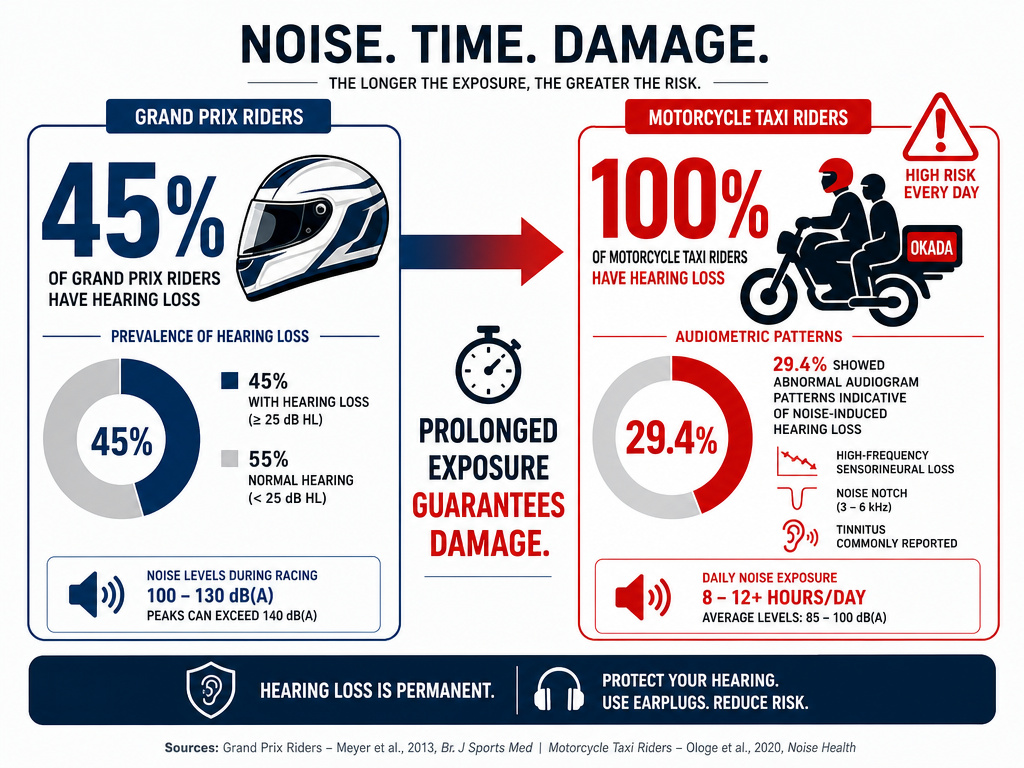
Recreational risk is one thing. Occupational exposure is another, and it shows us the inevitable endpoint of ignoring protection. A 1995 study (McCombe) of 44 Grand Prix riders found 45% had hearing losses greater than age-matched controls. Their hearing deficit correlated with racing experience.
More telling was a 2008 study (Revista CEFAC) of motorcycle taxi drivers in Brazil. It found 100% had noise exposure exceeding 100% of the permissible dose for their 12-hour shift, and 29.4% already showed audiometric characteristics of noise-induced hearing loss. These riders weren’t on race tracks; they were working city streets.
The message is brutal in its clarity: prolonged exposure without protection guarantees damage. The professional data is the canary in the coal mine for every commuter and tourer.
How long can you ride safely without earplugs?
The safe duration drops sharply with speed. A workplace safety standard sets 85 dB(A) over an 8-hour day as the risk threshold for hearing damage. On a motorcycle, wind noise hits 90 dB(A) at just 40 mph. Since noise exposure is cumulative, the faster you go, the less time you have before risk increases. One study (Kennedy et al.) found that a 30-minute journey can cause a temporary hearing threshold shift of over 15 dB, and another study (McCombe, 1993) found an hour at 80 mph caused a mean maximal TTS of 11 dB at 1000 Hz. There is no safe duration at high speeds without protection; your ride time should be guided by your speed and use of earplugs.
Can riding cause fatigue and headaches?
Yes, the noise from riding can lead to immediate physical strain beyond potential hearing damage. The intense, constant wind noise is a significant stressor on your body and mind. This acoustic overload forces your brain and nervous system to work harder to process sound, which can directly lead to mental fatigue and tension headaches. The helmet itself can amplify low-frequency rumble, adding a physical vibration that contributes to this sense of exhaustion. If you finish a ride feeling unusually drained or with a headache, the noise exposure is a likely culprit, signaling a need for better hearing protection.
Frequently Asked Questions
Can I just use noise-cancelling headphones?
Active noise-cancelling (ANC) headphones are designed for constant, low-frequency drone like airplane engines. They are ineffective against the unpredictable, broad-spectrum blast of wind noise. They also require batteries, add bulk under a helmet, and often isolate you too much from traffic sounds. Stick with purpose-built hearing protection.
Don’t I need to hear my engine and traffic?
This is the most common fear, and it’s backwards. Wind noise is a roar that masks important sounds. High-fidelity earplugs or filtered plugs attenuate the damaging wind blast while preserving the mid-frequencies where engine notes, horns, and sirens live. You often end up hearing more of your surroundings, not less.
How do I know if I already have hearing damage?
Early signs include tinnitus (ringing in the ears) after a ride, needing to turn up the TV or radio, asking people to repeat themselves (especially in noisy places), and feeling like people are mumbling. If you suspect damage, see an audiologist for a baseline hearing test. It’s a quick, painless check-up.
Are some motorcycles louder than others?
Yes, but it’s almost irrelevant. At highway speed, wind noise dominates everything, even on a loud Harley with straight pipes. A 1995 study measured noise levels from the wind, not the exhaust. Your biggest noise source is the air hitting you and your helmet.
What’s the single most effective thing I can do today?
Buy a pack of foam earplugs from any pharmacy or hardware store and use them on your next ride. Today. Then, spend time learning how to insert them properly. That one action will do more for your long-term hearing than any other gear purchase.
Before You Go
The math doesn’t lie. At highway speed, you exceed safe noise limits in minutes. The damage from each ride accumulates silently, and by the time you notice the ringing or the muffled conversations, it’s permanent.
Your action plan is straightforward. First, get real ear protection, start with foam, then move to filtered reusables. Second, recognize your helmet’s role and choose one from a list of verified quiet helmets. Third, be smart about your throttle hand and exposure time.
Most riders protect their eyes without a second thought. Your ears deserve the same defense. The gear is cheap, the habit is simple, and the alternative is a lifetime of asking “what?”
