
Foam vs Reusable Motorcycle Earplugs: How to Choose
This post contains affiliate links. As an Amazon Associate, we earn from qualifying purchases.
Foam earplugs are disposable, single-use plugs with high noise-blocking ratings (NRR 29–33 dB), best for maximum wind-noise reduction on long highway rides. Reusable motorcycle earplugs are washable silicone or TPE plugs with acoustic filters (typical SNR 15–27 dB), designed to cut damaging wind roar while preserving engine sounds, sirens, and intercom clarity. For most riders, reusable filtered plugs offer the best balance of protection, situational awareness, and long-term value.
The difference isn’t just about blocking noise versus filtering it. It’s about what you actually hear on the road and how long your hearing protection lasts before it fails or irritates you. This is the core of the debate over foam vs reusable motorcycle earplugs.
What follows: the real decibel math after regulator derating, how helmet type changes the comfort equation, and which plug type wins for city commuting, weekend touring, or track days. By the end, you’ll know exactly which one to reach for before your next ride.
Key Takeaways
- NIOSH recommends derating foam earplugs by 50%, while OSHA’s 29 CFR 1910.95 Appendix A mandates derating formable earplugs by 50% if the NRR is greater than 25, and by 25% if NRR is 25 or less.
- Wind noise hits 98–105 dB at highway speed. Unprotected exposure at this level risks permanent hearing damage in under 30 minutes.
- Reusable plugs preserve critical high frequencies. Brands like Alpine MotoSafe publish octave-band data showing they attenuate wind noise (high frequencies) more than engine rumble or speech (mid frequencies).
- Fit your helmet first, then the plug. A full-face helmet’s cheek pads will dislodge a poorly seated plug within the first mile; low-profile reusable designs like the EarPeace Moto Pro are made for this.
- Cost per ride favors reusables after 20 uses. A $40 set of filtered plugs used 100 times costs 40 cents per ride; a 50-cent foam pair used once is more expensive by the second season.
The Decibel Numbers That Matter: NRR vs. SNR
Look at a foam plug package and you’ll see NRR 29 or 33. Look at a European reusable plug like the Alpine MotoSafe Sport and you’ll see SNR 20. They are not the same number, and neither is a guarantee.
NRR (Noise Reduction Rating) is the U.S. Standard (ANSI/ASA S3.19). SNR (Single Number Rating) is the European standard (EN 352-2). Both represent the average decibel reduction a lab test achieved across frequencies. The Moldex SparkPlugs, which have an NRR of 33 dB, are also rated SNR 37 dB. You cannot directly compare an NRR to an SNR.
The critical part every rider misses is derating. Regulators assume you won’t insert the plug as perfectly as the lab technician did.
OSHA’s 29 CFR 1910.95 Appendix A mandates derating formable earplugs (that’s foam) by 50% if the NRR is greater than 25, and by 25% if NRR is 25 or less. NIOSH’s 1998 standard also recommends a 50% derating for foam. That Moldex SparkPlug with an NRR 33 rating? In the real world, with helmet pressure and imperfect insertion, treat it as 16.5 dB of protection.
| Plug Type & Model | Lab Rating (NRR/SNR) | Real-World Attenuation (After 50% Derate) | Primary Source |
|---|---|---|---|
| 3M E-A-R Classic (Foam) | NRR 29 dB / SNR 32 dB | ~14.5 dB | 3M OEM Page |
| Moldex SparkPlugs (Foam) | NRR 33 dB / SNR 37 dB | ~16.5 dB | Moldex OEM Page |
| Alpine MotoSafe Sport (Reusable) | SNR 20 dB | ~20 dB (No mandated derating for non-foam) | Alpine Product Page |
| EarPeace Moto Pro – Max Filter | 24 dB attenuation | ~24 dB (Filter performance is fixed) | EarPeace OEM Page |
Reusable filtered plugs rely on a physical acoustic filter and a complete seal for their rated attenuation. The fit changes the comfort, not the filter’s physics.
Comfort and Fit Under Your Helmet
Your helmet decides this. A full-face helmet with tight cheek pads presses directly on your ears. An adventure helmet with a wider interior gives more room. Get this wrong and the most protective plug in the world becomes a distracting pain in 20 minutes.
Foam plugs expand. That’s their job. Inside a helmet, that expansion can press outward against the helmet’s liner, creating a hot spot right on your tragus (that little nub in front of your ear canal). When you compare a foam vs reusable motorcycle earplugs, this pressure on a long tour turns into a headache.
Where this goes sideways: Putting your helmet on over expanded foam plugs. The act of pulling the helmet down can shear the plug, breaking the seal. You start your ride with 16.5 dB of protection and end the first mile with maybe 5 dB.
Reusable motorcycle plugs are designed for this. They have a low-profile, often contoured shape. The BOLLSEN Moto+ uses a silicone design that sits flush. The EarPeace Moto Pro has an oval “Contour Earplug” shape. The goal is to disappear inside the ear, giving the helmet padding nothing to push against.
Here is the honest take. If you mostly take short rides, the foam pressure might not bother you. But for any trip over an hour, the constant, low-grade irritation from expanded foam under helmet pressure is real. Reusables win on comfort for the long haul.
Situational Awareness: Blocking Noise vs. Filtering Sound
This is the core argument in the foam vs reusable motorcycle earplugs discussion. Foam is a barrier. It tries to block everything. A filtered plug is a tuned damper.
Think of wind noise as mostly high-frequency sound, a constant, exhausting hiss above 1000 Hz. Your engine, a car horn, a siren, and a rider’s voice over intercom live in the mid-frequencies, around 500–2000 Hz. A filtered plug is designed to dampen the high-end hiss more than the mid-range signals.
Alpine publishes the data. Their MotoSafe Sport shows an average noise reduction of 23.4 dB at 8000 Hz (wind noise) but only 18.8 dB at 63 Hz (engine rumble). That’s a engineered difference. You get less of the damaging noise and keep more of the useful information.
Foam doesn’t discriminate. The 3M E-A-R Classic reduces all frequencies fairly evenly. That’s great for a jackhammer. On a bike, it can make your Bluetooth intercom sound like it’s underwater and muffle the pitch of an approaching siren.
Common mistake: Choosing maximum NRR foam for city riding. You over-attenuate, lose critical traffic cues, and may ride with less awareness than if you’d used a moderate filtered plug.
If your ride involves constant highway droning, the absolute reduction of foam might be worth the muffling trade-off. If you’re in traffic, navigating with GPS, or riding with communication, a filtered reusable plug is the smarter choice.
Hygiene, Durability, and Long-Term Cost

A foam earplug is a single-use item. The Snugs website states it bluntly: “Foam earplugs can be a breeding ground for bacteria… Throw them away after a single use.” They’re porous, they absorb earwax and moisture, and they degrade. Reusing them is unhygienic and less effective.
Reusable plugs are washable. EarPeace instructs to wipe the Moto Pro with a damp cloth after each use and wash in warm soapy water (with the filter removed) when dirty. They’re made from medical-grade silicone or TPE, materials that don’t break down with cleaning.
We’ll discuss cost using actual figures.
- Foam Path: A bulk box of foam plugs has a low per-pair cost. Foam plugs have a low per-use cost when bought in bulk. The annual cost of using disposable foam plugs adds up. Every year. Forever.
- Reusable Path: A kit of reusable filtered plugs like the EarPeace Moto Pro has an upfront cost. It includes multiple plug sizes and filters. If you ride 100 times a year and the set lasts two years (a conservative estimate), your cost per ride is 20 cents. After year one, your cost plummets.
The environmental math is obvious. Two hundred foam plugs generate a lot of waste. One set of reusables in a small aluminum case does not.
Durability disagreements exist. NoNoise claims its TPE material outlasts silicone. Snugs and EarPeace stand by their medical-grade silicone. Without a definitive third-party test, assume any well-made reusable plug should last at least two seasons with proper care. The filters are the wear item; most brands sell replacements.
How to Choose: Highway, City, or Touring?
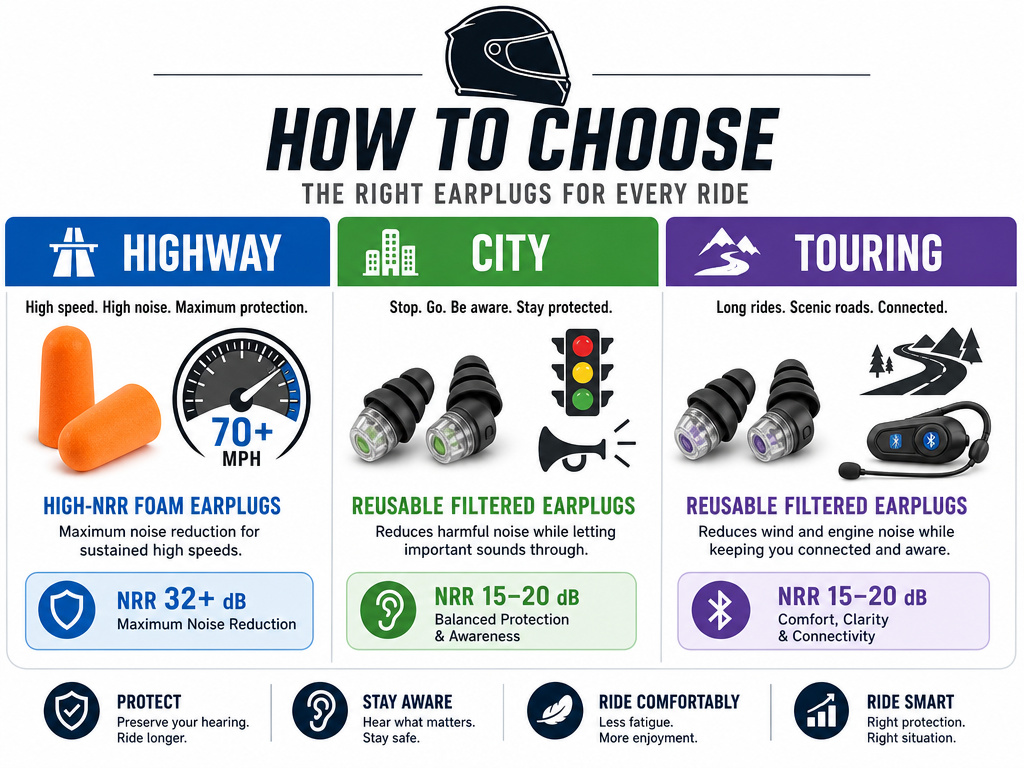
Your typical ride profile picks the winner. This isn’t about which is objectively better; it’s about which is better for your riding.
For Long Highway Slabs (Constant 70+ mph wind roar):
- Pick: High-NRR Foam. The goal is maximum attenuation of that relentless 100+ dB wind blast. The derated ~16.5 dB of protection from a Moldex SparkPlug is a significant drop. Awareness is less critical here.
- Action: Use a fresh pair every ride. Insert them properly, roll, insert, hold until expanded, before putting your helmet on.
For City Commuting & Traffic (Stop-and-go, need sirens/horns):
- Pick: Filtered Reusable Plugs. Preserving mid-frequency awareness is safety-critical. The Alpine MotoSafe Tour (SNR 17 dB) or EarPeace Moto Pro with the 20 dB filter is ideal.
- Action: Clean them weekly. Experiment with filter levels to find a balance between quiet and clarity for your specific bike and helmet combo.
For Weekend Touring & Sport Riding (Mix of roads, using intercom):
- Pick: Filtered Reusable Plugs. This is their sweet spot. They cut fatigue-inducing wind noise on the highway stretches while letting you hear your navigation, music, or riding partner clearly on backroads. The EarPeace Moto Pro Pack, which includes multiple filter options, is one option for this.
- Action: Carry the case. Swap filters if your day changes from interstate slog to twisty backroad chatter.
For the Rider Who Wants One Answer:
Get a set of EarPeace Moto Pro earplugs. Start with the 24 dB (Max) filters for highway work. If you find your intercom is too muffled, switch to the 20 dB (High) filters. A complete fit is important for most riders., and the design works under a helmet. It’s the most adaptable starting point.
How to insert motorcycle earplugs correctly
Correct insertion is the only way to get the protection listed on the package. For foam plugs, roll them into a tight, crease-free cylinder before pulling your ear up and back to straighten the canal. Insert them deeply enough that the end is flush with the opening of your ear canal, then hold them in place as they expand. For reusable silicone plugs, practice is required. You must be deliberate, gently pulling the ear to open the canal and twisting the plug until the flange seals completely. A complete seal feels snug but not painful. For both types, a mirror can help you check that the plug is seated correctly and not protruding.
What are the best foam and reusable motorcycle earplugs?
Remember that real-world protection is often lower due to derating. For reusable filtered earplugs designed for motorcycling, several models offer specific noise reduction. The Alpine MotoSafe Sport has an SNR of 20 dB, while the Alpine MotoSafe Tour offers an SNR of 17 dB. The EarPeace Moto Pro provides interchangeable filters for different attenuation levels, such as 20 dB and 24 dB (EarPeace.com also lists a 27 dB Ultra Max filter). The BOLLSEN Moto+ is rated at SNR 24 dB and uses hypoallergenic silicone.
Frequently Asked Questions
Are foam or reusable earplugs better for motorcycle riding?
For most riders, reusable filtered earplugs are better. They provide consistent protection, preserve situational awareness, and are more cost-effective and comfortable over time. Foam earplugs are better suited for very long, pure-highway rides where maximum noise blocking is the sole priority.
Can you still hear traffic with motorcycle earplugs?
Yes, especially with filtered reusable earplugs. They are engineered to reduce damaging high-frequency wind noise more than mid-frequency sounds like engines, horns, and sirens. Many riders report hearing traffic more clearly because the overwhelming wind roar is reduced.
How often should you replace reusable motorcycle earplugs?
Replace the silicone earplug bodies at any sign of stiffness, tearing, or permanent deformation, typically every 1-2 years with regular use. Replace the acoustic filters if they become clogged or damaged. Always follow the manufacturer’s cleaning instructions to maximize lifespan.
Is it legal to wear earplugs while riding a motorcycle?
In most U.S. States and countries, wearing passive hearing protection (non-electronic earplugs) is legal. Laws target devices that emit sound into the ear, like earphones. However, a few local jurisdictions have restrictions. It is your responsibility to check your local motorcycle hearing protection laws before riding.
Do you need earplugs with a full-face helmet?
Yes. A full-face helmet only reduces noise by about 7-10 decibels. At highway speeds, wind noise inside the helmet can still reach 95-105 dB, which is enough to cause hearing damage. Earplugs can help prevent hearing loss from motorcycle riding.
The Bottom Line
The foam vs. Reusable earplug debate ends at your ear canal. If you only ride long distances on interstates and want the simplest, cheapest max-protection option, buy a bulk box of Moldex SparkPlugs and use a fresh pair every time. For everyone else, commuters, tourers, canyon carvers, riders who use comms, the answer is a set of filtered reusable plugs.
Invest in a system like the EarPeace Moto Pro or Alpine MotoSafe Sport. Learn how to insert them properly (pull your ear up and back, then twist them in). Clean them. The upfront cost is higher, but the long-term payoff in hearing protection, comfort, and clear situational awareness is undeniable. Your ears thirty years from now will thank you for the choice you make this season.
Start your search with our hands-on review of reusable motorcycle earplugs to see which models we tested on the road. For a broader look at all your options, our overview of motorcycle hearing protection breaks down every category.
