
Chain vs Belt vs Shaft Drive Motorcycle: How to Choose
This post contains affiliate links. As an Amazon Associate, we earn from qualifying purchases.
Chain, belt, and shaft drives are the three systems that transfer power from your motorcycle’s engine to its rear wheel. A chain is a metal roller chain running on sprockets, a belt is a reinforced rubber/composite loop on pulleys, and a shaft uses a driveshaft and gears. The best system depends on your tolerance for maintenance, riding environment, performance needs, and budget — there is no single winner for every rider.
The debate isn’t academic. Your choice dictates your weekend chores, your long-term repair bills, and how the bike feels when you twist the throttle. It also locks you into certain bike categories, from track-ready sportbikes to continent-crossing tourers. This is the essential choice of chain vs belt vs shaft drive motorcycle.
What follows is a side-by-side breakdown for the chain vs belt vs shaft drive motorcycle, covering the specs, the real ownership costs, and the failure modes you won’t find in a brochure. By the end, you’ll know which system fits your garage, your wallet, and your riding style.
Key Takeaways
- Chain drives offer very high efficiency, with GearRiderHub citing 97–99% and FSWiki noting efficiency can be as high as 98%. And easiest customization but demand the most frequent upkeep: clean and lube every 500–1,000 km.
- Belt drives are nearly silent and require minimal maintenance (inspect tension every 5,000–10,000 km), but a single trapped stone can sever the belt catastrophically, making them poor for off-road.
- Shaft drives are the ultimate “set-and-forget” system with a potential lifespan of 200,000+ km, but they add significant weight (5–10 kg) and cost the most to repair.
- Always replace a chain and both sprockets as a set. A worn sprocket will destroy a new chain in weeks, turning a $300 job into a $600 mistake.
- Your riding environment decides the winner. Chain for dirt and performance, belt for clean-road cruising, shaft for high-mileage touring.
The Core Comparison: Chain, Belt, and Shaft at a Glance
The numbers tell the first part of the story. This table pulls data from manufacturer specs, service manuals, and aggregated industry benchmarks to show where each system lands.
| Feature | Chain Drive | Belt Drive | Shaft Drive |
|---|---|---|---|
| Power Efficiency | 97–99% (highest) | 96–98% | 90–95% (disputed: some sources cite as low as 80%) |
| Maintenance | High: Clean & lube every 500–1,000 km, adjust every 1,000–2,000 km | Low: Inspect tension every 5,000–10,000 km, no lube | Very Low: Oil change every 20,000–40,000 km, inspect cush drive rubbers |
| Typical Lifespan | 20,000–40,000 km (O/X-ring chain) | 50,000–100,000+ km | “Lifetime” – often 200,000+ km |
| Replacement Cost | $100–$300 (chain + sprockets set) | $150–$400 (belt only; pulleys rarely replaced) | $1,500–$3,500+ (final drive unit + labor) |
| Weight | Lightest (1–3 kg total) | Light (1.5–3 kg) | Heaviest (5–10 kg additional) |
| Noise Level | Moderate (audible chain whir) | Very quiet (nearly silent) | Quiet (slight gear whine at low speed) |
| Off-Road Suitability | Excellent – handles dirt, mud, impact | Poor – a trapped stone can sever belt fibers instantly | Good – sealed system, handles mud |
| Gearing Changes | Easy & cheap – swap sprockets ($20–$80) | Difficult – limited pulley options, expensive | Impossible without major engineering |
This comparison, drawing on sources like the GearRiderHub analysis and OEM specifications, shows the fundamental trade-offs: chain for tunability and performance, belt for low upkeep on pavement, shaft for maximum durability with added heft.
Chain Drive: The High-Performance Workhorse
You find chains on everything from a $3,000 beginner bike to a $30,000 superbike. The reason is raw mechanical efficiency and versatility. The ANSI/ASME B29.8M standard defines the sizing, with common pitches like 520 (5/8″ pitch) and 530. A quality sealed chain, like a D.I.D ZVM2 with its S-TEN steel and nitrile rubber O-rings, is built to retain lubrication and fight wear.
The performance feel is direct. Throttle response is immediate, with almost no dampening between your wrist and the rear tire. This, plus the light weight, is why chains dominate sport and off-road riding.
Where this goes sideways: Spraying lube on a dirty chain. You create an abrasive grinding paste that accelerates wear. Clean it first with a dedicated chain cleaner and a brush, then apply lube.
But that performance comes with a calendar. The primary wear mechanism is articulation wear at the pin and bushing interface, which slowly stretches the chain. A service manual, like the one for the 2023 Kawasaki Ninja 400, specifies a drive chain slack of 25–35 mm when measured midway between the sprockets with the bike on a sidestand.
The non-negotiable ritual looks like this:
- Clean: Every 500–1,000 km, or after riding in rain or dirt. Use a dedicated solvent and a brush. Skip this, and new lube can’t penetrate.
- Lube: Apply chain lubricant to the inside of the chain rollers while spinning the wheel. Let it set for ten minutes.
- Adjust: Check the slack midway between the sprockets. Too tight burns out bearings; too loose risks the chain jumping off.
- Inspect: Look for stiff links, hooked sprocket teeth, and rust. A chain wear gauge tool is a small investment that saves a sprocket set.
The big cost isn’t the lube. It’s replacing the chain and sprockets as a set every 20,000–40,000 km. A worn sprocket has sharp, hooked teeth that will chew through a new chain in a matter of weeks. Doing the chain and sprockets job yourself is a project with basic tools.
Belt Drive: The Quiet, Low-Maintenance Option
Belt drives trade some performance nuance for a dramatically simpler ownership experience. Found on cruisers like Harleys and most electric motorcycles (Zero, LiveWire), a belt is a reinforced loop of composite material, like the Gates Poly Chain® Carbon™ belt on a Zero SR/F.
The biggest sell is silence and cleanliness. There’s no metal-on-metal whir, no flung grease, and no required lubrication. You check tension every few thousand miles and look for cracks or fraying. That’s it for routine care.
The part nobody mentions: A CVT belt inside a scooter’s transmission is a different component. Your motorcycle’s final drive belt is a much stronger, toothed belt designed for direct power transfer, not variable gearing.
The feel is smoother, with a slight dampening effect that can soften throttle inputs. This pairs perfectly with the instant torque of an electric motor. For pavement cruising, it’s a brilliant system.
But belts have a critical vulnerability. The GearRiderHub source puts it bluntly: a single stone trapped between the belt and pulley can sever the reinforcing fibers instantly. The failure is catastrophic and not repairable on the roadside. This makes belt drives a poor choice for anything but clean pavement. If you ride gravel or venture off-road, this is your dealbreaker.
Tension is key, and learning how to adjust belt drive tension is a necessary skill. Too loose causes slippage and wear; too tight strains bearings. Changing the final drive ratio is difficult and expensive, as pulley options are limited compared to sprockets.
Shaft Drive: The Set-and-Forget Touring Solution
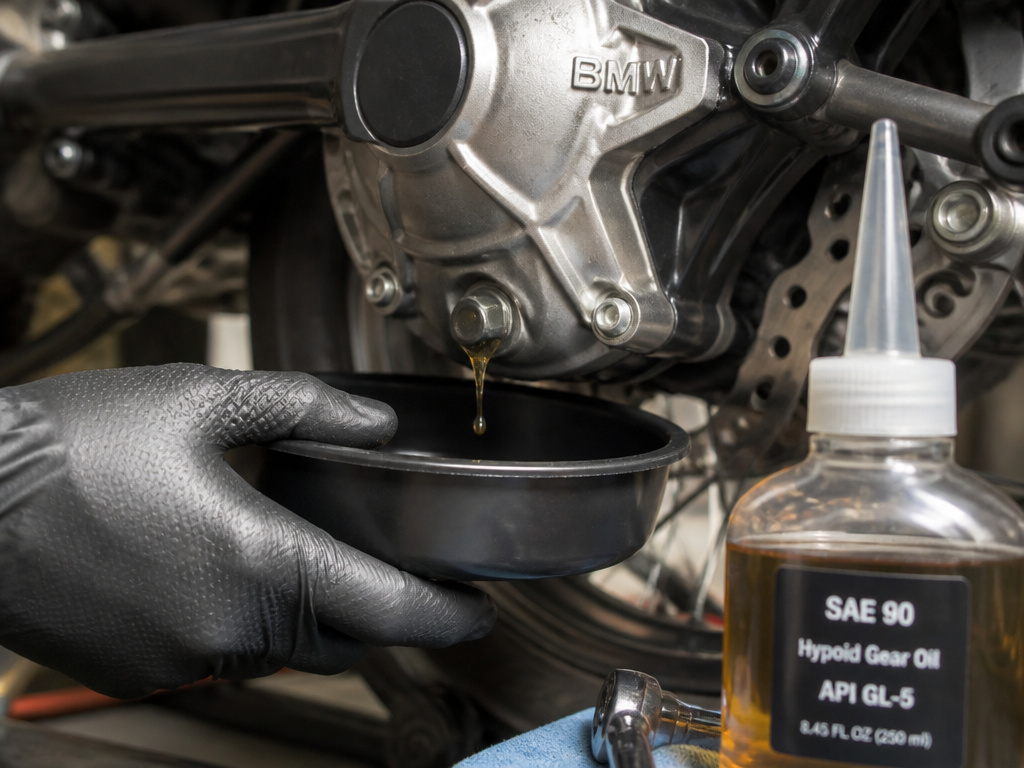
Shaft drive is the luxury sedan of final drives. It’s heavy, complex, and expensive, but it asks almost nothing of you day-to-day. Used on touring bikes like the BMW R 1250 GS and many large cruisers, it uses a driveshaft and a set of bevel gears in a sealed final drive unit.
Maintenance intervals are measured in years, not weeks. The BMW R 1250 GS manual calls for changing 180 ml of hypoid gear oil SAE 90 in the final drive every 20,000–40,000 km. That’s the primary task. You also periodically inspect the rubber cush drives in the rear hub for wear, which can cause driveline lash.
The feel is distinct. There’s a slight delay in throttle response, often called “shaft jacking,” where the bike may squat or rise under acceleration due to driveline torque. It’s smooth and generally quiet, with a faint gear whine at low speeds.
Common mistake: Believing “lifetime fill” means never checking. Seals can fail, allowing water ingress. The 2013 BMW recall for driveshaft spline corrosion on certain R1200GS models is a documented example. A periodic final drive oil check is cheap insurance.
The real cost of shaft drive is in repair. While the system is durable, a failure is a major event. Replacing a final drive unit can run $1,500–$3,500 with labor. You trade ongoing maintenance chores for a rare but very large potential bill. For riders putting on massive mileage, the reliability is worth it. For a low-mileage commuter, the added upfront bike cost and weight penalty might not be.
Efficiency, Noise, and Feel: The Riding Experience
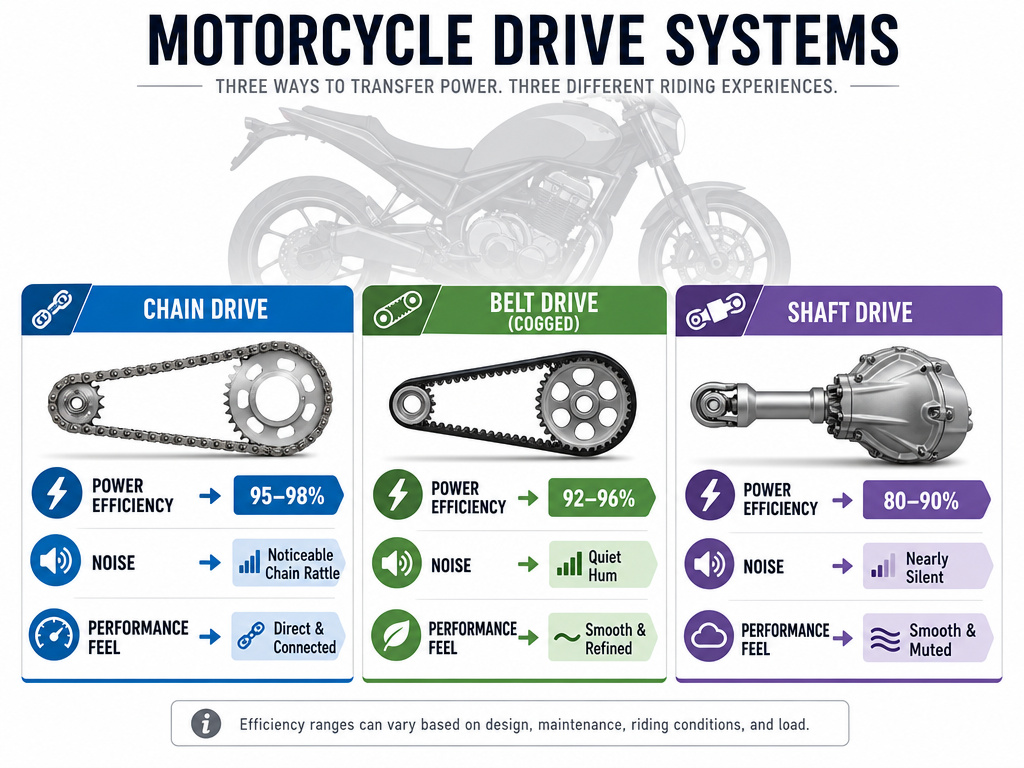
Beyond the maintenance log, the drive system changes how the bike communicates with you. These intangible factors matter on a long ride.
Power Efficiency is where chains consistently rank highest. Most sources, like the GearRiderHub analysis and the FSWiki engineering reference, agree a well-maintained chain is highly efficient, with GearRiderHub citing 97–99% efficiency. Belts are close behind at 96–98%. Shaft drives are generally the least efficient, with sources like GearRiderHub citing 90–95% efficiency, while others like FSWiki note they can be as low as 80%. That power turns into heat in the gearbox instead of motion at the wheel.
Noise is a comfort factor. Chains produce a characteristic whir that gets louder as they wear. Belts are nearly silent—you hear the engine and wind. Shafts are quiet but can produce a low gear whine, especially under load at low speed.
Performance Feel is subjective but real.
- Chain: Direct, immediate, and connected. You feel every nuance of the throttle.
- Belt: Smooth, dampened, and slightly muted. Takes the edge off abrupt inputs.
- Shaft: Solid, slightly delayed, and sometimes accompanied by that squatting “shaft jacking” sensation on hard acceleration.
These aren’t good or bad—they’re flavors. A sport rider craves the chain’s directness. A cruiser rider or electric bike fan might prefer the belt’s serenity. A tourer values the shaft’s unshakeable solidity over nuance.
Real-World Failure Modes and Roadside Repairability
Brochures talk about lifespan. Riders need to know what breaks and whether they can fix it on the side of the road.
| Failure Scenario | Chain | Belt | Shaft |
|---|---|---|---|
| Common Failure | Stretch, seized links, broken O-ring | Stone cut, cracking, frayed edges | Seal leak, bearing failure, spline corrosion |
| Roadside Fix Possible? | Yes, with tools. A broken link can be removed with a chain breaker; a master link can get you home. | No. A severed belt is a tow. Carry a spare belt and tools for a long trip. | No. A failed final drive or seized driveshaft requires a trailer. |
| Warning Signs | Increasing adjustment frequency, stiff links, rust, sprocket hooking | Visible cracks, fraying, unusual squeaks, tension changes | Oil leaks from final drive, clunking from rear hub, metallic grinding noise |
| Documented Recall | Harley-Davidson Pan America (2021-22): Loose rear sprocket bolts (NHTSA 22V-085) | Harley-Davidson Touring (2014-16): Loose rear pulley nut (Service Bulletin M-1423) | BMW R1200GS/RT (2005-11): Driveshaft spline corrosion (NHTSA 13V-176) |
A chain is the most field-serviceable. A basic toolkit with a chain breaker, spare master links, and a small can of lube can handle most roadside issues. This is a major reason chains rule the adventure and off-road world.
A belt failure is almost always a catastrophic stop. You’re not fixing a cut belt. Some long-distance belt-drive riders carry a spare belt and the tools to change it, which is a job that requires practice.
A shaft drive failure is the rarest but most severe. You’re not fixing a damaged final drive gearset on the roadside. The best you can do is preventative maintenance: checking for oil leaks and addressing unusual noises immediately.
How to Choose: The 5-Question Decision Checklist
Forget looking for a “best” system. Answer these questions to find the one that’s best for you.
-
What’s your primary riding environment?
- Dirt, gravel, all-weather commuting: Chain. Its debris resistance and repairability win.
- Clean pavement, fair-weather cruising: Belt or Shaft. Belt for lighter bikes and simplicity, shaft for heavy bikes and ultimate durability.
- Long-distance touring, high annual mileage: Shaft. The maintenance interval advantage is real.
-
What’s your tolerance for regular maintenance?
- “I don’t mind a 20-minute chore every other weekend.” Chain.
- “I’ll check it once a season, that’s it.” Belt.
- “I want to ride for years without thinking about it.” Shaft.
-
Is tuning performance or changing gearing important to you?
- Yes, I tweak for track days, off-road, or better acceleration. Chain is the only practical choice. A sprocket swap is cheap and easy.
- No, I’ll keep the stock setup. Belt or Shaft are fine.
-
What’s your budget for long-term ownership?
- Lower upfront cost, predictable periodic replacement: Chain. Budget for a new chain and sprockets every 20,000–40,000 km.
- Higher upfront cost, very low running costs: Belt or Shaft. The bike price is higher, but you’ll spend almost nothing on the drive for years.
-
How important is noise and a “connected” feel?
- I want mechanical feedback and don’t mind some whir. Chain.
- I prefer a silent, smooth experience. Belt.
- I want solid, quiet, and dampened. Shaft.
Most riders’ answers will cluster. Sport, naked, and adventure riders typically land on chain. Cruiser and electric bike riders often land on belt. Touring and luxury adventure riders gravitate to shaft.
Common Brand Examples for Each Drive Type
Specific brands have become synonymous with certain drive types. Harley-Davidson is a hallmark of belt drive, using a Poly Chain GT4 Carbon belt on models like the Sportster S. For shaft drive, BMW is the archetype, employing a single-joint cardan shaft in its R 1250 GS adventure tourer. In the electric motorcycle space, Zero Motorcycles fits its SR/F and SR/S models with a Gates Poly Chain Carbon belt system. Chain drive is the near-universal standard, found on sportbikes, nakeds, and dirt bikes from countless manufacturers, with companies like D.I.D producing high-performance chains for this vast market.
Frequently Asked Questions
Are belt drive motorcycles better than chain drive motorcycles?
“Better” depends on the metric. Belt drives are better at being quiet, clean, and low-maintenance. Chain drives are better at delivering maximum power efficiency, handling rough conditions, and allowing for easy performance modifications. For a rider who only uses clean roads and hates maintenance, a belt is better. For a rider who ventures off-road or values tuning, a chain is better.
Is a drive shaft better than a chain on a motorcycle?
For the specific use case of high-mileage touring or commuting where the rider wants to minimize maintenance, a shaft drive is better. It’s more durable and requires less frequent service. For almost every other metric—cost, weight, performance feel, efficiency, and off-road capability—a chain drive is the better system. The shaft’s advantages come with significant trade-offs in weight, cost, and repairability.
What is the 12 second rule on a motorcycle?
This is unrelated to final drive systems. The “12-second rule” is a visual following-distance guideline for safe riding. It means you should constantly scan the road ahead to a point where you are 12 seconds away from arriving, giving you ample time to identify and react to hazards.
Can you change the gearing on a belt or shaft drive bike?
It is extremely difficult and expensive on a belt drive, and effectively impossible on a shaft drive. Belt drive pulleys are limited and costly to source. Shaft drive gearing is set by the internal gear ratios in the sealed final drive unit, which cannot be altered without complete replacement. This is a key reason chain drive remains the choice for riders who customize their bike’s performance.
The Bottom Line
Your final drive is a long-term relationship. Choose the partner whose needs match your own.
If you ride hard, get dirty, or love to tinker, commit to the chain. Buy an O-ring chain from DID or RK, learn to check chain wear and adjust chain slack, and replace the whole set when it’s time. The performance payoff is worth the Saturday morning ritual.
If you stick to pavement and value simplicity, the belt is a legitimate low-fuss option. Just understand the debris risk and inspect it regularly.
If you rack up continental distances and view maintenance as a nuisance, the shaft’s “lifetime” durability justifies its cost and weight. Just budget for that one-in-a-hundred-thousand-miles major repair.
Don’t buy a bike solely for its final drive. But once you’ve narrowed your choices to two or three models, let this comparison be the tiebreaker. The right system makes ownership a pleasure. The wrong one turns every ride into a chore.
