
Foam vs Hard Shell Motorcycle Armor: How to Choose
This post contains affiliate links. As an Amazon Associate, we earn from qualifying purchases.
Foam motorcycle armor is soft, flexible, and uses viscoelastic materials to stiffen on impact, while hard shell armor uses rigid plastic plates to spread force over a larger area. For most street riders, foam offers superior comfort and adequate protection. For off-road or adventure riding where debris and direct impacts are common, a hard shell system provides better abrasion resistance and structural defense.
The difference comes down to how each material manages kinetic energy. Foam absorbs it; a hard shell deflects and distributes it. That single mechanical distinction dictates where you’ll feel the armor in an hour’s ride and what it can handle in a slide, a key consideration in the foam vs hard shell motorcycle armor debate.
What follows is a breakdown of the physics, the certified numbers, and the real-world trade-offs. We’ll compare specific models like the Bohn Armor SC-1/CP5 and the Leatt Body Protector 6.5, explain the EN 1621 test data, and give you a clear framework to match the armor to your bike and your riding.
Key Takeaways
- Foam armor (like D3O) is for comfort and street riding. It’s flexible, low-profile, and designed for all-day wear, reacting to disperse impact force only when needed.
- Hard shell armor is for off-road and debris protection. Its rigid plates defend against rocks and branches and are mandatory for motocross or adventure riding where direct, pointy impacts happen.
- Always look for CE certification to EN 1621 standards. This is your guarantee of tested performance. CE-certified back armor must transmit less than 9kN of force from a 50 Joule impact to meet the standard.
- Fit and positioning are essential. Armor that shifts off your elbow or spine in a riding tuck provides zero protection. It must stay locked over the impact zone.
- Armor has a lifespan and needs care. Viscoelastic foam can last up to ten years, but it degrades with detergent residue, salt, and moisture. Inspect it annually.
How Foam and Hard Shell Armor Work (The Physics)
Forget marketing terms. The real difference is in the force management. In a crash, your body must absorb kinetic energy. The goal of any armor is to extend the time over which that energy transfers, which lowers the peak force hitting your bones and organs.
Foam armor, specifically viscoelastic foam like D3O, is a non-Newtonian material. At rest, its polymer chains flow freely, making it soft and pliable. Under sudden, high-speed impact, those chains lock together almost instantly, turning the material rigid to absorb and disperse the energy. Once the force is gone, it returns to its flexible state. The Bohn Armor SC-1/CP5 uses a two-component design with this type of foam paired with a thin TPU shell, designed to provide “maximum comfort as well as maximum protection for all-day wearability.”
A 10mm thick sheet of D3O ST Solid foam has a density of 0.45 g/cm³ (per the D3O material data sheet).
Hard shell armor, typically made from molded thermoplastic polyurethane (TPU) or similar plastics, works differently. It doesn’t absorb much energy itself. Instead, its rigidity spreads the impact force over a much larger area of the underlying foam (or your body). This reduces the pressure on any single point. It also provides a tough, abrasion-resistant surface against road debris, rocks, or branches. This is why Leatt explicitly states its hard-shell protectors are for “off-road motorcycling and biking activities, such as Moto-X, Enduro, Downhill MTB, BMX and Adventure Sports.”
The takeaway from the foam vs hard shell motorcycle armor comparison? Foam manages energy through material science; hard shell manages it through geometry and surface area.
How Do CE Level 1 and Level 2 Armor Differ?
This is where the rubber meets the road, or rather, where the anvil meets the armor in a lab. The European EN 1621 standard is the global benchmark. It doesn’t just say “this is protective.” It gives you a number: transmitted force, measured in kilonewtons (kN).
The test involves dropping a 5kg striker with a standardized anvil from a height to deliver a 50 Joule impact onto the protector. Sensors underneath measure how much force gets through to the other side. Less force transmitted means better protection.
| Certification Level | Maximum Mean Transmitted Force (Back/Chest) | What It Means |
|---|---|---|
| CE Level 1 | Back: <9kN | Basic impact protection. The armor reduces force, meeting the minimum required threshold. |
| CE Level 2 | Back: <9kN (Note: Level 2 requires the same <9kN threshold as Level 1 but with a higher performance classification; it denotes a protector that has been tested and classified as offering higher performance within the standard’s framework.) | Higher performance protection. The armor dissipates force more effectively. For limb armor, Level 2 requires <20kN. |
It’s critical to read the specifics. For example, the Leatt 4.5 Hybrid Chest Protector manual states its chest plates meet Level 2 with a mean transmitted force below 18kN and a mean distributed force below 15kN from a 50 Joule impact. Bohn Armor clarifies that for CE Level 2 limb armor, the average transmitted force of nine tests must be less than 20 kN.
Where this goes sideways: Assuming Level 2 is always “twice as good” as Level 1.
For most street riding, Level 1 protection is sufficient. As Bohn Armor notes, “For most street and dual sport riders riding safely and within the speed limit, CE Level 1 protection is sufficient.”
Foam vs Hard Shell: A Rider’s Decision Matrix
This isn’t an academic choice. Your riding posture, typical roads, and crash risks decide the winner in the foam vs hard shell motorcycle armor selection. Use this table to narrow it down, then we’ll get into the specifics.
| Riding Style | Recommended Armor Type | Why It Wins | Product Example |
|---|---|---|---|
| Street / Commuting | Foam (Viscoelastic) | Superior comfort for long, static riding positions. Low-profile under street jackets. | Bohn Armor SC-1/CP5 |
| Sport / Canyon Riding | Foam or Hybrid | D3O Diablo (foam) | |
| Adventure / Dual-Sport | Hard Shell or Hybrid | Leatt Body Protector 3.5 | |
| Motocross / Enduro | Full Hard Shell System | Leatt Body Protector 6.5 | |
| Touring | Foam | Various CE Level 2 foam inserts |
The Case for Foam: Comfort and Concealment
If you ride a street bike, you’re in a relatively fixed position for hours. A hard plate digging into your back or shoulder blade gets old fast. Foam armor conforms to your body. It moves with you.
The sensory reality is simple: you forget it’s there. The protection is real—it’s just not bulky.
That’s the trade-off.
The Case for Hard Shell: Defense and Durability
A hard shell is your exoskeleton.
It provides a structural defense that foam can’t. For understanding how this integrated protection system should work, our guide on proper armor placement is essential.
The downside is ventilation, weight, and sometimes mobility.
The Lifespan and Care Your Armor Needs
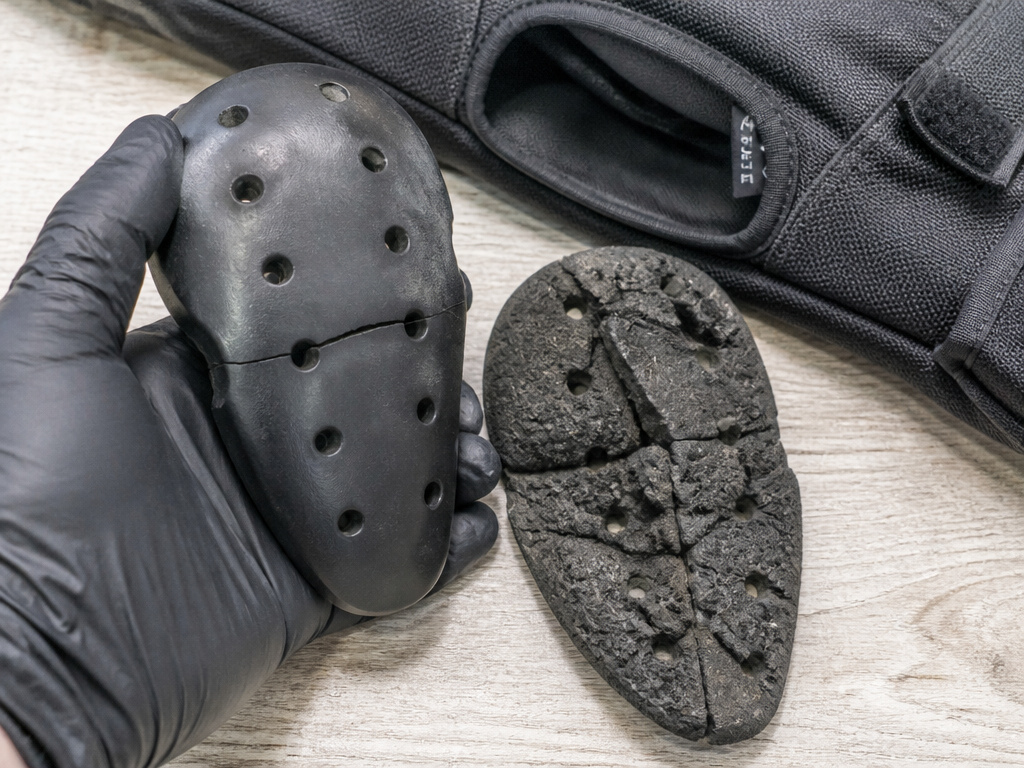
Armor isn’t a buy-it-for-life item. Its materials degrade. Knowing when to replace it is as important as choosing it.
Viscoelastic foam has a long but finite life. Bohn Armor states its foam “could potentially last up to ten years.” However, they and others note that limb armor has a typical expiration date of 5-10 years from manufacture. The enemy isn’t always a crash; it’s the environment.
Common mistake: Never removing armor to clean it. Detergent residue, body salt, and moisture degrade the foam’s chemical structure and can cause it to harden or crumble prematurely.
Here’s a basic maintenance checklist:
- After washing gear: Always remove the armor first. Let the armor air-dry completely away from direct heat before reinserting.
- Annual inspection: Flex the foam. Look for cracks, permanent creases, or a change in texture (it becomes powdery or crumbly). Check hard shells for deep cracks or compromised straps.
- Post-crash: Inspect for visible damage. A scratched shell is usually fine—sand down any sharp edges. But if the shell is cracked or the foam inside is deformed, replace it. Armor like the Bohn Armor SC-1/CP5 is multi-impact compliant, but not indestructible.
If you’re unsure about the condition of your current protectors, our article on armor lifespan dives deeper into the signs of wear.
Upgrading Your Gear: A Practical Guide
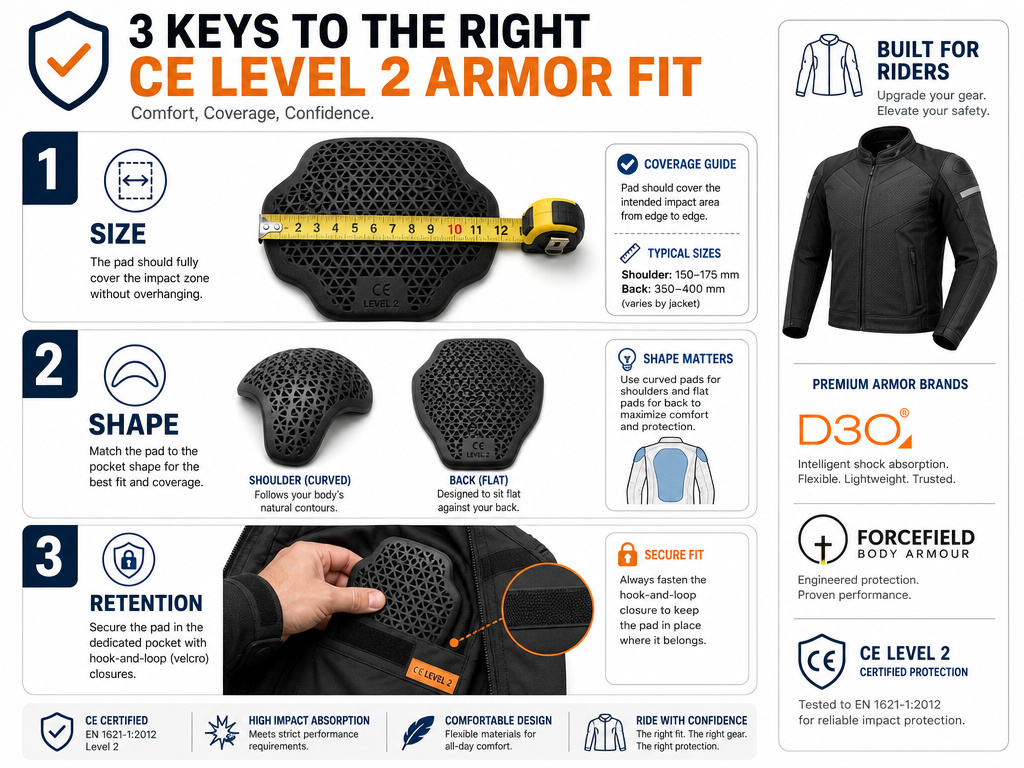
Most riders start with the armor that comes in their jacket. It’s often the weakest link. Swapping it out is the single most cost-effective safety upgrade you can make.
First, check the armor pockets in your jacket. You need to know:
- Size: Measure the existing pad. New armor must fit the pocket snugly.
- Shape: Is it curved for shoulders or flat for the back? Match the geometry.
- Retention: Does the pocket have a hook-and-loop closure or a sleeve? The new armor must be secure.
For street riders, the upgrade path is straightforward: buy CE Level 2 foam inserts for your back, shoulders, and elbows. Brands like D3O, Forcefield, and Bohn make aftermarket pads in standard sizes. Simply remove the old foam and drop the new pads in. For a step-by-step process, see our guide on how to upgrade motorcycle jacket armor.
Compatibility with your existing jacket is key—ensure there’s enough room in the torso so you’re not compressed.
What the Standards Don’t Cover (The Fine Print)
Every manual has a warning section. You should read it. Leatt’s is particularly clear, and it applies to all body armor: “Personal protective equipment is not designed or intended to protect a wearer against serious bodily injuries caused by hard collisions or crashes.“
To be blunt. Armor is designed to reduce soft tissue injuries—bruising, contusions, abrasions. It may reduce the severity of minor fractures. It is not designed to prevent serious fractures, spinal injuries, or internal organ damage from high-energy impacts. As Leatt states, “Protective equipment such as back or lumbar protectors do not protect against spinal injury.”
This isn’t scare talk. It’s about managing expectations. A back protector is not a force field. It’s a tool that improves your odds in a certain range of accidents. Your first lines of defense are riding skill, situational awareness, and a full suite of protective gear—starting with a good helmet.
How does temperature affect motorcycle armor?
The performance of some armor materials can change with temperature. This is particularly true for specialized foams that rely on their physical state to absorb energy. For consistent protection, consider where and when you ride.
How does armor absorb the force of an impact?
Armor works by managing the physics of a crash. When you hit the ground, your body must absorb kinetic energy. The armor’s job is to spread that energy transfer over more time and a larger area. Extending the time reduces the peak force that reaches your body. For example, a back protector certified to Level 2 must keep the mean transmitted force below 9kN from a 50 Joule impact. A hard shell spreads the force over a wider area to prevent concentrated point impacts, while the foam layer underneath works to slow down the transfer. The combination aims to lower the force to a level your skeleton and soft tissue can withstand without serious injury.
Frequently Asked Questions
What is the best body armor for motorcycles?
There’s no single “best.” For street riders, CE Level 2 viscoelastic foam armor (like D3O or equivalent) offers the best balance of proven protection and all-day comfort. For off-road riders, a full hard shell system (like the Leatt Body Protector 6.5) is necessary for debris and high-impact protection. Your riding style dictates the answer.
Does D3O armor expire?
Yes, all armor materials degrade over time. While D3O and similar viscoelastic foams are durable, manufacturers like Bohn suggest a typical lifespan of 5-10 years for limb armor. Exposure to sweat, detergents, UV light, and temperature extremes will accelerate aging. Inspect it annually for cracking or crumbling.
Can I mix foam and hard shell armor?
Absolutely. This is called a hybrid approach and it’s often the smartest choice. Common setups use a hard shell chest/back protector worn over a shirt that has built-in foam shoulder and elbow armor. This gives you abrasion resistance on the torso where you might slide, and flexible comfort on the joints. The key is ensuring the pieces don’t interfere with each other and restrict movement.
How tight should motorcycle armor be?
Armor should be snug enough that it does not shift out of position when you move into your riding posture. Sit on your bike (or mimic the position). Have someone check that the back pad still covers your spine, the elbow pads are centered on your elbow joints, and the shoulder pads are on the bony protrusion of your shoulder. If they slide, the fit is wrong. Our detailed guide on armor fit covers this in detail.
Is CE Level 1 armor safe?
Yes, CE Level 1 armor is safe and provides a certified, baseline level of impact protection. It has passed the same rigorous EN 1621 standard testing as Level 2, just at a different performance threshold. For lower-speed urban riding or cruising, it is sufficient. However, since Level 2 technology is now widely available and often just as comfortable, it is the recommended choice for new purchases.
The Bottom Line
Don’t overcomplicate it. Your armor choice follows from your handlebars.
If you spend your days on pavement, prioritize comfort with high-quality Level 2 foam armor. It’s the upgrade that you’ll actually wear every ride. If your bike sees dirt, rocks, or airtime, you need the external defense of a hard shell system.
One final, essential rule: trust the certification, not the claims. Look for the CE mark and the specific EN 1621 standard it meets. That label, backed by the transmitted force data we covered, is the only objective proof you have that the pad in your jacket is more than just decoration. Everything else is just marketing until the moment you need it.
