
How Should a Motorcycle Jacket Fit: Step-by-Step Fit Check
This post contains affiliate links. As an Amazon Associate, we earn from qualifying purchases.
A motorcycle jacket fits correctly when it holds armor securely over your shoulders and elbows without restricting movement, allows you to raise your arms to the angle required by its design (90º for an Aerostich R-3, 45º for a Classic Roadcrafter), and leaves just enough room to slide a flat hand between your chest and the zipped fabric. The sleeves should end about an inch above your knuckles when standing, and the jacket must not ride up or bind when you sit on your bike and reach for the handlebars.
That answer is the target. Hitting it means the jacket will do its job in a slide and you won’t notice it after the first ten minutes of a ride. Missing any of those points means the armor floats, the seams pull, or the wind finds a way in, which is why understanding how should a motorcycle jacket fit is crucial.
What follows is the breakdown of each checkpoint, where manufacturers disagree, and how to navigate the two biggest sizing traps: buying online and wearing an airbag vest.
Key Takeaways
- Fit the jacket in a riding position, not standing. A jacket that feels great upright can pull across your shoulders the first time you reach for the bars.
- Armor must stay in place. If you can push the shoulder or elbow pad away from your body with light finger pressure, the jacket is too loose.
- Leather needs a snug starting fit, it will stretch. Textile and mesh hold their shape from day one, so buy the fit you want.
- For an airbag vest, check the manufacturer’s specific guidance. Dainese says its jackets fit over their Smart Air without sizing up; D3O advises you to consider a larger size.
- Use the flat-hand test. You should be able to comfortably slide a flat hand between your chest and the zipped jacket. A fist’s worth of space is too loose.
The 90º vs. 45º Arm Rule (And Why It Matters)
The first test is arm mobility. But how high should you be able to raise your arms? The manuals from a single manufacturer, Aerostich, give two different answers.
The Technical Snippet: For the Aerostich R-3 and R-3 Light suits, fit is correct if the wearer can raise arms to a 90º angle. For the Aerostich Classic Roadcrafter one-piece suit, the wearer should be able to raise arms to a 45º angle with the right fit. The suit body on the Roadcrafter moves upward about 1.5 inches when arms are raised to horizontal.
That’s not a mistake. It’s a design choice. The R-3 is a sport-oriented suit built for a greater range of motion. The Classic Roadcrafter is a touring suit where a more restrained arm lift is part of its weather-sealed, over-the-pants design. The 1.5-inch body shift is engineered in.
The lesson isn’t to memorize one number. It’s to find the number for your jacket when you compare a how should a motorcycle jacket fit standard. A sport-cut Dainese Racing 5 jacket, with its “regular and sporty fit,” will have a different mobility standard than a loose-fitting Aerostich Darien, which the manual describes as a “roomy mountain parka” style.
| Jacket Type / Model | Arm Mobility Standard | Design Reason |
|---|---|---|
| Aerostich R-3 / R-3 Light | 90º (horizontal) | Sport/touring hybrid, maximizes range of motion. |
| Aerostich Classic Roadcrafter | 45º | Touring one-piece, minimizes suit ride-up and maintains seal. |
| Sport-fit leather (e.g., Dainese Racing 5) | Varies (check manual) | Pre-curved arms for forward tuck; may restrict upright lift. |
| Loose-fit textile (e.g., Aerostich Darien) | Not specified (check manual) | Designed for layering and maximum freedom of movement. |
If your jacket’s manual doesn’t specify an angle, consult the manufacturer or retailer for guidance, as standards vary by design. Can’t get there? The shoulders are too tight or the sleeves are cut wrong.
The Three Fit Categories: American, European, and Race
Not all “large” jackets are the same. The overall cut falls into one of three camps, as defined by armor maker D3O. Your riding position decides which camp you belong in.
American or Regular Fit: More room at the waist, arms, and shoulders. This is the default for most touring and adventure jackets. According to D3O, a regular fit jacket will come down to sit level with the waistband of your pants.
European Fit: A tighter, more tapered style around the body, waist, and arms. Think of brands like Dainese, which offers jackets with a slim, sporty fit. The armor sits closer, and there’s less flapping fabric at speed.
Race Fit: Designed for a full tuck. Pre-curved arms, an aggressively slim torso, and a shorter body length to suit the forward position. It will feel restrictive standing up. That’s the point, it’s meant to feel natural only when you’re on the tank.
Where this goes sideways: Buying a race-fit jacket for a standard motorcycle. You’ll fight the sleeves every time you sit upright, and the shorter torso will expose your back to wind and spray. Match the fit to your bike.
Your body type plays a role here, too. A tall, skinny rider in a European-fit jacket might find the torso too short. That’s where knowing your men’s vs women’s jackets fit differences and seeking out “long” sizes matters. The Aerostich R-3 manual notes the difference between Regular and Long torso lengths for the same chest size is about 2 inches.
The Step-by-Step Fit Checklist
Forget your t-shirt size. Motorcycle jackets run differently, and every brand has its own quirks. This checklist works in a store or at home before you seal the return-window box.
- Measure First. Grab a soft tape measure. The BMW Motorrad sizing guide provides instructions for measuring height, chest, waist, hips, outside leg, and inside leg. For a jacket, focus on chest and sleeve length. The D3O guide advises measuring chest, shoulders, waist, and sleeve length. Compare these numbers to the brand’s specific size chart, not your guess.
- Start Snug. Zip and close all closures. The jacket should feel like a firm athletic layer, not a winter coat. Perform the flat-hand test: can you slide a flat hand between your chest and the jacket? If yes, good. If you can fit a fist, it’s too loose. If you can’t get your hand in at all, it’s too tight.
- Check Armor Placement. This is essential. Feel for the shoulder and elbow pads. They should sit directly on the bony points of your body. Push them lightly with a finger. If they shift easily, the jacket is too big. Proper armor fit means the protection stays where you need it when you need it most.
- Test in Riding Position. This is the step everyone skips and the one that matters most. Sit on your bike, or simulate it by sitting in a chair and reaching forward. Can you fully extend your arms without the jacket riding up your back or binding across the shoulders? Do the sleeve cuffs stay put, or do they retreat to your forearms? The sleeves should be a touch longer than your street jacket to account for the forward reach.
- Assess Length. Standing, the jacket should cover your waist but not hang so low it contacts the seat when you’re mounted. A race jacket will be shorter; a touring jacket longer. The D3O guide notes that jackets are usually pretty short on the body and that anything too long will only get in the way.
- Consider Your Layers. Are you wearing a thin base layer or a thick winter fleece? Your fit should account for your typical riding climate. The Aerostich Darien manual notes that for cold weather use (20°–65°F), the jacket becomes about a half size larger. Our jacket layering guide has specifics on building a system that doesn’t compromise fit.
Leather vs. Textile: The Sizing Difference
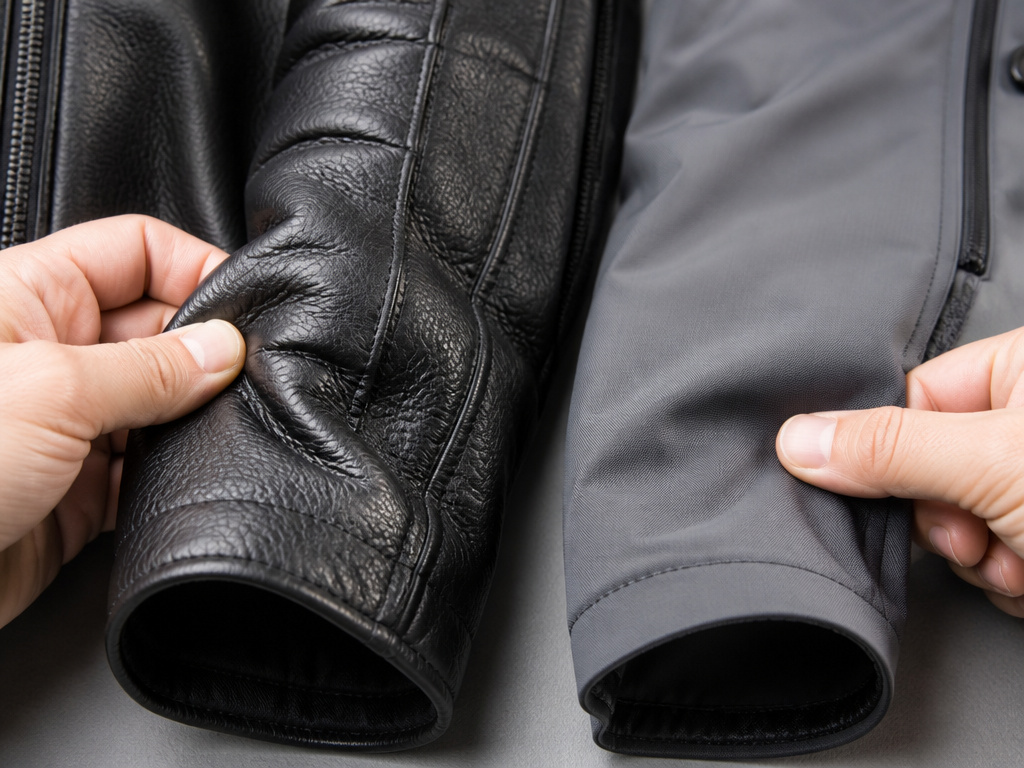
The material changes the game. Get this wrong and you’ll own a jacket that never fits right.
Leather is stiff out of the box. A quality hide will mold to your body with wear. Revv Rider advises to buy leather snug, not loose, it will relax into a perfect fit. If it’s comfortable in the store on day one, it will be baggy in six months. This break-in period is why a dedicated guide on how to break in a leather motorcycle jacket exists.
Textile and Mesh hold their shape from the first wear. What you try on is what you get. Mesh jackets, popular for heat, should still fit snugly at the shoulders and elbows even though the fabric feels airy. Depending on the riding style they are designed for, textile jackets may also sit a little baggier on the body.
This is the core of the leather vs textile debate beyond protection. One material moves, the other doesn’t, which directly impacts how should a motorcycle jacket fit. Your sizing strategy must adapt.
The Airbag Sizing Question
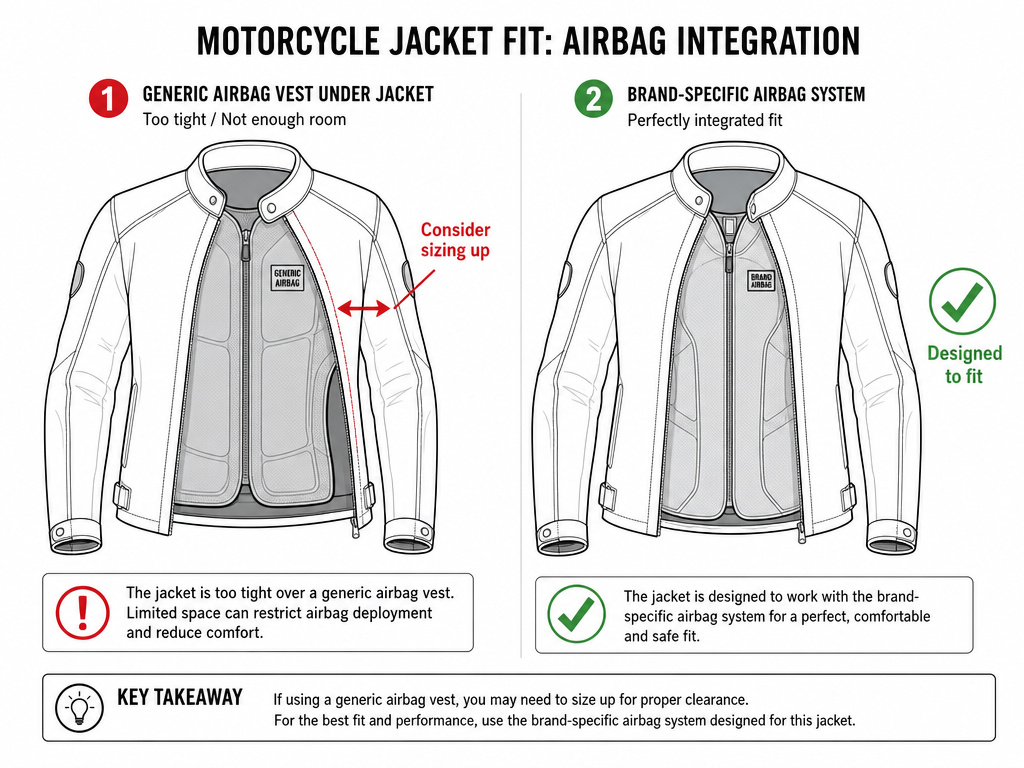
Modern gear includes airbag vests. Do you need a bigger jacket to wear one? The sources disagree.
- Dainese’s Position: For its Racing 5 and Iperattiva jackets, Dainese explicitly states the jacket “can be comfortably worn over the Dainese Smart Air airbag device without the need to purchase a larger size.”
- D3O’s Advice: The armor manufacturer’s guide takes a more cautious view: “You should also consider sizing up your jacket if you will be wearing an airbag.”
Who’s right? Both, in context. Dainese is speaking about its specific jackets designed to integrate with its specific airbag. The D3O advice is a general rule for the aftermarket airbag vests that go under any brand of jacket.
Common mistake: Assuming a general airbag rule applies to a brand-specific system. If you’re buying a Dainese jacket for a Dainese Smart Air, trust their product page. If you’re buying a generic jacket for a third-party airbag vest, listen to D3O and consider sizing up.
The only way to know for sure is to test it. If you’re buying online and plan to use an airbag, this uncertainty is a strong argument for ordering two sizes to try.
How Temperature Warps Fit (And Protection)
Your jacket doesn’t exist in a 70°F vacuum. Heat and cold change how it fits and even how its armor performs.
The Aerostich Darien manual provides hard numbers. Its TF5 impact pad material performs best between 65°F and 85°F. Leave the jacket outside in freezing temps, and the TF5 “may become stiff enough to split when flexed sharply.” That’s a specific failure mode with a cause.
The same manual states that for cold weather use (20°–65°F), your jacket becomes about a half size larger with layers. For hot weather (80°–100°F), you can open vents and zippers. But it carries a warning: “adjusting or opening wrist (or other) zippers for ventilation may result in shifting of the TF5 impact pads in some crash situations.”
For example, the Aerostich Darien’s TF5 impact pads may become stiff and split if left in freezing temperatures.
Buying Online Without Trying It On
This is the reality for most riders. Here’s how to minimize the gamble, beyond just checking a size chart.
- Know Your Measurements. Chest, sleeve, and shoulder width. Write them down.
- Read the Fit Description. Does the product page say “slim, sporty fit” (Dainese Super Rider 2) or provide sizing based on chest measurement (Aerostich Darien)? That tells you more than the size label.
- Check Return Policies. Before you click buy, know the return window and who pays for shipping.
- Order Two Sizes. If you’re on the line between a Medium and a Large, order both. The cost of return shipping is cheaper than the cost of a jacket that never fits.
- Have a Local Benchmark. If you own a jacket that fits well, note its brand, size, and fit category (American, European, Race). Use it as a reference point when researching new types of jackets.
This process also applies to matching your motorcycle pants fit. The goal is a system where everything works together, which is why learning how to zip a motorcycle jacket and pants together is a final, crucial step.
Frequently Asked Questions
How tight should a motorcycle jacket be?
It should be snug enough that the armor doesn’t shift when you push it, but loose enough to allow a full range of motion on the bike and to slide a flat hand between your chest and the zipped fabric. You should be able to take a deep breath without the back panel pulling tight.
Should I size up for a motorcycle jacket?
Only if the manufacturer advises it for a specific reason, like accommodating a certain airbag vest, or if you know you will consistently wear very thick layers underneath. For leather, size for your typical riding layer thickness, it will stretch. For textile, size for the fit you want on day one.
Is it better for a jacket to be too big or too small?
Too small is the greater evil. A jacket that restricts movement is uncomfortable and can be dangerous. A jacket that’s too big compromises protection because the armor floats. If you must err, err slightly toward too big, but then explore options like a different fit category or brand to get closer to correct.
How do I determine my motorcycle jacket size?
Throw out your street clothing size. Use a soft tape to measure your chest (over shoulder blades) and sleeve length (shoulder to wrist bone). Find the specific size chart for the jacket you want and match your measurements to it. Your best determination comes from trying the jacket on in a riding position.
Before You Go
Fit isn’t a one-time check. A new leather jacket will break in. A textile jacket’s liner will add bulk. Your layering changes with the season. The rule that doesn’t change: the armor must stay put.
If you remember one thing, make it this. Before you buy based on features or looks, put the jacket on and get into your riding stance. Reach for the bars. That single motion tells you more than any product spec sheet. It shows you where the seams pull, if the sleeves shorten, and whether the shoulders bind. No chart can predict that.
Once the fit is right, the other choices, like adding the best back protectors for motorcycle jackets or choosing from our list of best motorcycle jackets, become upgrades, not compensations. Start there. Everything else is secondary.
