
How Should Motorcycle Pants Fit: The 3-Step Fit Check
This post contains affiliate links. As an Amazon Associate, we earn from qualifying purchases.
Motorcycle pants should fit snug when you’re standing, comfortable when you’re seated on the bike, and keep the knee armor centered over your kneecap in the riding position. The two critical measurements are your hip circumference and your inseam; sources disagree on whether to measure inseam in a standing stance (e.g., BMW Motorrad) or a riding stance (e.g., Denimotto). Loose pants shift armor out of place in a crash; tight pants cut circulation and distract you.
That’s the baseline. The difference between a safe fit and a dangerous one comes down to where you measure, how you check, and what you do when the manufacturer’s size chart lies.
What follows: the three-part check you do before your first ride, the two ways to measure that actually work, the material-specific rules that break the standard advice, and the one adjustment every pair should have.
Key Takeaways
- Fit for the riding position first. A pant that’s perfect standing can be too tight seated or let armor slide down your shin.
- Size to your hip measurement, not your waist. A belt fixes a loose waist; a tight hip can’t be fixed without tailoring.
- Knee armor must not move. If it shifts when you walk or sit, use the internal straps or Velcro to lock it in place — riding without secured armor is like wearing a helmet that’s not buckled.
- Manufacturer charts can be wrong. The REV’IT! Ignition 4 H2O pant, for example, runs small in the waist versus its own published chart — always check independent retailer notes and owner forums before buying.
- Never ride in new pants until you’re 100 percent sure. Walk, sit, and mimic riding controls at home. Once they’ve touched pavement, most retailers won’t take them back.
The 3-Step Fit Check (Before You Ride)
You have the pants in hand. Don’t zip them to your jacket yet. Don’t even think about heading out.
Do this first.
Step one: stand and assess the base fit. Pull the pants on with whatever you’ll wear underneath — base layer, jeans, nothing. Zip and fasten them. They should feel snug but not restrict your ability to walk or squat. If you need to suck in your stomach to button them, they’re too small in the waist. If you can easily fit a fist in the waistband, they’re too large.
This is where most people stop. That’s the first mistake.
Step two: sit on your bike (or a chair that mimics the seat). This step is essential. Your body changes when seated: your knees bend, and your posture shifts. Fabric that was relaxed standing now pulls across your thighs and lower back.
The critical test is the knee armor. When you’re seated with your knees bent, the center of the armor pad should sit directly over your kneecap. Sources like RevZilla aim for this directly, while Leatt advises mounting them slightly low when standing so they migrate into place when seated.
If the armor settles on your shin or upper thigh, it’s in the wrong place. In a crash, it protects the wrong part of your leg.
Step three: move. Shift your weight forward and back like you’re working the controls. Stand up from the seated position. Walk a few steps. Does the armor stay put, or does it slide down? If it moves, you haven’t tightened the internal adjustment straps enough. Those straps exist for a reason.
Where this goes sideways: Assuming standing fit is good enough. Armor that sits perfectly at your knee while standing will often drop when you sit, potentially leaving your kneecap exposed. Check it seated.
If all three steps pass, you’re close. If any fail, you have a fit problem that will only get worse at speed.
How to Measure Yourself (The Right Way)
Your size in Levi’s or dress slacks is a suggestion, not a guarantee. Motorcycle pants are cut for a different posture and often sit higher on your waist.
There are two schools of thought on the tape measure, and they disagree.
The first method is the standard standing measurement. This is what BMW Motorrad and many size charts use. You measure your waist just above the top of your trousers, relaxed, without holding your stomach in. You measure your hips around the fullest part of your backside. You measure your inside leg from the crotch seam to the sole of your foot.
It works for traditional touring pants designed to go over your boots.
The second method is the riding-position measurement. This comes from Denimotto’s sizing guide for motorcycle jeans. Here, you measure your inseam with your feet forward and knees bent at a 90-degree angle, mimicking your riding stance. This yields a measurement 1-3cm longer than your standard standing inseam.
Why? Because your leg elongates when seated on a bike. A pant cut to your standing inseam will ride up your calf when you’re in riding position, exposing skin above your boot.
Which method is right? It depends on the pant.
- For over-the-boot pants (relaxed/touring fit), as RevZilla notes, they are designed to go over the boots, so use the standard standing inseam.
- For in-the-boot pants (sport/race fit), as RevZilla notes, they are designed to be tucked into the boot, so consider the riding-position inseam, especially if you have a taller seat or sportier riding posture.
| Measurement | Standard Method (e.g., BMW Motorrad) | Riding-Position Method (e.g., Denimotto) | When to Use Which |
|---|---|---|---|
| Waist | Just above trousers, relaxed | Right below the navel (pants ride higher) | Sources disagree on where to measure waist: BMW Motorrad advises measuring just above your trousers, while MotorcycleGear.com advises measuring right below the navel. |
| Hips | Fullest part of backside | Fullest part of backside | Always size to the hip if it conflicts with waist. |
| Inseam | Crotch seam to sole of foot | Crotch seam to sole, with knees bent 90° | Standing for over-boot pants; riding-position for in-boot pants/jeans. |
The Leatt garment manual states: “Protectors should be at the correct position and should stay in place when moving… Length of legs should be long enough to nicely cover your body.”
The rule is simple: size to your hip measurement. It’s the larger of the two core numbers, and it’s the one that’s hardest to alter. A waist that’s slightly loose is fixed with a belt or the pants’ own adjusters. A hip that’s tight is a tailor’s job, and it will restrict your movement on the bike.
Snug vs. Tight: Where Sources Disagree
How close should the fit be? You’ll find two different answers.
RevZilla’s guide says pants should be “snug but not restrict movement.” That’s the classic, common-sense advice. You want them close to your body without cutting off blood flow or making it hard to walk.
The Leatt manual for its 7.5 pants says: “Always use the available adjustment straps to tighten the garment as much as possible to keep protection in place and avoid flapping.”
That’s a stronger stance. It prioritizes locking the armor down, even if it means a tighter overall feel.
They’re both right, for different contexts.
Snug is the target for the overall garment. You shouldn’t feel like you’re wearing a wetsuit.
Tightened down is the target for the armor itself, via those internal straps and adjusters. The armor should have zero play. It should feel like a part of your leg, not a pad inside a pocket.
The disconnect happens when you compare a how should motorcycle pants fit guide to a pant cut so loosely that no amount of strap tightening keeps the armor in place. That’s a design flaw. If you buy a pant and the armor shifts even after you’ve cinched every strap, return it. It’s not the right cut for your body.
The Armor Position Debate: At Your Knee or Slightly Below?
Here’s another place the experts don’t fully agree.
RevZilla states: “When standing, the top of the armor should settle right at your knee.”
Leatt advises: “Mount knee protectors slightly low in upright standing position so when on the bike with bent knees the protector is in place.”
Both are aiming for the same outcome in the how should motorcycle pants fit debate: armor over the kneecap when you’re riding. Leatt’s method accounts for the fact that when you stand straight, your knee is extended. When you sit on a bike and bend your knee, the skin and fabric over your kneecap move downward. If the armor is already slightly low when standing, it migrates into the correct position when seated.
RevZilla’s method assumes a well-designed pant will account for that migration on its own.
The practice check: Put the pants on. Stand up. Note where the armor sits. Now sit on your bike or a chair in your riding posture. Have a friend mark where your kneecap is on the outside of the pant. Stand back up and see if the armor center lines up with that mark.
If it’s significantly off, use the pant’s adjustment system to move the armor pocket up or down. Many pants, like the REV’IT! Ignition 4 H2O, have internal Velcro to adjust armor height independent of the inseam length.
If your pants don’t have adjustable armor, and the armor is consistently in the wrong place, they’re the wrong pants for you. It’s that simple.
Material-Specific Rules That Break the Standard Advice
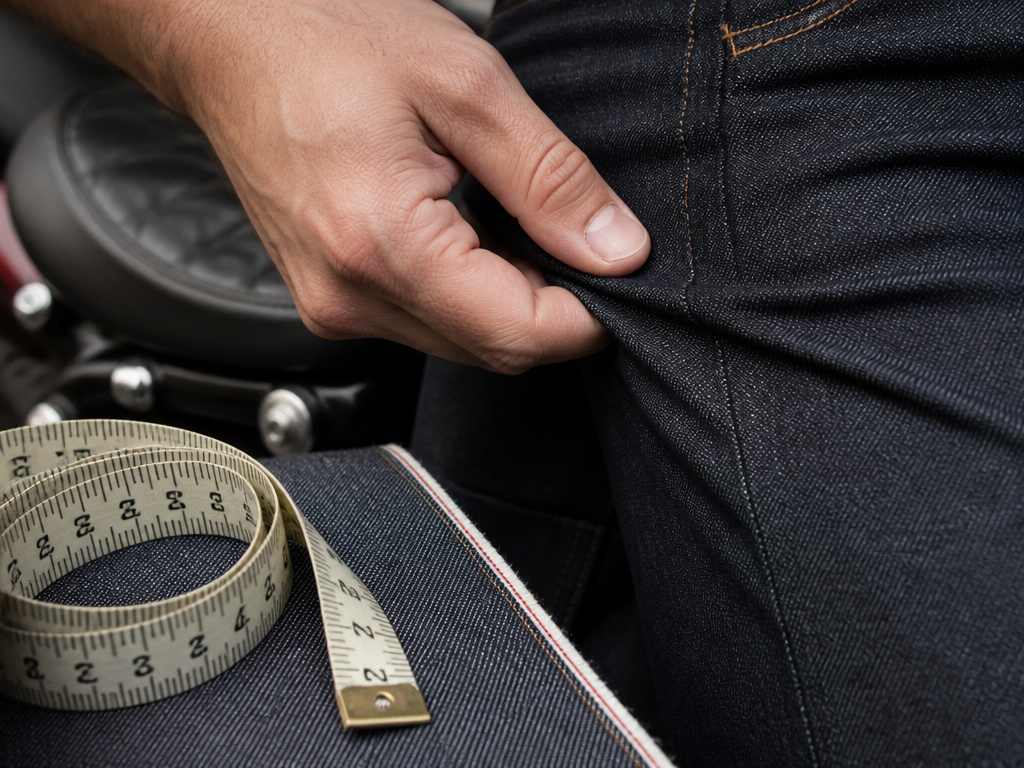
Not all pants are created equal. The fabric changes the rules.
Leather pants, especially race-oriented ones, are designed to be pre-curved and worn in a tuck. They will feel stiff and tight standing. They’re supposed to. They break in and mold to your body over a few rides. Don’t expect them to feel like sweatpants on day one. If they’re painfully tight or restrict your ability to reach the controls, size up. If they’re just stiff, wear them around the house.
Textile pants for touring or adventure riding are cut fuller to accommodate liners and layers. They should feel roomier from the start. The “snug but not restrictive” rule applies directly here.
Motorcycle jeans have their own sub-rules, and this is where the standard sizing advice most often fails.
- Raw selvedge denim will stretch. Denimotto’s guide is explicit: “Buy one size down from your measurement.” If you buy your exact waist size in raw denim, it will be too loose after a month of wear.
- Pre-washed or stretch denim doesn’t stretch the same way. For these, buy true to your measured size.
Common mistake: Translating your fashion jean size directly to motorcycle jeans. Your size in Levi’s is calibrated for standing fit and a specific cut. Motorcycle denim is cut for a riding posture and uses different materials. Measure your body and use the brand’s chart, not your wardrobe memory.
This is why checking forums and reviews is critical. The Drive’s guide explicitly advises this because “some manufacturers’ sizes don’t quite line up with your normal size.” A retailer like MotorcycleGear.com found the REV’IT! Ignition 4 H2O pant runs small in the waist compared to REV’IT!’s own chart. They created their own sizing estimate to compensate.
The Two Main Fit Categories: Relaxed/Touring vs. Sport/Race
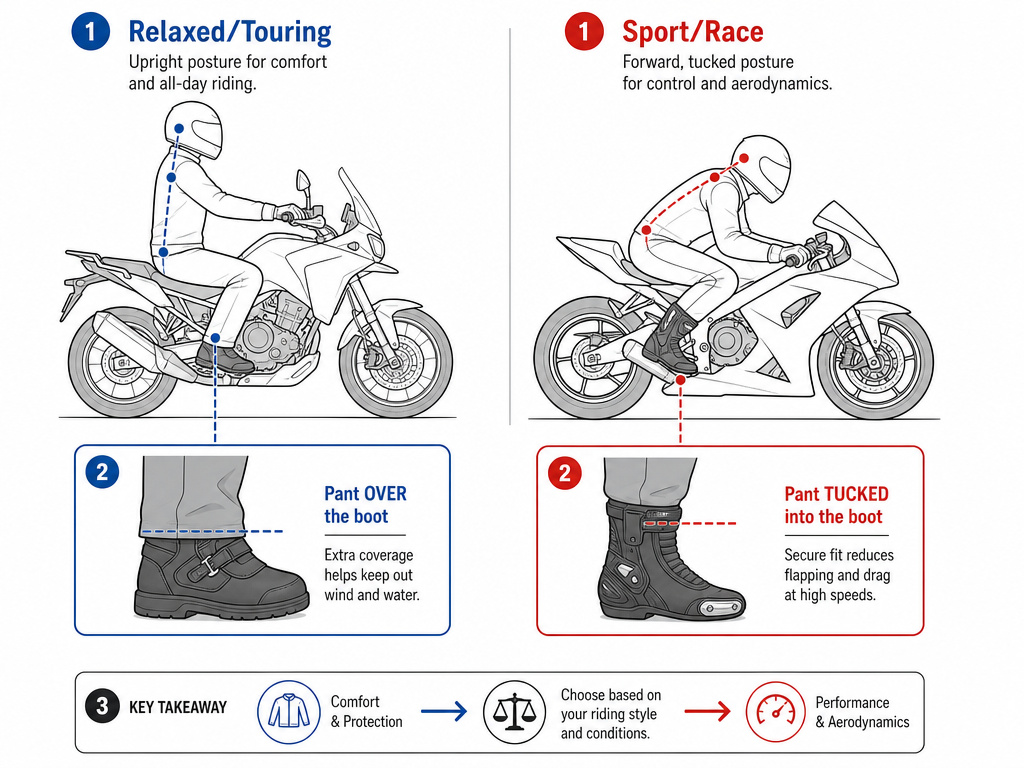
Your riding style dictates the cut. This isn’t about fashion; it’s about geometry.
Relaxed/Touring Fit pants are designed for upright seating positions and long-distance comfort. They are cut for an upright seating position. They are meant to go over the top of your boots. This keeps weather and debris out. The inseam for these is your standard standing measurement.
Sport/Race Fit pants are cut for a forward-leaning, tucked position on a sport bike. They are cut for a forward-leaning, tucked position. They are designed to be tucked into your boots. This is part of the design for sport riding. The inseam here is trickier — you may need the riding-position measurement to prevent the pant leg from pulling out of your boot when you extend your leg.
Trying to wear a sport-fit pant over a boot, or a touring-fit pant tucked in, will cause bunching, discomfort, and a compromised fit. Choose the category that matches your primary riding posture.
For a deeper look at the pros and cons of different types of riding pants, the material choice is just as important as the cut.
Adjustments and Zippers: The Fine-Tuning That Matters
Good motorcycle pants aren’t passive. They have adjustment points for a reason.
Waist adjusters are common, often offering about a 2-inch range (like on the Ignition 4 H2O). Use them to take up slack after a long day or if you’re between sizes.
Internal armor straps are required. They are hook-and-loop strips inside the knee pocket that let you position the armor higher or lower. Once you find the sweet spot, press the Velcro hard. The armor should not budge.
Connection zippers turn a jacket and pants into a two-piece suit zipper system. Always zip them together. This prevents the jacket from riding up and exposing your back in a slide. It also improves weather sealing and eliminates flapping.
If your pants lack these adjustment points, you’re buying a less capable product. Adjustability is what allows you to tailor an off-the-rack pant to your unique body.
When Manufacturer Charts Lie (And How to Know)
You measured. You checked the chart. You ordered the indicated size. The pants arrive and they’re obviously wrong.
It happens more than you think. Sizing is not standardized across brands, or even across a single brand’s different product lines.
The defense:
- Read independent retailer notes. MotorcycleGear.com, RevZilla, and other major retailers often add fit notes to product pages. “Runs small,” “true to size,” “order one up” — this is gold.
- Scour owner forums. A quick search on forums or subreddits for the specific pant model will reveal a pattern of fit feedback. This is real-world data from people who bought them.
- Understand the certification baseline. Pants certified to standards like EN 17092-3:2020 (Class AA) or EN 17092-4:2020 (Class A) have passed specific safety tests, but the fit can still be off. The certification guarantees protection levels, not that a size 34 will fit you.
When in doubt between two sizes, order both and return one. It’s a hassle, but it’s cheaper than eating the cost of a single pair that doesn’t fit.
For a curated list of models that consistently get fit right, see our pants buyer’s guide.
How should motorcycle pants fit for sport vs cruiser riding
Your riding position changes how pants should fit. Sport or race-fit pants are designed to be tucked into your boot. When you’re in a forward-leaning sportbike tuck, the pants need to be snug to keep armor in place without bunching. For a relaxed touring or cruiser position, pants are typically cut to go over the boot. The key is to test the fit in your actual riding posture. Motorcycle jeans should feel snug when you’re standing but comfortable when you’re in the riding position with your knees bent. This ensures the armor stays correctly positioned when you’re on the bike.
What if motorcycle pants are loose at the waist
A perfect waist fit can be tricky. If your pants are slightly loose, use the built-in adjustment straps or a belt to snug them up. Many pants have Velcro waist adjusters for this purpose. The real priority is the hip fit; always size to your hip measurement if it points to a different size than your waist. A waist that’s a little big is an easy fix. A hip that’s too tight will restrict movement and is difficult to alter. Before riding, make sure the waist is secure enough that the pants won’t slide down, which could displace your hip and knee protection.
Why zip motorcycle pants to a jacket
Zipping your pants to your jacket creates a one-piece suit, which is a critical safety feature. It also stops gaps from forming at your waist, ensuring no skin is exposed to the pavement. When checking the fit of pants you intend to zip, make sure the waistline sits where it’s designed to, which is often higher than fashion jeans. The zipper connection should be secure without creating uncomfortable tension or pulling the pants too high when you’re in your riding position.
Frequently Asked Questions
What if my waist and hip measurements point to different sizes?
Size to your hip. It’s the larger measurement and the hardest to alter. A slightly loose waist is easily fixed with the pants’ internal adjusters or a belt. A tight hip will restrict your movement on the bike and can’t be fixed without expensive tailoring.
Do motorcycle pants stretch out over time?
It depends on the material. Leather will mold and soften, becoming slightly more accommodating but not significantly larger. Raw denim will stretch, especially at the waist and knees — that’s why you size down one in raw selvedge. Textile and pre-washed denim have minimal stretch. Fit them correctly from the start.
How do I know if pants are too tight?
The test is in the riding position, not standing. If, when seated on your bike, the waistband digs into your stomach, the fabric pulls painfully across your thighs, or you can’t comfortably bend your knee to 90 degrees, they’re too tight. Discomfort standing is one thing; discomfort riding is a distraction you can’t afford.
Can I wear knee protection under my pants?
Yes, but it changes the fit equation entirely. This is common for dirt bikers. If you plan to wear separate knee braces or pads underneath, you must size up to accommodate the extra volume. A pant designed for integrated armor will be too tight with an external protector inside. This is a specific case where following standard sizing will fail.
What’s more important, fit or protection level?
Fit is part of the protection. A pant with the highest CE certification is useless if the armor isn’t positioned over your joints when you crash. Always solve for fit first. A well-fitting Class A pant is safer than a poorly fitting Class AA pant.
Before You Go
One rule most guides skip: if you can’t get the knee armor to stay centered over your kneecap in your riding position, stop. Return the pants. No amount of break-in or adjustment will fix a fundamental mismatch between the pant’s cut and your body geometry.
The entire point of this gear is to have a layer between your skin and the pavement that holds hard protection in the right spots. If the armor isn’t in the right spot, you’ve bought an expensive pair of reinforced trousers, not protective riding pants.
Everything above assumes you’re buying a dedicated riding pant. The calculus is different if you’re looking at riding overpants designed to go over your street clothes, or if you’re comparing the trade-offs in our jeans vs textile pants breakdown.
Fit first. Features second. Your knees and hips will thank you.
