
How to Get Motorcycle License in Oklahoma: Step-by-Step
This post contains affiliate links. As an Amazon Associate, we earn from qualifying purchases.
Here’s how to get motorcycle license in Oklahoma: add an M endorsement to your driver license through Service Oklahoma. Riders under 18 must pass an MSF course. Riders 18 and up can take MSF or pass the motorcycle written and skills tests. Under 16, you start with a learner permit held 30 days.
That MSF requirement sets the whole timeline. Service Oklahoma accepts no other rider course, and MSF classes can’t be done online because the training happens on a bike. Book the course first and the licensing office visit becomes mostly paperwork.
What follows: the three routes by age, the under-16 permit rules, test-day paperwork, the gear that matters, and the six places where Oklahoma’s own documents disagree with each other.
Key Takeaways
- Service Oklahoma counts only MSF courses, so a free class from another program won’t waive your tests.
- A learner permit has to be held 30 days before you can get the full endorsement.
- Permit holders under 16 ride only between 4:30 a.m. And 9:00 p.m., on 300cc or less, with a licensed rider 21 or older.
- Without a windshield on the test bike, you need ANSI Z87.1 goggles or a face shield for the drive test.
- Official sources disagree on whether an 18-year-old needs the course. Plan around the stricter reading and you won’t get sent home.
Which Route Fits Your Age? Three Ways Into an M Endorsement
Your age on test day picks your route for you. Service Oklahoma splits applicants into three bands, and each band has its own rules.
An Oklahoma motorcycle endorsement requires a passing score on the Class D written test plus one qualifying path. Applicants ages 16 to 18 complete the MSF Basics course. Applicants 18 and older complete MSF Basics or pass the motorcycle written and skills tests. A learner permit, available from age 14, must be held 30 days before the full endorsement.
The Oklahoma motorcycle endorsement requirements page lays this out in plain text. The table below is the short version. If you’re comparing Oklahoma with another state, the general motorcycle license steps look familiar. The age lines and course rules are where Oklahoma gets particular.
| Your situation | What you need | Tests you take |
|---|---|---|
| Age 14-15, permit | Class D written test, MSF Basics | Class D written |
| Age 16-17, endorsement | MSF Basics course | Class D written |
| 18+, course route | MSF Basics course | Class D written |
| 18+, test route | No course | Motorcycle written and skills |
| 18+, never licensed | No course | Class D written, motorcycle written, skills |
Ages 14 and 15
You start with a motorcycle learner permit. You need to pass the Class D written test and finish the MSF Basics course first. If you’re under 18, a parent or legal guardian has to be present when you take the written test. No guardian, no test.
Ages 16 and 17
You can skip the permit entirely. Pass the Class D written test, show your MSF Basics completion, and Service Oklahoma adds the endorsement to your current license.
18 and older
Here you get a real choice: take MSF Basics, or pass the motorcycle written and skills tests at a licensing office. One catch for adults who have never held any driver license. You take two written tests, the Class D and the motorcycle test.
Honestly, if you’re 18 and on the fence, I’d still take the course. It waives both motorcycle tests, and it puts a coach next to you before you learn bad habits on your own.
Does a Car License Let You Ride in Oklahoma?
No. Your Class D card alone doesn’t cover a motorcycle.
Oklahoma law, as quoted in the 47 O.S. Section 6-101 text inside SB417, says nobody may operate a motorcycle or motor-driven cycle without a valid Class A, B, C, or D license with a motorcycle endorsement. The endorsement is the part that matters. Your car license is the base it gets stamped onto.
Service Oklahoma draws one firm line on engine size. Any combustion engine with a piston displacement of 150cc or more requires a motorcycle license. That includes scooters and mopeds that cross the line, whatever the dealer calls them.
What about smaller machines? This is where I’ll admit the official picture gets thin. The endorsement rule covers “motor-driven cycles” too, and the public page I checked doesn’t spell out every class below 150cc. Before you buy a small scooter on the theory that it’s license-free, ask your licensing office how they’d classify that exact model.
The MSF Course Is the Only Class Service Oklahoma Counts
The Motorcycle Safety Foundation is the only course name on Service Oklahoma’s approved list. Take a class from anyone else and you’ll still owe the state its written and skills tests.
An MSF Basic Rider Course completion waives the motorcycle written and driving exams. Service Oklahoma’s A.07 procedure document says it, and so does the statute text in SB417. With an approved certificate in hand, you can upload it during an online renewal or replacement and add the M endorsement without standing in line.
In Oklahoma City, the OSU-OKC Basic RiderCourse registration page lists a licensing course at the Public Safety Training Center, 3501 W Reno Ave. OSU-OKC pitches it at riders with little or no riding experience. That’s exactly who it should be for.
I’d push any new rider toward the MSF course even when the law gives them a choice. The skills test checks whether you can pass a test. The course gives you hours of coached riding before anybody is grading you, and that’s where the habits get set.
SafeRiders: Free, Taught by Troopers, and Easy to Misread
The Oklahoma DPS SafeRiders program is a free course taught by Oklahoma Highway Patrol motorcycle troopers and funded by the Oklahoma Department of Transportation. It sounds like a shortcut to a license. Read the fine print first.
SafeRiders says you need an M endorsement and valid insurance to take part. Its own FAQ then answers “No” when asked whether you need an endorsement before showing up. Either way, Service Oklahoma only accepts MSF as a qualifying course, so treat SafeRiders as extra training after you’re licensed. Classes cap at 30 spots each, and you bring your own insured, registered bike in good working order.
The Gear List, and the Piece I’d Buy First
SafeRiders publishes a gear list that works for any Oklahoma training day:
- A federal DOT-approved helmet, worn during every riding exercise.
- Eye protection.
- A long-sleeved shirt and long pants. Torn or ripped clothing isn’t allowed, so the beat-up jeans stay home.
- Full-fingered motorcycle gloves.
- Over-the-ankle boots, preferably leather.
- A sack lunch and water.
That last one isn’t a joke. SafeRiders requires the sack lunch because the break is short, and it warns about Oklahoma’s heat. By mid-afternoon on a summer range, a long-sleeved shirt is glued to your back and the inside of your gloves turns slick with sweat. Drink before you’re thirsty.
After the helmet, gloves are my first buy for a new rider. Hands go out first in a fall. Cheap gloves are like a cabinet held together with staples instead of joinery: fine on the showroom floor, apart the first time real weight hits them. Sneakers aren’t boots either (yes, I’ll die on that hill).
The Under-16 Permit Rules That Catch Families Off Guard
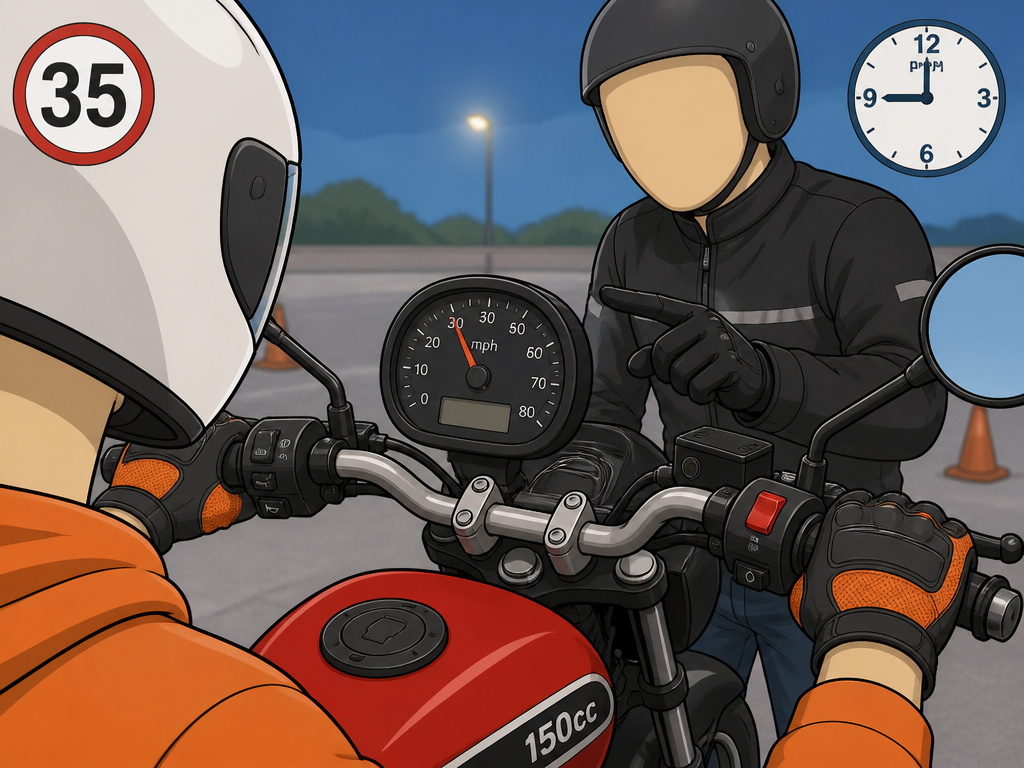
A 14-year-old passes the Class D written test with a parent beside them, finishes MSF, and walks out with a permit. Then the restrictions kick in, and they’re tighter than most families expect.
Service Oklahoma’s public page and the Service Oklahoma A.07 standard procedure together set these rules for riders under 16:
- Ride only between 4:30 a.m. And 9:00 p.m.
- Engine displacement can’t exceed 300cc.
- Wear approved protective headgear. Every ride.
- A licensed motorcycle rider at least 21 years old has to be with you and giving instruction. Your 19-year-old cousin with an endorsement doesn’t count, no matter how good a rider he is.
- No passengers.
- On a bike of 150cc or less, stay off any highway with a posted minimum speed, and never go over 35 mph (or the posted limit, if that’s lower).
Easy to miss: The 35 mph cap applies to under-16 riders on bikes of 150cc or less. A parent who buys a small bike to “keep it safe” is also buying a hard speed ceiling and a ban on minimum-speed highways until the rider turns 16.
The A.07 document labels this the “0” motorcycle-only restriction. It lifts on its own at 16, with no extra trip to the office. The 30-day permit hold still applies before the full endorsement.
In my view, the 21-or-older rule does more good than any other line on this list. A teenager learning beside an experienced adult picks up road sense that no written test checks.
How to Get Motorcycle License in Oklahoma at 18+ Without the Course
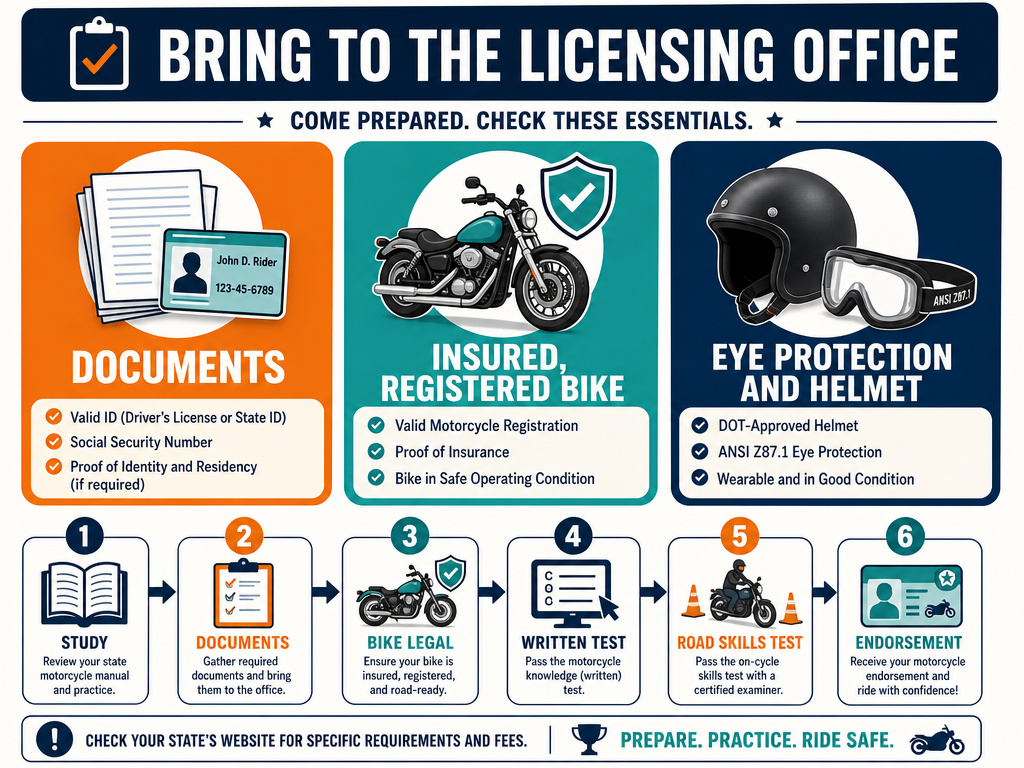
Three things go with you to the licensing office: documents, an insured motorcycle, and eye protection. Forget any one of them and the drive test doesn’t happen.
Before you start: The drive test puts you on a moving bike in front of an examiner, so treat it like any ride. Without a sufficient windshield, wear ANSI Z87.1-rated goggles or a face shield (a closed shield fogs from your own breath the moment you stop, so crack it open one notch). Wear a DOT helmet even if you’re over 18; a low-speed tip-over in a parking lot still slams your head into pavement. And check both mirrors before you leave home, because Oklahoma requires them on every street bike.
Here’s the order I’d follow:
- Study for the written knowledge test. Service Oklahoma publishes the motorcycle manual online, and the vision and written tests happen together. Walk in cold and you’ll burn a trip on a fail.
- Gather your documents. Bring proof of identity, proof of lawful presence, one proof of address (two for REAL ID), and your Social Security number. The physical card isn’t required. If your name doesn’t match your ID, bring the legal name change document, or the clerk stops right there.
- Get the bike legal. Finish registering your motorcycle and carry proof of motorcycle liability insurance. Oklahoma requires liability insurance just to ride, the test included.
- Take the written test. Pass it and you move on. If you’ve never held any license, the Class D written test comes first.
- Take the road skills test. Practice slow-speed control on your own bike beforehand. Low-speed work is where nerves show up, and a dropped bike ends the test.
- Collect the endorsement. Visit a Service Oklahoma Licensing Office or a Licensed Operator. Many licensing offices take walk-ins.
For prep, our walkthrough on how to pass the road skills test covers the slow-speed drills. Coming from another state? Service Oklahoma handles out-of-state motorcycle license transfers on a separate page, so check that one before you assume your old endorsement carries over.
Where Oklahoma’s Own Documents Disagree
Oklahoma’s official sources contradict each other in six places. I lined up Service Oklahoma’s public page, its internal A.07 procedure, the statute text quoted in SB417, and the SafeRiders page side by side. Here’s what each one says.
| Question | One source says | Another source says |
|---|---|---|
| Who must take MSF? | A.07: anyone under 18 | SB417 statute text: 17 or younger |
| Endorsement letter | Public page: “M” | A.07: “L” |
| Permit supervision | Public page: accompanied by, receiving instruction | A.07 “A” code: in view, regardless of age |
| SafeRiders entry | Requirements: M endorsement needed | FAQ: endorsement not needed |
| 300cc cap | Public page: all permit holders | A.07: “0” holders under 16 |
| Eligible license class | A.07: unrestricted Class D only | Statute text: Class A, B, C, or D |
The MSF age line is the one that matters most. Service Oklahoma’s public page says anyone “between the ages of 14 and 18” must complete an MSF course. Its endorsement section says riders aged 16-18 take MSF, while those 18 and older can choose whether to. A.07 says “Completion of MSF is required for anyone under the age of 18.” The statute text says “seventeen (17) years of age or younger.”
So can an 18-year-old skip the course? The public page’s endorsement rules say yes. The phrase “14 and 18” muddies it. I can’t settle that from the documents alone.
If two official documents disagree, plan around the stricter one. An extra course weekend beats a second trip to the licensing office.
The letter change is simpler. The A.07 procedure still calls it an “L” endorsement, while the public page calls it “M.” Don’t panic if you see either on paperwork. The course rules themselves go back a while: the Senate’s 2016 vote record shows HB2260 dealt with motorcycle safety course requirements for licenses.
What It Costs, Plus the Bike Rules Nobody Checks
Service Oklahoma charges a small motorcycle application fee on top of your license renewal or replacement fee. The fee is stacked, so you pay both. The exact amounts are on the endorsement page, and they’re the kind of number worth checking the week you go, since state fees get revised.
Riders 65 and older get a break. The statute text quoted in SB417 says anyone 65 or older isn’t charged a fee for issuing or renewing a Class D license or motorcycle endorsement. I’m reading that from bill text, so confirm it at the counter.
Course fees run separately and vary by provider. SafeRiders is the one free option, and it doesn’t count toward licensing.
The bike itself has to pass muster too. HB1021, as enrolled, requires two rearview mirrors at least 3 inches in diameter, one per side, plus a working speedometer that reads at least the bike’s maximum legal speed. HB1021 also deletes the old handlebar-height limit. I couldn’t confirm its effective date from the enrolled text, so don’t bolt on tall bars for test day just yet.
The Helmet Rule, and Where I Land on Price
Under HB1021, nobody under 18 can ride or operate a motorcycle without a helmet meeting 49 C.F.R. Section 571.218, the federal standard behind the DOT label. The statute’s helmet requirement applies to riders under 18, but learner permit holders of any age must also wear approved protective headgear. I’d wear one anyway.
Fair warning: I think most top-shelf helmet pricing pays for paint and a logo, not extra protection. Fit matters far more. A properly sized helmet stays planted and quiet at highway speed, while a loose one buffets and pulls at your neck within the first few miles. Safe gear only works if you actually wear it.
Frequently Asked Questions
How hard is it to get your motorcycle license in Oklahoma?
The steps aren’t hard, but the rules branch by age. The written test covers material from the state motorcycle manual. The skills test rewards slow-speed control above all. The MSF course waives both motorcycle tests, which makes it the easier route for most new riders.
How much does it cost to get your motorcycle license in Oklahoma?
You pay a small motorcycle application fee plus your license renewal or replacement fee, with exact amounts posted by Service Oklahoma. MSF course fees are set by each provider. Riders 65 and older aren’t charged for issuing or renewing a Class D license or motorcycle endorsement, per the statute text.
What size motorcycle can I ride without a license in Oklahoma?
Service Oklahoma says any combustion engine of 150cc or more needs a motorcycle license. The endorsement rule also covers motor-driven cycles, so smaller machines aren’t automatically exempt. Ask a licensing office about the exact model before you buy.
Can I ride a motorcycle with just my car license in Oklahoma?
No. Oklahoma requires a motorcycle endorsement on your driver license to operate a motorcycle or motor-driven cycle. Your car license is the base it gets added to.
Can I take the MSF course online?
No. Service Oklahoma says MSF courses can’t be done online because they include in-person riding training. You can, however, upload your completion certificate online when renewing or replacing your license.
Do I need my own motorcycle for the course or test?
SafeRiders requires your own insured, registered bike in good working condition. For the Service Oklahoma drive test, you need proof of motorcycle liability insurance. Check your course provider’s bike policy before you sign up.
Before You Go
Your first step this week: book an MSF course. It’s the only class Service Oklahoma accepts, it waives both motorcycle tests, and it’s required for most riders under 18. Training seats fill, and that course date sets your whole timeline.
One limit on everything above. Oklahoma’s own documents disagree on the MSF age line, the endorsement letter, and the permit supervision wording. If you’re right on an age boundary, call your licensing office before test day. Take the stricter reading when in doubt.
That’s how to get motorcycle license in Oklahoma without wasted trips: course first, paperwork second, an insured and mirrored bike third.
Bottom line: if you’re under 18 or new to riding, take the MSF course and skip the testing gamble. If you’re an experienced adult rider, the written and skills tests are a fair shortcut.
