
How to Get Motorcycle License in New Jersey: 2 Routes
This post contains affiliate links. As an Amazon Associate, we earn from qualifying purchases.
To get a motorcycle license in New Jersey, you add a motorcycle endorsement to your driver license through one of two routes. Finish a Basic Rider Course, or get a permit, practice ride at least 20 days, and pass the MVC road test. Test on a bike of 231cc or less and you’re capped at 500cc.
That 231cc line is the detail in the how to get motorcycle license in new jersey process that follows you for years. It took effect on January 1, 2013, and the only clean ways around it are testing on a bigger bike or finishing a state-approved safety course. So the route you pick decides which bikes you’re allowed to ride afterward, and that’s worth settling before you book anything.
What follows: both routes step by step, the permit rules that eat practice time, a side-by-side on which route is easier, the longer path for riders with no driver license, and the spots where MVC’s own documents don’t agree with each other.
Key Takeaways
- Taking the road test on a bike of 231cc or less caps you at 500cc bikes and a restriction card you must carry. A finished safety course removes that cap.
- Permit holders can’t ride from half an hour after sunset to half an hour before sunrise, carry passengers, or use toll roads and limited-access highways.
- Confirm what the course actually gets you. MVC’s web page and its Motorcycle Manual describe the outcome differently, so ask before you skip booking a road test.
- No driver license? Plan on 3 to 6 months of practice depending on your age, instead of 20 days.
- My default pick is the Basic Rider Course, unless you already own a registered, insured bike over 231cc and ride it well.
Endorsement or Motorcycle-Only License: Which One Do You Need?
Already hold a New Jersey driver license? Then the how to get motorcycle license in new jersey answer is an M endorsement added to it, and most of the steps below follow that path.
New Jersey requires every resident who operates a motorcycle to hold either a motorcycle endorsement on an existing driver license or a separate motorcycle-only license. The endorsement must be on the license before the first ride. Every motorcycle, including a trike or a low-speed model, must also be titled, registered and insured in the state.
No driver license at all puts you on a different track. You’d be working toward a motorcycle-only license, a separate license that covers motorcycles and nothing else. That path starts with a permit and carries much longer practice rules.
The NJ MVC motorcycle licensing overview lists both tracks on one page. It’s dry reading. Read it anyway.
New Jersey’s version of the usual motorcycle license steps has two quirks worth knowing up front: an engine-size rule tied to your test bike, and a trike-only endorsement for three-wheelers. I’d sort out which license you’re chasing first. Everything else follows from it.
Route 1: The Basic Rider Course and the Waiver Question
The state’s training page leads with one number: 90% of motorcycle accidents involve untrained riders, and trained riders suffer fewer injuries when crashes do happen. The NJ Ride Safe education program is the state’s Motorcycle Safety Education Program, or MSEP. The Basic Rider Course (BRC) is its entry-level class.
What finishing the course gets you
The cleanest benefit sits in writing on two separate MVC pages. Anyone who successfully completes an MSEP course is exempt from the bike-size restriction, so you won’t end up capped at 500cc no matter what you trained on.
After the course, the MVC motorcycle page tells you to bring your course completion documents and 6 Points of ID verification to a driver testing center. “6 Points of ID” is MVC’s document scoring system: you stack up identity papers until they add up to six points.
Course fees, schedules and loaner gear are set by the individual providers on the Ride Safe list. MVC doesn’t fix any of them on the pages I checked. So when you call a provider, ask about all three before you pay.
If you have no driver license, the manual adds two hard conditions: 100% participation, and you must successfully complete the course. Miss a session and you’re done.
Where MVC’s own documents disagree
This is where it gets messy. MVC’s web page and its Motorcycle Manual describe the course outcome in different terms, and neither one cleanly cancels the other.
| Question | MVC motorcycle web page | NJ MVC Motorcycle Manual |
|---|---|---|
| Does the BRC replace the road test? | Lists the BRC as one of two endorsement routes | No-license path: card only, “not a road test waiver” |
| What do you apply for after the BRC? | A motorcycle permit, at a driver testing center | Step titled “Get Motorcycle Endorsement” |
| Minimum practice riding | 3 months for first-time applicants over 21 | 20 days with a license; 6 or 3 months without |
That last row looks like a conflict but isn’t one. The 20-day rule covers riders who already hold a driver license, and the month-long rules cover riders who don’t. The first two rows are the real split.
Which document will a testing-center clerk follow on the day? I can’t tell you. Nobody outside MVC can, honestly, so ask one plain question before you book: will my completion documents get me the endorsement, or a permit plus a road test?
I’d book the course and still get MVC’s answer on what the completion card gets you, in writing if you can. Showing up expecting an endorsement and leaving with a permit wastes a morning, and the documents I read leave room for either outcome.
Route 2: Permit, 20 Days of Practice, Then the MVC Road Test
Four stops, in this order: permit, practice, road test, endorsement. This version of the route assumes you already hold a driver license, and you must be at least 18 on road test day, per the NJ MVC Motorcycle Manual PDF.
The permit itself means passing MVC’s knowledge and vision tests. The manual is the study material MVC publishes, so read its riding chapters before you sit the motorcycle permit test. Its table of contents covers blind spots, following distance, slippery surfaces and night riding.
Before you start: Three things trip up permit riders before the test ever happens. First, the practice bike must be titled, registered and insured, so sort the paperwork on a borrowed bike before it leaves the driveway. Second, a helmet that rocks forward when you nod will slide over your eyes on a hard stop; get it sized snug before day one. Third, practicing on a bike of 231cc or less is fine, but testing on one brings the 500cc cap.
- Get the permit at a local motor vehicle agency. Bring 6 Points of ID, pass the knowledge and vision tests, and pay the fee. You must be 17, with parent or guardian consent under 18. Show up a document short and you leave without a permit.
- Book the road test at the same visit. The manual lists the appointment as part of the permit step. Skip it and you’ll hunt for a slot after your 20 days are already up.
- Practice ride for at least 20 days. Follow every permit restriction the whole time.
- Take the road test on your own bike. Bring a registered, insured motorcycle or trike, a helmet, and eye protection. Forget any one of those and you test another day; test on 231cc or less and the 500cc cap lands on your license.
- Pay the fee and get the endorsement. Until it’s on your license, you’re still a permit rider with permit limits.
The permit restrictions run the whole time you hold it:
- No riding from one-half hour after sunset to one-half hour before sunrise.
- No passengers.
- No state toll roads or limited-access highways. That takes the Garden State Parkway and the New Jersey Turnpike off your map, so plan practice routes on local roads.
Fair warning. The night rule eats more practice time than you’d expect in late fall, when the cutoff lands before most evening commutes end.
Low-speed control is where riders struggle. At a walking pace the bike feels heavy, the bars twitch, and the engine note sags the moment you let the clutch out past the friction zone (the narrow band of lever travel where the clutch starts to bite). I’d spend most of those 20 days in an empty lot before the motorcycle road test, because that’s where the slow-speed habits get built.
The 231cc Rule That Caps You at 500cc

This one bites later. Since January 1, 2013, anyone who takes the MVC road test on a bike of 231cc or less is restricted to motorcycles of 500cc or less. The license shows restriction code “5”, and you must carry an MVC-issued restriction card while riding.
| How you qualify | What you can ride | On your license |
|---|---|---|
| MVC road test on 231cc or less | Motorcycles of 500cc or less | Restriction “5” plus a restriction card |
| MVC road test on a bike over 231cc | Any motorcycle | No size restriction |
| Completed MSEP course | Any motorcycle | No size restriction |
| Road test on a trike, or 3-wheel BRC | Three-wheel motorcycles only | Trike-only restriction |
Small bikes tempt test-takers for a plain physical reason. Less weight sits above the tires, so it takes less effort to hold the bike upright at a crawl and less mass swings the bars in a tight turn. That’s exactly the slow work a parking-lot test is built around.
The catch shows up when you shop for your second bike. The restriction card is like a clamp you forgot to take off a glue-up: harmless until you try to move the piece, then it’s in the way every time.
Where this goes sideways: Borrowing a light bike of 231cc or less just to make the test easier. You pass, and the 500cc cap follows you to every bike you look at next season.
If you plan to buy anything bigger in your first couple of seasons, I wouldn’t test small. Take the course or test on a bike over 231cc.
No Driver License at All? Expect Months, Not Days
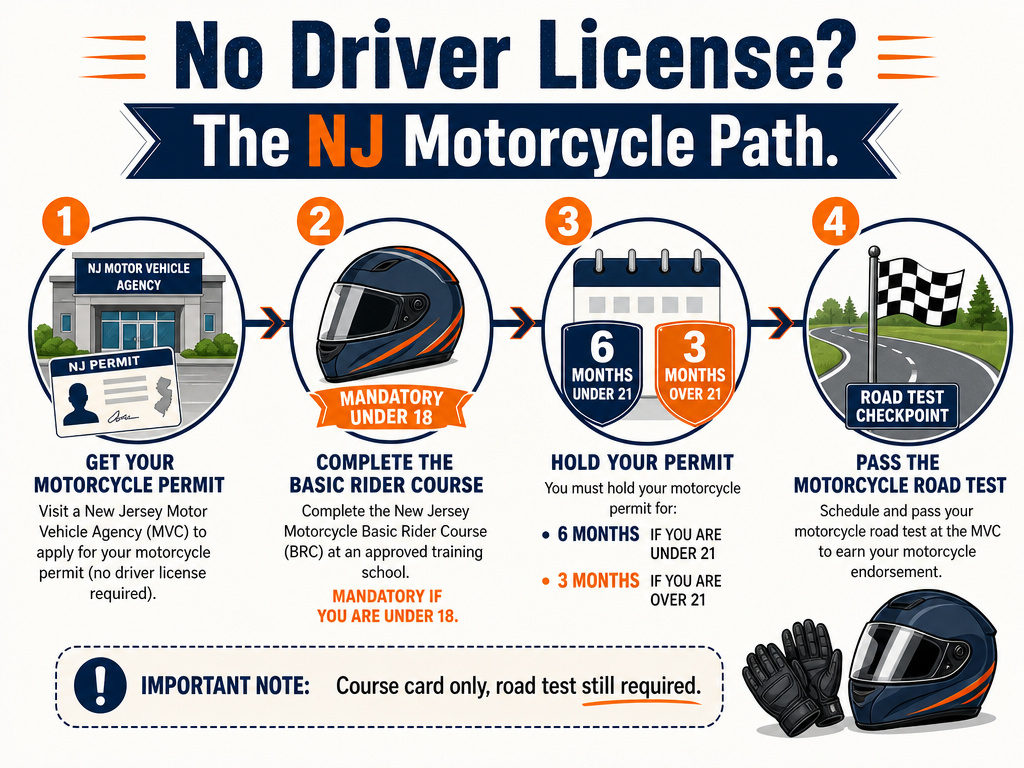
Picture a 20-year-old who never bothered with a car license and wants a bike as daily transport. That rider doesn’t get the 20-day path. Per the manual, you always begin by buying a permit at a local motor vehicle agency, and the timeline stretches from there.
- Under 18: the Basic Rider Course is mandatory.
- Practice riding runs at least 6 months if you’re under 21, or 3 months if you’re over 21, without any suspensions or postponements. MVC treats this as part of its GDL program, the Graduated Driver License system for first-time licensees.
- The course and the practice time can happen in either order. The practice time still has to be finished before you get the license.
- Finishing the course on this path earns a course completion card only, so keep the road test on your plan.
No driver license, no shortcut. Count your practice months from the permit date and keep a road test on the calendar.
Honestly, I’d treat those months as a gift. Use them to sort out gear that fits and stays put while the stakes are low, instead of learning on day one of a real commute that your gloves bunch up at the fingertips.
Course or Road Test: The Easiest Way to Get a Motorcycle License in New Jersey
The road test route looks quicker on paper. You skip a class, ride 20 days, and test. Here’s how the two routes compare for a rider who already holds a driver license.
| Factor | Basic Rider Course | Permit + MVC road test |
|---|---|---|
| Bike you supply | Ask your course provider | Your own, registered and insured |
| Bike-size cap afterward | None (MSEP exemption) | 500cc cap if tested on 231cc or less |
| Minimum age to finish | 17, with consent under 18 | 18 for the road test |
| MVC road test | Unclear; MVC documents conflict | Required |
Verdict: take the course, with one caveat.
If you’re new to riding and hold a driver license, the Basic Rider Course is the route I’d pick. You train with an instructor, you dodge the 231cc trap, and the state’s own crash figure points the same way. The caveat is the waiver question from Route 1, so get MVC’s answer before you assume the road test is gone.
The permit route makes sense for one rider: someone who already owns a registered, insured bike over 231cc, rides it competently, and can’t get a class seat when they need one. Everyone else is saving a little time and taking on more risk.
What to Bring on Test Day (and the Gear I’d Actually Wear)
MVC’s road test list is short: your own motorcycle or trike, registered and insured, plus a helmet and eye protection. Short list. Plenty of ways to get it wrong.
- The bike, with proof it’s registered and insured.
- A helmet that fits.
- Eye protection. A face shield on a full-face helmet handles this; an open-face lid needs goggles or riding glasses.
Paperwork comes before the ride. If the bike’s new to you, registering your motorcycle comes first, since New Jersey wants every motorcycle titled, registered and insured. If there’s a loan on it, the lien holder needs an Entity Identification Number (EIN), which is MVC’s ID number for lenders.
New Jersey stopped requiring motorcycle inspections on August 1, 2010. You still own the bike’s mechanical condition, and police can still cite you for equipment out of compliance. Certified motorcycles also have to meet the minimum safety standards set by NHTSA (the federal road-safety agency) and the EPA.
Easy to miss: Treating an open-face helmet as your eye protection. MVC lists eye protection separately, so bring goggles or glasses with an open-face lid or plan on testing another day.
Gear is where I’ll get opinionated. Read up on motorcycle helmet laws first so the helmet you pick is legal everywhere you plan to ride. Then shop for fit.
Fit beats price tag. A helmet that’s too big shifts when you shoulder-check, and the brow pad creeps down until the top of the eye port cuts into your view. The right fit feels snug at the cheeks with no hot spot on the forehead after twenty minutes. For a first helmet, I’d point you at a plain full-face, bought in a shop where you can try several sizes.
After the helmet, gloves are my next buy, because your hands go out first in a fall. A short sport glove covers parking-lot practice and summer riding. Leave the sneakers home. Wear a boot that covers the ankle bone and has a stiff sole.
I won’t weigh in on Bluetooth headsets for test day. My testing there is thin, and you don’t need one to pass.
Trikes, Low-Speed Bikes, and Dirt Bikes Follow Their Own Rules
Riding three wheels, or something under 50cc? The standard path changes.
Trikes
Anyone who wants to ride a trike needs a motorcycle endorsement, and MVC adds a restriction limiting it to three-wheel motorcycles. You earn that trike-only endorsement by passing the road test on a trike or finishing a 3-wheel BRC. A two-wheeler stays off limits until you qualify on one.
Low-speed motorcycles
MVC defines a low-speed motorcycle as under 50cc, or 1.5 brake horsepower or less, with a top speed of no more than 35 mph on a flat surface. Brake horsepower is the engine’s measured output before drivetrain losses. A basic auto license covers these bikes, with no endorsement needed.
They still have to be titled, registered and insured. They also can’t go on state toll roads, limited-access highways, or any public road posted above 35 mph. That rules out a lot of suburban arterials, so map your route before you buy one.
Dirt bikes and state forests
ATVs and dirt bikes are banned in all New Jersey state parks and forests. MVC notes you may be able to ride a motorcycle in parts of Lebanon, Bass River and Brendan T. Byrne State Forests. Call the Division of Parks and Forestry at (800) 843-6420 before you load the truck.
How Much Does the Motorcycle Safety Course Cost in New Jersey?
The course fee is set by each training provider, so the price you see depends on where you sign up. Before you pay, ask the provider exactly what the fee covers. The two questions that matter most are whether a training motorcycle is provided for the riding portion and whether a helmet is supplied or you need to bring your own. Also ask about any gear you must wear, such as eye protection, sturdy boots and gloves.
Keep the course fee separate from what you pay MVC. After you finish, you still bring your completion documents and 6 Points of ID to a driver testing center; the MVC web page says you apply for a motorcycle permit there, while the Motorcycle Manual describes an endorsement that requires passing the vision test and paying the required fee. Budget for both amounts so nothing surprises you at the counter.
If the price looks high, weigh it against the alternative. Skipping the course means buying, registering and insuring your own bike for practice and the road test, and MVC expects you to bring your own helmet and eye protection to that test.
How Long Is the Basic Rider Course and How Does It Work?
The Basic Rider Course mixes classroom instruction with hands-on riding on a practice range. Providers arrange their schedules differently, so confirm the total hours, the number of days and the start times when you book. Plan to clear your calendar for the full stretch, because the course needs to fit around work and other commitments without gaps.
Attendance matters. MVC’s manual says full participation is required and you must successfully complete the course, so missing a session can mean you don’t finish and have to rebook. Ask the provider what happens if weather cancels a riding session or if you need to make up time.
When you pass, you receive course completion documents. Hold on to them, since you’ll bring them along with 6 Points of ID to a driver testing center for the next step. Losing that paperwork can slow you down, so keep it somewhere safe right after the final session.
Frequently Asked Questions
What is the easiest way to get a motorcycle license in New Jersey?
For most new riders who already drive, the Basic Rider Course. It removes the 231cc size restriction and puts an instructor next to you while you learn. Confirm with MVC whether your completion documents get you the endorsement directly or a permit first, because its own documents describe it differently.
How much does it cost to get a motorcycle license in New Jersey?
Expect an MVC permit fee, an endorsement fee, and the course provider’s fee if you take the class. The sources I checked list conflicting endorsement amounts, and I couldn’t confirm a current figure on an official page. Check MVC and your provider for current numbers, then budget for gear and insurance on top.
Is the NJ motorcycle permit test hard?
It’s a knowledge test plus a vision test at a motor vehicle agency, and MVC doesn’t publish a pass rate on the pages I reviewed. The Motorcycle Manual is the study material MVC provides. Read its chapters on blind spots, following distance, dangerous surfaces and night riding before you go.
Is the MSF course difficult to pass?
New Jersey’s Basic Rider Course runs through the state’s MSEP providers, and I found no published pass rate for it. What the manual does spell out for the no-license path is 100% participation plus successful completion. Show up to every session, and practice low-speed clutch control beforehand if you can do it legally.
Do motorcycles need an inspection in New Jersey?
No. Inspections stopped on August 1, 2010. You’re still responsible for keeping the bike in safe working order, and police can cite you for equipment problems.
Can I ride on the Garden State Parkway with a motorcycle permit?
No. Permit holders can’t ride on any state toll road or limited-access highway. Stick to local roads until the endorsement is on your license.
Before You Go
One thing to do this week: call a Ride Safe course provider and the nearest MVC driver testing center, and ask both the same question. Will course completion get you the endorsement, or a permit plus a road test? That single answer settles which route you’re really on.
The one threshold to remember is 231cc. If the bike you’d test on is at or under that line and you plan to ride anything over 500cc within a season or two, take the course or test on a bigger bike. Fixing it afterward is the slow way.
This all shifts if you have no driver license. Then you’re looking at 3 to 6 months of permit riding, and the course alone won’t skip the road test. If you came here asking how to get motorcycle license in New Jersey without a car license first, budget the time before the gear.
Bottom line: if you drive already and you’re new to bikes, take the Basic Rider Course; if you own a registered bike over 231cc and ride it well, the permit and road test route is a fine shortcut.
