
Adventure Motorcycle Pros and Cons: Which Should You Buy?
This post contains affiliate links. As an Amazon Associate, we earn from qualifying purchases.
An adventure motorcycle is a tall, heavy, and often complex machine designed to bridge paved roads and moderate off-road trails. The core trade-off is versatility for compromise: you gain long-distance comfort and cargo capacity but sacrifice the agility of a street bike and the prowess of a dirt bike. For the rider who actually splits time between highways and forest roads, it’s a brilliant tool. For someone who commutes on pavement 95% of the time, it’s an expensive, cumbersome choice.
That trade-off shows up in the service manual. Manufacturers design maintenance schedules for a mix of conditions, but real-world use, especially off-road, can slash those intervals in half. The bike’s complexity means a Desmodromic valve clearance check on a Ducati Multistrada V2 takes three hours of dealer labor, while a BMW R1150GS‘s drivetrain belt needs replacement at a hard 60,000-kilometer mark. The pros and cons aren’t just about riding feel; they’re printed in the maintenance charts and felt in your wallet. A key part of choosing a bike is weighing the adventure motorcycle pros and cons.
What follows is a breakdown of where adventure motorcycles deliver, where they fall short, and the specific numbers, from seat heights to service hours, that should guide your decision.
Key Takeaways
- The versatility is real but limited; these bikes handle gravel and pavement well but are outmatched by dedicated machines in either extreme.
- Weight and seat height are primary barriers, with many models exceeding 500 lbs and 34-inch seat heights, complicating low-speed maneuvers and parking.
- Maintenance costs are model-specific and can spike; a Ducati Multistrada V2’s 30,000km major service takes 7.5–9.5 hours of labor, while a BMW R1150GS requires a Poly-V belt replacement at 60,000km.
- For strictly on-road use, a sport-touring or standard motorcycle often provides more comfort and performance for less money and complexity.
- The used market is where value shines, as early-model electronics issues are known and depreciation on premium brands is steep.
What Exactly Is an Adventure Motorcycle?
Forget the marketing photos of bikes leaping over sand dunes. At its core, an adventure motorcycle is a street-legal machine built with longer-travel suspension, upright ergonomics, and larger fuel capacity to handle extended travel over varied surfaces. Think of it as a Swiss Army knife: capable of many tasks, but a specialist at none.
The design prioritizes a few key things. Ground clearance allows the bike to cross rocks and ruts. An upright riding position reduces fatigue over hundreds of miles. Large, often spoked, wheels (usually a 21-inch front) improve stability on loose surfaces. This formula creates a distinct riding experience, you sit in the bike, not on it, with a commanding view of the road ahead.
The adventure motorcycle segment spans a wide spectrum, from heavily road-biased models with cast wheels and electronic suspension to rally-inspired machines with minimal electronics and aggressive off-road geometry. The common thread is the intent to travel beyond the pavement’s end, not necessarily to conquer extreme enduro terrain.
This intent shapes everything, including the maintenance schedules. KTM’s manuals explicitly warn that use in “dusty environments, heavy rain, high heat or with a heavy load” means inspecting critical components before the next scheduled service. That’s not a suggestion for hardcore riders; it’s the factory acknowledging that advertised intervals assume ideal conditions.
The Pros: Where Adventure Bikes Truly Shine
Unmatched Touring Versatility
This is the flagship advantage. An adventure bike can comfortably chew up an 800-kilometer highway day, then confidently turn down a graded forest service road to a campsite. You don’t need to choose between the superslab and the scenic route. The large fuel tank common on adventure bikes means range anxiety disappears, even in remote areas.
The riding position is a huge part of this. You’re seated upright with minimal weight on your wrists, and your legs are in a natural, slightly bent position. This reduces pressure points and allows for subtle body movement, which is crucial for both long slogs and off-road sections. After ten hours in the saddle, the difference between an adventure bike and a sportbike is the difference between being tired and being broken.
Confidence-Inspiring Ergonomics and Suspension
That tall stance does more than just look adventurous. It provides a commanding view of traffic, letting you see over cars and plan further ahead. More importantly, the long-travel suspension common on adventure bikes acts as a magic carpet over broken pavement, potholes, and expansion joints.
Off-road, this suspension soaks up impacts from rocks and roots, keeping the wheels in contact with the ground for better traction. It’s not about going fast off-road; it’s about going confidently. The bike remains composed where a street bike would be skipping and bucking. This capability opens up routes that are simply not viable on other types of street-legal machines.
Cargo Capacity and Aftermarket Support
Adventure bikes are designed to carry gear. From factory-mounted hard cases to a universe of aftermarket luggage racks, soft bags, and tank bags, the ecosystem is vast. The frames are built to handle the weight, and the suspension is often adjustable to account for it. This makes them ideal for moto-camping, photojournalism, or any trip where you need to bring your life with you.
The aftermarket support extends far beyond luggage. You can find everything from heavy-duty skid plates and crash bars to custom seats and auxiliary lighting kits. This culture of customization means you can tailor the bike closely to your specific type of adventure, whether that’s crossing continents or exploring local fire roads.
The Cons: The Compromises You Must Accept
Heavy, Tall, and Sometimes Awkward
This is the most frequently cited deal-breaker. A fully loaded adventure bike can tip the scales at over 600 lbs wet. Many adventure bikes weigh around 500 lbs or more. That weight is manageable at speed, but in a parking lot, on a loose gravel slope, or when you need to paddle through a deep rut, it becomes a physical challenge. Picking one up after a drop is a specific skill, and a tiring one.
The seat height compounds this. Many models start at 34 inches, and Some models approach 35.5 inches. If you have a sub-32-inch inseam, you will be on your toes at stops. This affects confidence at low speeds and in tricky off-camber situations. There are lowering kits and low-seat options, but they often reduce ground clearance, negating a core advantage.
Real-World Maintenance Intervals & Costs
The complexity that enables versatility also demands more meticulous care. Maintenance isn’t just more expensive; it’s often more frequent if you use the bike as intended. Here’s where OEM data cuts through the speculation.
| Model & Service | Interval / Labor Time | Key Consideration |
|---|---|---|
| Ducati Multistrada V2 – Major Service | 30,000 km / 7h:36min (76 LU) for standard, 9h:30min (95 LU) for high-spec | Includes Desmodromic valve clearance check, a 3-hour job on its own. Labor costs add up fast. |
| BMW R1150GS – Poly-V Belt | Re-adjust at 10,000 km, replace at 60,000 km | A hard mileage limit. Failure can strand you. Non-BMW workshops void BMW’s liability for related damage. |
| BMW R1150GS – Severe Use | Annual inspection every 3 months or 3,000 km if ridden short trips or below 0°C | For commuters or winter riders, service frequency quadruples. |
| KTM – Air Filter (Dusty Conditions) | Replace every 10,000 km vs. Longer standard interval | Off-road riding directly increases consumable costs. |
Where this goes sideways: Assuming the dealer’s advertised service schedule is gospel. KTM states the definitive schedule is held electronically by authorized dealers and “may change in the course of technical developments.” Always confirm the current interval for your specific model and VIN.
The takeaway is that you cannot estimate costs based on a Japanese standard motorcycle. A major service on a premium European ADV bike can easily run into the thousands. And as the touring motorcycle pros and cons show, a dedicated touring bike might have longer, simpler intervals for similar mileage.
The Off-Road Capability Ceiling
An adventure bike is not a dirt bike. It’s too heavy, its suspension isn’t designed for repeated big hits, and the street-oriented tires (even 50/50 ones) have limited grip in mud or deep sand. Pushing an ADV bike beyond its limits is a quick way to get exhausted, break expensive parts, or have a crash.
The skill floor is higher. Managing 500+ lbs on a slippery, off-camber trail requires technique and strength that many new riders lack. This is where proper adventure riding tips are not optional, they’re essential for both enjoyment and safety. For true single-track or technical terrain, a lightweight dual sport vs adventure bike is the correct tool.
Complexity and Electronics
Modern adventure bikes are rolling computers. Ride modes, traction control, cornering ABS, electronic suspension, cruise control, tire pressure monitors, the list is long. This tech can be incredibly beneficial, like cruise control on a long highway stretch or lean-sensitive ABS in a sudden panic brake on a wet curve.
But it adds points of failure, repair complexity, and cost. A glitch in a control unit can disable multiple systems. The 2017 KTM 1290 Super Adventure T, for example, was delivered without its Hill Hold Control and Motor Slip Regulation software enabled, requiring a dealer update. For riders planning remote travel, this dependence on electronics is a legitimate concern that simpler, more rugged machines don’t share.
The 10,000km vs. 30,000km Service Reality Check
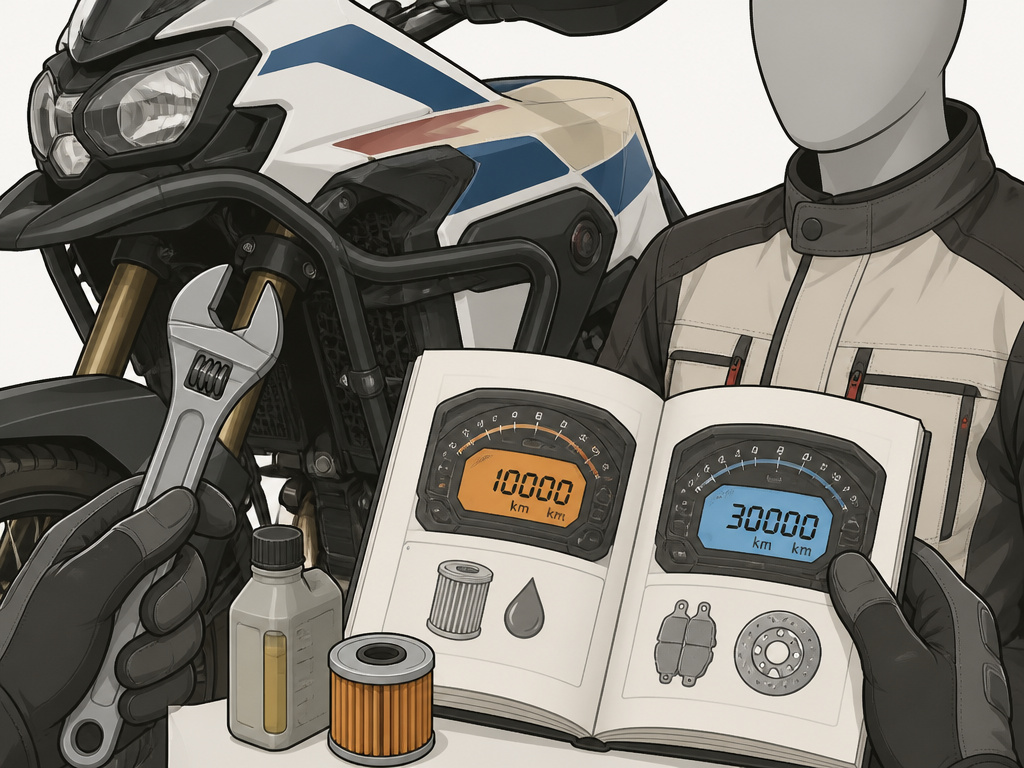
We will use specific numbers from the factory manuals. This is the real cost of ownership that brochures gloss over when you compare adventure motorcycle pros and cons.
The BMW R1150GS schedule is a classic example of tiered maintenance. After the initial 1,000 km run-in check, the first major Service is at 10,000 km, then every 20,000 km after. The Inspection (a more thorough check) hits at 20,000 km, then also every 20,000 km. On top of this, an Annual Service is required for time-based items like brake fluid, regardless of mileage.
Now, compare that to the Ducati Multistrada V2. Its major service, including the critical Desmodromic valve check, lands at 30,000 km. But that service takes a minimum of 7 hours and 36 minutes of dealer labor. If you have a high-spec model with more components to remove, it jumps to 9 hours and 30 minutes.
Common mistake: Comparing only the mileage intervals between brands. A 30,000 km interval sounds long, but if the labor time is 8 hours at $150/hour, that’s a $1,200 service bill before parts and fluids. A bike with a 10,000 km interval but a 2-hour service might be cheaper per mile.
This is why the used market is so appealing for adventure bikes. The first owner absorbs the steepest depreciation and often completes the initial, critical break-in services. A well-maintained used BMW GS or KTM Adventure with a documented service history can be a fantastic value, as the major cost hurdles are already in the past.
Adventure Bike vs. The Alternatives
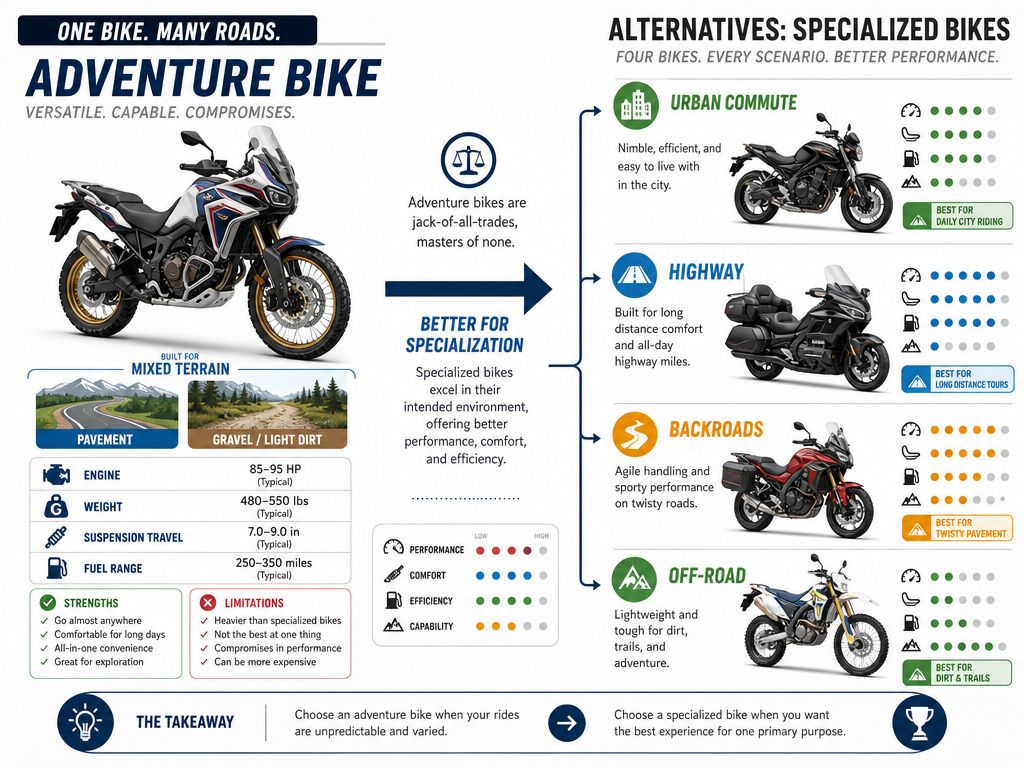
Should you buy one? It depends entirely on what you’ll actually do. This head-to-head comparison makes the trade-offs clear.
| Use Case | Adventure Bike Verdict | Better Alternative |
|---|---|---|
| Daily Urban Commute | Poor. The weight and height hinder filtering and parking. Fuel economy is often mediocre. | Standard/Naked Bike. Lighter, nimbler, cheaper to run. |
| Long-Distance Highway Touring | Good to Excellent. Comfort and range are top-tier, especially with luggage. | Dedicated Touring Bike. Often has better weather protection, stereo, and passenger comfort for a similar price. See how they stack up in our touring motorcycle pros and cons guide. |
| Weekend Backroad Exploring | Excellent. This is its sweet spot—handling twisty pavement and the occasional unpaved connector. | Sport-Touring Bike. If you never leave pavement, a sport touring motorcycle offers sharper handling and often more power. |
| Technical Off-Road Trails | Fair to Poor. Can be forced through with great skill, but it’s a workout. Not sustainable. | Dual-Sport or Enduro Bike. Lightweight, durable, and designed for it. The differences between dual sport and adventure motorcycles are critical here. |
Specialization is the main point. If your riding is 80% one thing and 20% another, a bike specialized for the 80% part will usually be more rewarding. The adventure bike asks you to live in the 50/50 split to justify its existence.
Before You Buy: Critical Questions to Answer
Cut through the fantasy and audit your real situation.
- What is your inseam? Go sit on the actual bike, with the suspension settled. Can you flat-foot one foot comfortably? If you’re on your toes, practice slow-speed maneuvers will be fraught with anxiety.
- What is your local dealer network? If you buy a European exotic and the nearest dealer is three hours away, every warranty claim and major service becomes a logistical ordeal. Japanese brands often have broader support.
- How will you handle drops? You will drop it, especially off-road. Are you prepared to install motorcycle crash bars and learn the proper technique for picking up a heavy adventure motorcycle? The gear matters too, a full set of adventure motorcycle gear is designed for this kind of riding.
- Have you budgeted for the full package? The bike’s sticker price is the start. Add mandatory accessories (luggage, protection), insurance (which can be high), and the real service costs from the manual. Does that still fit?
These questions aren’t meant to dissuade you, but to ground the decision in the adventure motorcycle pros and cons. The right adventure bike, for the right rider, is a passport to incredible experiences. The wrong one is an anchor.
Is an adventure motorcycle good for beginners?
Generally, no. These bikes are physically large and tall, demanding confidence at stops and on uneven ground. Their weight, while often well-balanced, can be intimidating for new riders to manage, especially when loaded for a trip. The advanced electronics and maintenance schedules are designed for experienced users who understand their complexity. Beginners should focus on mastering core skills on a lighter, more manageable machine before considering the unique challenges and rewards of a full-size adventure bike.
What are some good adventure motorcycle models?
Models vary widely to suit different riders and budgets. Consider a bike’s intended use: heavy off-road travel demands a lighter, more rugged machine, while long-distance touring favors comfort and weather protection. Pay close attention to manufacturer service requirements. Some models require a major service with a valve clearance check at specific high-mileage intervals, which can be a lengthy and costly procedure. Others may need more frequent inspections if ridden in severe conditions like dust or extreme cold. Always consult a dealer for the definitive maintenance schedule.
Frequently Asked Questions
Is an adventure motorcycle good for daily use?
It can be, but it’s rarely the best tool for the job. The tall seat and wide handlebars are great for visibility but can make lane-splitting tricky. The weight is noticeable in stop-and-go traffic. Fuel economy is generally worse than a middleweight standard bike. If your commute involves a mix of highway and the potential for detours down unpaved roads, it works. For a pure urban grind, a lighter, narrower motorcycle is less taxing.
What are the biggest disadvantages of owning an adventure bike?
The trifecta is cost, complexity, and physical demand. Purchase prices are high, maintenance is expensive and sometimes frequent, and the electronics can be finicky. Physically, the weight and seat height limit the rider pool and make low-speed or off-road handling a skill-intensive task. For purely on-road riding, you pay a penalty in agility and running costs for capability you don’t use.
What is the 12-second rule on a motorcycle?
This is a general road safety principle, not motorcycle-specific. It advises drivers to scan the road ahead far enough that it would take 12 seconds to reach that point, allowing more time to identify and react to hazards. On a motorcycle, especially a tall adventure bike with good sightlines, practicing the 12-second rule is a powerful way to use your positioning advantage proactively.
How do I choose the right tire?
Tire choice is a direct reflection of your riding mix. A 90/10 street tire will be confidence-inspiring on pavement but sketchy on dirt. A 50/50 tire like a Mitas E-07 or Continental TKC 70 Rocks will be surprisingly good on road and capable off it, but will wear faster on asphalt. Your choice should mirror the tire on-off-road ratios you actually ride. Most adventure riders default to an 80/20 or 70/30 tire for a balanced reality.
Are older, used adventure bikes reliable?
Often, yes, and they represent tremendous value. Models like the BMW R1150GS are known for bulletproof shaft drives and simple (by modern standards) electronics. The key is documented service history. Check for major interval services, like that 60,000 km belt drive replacement on the BMW, and look for signs of off-road abuse (bent rims, damaged crash bars). A clean, well-serviced used bike from a brand like BMW can be a far smarter buy than a new one straining your budget.
The Bottom Line
An adventure motorcycle is a compromise engineered for a specific purpose: continent-spanning travel over unpredictable routes. Its genius is also its flaw, it does many things well, but nothing the best.
If your riding life is a spreadsheet, and the “off-road” column has more than a few entries a year, and the “multi-day trip” column is consistently filled, then the compromises start to make sense. The comfort, cargo space, and rough-road capability pay dividends. But if you’re buying the idea of adventure more than the practice of it, you’re signing up for the tall seat, the heavy weight, and the expensive service bills without reaping the core benefits.
Look at the service manual numbers. Sit on the bike. Be brutally honest about where you’ll ride. The answer isn’t in a brochure; it’s in the gap between the pavement outside your door and the roads on your map.
