
Motorcycle Crash Bars Pros and Cons: Which Should You Buy?
This post contains affiliate links. As an Amazon Associate, we earn from qualifying purchases.
Motorcycle crash bars protect the engine and frame by hitting the ground first during a tip-over or low-speed slide, reducing cosmetic and mechanical damage. They do not prevent rider injury and can introduce vibration, complicate maintenance, and even damage the frame if installed incorrectly. For most riders, they are a worthwhile upgrade for parked drops and off-road mishaps, but you must follow the manufacturer’s specific installation and compatibility rules.
The difference between saving your plastics and cracking your frame often comes down to where and how the bars attach. Manufacturers and aftermarket brands have fundamentally different design philosophies, and the torque on a single bolt decides the outcome. Understanding motorcycle crash bars pros and cons is key to this choice.
What follows is a hard look at the trade-offs in the motorcycle crash bars pros and cons, grounded in forum reports, official service bulletins, and the kind of failure photos that don’t make it into glossy catalogs. By the end, you’ll know exactly which riders should install them, which should skip them, and the one essential step that comes before you touch a wrench.
Key Takeaways
- A crash bar is a sacrificial part – it’s designed to bend or break to save your frame and engine. A Kawasaki KLR forum user reports that SW-Motech stated crash bars are not covered under warranty if they protected the bike once, even after a ‘gentle’ low-speed drop.
- Incorrect installation creates serious risks. BMW Motorrad warns that improper handling gives rise to considerable safety risks and strongly recommends professional installation.
- Follow the specified torque sequence. BMW’s instructions call for 55 Nm on the rear lower bolt and 19 Nm on the top mounts, using Loctite 243 thread-locker on cleaned threads. Skipping this can lead to loosening and catastrophic failure.
- Vibration is a reported side effect in some cases. Kawasaki Versys and Triumph Tiger 1050 forum users report noticeable vibration/buzz at specific RPMs (e.g., 4000 RPM, 5000 RPM) after installing SW-Motech crash bars, while BMW Motorrad/OEM installation instructions do not mention vibration transfer as a potential side effect.
- Mounting point design is critical. Aftermarket bars that clamp to small welded frame brackets (like some SW-Motech kits) have been reported to deform the frame itself in a crash, while OEM bars often use more substantial mounting points.
How Do Motorcycle Crash Bars Actually Work?
Crash bars are metal hoops or cages bolted to a motorcycle’s frame, creating a physical buffer that extends beyond the engine and bodywork. In a tip-over or low-speed slide, the bars contact the ground first. The goal is simple: let a replaceable, relatively cheap steel tube absorb the impact instead of your cylinder head, radiator, or fragile plastic fairings.
Crash bars are particularly effective in low-speed crashes, parking lot tip-overs, and situations where the motorcycle slides onto its side.
This makes them a staple on adventure and touring bikes, where riders face uneven terrain and a higher statistical chance of a stationary drop. They’re the first line of defense when a kickstand sinks into hot asphalt or a trail gets too steep.
But a crash bar’s job isn’t to make your bike invincible. It’s to turn a potentially total-loss scenario into a repairable one. The bars bend, the bike slides, and ideally, you pick it up with nothing worse than scuffed bar-ends and a bruised ego. The real test is whether the force of the impact travels into the bar’s stout mounting points or finds a weaker path into your frame. That’s where design and installation separate effective protection from costly damage.
The 4-Step Crash Bar Installation Safety Checklist
Putting on crash bars isn’t like bolting on a phone mount. You are altering the stress paths on your motorcycle’s frame and adding rigid connections to the engine. Get it wrong, and you create a new single point of failure. BMW Motorrad’s workshop manuals are brutally clear on the stakes.
Before you start: Vehicle not securely propped: Risk of damage to parts if vehicle topples. Prop the vehicle securely. Hot engine and exhaust: Risk of burn injury. Allow the engine and exhaust system to cool. Incorrect installation: Gives rise to considerable safety risks. BMW recommends installation by a specialist workshop. Scratching components: Use care not to scratch parts; cover or mask as necessary.
That last point isn’t about cosmetics. It’s about preventing galvanic corrosion between dissimilar metals and ensuring clean, flush mating surfaces for a solid connection.
If you proceed, your process is dictated by the manufacturer’s instructions. For a BMW kit, that means a specific tightening sequence and exact torque values pulled directly from the official workshop manual.
| Fastener Location | Torque Spec | Critical Note |
|---|---|---|
| Crash bar to frame (rear bottom, M10) | 55 Nm | Primary load-bearing joint |
| Crash bar to frame (top, M8) | 19 Nm | Requires thread-locking compound |
| Crash bar to engine (M8) | 19 Nm | Requires thread-locking compound |
Thread-locking compound (Loctite 243, Medium strength) is mandatory on specified screws. The instructions also explicitly state to clean the threads before application. Skipping Loctite because you think a bolt is “tight enough” is how bars work loose over hundreds of miles of vibration. A loose bar can then act as a lever, multiplying force against its mounting point in a crash.
The final, often overlooked step is a compatibility check. For example, BMW states crash bars cannot be installed in combination with an engine spoiler (OE 0580). KTM Duke 390 owners have reported that KTM Powerparts ignition cover protectors are not compatible with KTM Powerparts crash bars—the parts physically conflict, sandwiching the protector and potentially transferring impact directly to the engine cover.
Motorcycle Crash Bars Pros
The benefits are tangible and often immediately apparent the first time you need them.
1. Protection for the Bike in Drops and Slides. This is the core function. A simple parking lot tip-over can crack a clutch cover, shatter a turn signal, and dent a fuel tank. Crash bars turn that into a scuff on a metal tube. Forum reports on bikes like the KLR650 show bars surviving multiple slow-speed drops, saving on plastic and labor costs.
2. Potential Cost Savings on Repairs. A scratched crash bar can be sanded and repainted, or simply ignored. Replacing a cracked OEM side fairing, a bent radiator, or a punctured engine case can be expensive. For adventure riders who expect to drop their bike, bars are cheap insurance.
3. Mounting Points for Accessories. Many crash bar designs incorporate threaded holes or flat sections for mounting auxiliary lights, small tool bags, or GPS brackets. This keeps your handlebar clean and distributes weight lower on the bike’s chassis.
4. Protection for Rider’s Legs. In a low-side slide, a crash bar can prevent the bike from pinning the rider’s leg directly against the pavement. While they don’t prevent injury, they can create a space for the leg to slide through, potentially reducing severity. This is a secondary benefit, not a guarantee of safety.
5. Peace of Mind for Off-Road and New Riders. Knowing your bike has a protective cage lowers the mental barrier to riding technical terrain or practicing low-speed maneuvers. This can make you a more confident, and thus more skilled, rider.
Motorcycle Crash Bars Cons and Risks

The downsides aren’t just about weight or looks. They involve mechanical side effects and genuine failure risks that many product listings gloss over.
1. Added Weight and Altered Handling. Steel crash bars add weight, mounted low and wide. This can subtly change a bike’s steering feel, particularly at very low speeds or when paddling it around a garage. The extra width can also make filtering through tight traffic more difficult.
2. Increased Vibration and Harmonic Buzz. This is the most commonly reported mechanical side effect in owner forums. It’s not in any installation manual, but it’s real.
Where this goes sideways: Installing rigid SW-Motech crash bars. A Kawasaki Versys owner reported a new vibration resonating at 4000 RPM after installation. A Triumph Tiger 1050 owner reported a bad ‘buzz’ above 5000 RPM. The bars create new, rigid pathways for engine vibration to transfer into the frame and fairings. You’ll feel it in the footpegs and hear it as a buzzy rattle in the plastics. Some riders adapt; others find it intolerable.
3. Interference with Maintenance and Access. Oil filter changes, coolant drain bolts, and even basic chain adjustments can become more difficult with bars in the way. You may need to partially loosen or remove a bar for routine service, adding time and hassle.
4. Risk of Causing Frame or Engine Damage. This is the worst-case scenario, and it’s not theoretical. The design and mounting points are everything.
- Weak Mounting Brackets: A detailed report on the KTM Duke 390 forum showed SW-Motech crash bars (Art. No.: SBL.04.539.10001/B) mounted to “very weak brackets welded on the frame.” In a lowside, the brackets deformed, punching inward around 2 centimeters and damaging the frame paint. The user’s frame was later replaced.
- Improper Mounting Philosophy: A Triumph NHTSA bulletin warns against any aftermarket upper bars mounting to the front cylinder head, declaring it a critical structural joint linked to frame rail cracking. BMW Motorrad, conversely, provides specific torque sequences for crash bars that attach to frame/engine points, indicating sanctioned designs exist for those mounts.
5. Aesthetic Impact and “Overbuilt” Look. Not everyone likes the industrial, caged appearance of crash bars. On sleek street bikes, they can look out of place. This is subjective, but it’s a real consideration for many riders.
6. The “Bent Bar” Problem and Warranty Realities. Crash bars are meant to bend. But a bent bar can then rub against your fairings, creating an annoying buzz or even wearing through the plastic.
A KLR650 forum user described a bent SW-Motech bar making contact, with clearance of maybe 1mm causing a rattle at idle. SW-Motech denied a warranty claim, stating the bars did their job by protecting the bike in a prior drop. A Kawasaki KLR forum user reports using ratchet straps to lever the bike against a bent crash bar to regain about 1/4″ of clearance, a method not found in service manuals. BMW Motorrad/OEM service manuals provide no procedure for straightening bent crash bars; the implied solution is replacement.
OEM vs. Aftermarket Crash Bars: A Mounting Point Showdown
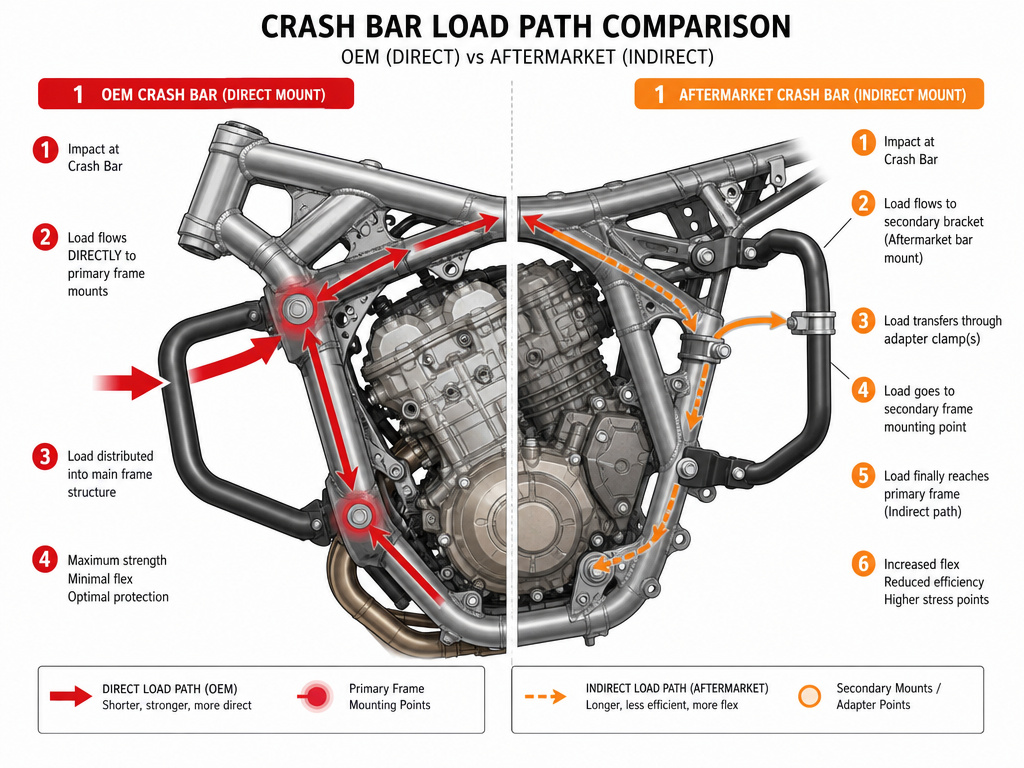
The motorcycle crash bars pros and cons question isn’t just about brand loyalty or price. It’s about engineering philosophy and where the manufacturer believes the crash forces should go.
OEM bars (like those from BMW Motorrad or KTM Powerparts) are designed in tandem with the bike’s frame engineers. They typically use larger, more integrated mounting points. The KTM Duke 390 OEM bars, for example, mount into “a noticeably larger section of tube” between frame brackets, as noted in the forum report that criticized the SW-Motech design.
Aftermarket bars from companies like SW-Motech, Givi, or Outback Motortek must design a one-size-fits-many solution. This sometimes results in clamping to smaller, secondary frame brackets or using long through-bolts. The trade-off for wider model compatibility can be a less optimal load path.
| Consideration | OEM Crash Bars | Aftermarket Crash Bars |
|---|---|---|
| Mounting Integration | Designed with frame, often uses primary points | May clamp to secondary brackets or use adapters |
| Cost | Usually more expensive | Often more affordable |
| Availability | Specific to your exact make/model/year | Broader fitment across model years |
| Vibration Risk | Less frequently reported | More commonly reported in forums |
| Warranty Impact | Unlikely to affect factory warranty | Potential gray area if installation causes damage |
The “right” choice depends on your bike and risk tolerance. For a modern adventure bike with a complex frame, OEM is often the safer bet. For an older, simpler machine like a KLR650, an aftermarket option from a specialist brand might be perfectly adequate.
Are Crash Bars Worth It?
It depends almost entirely on how and where you ride.
Yes, get crash bars if:
- You ride off-road or on adventure trips where drops are expected.
- Your bike is tall and heavy, making parking lot tip-overs more likely.
- You are a new rider still building low-speed confidence.
- You want to mount auxiliary lights and prefer a bar-mounted location.
- You own a bike where the OEM or a highly-regarded aftermarket option uses robust, frame-friendly mounting points.
No, skip crash bars if:
- You primarily ride sport bikes or cruisers on paved roads and value clean aesthetics.
- You are highly sensitive to added vibration or NVH (noise, vibration, harshness).
- You perform your own maintenance and the bars severely block access to critical service points.
- You are considering a cheap, no-name brand with no verified installation instructions or user feedback.
- Your bike has a known issue where even approved crash bar designs have been linked to frame stress (research your specific model forums).
For the majority of riders on tall dual-sports or adventure tourers, the pros outweigh the cons. The protection they offer in the most common crash scenarios—stationary and low-speed drops—is real and financially worthwhile. Just buy with your eyes open: install them correctly, accept they may buzz, and understand they are a consumable item designed to be damaged so your bike isn’t.
Are crash bars effective in all types of crashes?
Crash bars are often the first part of the bike to contact the ground during a tip-over. They are particularly effective in low-speed crashes, parking lot tip-overs, and situations where the motorcycle slides onto its side. However, their performance can vary dramatically. Forum reports describe crash bars bending inward several centimeters after a simple lowside, sometimes transferring force to the mounting points. In a more violent high-side crash where the bike is flung or tumbles, the bars may offer little protection and could potentially snag on the ground. They cannot prevent accidents or eliminate the risk of serious injuries.
Crash bars vs. Frame sliders: which is better?
The choice between crash bars and frame sliders depends on your bike and riding. Crash bars create a larger protective cage, while frame sliders use smaller, replaceable pucks that bolt to the frame. A key difference is mounting philosophy. Some manufacturers warn against aftermarket bars that mount to critical engine points, while others provide specific torque sequences for such attachments. Compatibility is also a concern; crash bars often cannot be installed with other engine spoilers or case protectors. Consider how each system attaches to your specific motorcycle’s frame.
Frequently Asked Questions
Should I get crash bars on my motorcycle?
If you ride off-road, have a tall adventure bike, or are a newer rider, crash bars are a strong recommendation. They provide proven protection for your bike in low-speed tip-overs.
What kills motorcyclists the most?
While crash bars protect the bike in a fall, wearing a DOT-approved helmet and other full protective gear is the single most effective thing a rider can do to reduce the risk of serious injury or death in any crash. While crash bars protect the bike in a fall, wearing a DOT-approved helmet and other full protective gear is the single most effective thing a rider can do to reduce the risk of serious injury or death in any crash.
Do crash bars prevent frame damage?
They are intended to, but poor design or installation can cause it. Crash bars must channel impact energy into the strongest parts of the frame. If they mount to weak brackets or are improperly torqued, they can bend those brackets or concentrate stress in a way that cracks the frame. This is why you must follow the manufacturer’s specific instructions.
Can you fix bent crash bars?
Technically, yes, but it’s not recommended. Metal that has been bent and straightened is weakened and more likely to fail catastrophically in a subsequent impact. Owners have straightened bars in the field using methods like ratchet straps, but this is a temporary, get-you-home fix. The correct procedure per manufacturers like BMW Motorrad is replacement.
Do crash bars make your bike vibrate more?
They can. Multiple independent forum reports across different bike models (Kawasaki Versys, Triumph Tiger 1050) cite new vibrations at specific RPMs after installing rigid crash bars, particularly from brands like SW-Motech. The bars create a new direct path for engine harmonics to transfer into the frame and fairings.
The Bottom Line
Here is what actually held up. Crash bars are a functional upgrade, not a cosmetic one. Their value is proven in the scuffs on a thousand battered tubes and the unpunctured engine cases beneath them. But their cost isn’t just the purchase price—it’s the risk of new vibrations, the hassle of blocked service access, and the critical importance of a perfect installation.
If you buy them, buy the right ones for your bike. Ground your choice in the BMW MOA crash bar thread and other owner forums, not the marketing copy. And if you install them yourself, your torque wrench and a bottle of Loctite 243 are more important than the bars themselves. That 55 Nm spec isn’t a suggestion; it’s the line between a guard and a hazard.
Ride it before you trust it. After installation, take a careful ride. Listen for new buzzes, feel for strange vibrations. That’s your bike telling you how it’s handling the new hardware.
