
How to Store a Motorcycle in an Apartment: Step-by-Step
This post contains affiliate links. As an Amazon Associate, we earn from qualifying purchases.
To store a motorcycle in an apartment, you need to solve three problems: securing a safe space, preparing the bike for long-term indoor storage, and preventing theft. Your best options are bringing it inside your unit (if your lease allows), using a rented self-storage unit, or parking it in a designated spot with maximum security. The bike itself needs fuel stabilizer run through the system, a battery maintainer, and protection from dust and flat spots.
That last part, preparing the bike, is where most riders guess wrong. You cannot just park it and walk away. Fuel goes stale, batteries sulfate, and tires develop flat spots that feel like a bent rim on your first spring ride. The official factory manuals get specific: Indian and Polaris say to store after 60 days, run the engine for 15 minutes after adding stabilizer, and Indian’s manual specifies keeping the battery between 32–90°F. The principles of how to store a motorcycle in an apartment follow the same core rules.
What follows is the apartment rider’s playbook for how to store a motorcycle in an apartment. We will walk through getting landlord approval, compare the real costs of every storage method, detail the essential mechanical prep from the factory manuals, and name the specific locks and stands that work in tight spaces.
Key Takeaways
- Check your lease first, storing gasoline and a motorcycle indoors often violates fire codes and lease terms; get written permission.
- Run fuel stabilizer for 15 minutes per the Indian Motorcycle guide to coat the entire fuel system, not just sit in the tank.
- Use a battery tender or remove the battery; a dead battery can be damaged by deep discharge.
- Overinflate tires to help fight flat spots, especially if the bike sits on its own weight.
- A breathable indoor motorcycle cover beats a plastic tarp every time for preventing dust without trapping moisture.
Your 3 Storage Options (And What They Really Cost)
When figuring out how to store a motorcycle in an apartment, you have a bike and four walls. The math is straightforward: inside your apartment, in a rented storage unit, or outside in a complex parking spot. Each has a different price tag and risk profile.
A self-storage unit is the default for a reason. It is a dedicated, secure, and often climate-controlled space. A self-storage unit is a dedicated, secure, and often climate-controlled space with a monthly rental cost. That is a significant line item, but it keeps fuel fumes and potential leaks out of your living space, which most landlords and fire codes demand. For a seasonal winter storage, it can be worth the peace of mind.
Bringing the bike inside your apartment is the zero-rent option, but the hidden costs are high. You will likely need a motorcycle dolly to maneuver it, and ramps to get it over thresholds., and you must be certain your floor can handle the concentrated weight, a 500-pound bike on a dolly focuses that weight on two small wheels. Then there is the smell of gasoline and oil, which never fully leaves a carpeted space.
Outdoor apartment parking is the most dangerous choice. Theft at complexes is a common concern., and exposure to the elements demands a heavy-duty, weatherproof cover. You will need to invest in multiple, high-quality anti-theft devices, think a disc lock, a heavy chain around a fixed object, and maybe an alarm. The ongoing cost here is gear, not rent, but the risk never drops to zero.
| Storage Method | Upfront Cost | Monthly Cost | Biggest Risk | Best For |
|---|---|---|---|---|
| Self-Storage Unit | First month + lock | $50–$150 | Forgetting prep steps; unit not climate-controlled | Riders who can afford it and want max security |
| Inside Apartment | Dolly + ramps ($180–$500) | $0 | Landlord violation / eviction; fluid leaks on floor | Ground-floor units with direct, wide access |
| Outdoor Complex Spot | Premium cover + 2+ locks ($250–$600) | $0 | Theft and weather damage | Short-term only, with comprehensive insurance |
How to Get Landlord Approval (The Right Way)
Do not just roll the bike into the living room and hope nobody notices. That is a fast track to a lease violation. Your first step is a careful review of your rental agreement. Look for clauses about “hazardous materials,” “vehicle storage,” “flammable liquids,” or “prohibited items in living areas.” Gasoline is highly flammable, and most leases forbid storing it indoors.
If the lease is silent, you still need to ask. Draft a short, formal proposal to your landlord or property manager. Offer to provide proof of insurance listing the storage location, promise to use a drip tray under the engine, and mention you will use a breathable motorcycle dust cover to protect floors. Offering to pay an additional security deposit can sometimes turn a “no” into a “yes.”
Where this goes sideways: Assuming a balcony is a safe compromise. Balcony weight limits are rarely rated for a motorcycle, and fuel vapors can seep into neighboring units, creating a fire hazard you are liable for.
Be prepared for a “no.” In that case, your negotiation shifts to the parking lot. Ask if you can install a ground anchor in your assigned spot for a heavy chain. Some landlords will allow this if you assume all costs and responsibility for repairing the concrete when you leave.
The 4-Step Indoor Storage Prep Guide
This is the core. Parking a bike inside for months is different than parking it in a garage. Ventilation is worse, temperature swings are milder, and you absolutely cannot have fuel or oil leaks. The factory manuals from Indian, Polaris, and Honda are your bible here, and they disagree on a few key points.
Step 1: Fuel System Prep
There are two schools of thought, and your bike’s manual picks the school. * Stabilized Full Tank (Indian/Polaris & most street bikes): Fill the tank with fresh fuel, add a fuel stabilizer, and run the engine for 15 minutes to circulate the treated gas through the entire system. This prevents internal tank rust from condensation. * Complete Drain (Some competition bikes like the Honda CRF250R/RX): Some manuals for non-street-legal bikes advise relieving fuel pressure and draining the tank completely, where fuel degradation is a bigger concern than rust.
For an apartment-stored street bike, the stabilized full tank method is standard. The fuel smell is contained in the tank, not venting from an empty one.
Step 2: Battery Care
This is essential. A lead-acid battery will self-discharge and can be damaged if not maintained.
- Option A (Best): Remove the battery entirely. Store it in a cool, dry place like a closet, on a wooden board, not concrete. Connect it to a battery maintainer. Indian’s manual specifies a storage temperature between 32–90 °F (0–32 °C).
- Option B: Leave the battery in the bike, disconnect the negative terminal, and attach a tender. This only works if you have a safe, accessible outlet near the bike.
Step 3: Protecting Tires and Fluids
Flat spots form when a tire sits under load in one spot. Overinflate tires by 5-10 PSI above normal to help the carcass hold its shape. There is a manufacturer split on how to support the bike:
- Indian/Polaris: Advises blocking the frame to take weight off the wheels.
- Honda CB1000A: Says to use the center stand and a block to lift both tires off the ground.
Manufacturers disagree on support: Indian advises blocking the frame to take weight off the wheels, while Honda advises using a center stand and block to lift both tires off the ground. If not, a motorcycle dolly gets the weight on its own wheels but allows you to rotate the tire slightly every few weeks to prevent flat spots.
Step 4: The Final Clean & Cover
Wash and dry the bike thoroughly. Honda’s manual says to wax all painted surfaces (except matte finishes) and coat chrome with rust-inhibiting oil. Lubricate the chain. This stops corrosive grime from etching in. Finally, use a soft, breathable indoor motorcycle cover. A plastic tarp traps moisture against cold metal and guarantees condensation.
The official word from Indian Motorcycle is clear: “Do not store the motorcycle in any area (in home or garage) where it could be near open flames, pilot lights, sparks or electric motors. Do not smoke in the storage area.” Treat your living room with the same respect.
Apartment-Specific Theft Prevention
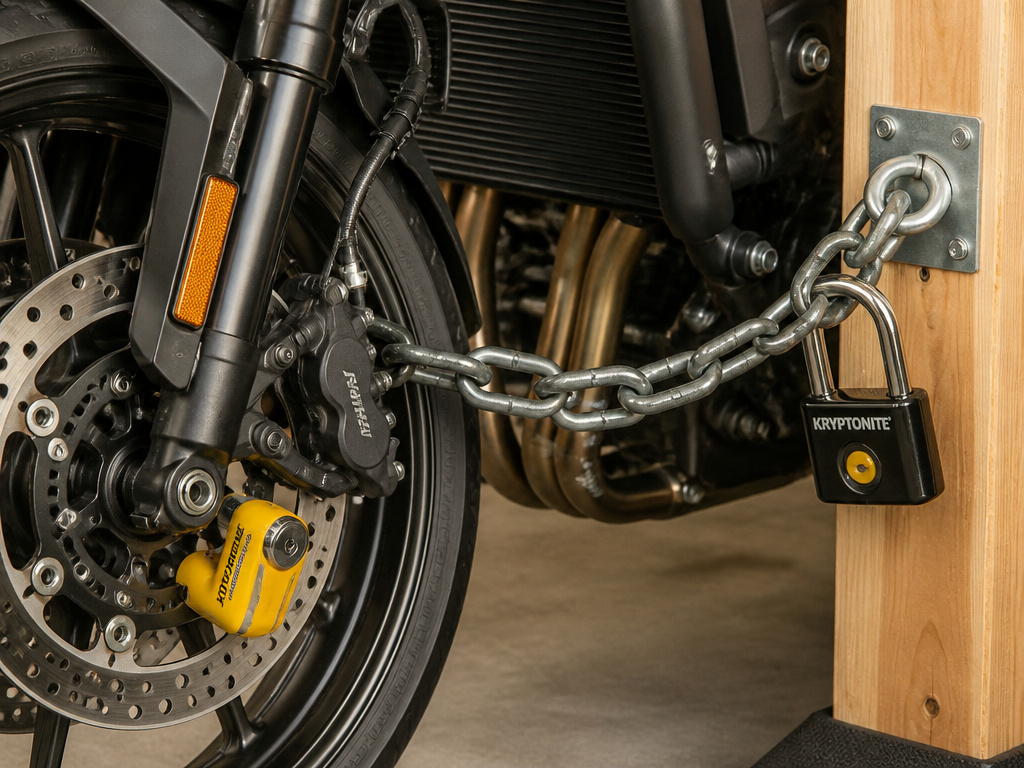
Storing a motorcycle at an apartment complex, whether indoors or out, makes you a target. Thieves scout these lots. Your goal is to make your bike the hardest one to take.
Layering is everything. Start with the steering lock, but know it is trivial to break. Add a visible, bright-colored disc lock on the front rotor, it is a visual deterrent. The real anchor is a heavy, hardened steel chain. Passed through the frame (not just a wheel) and around a fixed, immovable object. In a parking lot, this might mean installing a ground anchor with your landlord’s permission. Inside your apartment, you could chain it to a heavy-duty eye-bolt secured into a wall stud.
An alarm is your second layer. A simple, battery-powered disc lock alarm shrieks if the bike is jostled. More advanced systems have perimeter sensors and GPS tracking. The noise alone can scare off a casual thief in a populated lot.
Finally, make it invisible. If parked outside, a tight-fitting, non-descript cover hides attractive models and shiny parts. Just be sure it is a cover rated for outdoor use, as the difference between indoor and outdoor covers is breathability versus waterproofing.
What NOT to Do: The Quick-Kill Mistakes
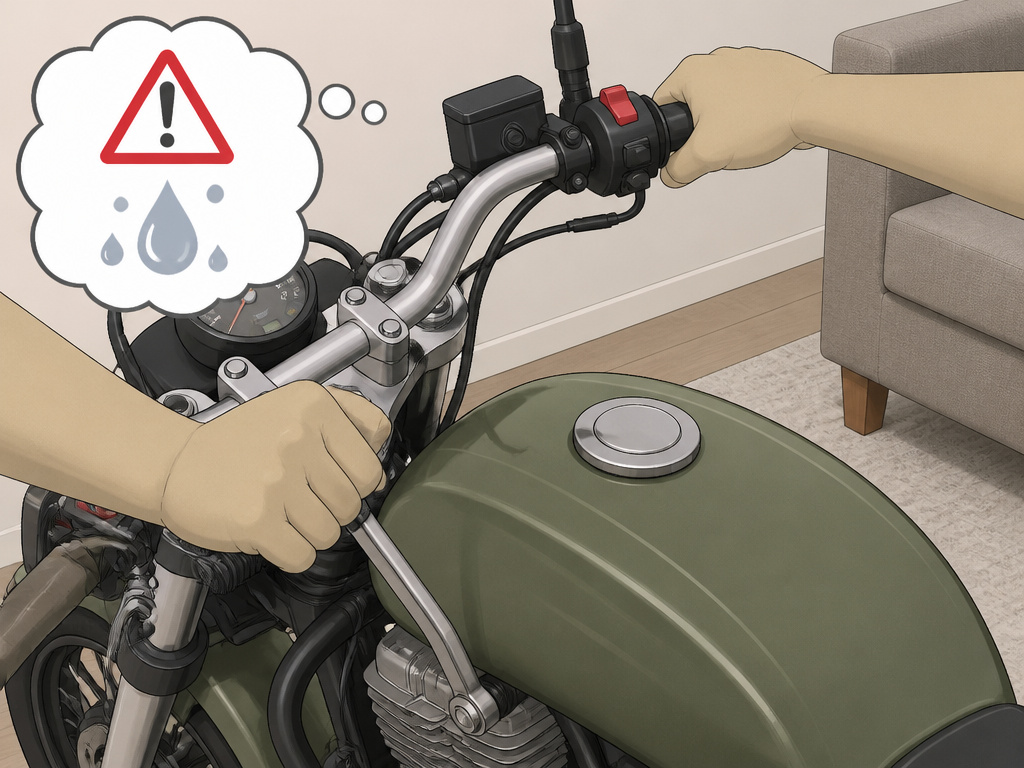
Apartment storage has zero margin for error. These mistakes cost you your bike, your deposit, or both.
Do Not “Just Start It” Every Few Weeks. Indian Motorcycle explicitly warns against this. A short run does not get the engine hot enough to burn off condensation, so you introduce moisture into the oil and exhaust, accelerating corrosion. Either prep it for storage properly or leave it alone.
Do Not Store It on a Balcony. Beyond weight and vapor issues, getting it up there is a huge risk. Dropping a bike down a flight of stairs is a total loss and a massive liability.
Do Not Skip Rodent Protection. If storing in a basement locker or ground-floor unit, mice are a real threat. Indian’s guide says to place a screen mesh over intake or exhaust openings. Steel wool in the exhaust pipe works too, just remember to remove it.
Do Not Neglect Your Lease. The financial and legal fallout from violating your lease agreement dwarfs the cost of a storage unit. A written “okay” is your only safe path.
How to use a motorcycle stand to save space in an apartment
A good stand is key for apartment storage. It allows you to tuck the bike into a tighter footprint, often letting you push it flush against a wall. More critically, proper support protects the motorcycle during long-term storage. Factory manuals specify taking the weight off the tires to prevent flat spots. You can block the frame to lift the wheels or use a center stand with a block to get both tires off the ground. This also makes it easier to perform maintenance like lubricating the drive chain before you store it.
Is an enclosed trailer good for motorcycle storage?
An enclosed trailer parked in a designated spot can act as a private garage. It provides a dry, secure shell around your bike. The interior must be treated like any indoor storage space. This means no open flames, pilot lights, sparks, or electric motors should be near the trailer, and you should never smoke inside it. Since it’s a confined space, ventilation is a concern. Before closing it up, ensure the motorcycle is clean, with wax on painted surfaces and chrome coated with a rust inhibitor, to fight moisture in the sealed environment.
Where to park a motorcycle in an apartment lot
Securing a regular spot is the first challenge. If you have a dedicated car space, that’s your best bet. Some renters successfully share a single car space with their vehicle, parking the bike in front or beside the car. Always get explicit permission. For inconspicuous spots, look for unused corners or ends of rows that don’t block traffic. Wherever you park, a full-body cover is recommended for outdoor storage. After rain, remove the cover to let the motorcycle dry. Always be mindful of building rules and avoid areas near heat sources or electrical equipment.
Frequently Asked Questions
Can I store my motorcycle inside my apartment?
You can, but only if your lease explicitly allows it and you follow strict safety prep. Gasoline fumes are flammable and can permeate living spaces, violating most fire codes and lease terms. You must get written permission from your landlord, prepare the bike with fuel stabilizer, and place a drip tray underneath it.
What is the best cover for indoor motorcycle storage?
Soft, breathable fabric cover designed for indoor use is best. Lightweight dust covers designed for indoor use are available. Avoid plastic or vinyl tarps, as they trap moisture against the metal and cause condensation, leading to rust and mold. The right indoor motorcycle cover will be breathable and soft enough not to scratch paint.
How do I move my motorcycle into my apartment?
You will need at least two people, a sturdy loading ramp, and a motorcycle moving dolly. Measure all doorways, hallways, and elevators first. Roll the bike onto the dolly outside, then carefully push it over thresholds. Take corners slowly, handlebars are wider than you think. For anything beyond a ground-floor unit, a freight elevator is usually required.
Is it safe to store a motorcycle with fuel in the tank indoors?
It is the standard method, but it introduces risk. A sealed, full tank with stabilizer is safer than an empty one, which can rust and still vent fumes. The key is to ensure there are zero leaks, the bike is in a well-ventilated area away from ignition sources, and you have landlord approval. The Indian Motorcycle storage guide mandates keeping it away from “open flames, pilot lights, sparks or electric motors.”
The Bottom Line
Storing a motorcycle in an apartment is a logistics puzzle, not an impossibility. Your first call is to your lease, not the hardware store. If you get the green light, the factory steps are clear: stabilize the fuel, tend the battery, protect the tires, and cover it with the right fabric.
For most renters, a small self-storage unit is the winning move. It removes the hazard from your home, provides real security, and often includes climate control for the battery. The monthly fee is the cost of riding while renting.
If you do bring it inside, prep like a mechanic. That means following the 15-minute stabilizer run, using a battery tender, and putting the whole bike on a drip tray. One small fuel leak on carpet is a security deposit gone. The goal is to un-cover it in the spring and ride, not start a lengthy and expensive repair.
