
Dot vs ECE vs Snell Motorcycle Helmet Standards
This post contains affiliate links. As an Amazon Associate, we earn from qualifying purchases.
When you weigh dot vs ece vs snell motorcycle helmet standards, DOT is the U.S. Legal floor with a peak g limit of 400. ECE adds third-party batch testing and rotation limits, and Snell is a stricter voluntary standard with lower peak limits and more test sites. Fit decides whether any label helps.
The 400 g DOT ceiling is the reason many riders treat ECE and Snell as upgrades. But the labels answer different questions: legality, testing, and crash severity. ECE 22.06 tests up to 50 production helmets, with 8 to 26 based on batch size, while Snell uses its own random retail sampling.
What follows: each standard’s test numbers, where sources disagree, how to read multi-cert labels, and the fit checks that decide which helmet actually protects you.
Key Takeaways
- DOT allows peak g up to 400, but ACT LAB found 72 of 167 helmets failed FMVSS 218.
- ECE 22.06 tests up to 50 production helmets, with 8 to 26 based on batch size.
- Snell M2025 uses an 8.00 plus or minus 0.12 m/s drop speed and a 10,000 rad/s2 rotation limit.
- A well-fitting DOT lid can beat a poorly fitting Snell lid for daily riding.
- Check the chin strap first, since a loose retention system will let the helmet roll off during a slide.
Which Helmet Standard Is the Safest?
No single standard wins for every rider. The Snell Memorial Foundation says its voluntary standards are the most stringent for impact protection. The Motorcycle Safety Foundation comparison tests found Snell helmets averaged 164 g in a 2 m asphalt drop. DOT-only helmets averaged 157 g, and ECE-certified helmets averaged 162 g. Fit and strap tension matter more in the way a helmet fails on a real head.
That gap is small.
DOT FMVSS 218 uses a flat-anvil drop from 54.5 in at 5.2 m/s and a hemispherical-anvil drop from 72 in at 6.0 m/s, with peak acceleration limited to 400 g. Peripheral vision must reach 105 degrees, and surface projections can’t exceed 5 mm. Tests also include penetration resistance, static and dynamic retention, and environmental conditioning before impact.
I have seen a sticker-only lid fail the hand test. The shell felt thin, and the liner pressed like a hard cap band. A certification label can’t fix that feel.
Dot vs ECE vs Snell Motorcycle Helmet Standards: What Each Label Means
Each label answers a different question. DOT tells you whether a helmet is legal for U.S. Roads. ECE tells you whether a lab approved a production batch. Snell tells you whether a voluntary standard found enough impact headroom.
DOT: the legal floor
FMVSS 218 is the U.S. Federal helmet rule. All motorcycle helmets sold in the United States must meet DOT standards. A DOT certification label is required for road use, but manufacturers self-certify.
NHTSA is the U.S. Highway safety agency. It can conduct random checks. California’s ACT LAB is a testing lab. It tested 167 helmets between 2014 and 2019, and 72 failed FMVSS 218. That is more than 40 percent.
Novelty helmets I handled felt very light and had thin EPS liners. A fake DOT helmet can carry a sticker that never passed independent verification.
ECE: batch testing and rotational limits
ECE certification is mandatory in many European and global markets. ECE certification is mandatory in many European and global markets. The ECE 22.06 update replaced ECE 22.05 and added rotation testing. The ECE 22.06 update has been introduced.
ECE 22.06 sets a high-energy limit of no more than 275 g. Its low-energy limit is no more than 180 g. Its Peak Rotational Acceleration limit is 10,400 rad/s2.
ECE 22.05 sets a Head Injury Criterion limit of 2400. ECE 22.06 includes youth sizes down to 48 cm. The ECE helmet safety regulation provides the rule behind ECE 22.05 and 22.06.
Snell: voluntary severity and two paths
Snell certification is voluntary. The Snell certification standard describes independent nonprofit lab tests.
The Snell M2020 helmet standard says M2020D and M2020R assure greater impact management than ECE or FIM.
Snell M2025 uses an impact speed of 8.00 plus or minus 0.12 m/s. Its Peak Rotational Acceleration limit is 10,000 rad/s2. M2025R peak linear limits are 257 g and 275 g. M2025D limits are 243 g and 275 g. Snell requires surface projections of 7 mm or more to break away. Snell M2025 has different versions, such as M2025R and M2025D, with different peak linear acceleration limits.
| Standard | Legal role | Verification method |
|---|---|---|
| DOT | U.S. Road minimum | Manufacturer self-certifies |
| ECE | European and global market | Independent lab tests per ECE sources |
| Snell | Voluntary upgrade | Nonprofit tests and random retail samples |
The verification column is not unanimous. Snell’s FAQ calls DOT and ECE government minimal standards that rely mostly on helmet manufacturers to police themselves. Other sources, including those describing ECE certification, state that ECE requires independent, third-party testing. The safer reading is to check the label, the model’s published approvals, and the fit.
Read all three.
I also check SHARP ratings when I want model-level impact results instead of a pass/fail logo. SHARP is a UK star-rating program. SHARP is a UK star-rating program that evaluates helmet models.
I read DOT as a self-certification claim, ECE 22.06 as batch-tested, and SHARP as a model-level cross-check. Trusting one sticker alone is the easy way to buy a helmet that fails in the way that matters.
How Do the Test Methods Differ?
Which anvil matters more than the logo? Anvils, drop speeds, and headform mass change the answer. DOT uses flat and hemispherical anvils. Snell uses edge anvils and an impact speed of 8.00 plus or minus 0.12 m/s. ECE 22.06 tests up to 50 production helmets, with 8 to 26 based on batch size.
- DOT uses flat and hemispherical anvils, with penetration and retention checks.
- Snell uses edge anvils and stricter peak linear limits.
- ECE 22.06 adds rotation testing and checks face shields, sun visors, and Bluetooth communicators.
Sources disagree on ECE test sample size: one source says ECE tests 50 helmets, while another states ECE 22.06 tests up to 50 production specimens, with 8–26 based on batch size. Ultimate Motorcycle says up to 50, with 8 to 26 based on batch size. That disagreement matters because sample size affects how many production helmets are checked before a label is issued.
The Motorcycle Safety Foundation comparison tests measured construction averages. DOT-only helmets averaged 1587 g weight. Shell thickness was 4.7 mm. Liner thickness was 36 mm. Liner density was 49 kg/m3. DOT plus ECE helmets averaged 1517 g weight. Shell thickness was 2.8 mm. Liner thickness was 34 mm. Liner density was 53 kg/m3. Snell headform masses range from 3.100 kg for size A to 5.600 kg for size M.
Does penetration testing make a helmet safer? Snell includes penetration resistance. ECE 22.05 omits it. A 2008 MYMOSA Project study argued stiff shells made for penetration tests protect worse in common flat or curved surface impacts. Snell’s own M2020 document says its standards assure greater impact management than ECE or FIM, while other sources, such as a MotorBiscuit article, state that ECE helmets are largely considered to be the safer standard over DOT or Snell.
The disagreement is real.
Racing use: FIM matters
FIM has its own racing helmet standard which applies to track use. That standard applies to racing gear, not ordinary street riding. If you ride on track, check the event rulebook. If you commute, DOT plus ECE or Snell is the practical zone. If you tour, ECE 22.06 plus a proper fit is a sensible target.
Does Fit Matter More Than Certification?
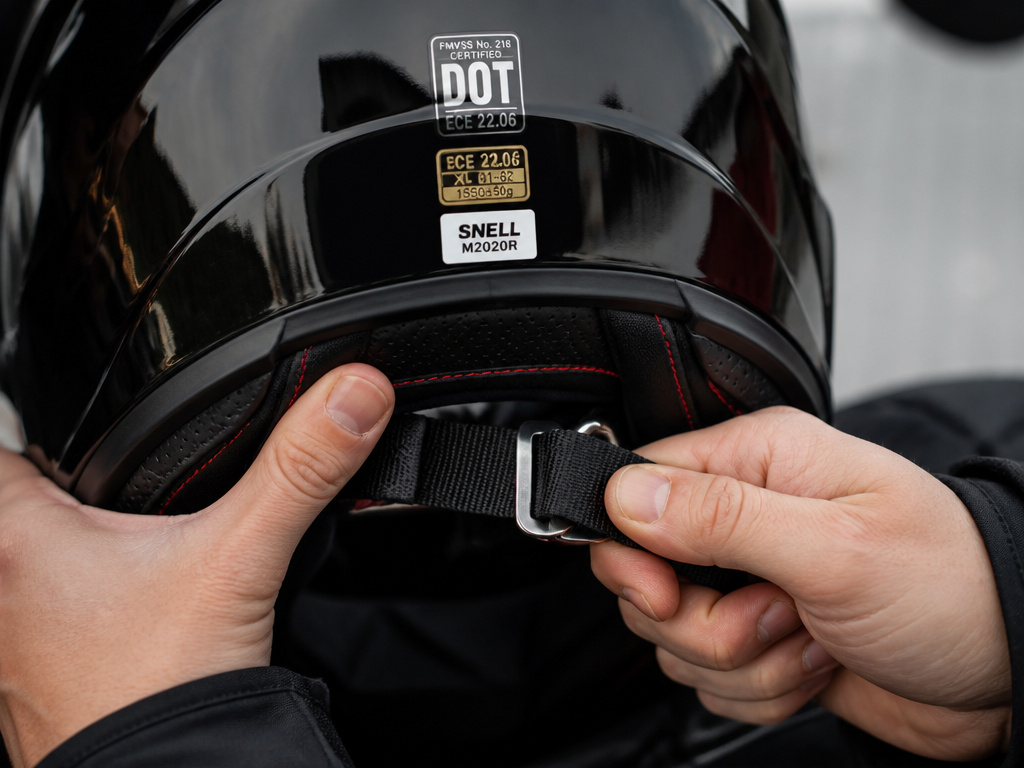
I once followed the usual advice to buy a very snug helmet because padding would loosen. For my narrow head, it created a sharp forehead pressure point within an hour. Certification sets a floor, but fit decides whether you stay on that floor. MotoSport says a DOT-certified helmet that fits well can beat a heavier, poorly fitting Snell-certified helmet for some riders.
I agree.
I switched to a different head shape, and the pressure point disappeared. That taught me to trust my own head over the sticker. A helmet that moves on your head can’t deliver lab-tested protection.
A loose double-D ring is the quiet failure. I check it before I check any logo. The strap shouldn’t roll over the chin, and the helmet shouldn’t slide when you shake your head. If it shifts, it won’t protect the way the lab tested it.
Rotational systems such as MIPS aren’t certifications, per RevZilla. MIPS is a rotational liner system. Skip them if they make the helmet fit worse.
A significant portion of impacts occur at the chin bar or face. A full-face lid with a strong chin bar covers that zone.
For street riders who want multi-cert options, compare best Snell helmets with Arai, Shoei, or Bell models. Check current reviews on Amazon for the label you want. I reach for Arai, Shoei, or Bell when I need a full-face lid with a label I can verify.
What Should You Do Before Buying a Helmet?
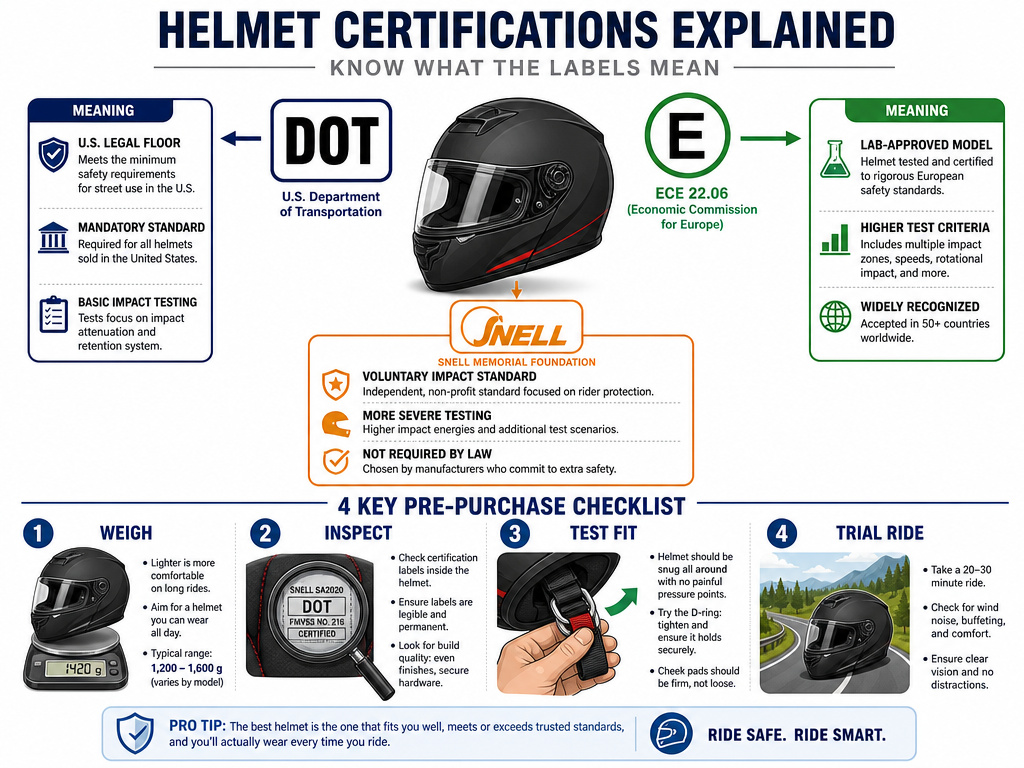
Start with the label, then test the helmet on your head. DOT certification tells you the U.S. Legal floor. ECE certification tells you a lab approved the production model. Snell certification tells you a voluntary standard found impact headroom. Read all three, then reject the helmet if it moves.
Before you start: Check the chin strap for fraying, confirm the liner is thick enough to crush without bottoming out, and never trust a loose double-D ring. A loose ring can let the helmet roll off during the first slide.
- Weigh and inspect the helmet. A novelty lid can feel light and thin. A thin liner can run out of crush room before the head stops.
- Check label stitching and model data. A sewn DOT label is a better sign than a sticker alone. Verify the model against the certifier’s published list.
- Tighten the ring and shake your head. If the helmet rolls over your brow, it won’t stay in position during a crash.
-
Ride it around the block. If a pressure point appears quickly, reject it.
-
Novelty helmet: don’t buy it because it looks like a motorcycle helmet. The shell can show light weight and thin EPS, and the sticker can mean nothing.
- Ear fatigue: a buddy of mine blamed helmet noise for short rides. Earplugs and a small neck-roll adjustment fixed it.
- Multi-cert sticker: don’t treat it as proof of fit. A helmet can carry three labels and still press on your forehead.
| Problem | Likely cause | What to check |
|---|---|---|
| Sticker only, light shell | Fake or novelty helmet | Liner thickness and sewn label |
| Sharp forehead pressure | Wrong head shape | Different shell or brand |
| Helmet rolls on brow | Loose double-D ring | Strap tension and retention |
| Ride ends early from fatigue | Noise or neck-roll fit | Hearing protection and neck roll |
How to Spot Real vs. Fake Helmet Certification
Verification methods differ by standard. For DOT, look for the certification label inside the helmet; it’s a self-certification by the manufacturer, so the presence of the label is the primary check. Independent testing labs do not verify DOT compliance before sale. For ECE certification, a label with a circled ‘E’ and a number indicates the country of approval, and this certification requires independent, third-party testing of production batches. Snell certification is a voluntary program from an independent, non-profit organization, and certified helmets will have a Snell sticker inside. The most reliable method is to purchase from reputable dealers and verify the model on the standard’s official website if available.
Updates to Helmet Standards: ECE 22.06 and Snell M2025
Standards evolve to address new research. The ECE 22.06 standard introduces significant changes from 22.05, including a low-energy impact limit and a limit for rotational acceleration. It also expands testing to include youth sizes. The Snell M2025 standard sets specific peak linear acceleration limits for different helmet types and includes a rotational acceleration limit. Both newer standards, ECE 22.06 and Snell M2025, now incorporate rotational acceleration metrics, reflecting a modern understanding of brain injury mechanisms that earlier versions like ECE 22.05 did not address.
Testing Philosophy: Self-Certification vs. Independent Lab
The core philosophy differs. DOT is a government minimum standard where manufacturers self-certify their products; no proactive, independent testing is required before helmets are sold. In contrast, both ECE and Snell involve independent, third-party testing. ECE certification requires testing of production batch samples by an approved laboratory before market release. Snell certification is conducted by the non-profit Snell Memorial Foundation itself. This means DOT compliance relies on manufacturer integrity and post-market enforcement, while ECE and Snell provide a pre-market check by an external entity.
Frequently Asked Questions
Is Snell better than ECE?
Sources disagree. The Snell Memorial Foundation says its standards are the most stringent for impact protection. The Motorcycle Safety Foundation comparison tests found Snell helmets averaged 164 g in a 2 m asphalt drop, while ECE helmets averaged 162 g. The practical gap is small.
Is ECE better than DOT?
ECE adds independent testing and rotational limits, while DOT allows peak acceleration up to 400 g. But DOT is the U.S. Legal floor, so a helmet can’t be sold for road use here without it.
Can a helmet have multiple certifications?
Yes. A helmet can carry DOT, ECE, and Snell labels. Read each label as a separate claim, then check the model’s published approval list before you trust the sticker.
What is the biggest buying mistake?
Trusting a logo more than fit. A helmet that shifts on your head can’t protect as the lab tested it, even if the sticker is real.
The Bottom Line
When you compare dot vs ece vs snell motorcycle helmet standards, use this trigger. If the helmet shifts during a hard stop or a head shake, reject it. Certification tells you what happened in a lab. Fit decides what happens on your head.
I still check the chin strap before I check the sticker. A real label can’t fix a bad pressure point.
If you ride in the United States, DOT is the legal floor. If you want more verification, look for ECE 22.06 and Snell labels. If you ride on track, check the event rulebook before you buy.
