
Cartridge vs Damper Rod Motorcycle Forks: How to Choose
This post contains affiliate links. As an Amazon Associate, we earn from qualifying purchases.
Cartridge forks use a piston with a tunable shim stack to create velocity-sensitive damping, making them firm on small ripples and soft on big hits. Damper rod forks use oil forced through fixed holes, which feels mushy at low speeds and harsh at high speeds. For any serious street riding or track use, moving beyond basic damper rod damping is essential, with options ranging from cartridge emulators to full cartridge kits.
That difference in the damping mechanism is the entire game. The debate over cartridge vs damper rod motorcycle forks centers on this core principle. Everything else, including adjustability, weight, and cost, flows from that single engineering choice.
The rest of this guide walks through the physics, the upgrade paths, and the real-world specs that matter. You’ll get a method to identify what’s inside your forks, a side-by-side look at major cartridge kits, and the one-step test that tells you more than any spec sheet.
Key Takeaways
- Damping rods use orifice damping, which squares damping force with shaft speed, creating a mushy-harsh feel.
- Cartridge forks use shim stacks that can flex, providing superior, tunable, and linear damping control across all speeds.
- Proper fork sag (25-35mm) must be set first on any system, as it defines the suspension’s working range.
- Cartridge emulators (like Race Tech’s Gold Valve) modify damper rod forks and can deliver near-cartridge performance at a lower cost and complexity.
- Full cartridge kits (like K-Tech RDS) are race-focused, add significant unsprung weight, and require professional installation and a 20-hour service interval.
The Core Damping Difference: How They Work
Start by looking at the business end of your fork leg. If you see a simple, solid rod with a few small holes drilled through it, you have a damper rod. If you see a more complex assembly with a smaller piston rod entering a separate tube, you’re looking at a cartridge.
The technical difference: In a damper rod fork, oil is forced through fixed orifices in the rod. Damping force is proportional to the square of the shaft velocity (Force ∝ Velocity²). This creates a non-linear response: too little damping at low speed (mushy brake dive), too much at high speed (harsh spike on a sharp bump). A cartridge fork uses a piston covered by a stack of flexible shims (the shim stack). At low speeds, the oil pressure flexes the shims slightly, providing control. At high speeds, the shims deflect fully, opening larger ports to prevent excessive damping force.
That shim stack is the heart of the system. Its thickness, diameter, and number are variables a tuner can change. A damper rod’s holes are fixed. You can drill them larger, but you can’t make them speed-sensitive.
The velocity-sensitive part is why cartridge forks work. They react to how fast the suspension is moving, not just how far. Your front tire encounters a huge range of velocities: slow compression from braking, medium-speed bumps from road imperfections, high-speed jolts from pavement seams. A single orifice can’t handle all three well. A shim stack can.
Common Modern Bikes with Damper Rod Forks (And Why)
You might think damper rods are ancient history. They’re not. Look at popular, budget-conscious models like the Yamaha XSR700, Honda CBR500R, and Kawasaki Ninja 650R. Manufacturers use them because they are cheap to produce, simple, and reliable enough for the intended use.
These forks get the job done for casual commuting and light-duty riding. Their failure mode isn’t breaking; it’s delivering a poor ride quality that limits control and confidence as pace increases. If your bike is in this category and you’re feeling that vague, wallowy front end, the damper rod is the primary culprit.
The Cartridge Upgrade Paths: Emulator vs. Full Kit
When considering the cartridge vs damper rod motorcycle forks upgrade, you have two proven routes: modifying your existing damper rods, or replacing them entirely.
Path 1: Cartridge Emulators. Products like the Race Tech Gold Valve Cartridge Emulator install inside your damper rod fork. They work by adding a sprung valve on top of the damper rod. On compression, oil flows through the rod’s fixed holes as before. On rebound, the oil must first lift the emulator’s spring-loaded valve, which acts like a basic shim stack. This separates compression and rebound damping circuits and adds some velocity sensitivity.
The evidence for emulators is solid. Race Tech documents a case where a Suzuki SV650 with their emulators in damper rod forks posted lap times “virtually identical” to an identical bike with full cartridge forks in a championship endurance race. For the cost, it’s a staggering performance return.
Where this goes sideways: Installing emulators without drilling the damper rod’s compression holes. If the holes are too small, compression damping remains harsh. If they’re too large, the fork dives too easily under braking. The drill bit size in the instructions isn’t a suggestion.
Path 2: Full Cartridge Replacement Kits. This is the nuclear option. You remove all the stock internals (damper rods, springs, everything) and install a complete cartridge unit. Brands like K-Tech, Bitubo, and Traxxion Dynamics dominate this space.
| Upgrade Type | Best For | Key Limitation |
|---|---|---|
| Cartridge Emulators | Street riders wanting 80% of cartridge performance at 30% of the cost and labor. | Limited ultimate tunability; compression damping is still orifice-based. |
| Full Cartridge Kit | Track riders, competitive racers, or street riders who demand maximum tunability and performance. | High cost, significant added unsprung weight, requires expert installation and frequent service. |
K-Tech’s manuals are blunt about their products. Their DDS cartridges are designed for the highest levels of competition and their RDS cartridges are for track and racing use, with both carrying a clear warning: “This product is not designed or intended for highway use.” That’s not legal boilerplate. It speaks to the service intervals and the intended suspension setup envelope.
Real Cartridge Kits: Specs That Matter
When you look at a product page, ignore the marketing. Look for these numbers. They tell you what you’re actually buying.
| Product | Cartridge Tube | Piston Rod | Key Feature | Service Interval |
|---|---|---|---|---|
| K-Tech DDS | 20mm dia. | 8mm dia. | Closed cartridge, pressurized. | 20 hours of use. |
| K-Tech RDS | 25mm dia. | 14mm dia. | Open cartridge, 30-click rebound, 24-click compression adjustment. | 20 hours of use. |
| Bitubo EBH | Not specified | 10mm dia. | Asymmetric design: one leg controls compression, the other rebound. | Not specified; uses FUCHS-Silkolene oil. |
| Traxxion Axxion | 20mm dia. | 12.5mm dia. | Designed as a superior alternative to 25mm tubes per their FAQ. | Not specified. |
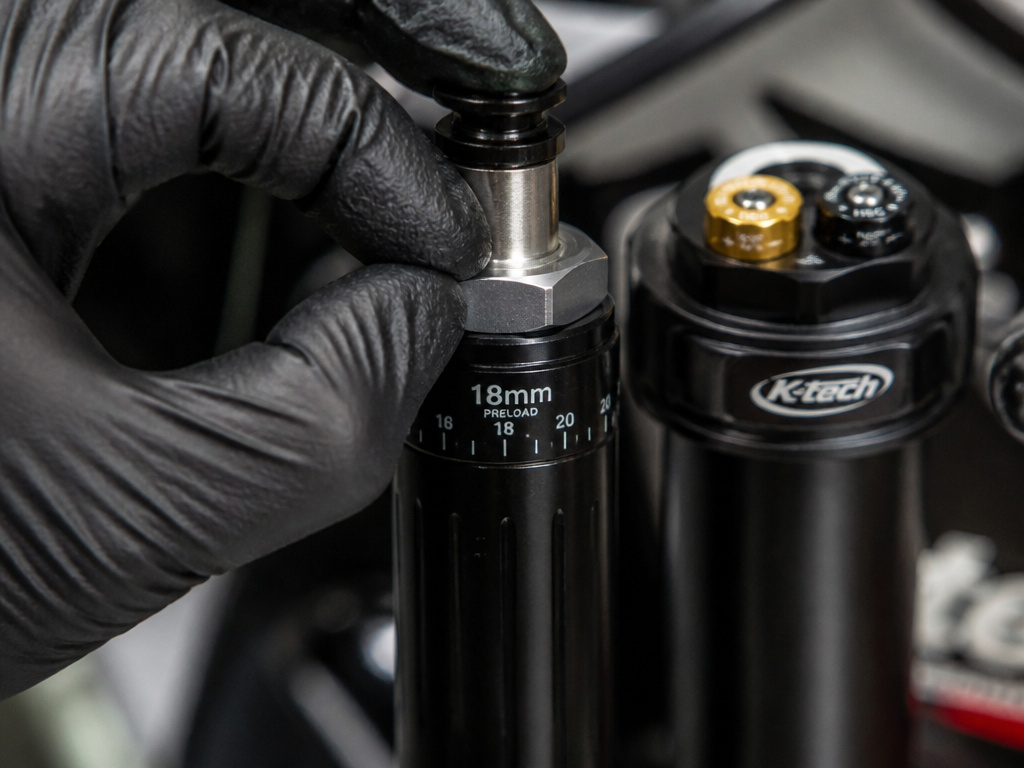
The K-Tech RDS spring preload has 18mm of adjustment, with 1 turn of the hex nut equaling 1mm of preload. That’s a precise, measurable adjustment. Compare that to the vague, notch-less preload collars on many stock forks.
The recommended fork sag for K-Tech cartridges is between 25-35mm. That’s your baseline. Before you touch damping clickers, you set preload to achieve that sag with you in your riding gear on the bike. No sag measurement means you’re tuning in the dark.
The 20mm vs 25mm Cartridge Tube Debate
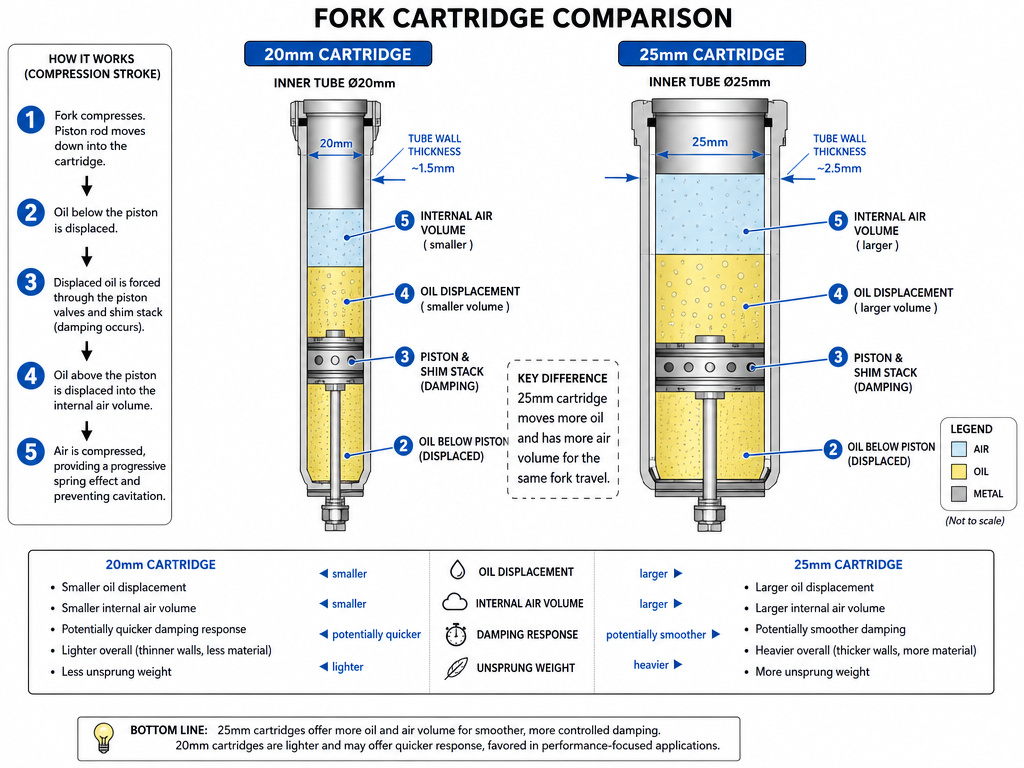
Here’s where experts disagree, and the specs above show it. K-Tech’s RDS uses a 25mm tube and a 14mm rod for “a larger displacement of oil for improved damping performance.” Traxxion Dynamics argues the opposite.
In their FAQ, Traxxion states a 25mm cartridge is “all hype.” Their founder, Max, explains that for the same rod diameter and stroke, a 25mm tube doesn’t displace more fluid than a 20mm tube. The larger internal volume of air and oil, he argues, means “it takes a longer period of time (and distance) for damping to occur. This results in more drop and dive.” He also cites the massive increase in unsprung weight as a critical negative.
K-Tech’s position is that the larger components and oil volume provide “race level performance.” Who’s right? It likely depends on the specific tuning, the bike, and the rider.
Step-by-Step: Identifying Your Fork Type
Before you spend a dollar, know what you have. You don’t need to disassemble the fork.
- Consult your owner’s manual or service guide. It often specifies “damper rod” or “cartridge” type.
- Look for external adjusters. A single screwdriver slot on the fork cap typically adjusts only preload on a damper rod fork. Multiple adjusters (a screw on the cap and a knob on the bottom) suggest a cartridge fork with separate rebound and compression damping circuits.
- Research your specific bike online. Forums and parts diagrams are definitive. As noted, modern bikes like the Ninja 650R use damper rods.
- The Parts Diagram Test. Search for a “fork types” or “fork oil” guide for your model. The internal parts schematic will show either a simple rod or a cartridge assembly.
If you’re still unsure, a motorcycle mechanic can tell you in 30 seconds. It’s worth knowing.
What Most People Get Wrong About Upgrading
The biggest mistake is throwing a premium cartridge kit at a problem that could be solved with fresh oil, the correct spring rate, and proper sag. A $1500 K-Tech RDS kit in a fork with 10-year-old, watery oil and a spring meant for a 130-pound rider is a waste of money.
The upgrade hierarchy should be:
- Set sag. If you can’t achieve 25-35mm of rider sag with the available preload, you need different springs.
- Change the fork oil. Viscosity breaks down over time. Fresh oil of the correct weight is the cheapest performance gain.
- Consider emulators. For most street riders on damper rod forks, this is the sweet spot.
- Only then, if you need the absolute maximum tunability and are willing to deal with the maintenance, go for a full cartridge kit.
Common mistake: Buying a cartridge kit for a bike you only ride on the street. The performance gain over a well-set-up damper rod fork with emulators is marginal for public-road speeds, but the cost, weight, and maintenance penalty are not.
The Bottom Line
For a modern bike with damper rod forks that you ride aggressively on backroads, install a set of proven cartridge emulators like the Race Tech Gold Valve. Have the work done by a shop that knows how to drill the compression holes correctly. Set your sag. You’ll get 90% of the feel of a full cartridge system for a fraction of the price and hassle.
If you are building a dedicated track bike or are a serious club racer, a full cartridge kit is a necessary tool. Go in knowing it commits you to a relationship with a specialist tuner and a strict service schedule. For everyone else, the simpler, lighter, cheaper path is almost always the smarter one. The goal is better damping, not the most expensive part number on the invoice.
Spring types (progressive, linear) in relation to forks
Spring choice is separate from the damping mechanism, whether it’s a damper rod or a cartridge. A linear spring provides a consistent force throughout its travel, while a progressive spring gets stiffer as it compresses. In a fork, the spring’s job is to support the bike’s weight and absorb bumps, while the damper controls the speed of the spring’s movement. The internal diameter of the fork tube dictates the maximum spring size you can use. Selecting the correct spring rate for your weight and riding style is a critical first step before fine-tuning the damping, as a mismatched spring will prevent any damper from working correctly.
Frequently Asked Questions
Are all upside-down forks cartridge forks?
No. Fork tube orientation (right-side-up vs. Upside-down) is independent of the internal damping mechanism. Many upside-down forks, especially on budget models, still use damper rod internals. The cartridge is inside the fork leg, not defined by it.
Can I convert my damper rod forks to cartridge forks myself?
Technically, yes, if you purchase a full kit. Realistically, no. This is not recommended unless you are a highly experienced mechanic with specific fork tools. K-Tech states their RDS cartridges are only available through authorized dealers, implying installation should be performed by qualified professionals with specialist tools and techniques. The risk of improper assembly leading to catastrophic failure is high.
How often should fork oil be changed in a cartridge fork?
For racing cartridge kits like K-Tech’s, the service interval is extreme: every 20 hours of use. For a street-oriented cartridge or a standard damper rod fork, the oil should be changed periodically as it degrades from heat, moisture, and mechanical shear. Oil degrades from heat, moisture, and mechanical shear.
Do cartridge forks make a bike more comfortable?
Not necessarily “comfortable” in a plush sense. They make the bike more controlled. A well-tuned cartridge fork will feel firmer on small bumps (like highway seams) because it’s actually damping them, not letting the fork wallow. It will feel more composed and less harsh on big impacts. The result is less fatigue because the bike is doing the work, not throwing you around.
What’s the first sign my fork seals need replacement?
Oil leaking past the seals, leaving a dirty film on the fork stanchion or the front brake caliper/rotor. A small weep might be okay on an older bike, but active dripping means it’s time for a fork seal replacement. Ignoring it leads to low oil level, reduced damping, and potential damage.
