
How to Measure Your Head for a Motorcycle Helmet
This post contains affiliate links. As an Amazon Associate, we earn from qualifying purchases.
To measure your head for a motorcycle helmet, wrap a soft tape measure around the widest part of your head, typically just above your eyebrows and ears, to get your circumference in centimeters or inches. Then, use the specific brand’s size chart, not a generic one. If your measurement falls between sizes, Riddell and Alpinestars advise starting with the smaller size, while AFX suggests testing one size smaller and one size larger.
That number is your starting point, not your final answer. A helmet isn’t a hat. Its job is to stay put during an impact, not just feel snug in the store. The circumference gets you into the right ballpark, but head shape decides whether you actually get a ticket. Knowing how to measure your head for a motorcycle helmet is the essential first step.
What follows: the exact, conflicting measurement spots from three major helmet makers, how to diagnose your head shape in thirty seconds, and the concrete checklist to use when you can’t try before you buy. By the end, you’ll know your size and the three signs that the fit is wrong.
Key Takeaways
- Measure at your head’s widest point, which varies by brand. Riddell says 1 inch above the eyebrows, while AGV measures from above the ears.
- Always use the brand’s own size chart; a “Large” can mean 56–60 cm (Riddell) or 60–61 cm (AGV).
- If your measurement is between sizes, try the smaller size first, as the padding is designed to break in.
- Head shape (round, intermediate, long oval) is as critical as size; a mismatch causes hot spots and helmet roll.
- Test fit with the 2-2-2 rule: two fingers under the strap, two fingers on the brow, and the helmet should not roll off with a firm twist.
The Two-Minute Measurement (and the One Spot That Changes Everything)
Get a soft, flexible tape measure. The metal carpenter’s tape won’t contour to your skull and will give you a false small number. If you don’t have one, use a string and then measure the string against a ruler.
Now, where do you wrap it? This is where the manuals disagree, and getting it wrong can push you into the next size.
Wrap the tape around the head’s circumference. Riddell specifies measuring approximately 1 inch above the eyebrows. AGV instructs measuring from above the ears. The SuperTech R7 manual states to measure at the head’s widest point just above the eyebrows and the ears. Use the method specified by the helmet brand you intend to purchase.
Riddell’s “1 inch above the eyebrows” is a precise measurement point specified by that brand. AGV’s “from above the ears” is the measurement point specified by that brand. The SuperTech (Alpinestars) method is to measure at the head’s widest point just above the eyebrows and the ears.
Pull the tape snug, but don’t compress your skin or hair. You want the tape to contact your head all the way around. Record the number in both centimeters and inches. Write it down.
What most people get wrong: They measure once, loosely, and round up. Measure three times. Take the largest consistent number. This isn’t a place for optimism.
Decoding the Size Chart Maze
Your circumference is 59 cm. You look up “motorcycle helmet size chart” and see that a Large is 59–60 cm. Perfect. You order a Large.
It arrives, and it’s crushing your temples. Why? Because you used a generic chart, not the chart for the AGV K5 S or the Shoei RF-1400. Brand charts are not interchangeable.
| Brand & Model | Size L Head Circumference Range | Where to Measure |
|---|---|---|
| Riddell Speed | 56–60 cm (22–23.5 in) | 1 inch above eyebrows |
| AGV Pista GP RR | 60–61 cm (23.6–24.0 in) | Above the ears |
| SuperTech R7 | 59–60 cm (23.2–23.6 in) | Widest point above eyebrows/ears |
See the problem? A 59 cm head is at the top of a Riddell Large, the very bottom of an AGV Large, and the middle of a SuperTech Large. The only chart that matters is the one from the company that made the helmet you want. Never assume.
This is the core of using a proper helmet sizing guide. It forces you to match your number to the right chart.
Where this goes sideways: Picking a size by a generic chart. The helmet arrives, doesn’t fit, and you convince yourself it’s “close enough.” An improper fit reduces protection from day one.
If your measurement falls squarely between two sizes on the correct chart, say, 58 cm on a chart where Small is 55–56 cm and Medium is 57–58 cm, you have a decision. Riddell and Alpinestars are clear: start with the smaller size. Their padding is designed to break in. AFX, in its manuals, suggests testing one size smaller and one size larger. The safer, more common path is to size down. You can’t add material to a helmet that’s too big.
Head Shape: The Silent Dealbreaker
Circumference gets the helmet on your head. Head shape decides if it stays there. This is the part online sizing tools almost always ignore.
There are three common shapes: Round Oval, Intermediate Oval, and Long Oval. Your basic profile, looking down at the top of your head, tells you which you are.
- Round Oval: Your head is nearly as wide from front-to-back as it is from side-to-side. It’s like a circle.
- Intermediate Oval: The most common shape. Your head is slightly longer front-to-back than it is wide. It’s an egg shape.
- Long Oval: Your head is significantly longer front-to-back than it is wide. It’s a narrow egg.
Here’s a thirty-second test. Look in a mirror from the front. Are your cheeks wide? Now, look at your profile. Is the back of your head prominent? If you’re wide in both directions, you’re likely round. If you have a narrower face and a long back skull, you’re likely long oval. Most people are intermediate.
Why does this matter? A long oval head in a round oval helmet will have massive pressure points on the forehead and back of the skull, with air pockets at the temples. The helmet will rotate easily. It’s unstable. Conversely, a round head in a long oval helmet gets vise-like pressure on the temples. I learned this the hard way.
Standard advice says buy a snug helmet because the padding will loosen. For my narrow head, a very snug round-oval helmet created a sharp pressure point at the forehead within an hour. I switched to a long-oval model in the same brand and size, and the problem disappeared. The circumference was identical. The shape was everything.
Brands build for specific head shapes. This is why trying on multiple brands is essential, and it’s the heart of any good head shape guide.
The 2-2-2 Rule and the Real-World Fit Test
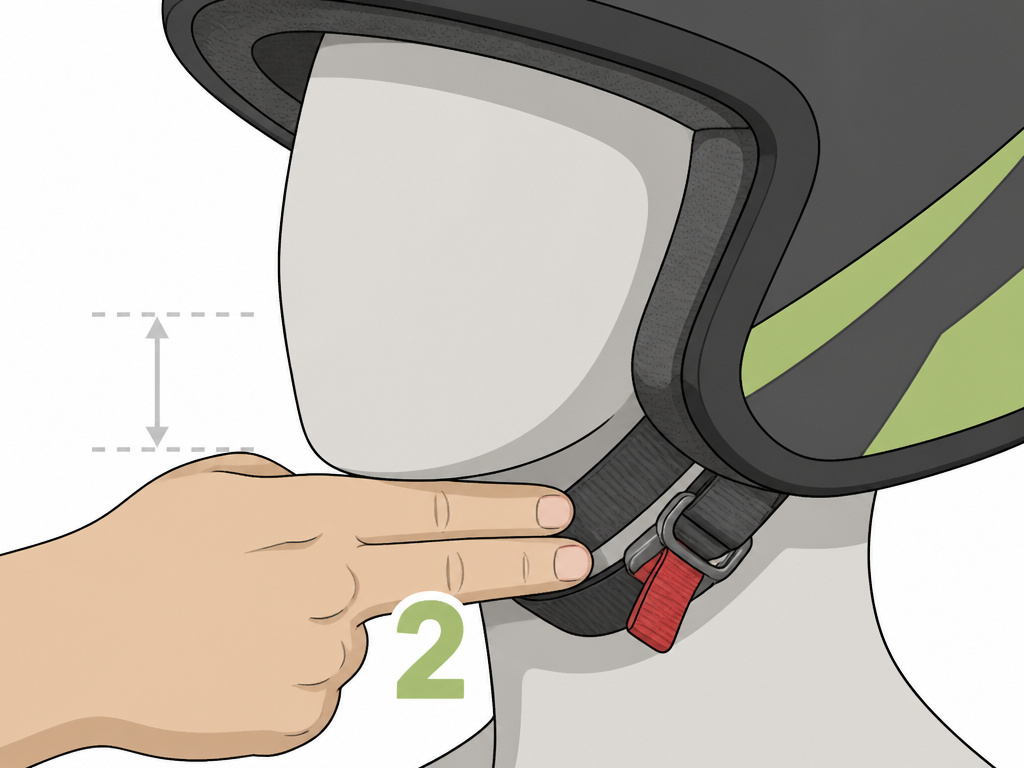
You have the right size and shape. Now, test the fit. The 2-2-2 rule is your field manual.
- Chin Strap: With the helmet on and strapped, you should only be able to fit two fingers flat between your chin and the strap. Any more, and it’s too loose.
- Brow: Look up. The front edge of the helmet should be about two fingers’ width above your eyebrows. You shouldn’t see the lid when you look upward.
- Roll-Off: Grab the helmet at the back. Try to roll it forward off your head. It should not come off. Your scalp and eyebrows should move with the helmet.
Now, wear it. Sit with it on for at least ten minutes. Listen for your body.
- Do you feel a focused, painful hot spot on your forehead, temples, or crown? That’s a shape mismatch, not a break-in issue.
- Do your cheeks feel stuffed, like a squirrel? Good. Cheek pads break in the most.
- Can you feel the helmet lightly gripping your entire head without throbbing pain? That’s the goal.
This process confirms the proper helmet fit. It turns a guess into a verifiable standard.
Common mistake: Taking the helmet off after 30 seconds because it’s “tight.” The initial squeeze is correct. A headache that builds over 10 minutes is a red flag.
The Final Checklist Before You Click Buy
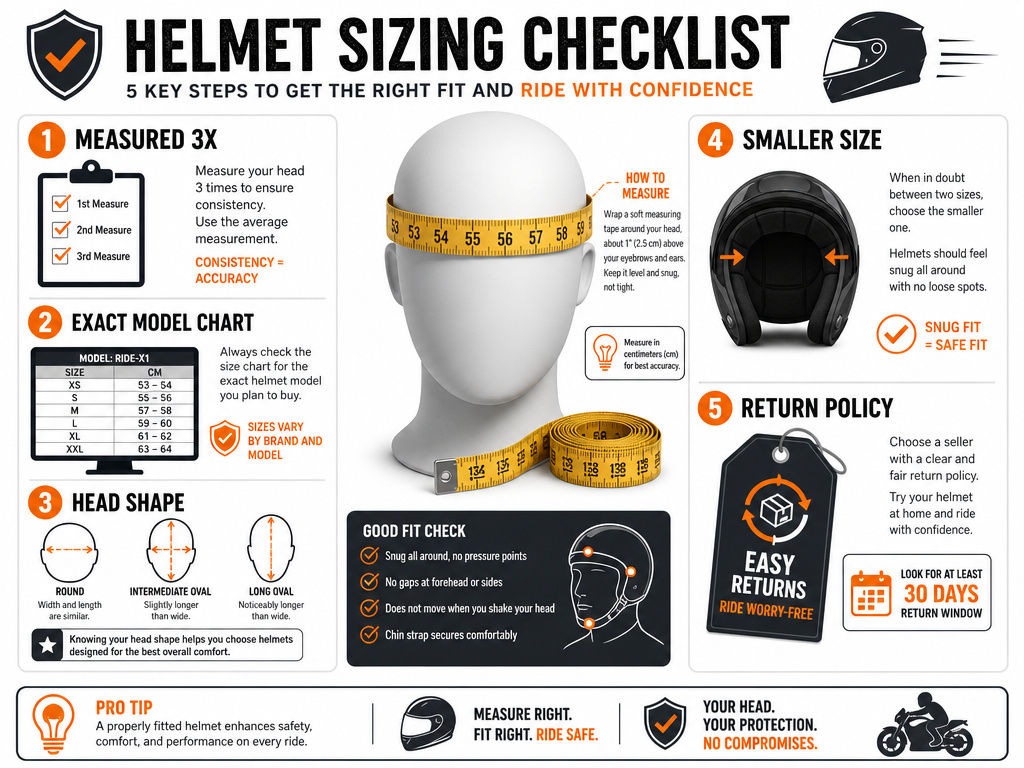
Buying online is a gamble, but you can stack the odds. Use this list.
- [ ] Measured 3x at the widest point, using the brand’s specified landmark.
- [ ] Checked the exact model’s size chart, not the brand’s generic one.
- [ ] Identified my head shape (Round/Intermediate/Long Oval).
- [ ] Researched which brands/models suit that shape.
- [ ] Picked the smaller size if my measurement was between two.
- [ ] Verified the retailer’s return policy for helmets (many have strict hygiene rules).
What about long hair or glasses? For measurement, tie your hair flat as you wear it riding. For the fit test, wear your riding glasses. Thin wire frames are fine; thick plastic temple arms can distort fit and create pressure points. Some helmets have designed channels for glasses.
If you follow this and the helmet still isn’t right, the issue is almost always shape. This is where knowing the signs of a helmet too small (constant pressure, immediate headache) versus a helmet too big (excessive roll, wind noise) saves you weeks of hassle.
Frequently Asked Questions
What is the 2-2-2 rule when fitting a helmet?
The 2-2-2 rule is a quick fit check. With the helmet on and strapped: you should fit only two fingers under the chin strap; the helmet’s front should sit about two fingers’ width above your eyebrows; and the helmet should not roll forward off your head when you grip the back and try to twist it off. It tests strap tightness, vertical position, and overall stability.
How do I know what size my head is for a motorcycle helmet?
You know your size by measuring your head’s circumference at its widest part, typically just above your eyebrows and ears, with a soft tape measure. Take the measurement in centimeters, then find that number on the size chart for the specific helmet model you want to buy. That chart translates your measurement (e.g., 59 cm) into a manufacturer’s size (e.g., Medium or Large).
What size helmet should I get if my head is 23 inches?
23-inch head circumference is approximately 58.4 cm. According to the size charts in our sources, this measurement corresponds to a Medium in a SuperTech R7 (57–58 cm), a Large in a Riddell Speed (22–23.5 inches), and likely an MS or ML in an AGV model (check their specific chart). You must use the chart for your target helmet.
What size helmet is a 22 inch head?
This discrepancy is exactly why you must use a model-specific chart. When in doubt between sizes, the prevailing advice from Riddell and Alpinestars is to choose the smaller size.
Before You Go
One rule most fitting guides skip: if you can’t get a helmet to pass the 2-2-2 roll-off test, stop. No amount of break-in will fix a fundamental shape mismatch. A helmet that rotates on your head in the living room will be a dangerous distraction at speed.
Your head’s number is a key on a ring. The right helmet model is the lock it opens. Don’t force it. The goal isn’t just a helmet that fits today, but one that you’ll actually wear every single ride. That’s the difference between a piece of gear and a piece of safety equipment.
For most riders starting out, the best path is to use your measurements to narrow the field to 2-3 models known for your head shape, then find a way to try them on. That effort beats returning two wrong helmets. Once you know your fit in a trusted brand like Shoei or HJC, you can use that knowledge to explore other recommended helmets with confidence. Fit first, features second.
