
How to Tell If a Motorcycle Helmet Is Too Small
This post contains affiliate links. As an Amazon Associate, we earn from qualifying purchases.
A motorcycle helmet is too small if it leaves red pressure marks on your forehead or temples after a short try-on, gives you a headache, or fails the official fit tests from the NHTSA and manufacturers like Bell. A correct fit is snug with even pressure, not painful. The padding will break in slightly, but pressure points and pain will not go away, they signal the wrong size or wrong head shape.
That distinction between snug and tight is where most riders get hurt. A helmet that’s just a little too small feels fine in the store for five minutes. On a long ride, a pressure point on your temple can turn into a throbbing headache that ruins your focus. The wrong fit isn’t just uncomfortable; it compromises the helmet’s ability to stay put and protect you in a crash. Knowing how to tell if a motorcycle helmet is too small is therefore critical.
What follows breaks down the five physical signs your helmet is too small, the official pass/fail tests, and how to tell if the problem is size, head shape, or just new-helmet stiffness, providing a complete guide on how to tell if a motorcycle helmet is too small. We’ll also cover what you can actually adjust and when your only move is to try a different shell.
Key Takeaways
- A helmet that leaves red marks or gives you a headache within a short try-on is too small, padding break-in won’t fix this.
- Your skin should move with the helmet liner during the official shake test; if the helmet slides over stationary skin, it’s too loose, but if it bites and pinches, it’s too tight.
- The NHTSA recommends trying on a new helmet for 30 to 45 minutes after purchase to check for pressure points before using it on a ride.
- Head shape mismatch (round oval vs. Long oval) can mimic a too-small fit; pressure on the forehead means the helmet is too round for your head.
- Never buy a used helmet, the inner foam compresses to the previous owner’s head, making a correct fit for you impossible.
The 5 Physical Signs of a Too-Small Helmet
Your body tells you a helmet is too small, which is a key part of how to tell if a motorcycle helmet is too small, long before any official test. Ignoring these signs means buying a headache, literally.
First, look for red pressure marks on your forehead or temples after just 20 minutes of wear. These aren’t faint lines from the liner; they’re defined, angry spots where the rigid shell or dense foam is digging in. The SCOTT manual says the front should sit just above your eyebrows, but if you see a red band exactly there after taking the helmet off, the shell is pressing too hard.
Second, listen for headaches that start at the temples or forehead about half an hour into a ride. This isn’t general fatigue. It’s a localized, pressing pain that fades soon after you remove the helmet. That’s the polystyrene liner compressing nerves and blood vessels. Padding break-in might soften the liner a bit, but it won’t change the fundamental shell geometry causing the pinch.
Where this goes sideways: Assuming new-helmet stiffness is the same as a too-small fit. Stiffness is uniform pressure that eases over 15–20 hours. A too-small fit is specific, pinpoint pain that gets worse.
Third, check for numbness or tingling in your face or scalp. This is less common but a major red flag. It means the helmet is compressing a nerve, usually around the cheeks or the trigeminal nerve on the forehead. The Bell fit test says the cheek pads should be snug, you might feel them against your cheeks, but they should never cut off sensation.
Fourth, notice if it’s uncomfortable to open your mouth wide with the chin strap secured. The Bell manual is explicit here: fasten the strap so it’s “snug with your mouth closed and uncomfortable to open your mouth.” That’s the correct tension. But if you feel the top of the helmet pressing down on your skull when you yawn or talk, the shell is too shallow. Your scalp should not be forced against the crown liner by the simple act of opening your jaw.
Fifth, feel for excessive pressure on your crown. Run your hand over the top of your head after removing the helmet. Is there one spot that feels noticeably more compressed or tender than the rest? A correct fit applies even pressure like a firm handshake all around. A hotspot on the crown means the helmet is too shallow for your head height, not just too narrow. This is a head shape issue that sizing up won’t fix.
The Official Fit Tests You Must Pass
Manufacturer manuals and the NHTSA helmet selection guide don’t leave fit to guesswork. They provide concrete, pass/fail tests. A helmet that fails any of these is the wrong size.
Start with the shake test. With the chin strap securely fastened, grab the helmet and try to rotate it left and right and forward and backward on your head. According to Bell, “your skin should move with the liner of the helmet.” If the helmet slides easily over stationary skin, it’s too big. If it doesn’t move at all and instead pinches and pulls your skin, it’s too small. You’re looking for a slight, unified movement where your scalp and the liner move together.
Next is the critical roll-off test. Fasten the strap. Place one hand on the chin bar to stabilize it. With your other hand at the back base of the helmet, try to roll the helmet forward off your head. Then, try to roll it backward from the front. “If the helmet comes off your head in either case,” the Bell manual states, “the helmet does not fit right.” This test checks retention in a simulated impact. A helmet that rolls off is dangerously loose, but one that is so tight it barely budges can also fail by transferring too much direct force.
The visual field check is about placement. Different manufacturers have slightly different guidance. SCOTT says the front should be “positioned closely just above your eyebrows.” Bell says it should be “placed low on the forehead so the edge of the helmet is visible in your upper field of vision.” These represent different manufacturer recommendations for proper vertical positioning. If you can’t see it, the helmet is too high and exposes your forehead. If it’s pressing directly on your brows, it’s too low and likely too small.
Finally, do the 30–45 minute wear test recommended by the NHTSA. After you buy a new helmet, sit with it on at home for a full episode of a TV show. “These hot spots may not be immediately apparent but can grow into painful problems over time,” they note. This test catches the delayed pressure points a two-minute store try-on will miss.
| Test | How to Perform | Pass Condition | What Failure Means |
|---|---|---|---|
| Shake Test | With strap fastened, try to rotate helmet left/right and forward/back. | Skin moves with the helmet liner. | Slides easily = too big. Pinches/pulls skin = too small. |
| Roll-Off Test | With strap snug, try to roll helmet forward from the back and backward from the front. | Helmet should not roll off your head. | Rolls off = too loose, fails safety retention. |
| Visual Field Check | Look straight ahead, then glance upward with just your eyes. | You should see the bottom edge of the helmet shell in your upper vision. | Can’t see edge = too high. Pressing on brows = too low/small. |
| Extended Wear Test | Wear the helmet, strapped, for 30–45 minutes while stationary. | No development of new, painful pressure points. | Emerging “hot spots” indicate a poor fit that will cause pain on long rides. |
Snug vs. Tight: The Difference That Decides Safety
This is the core confusion. A snug fit is safe and correct. A tight fit is dangerous and wrong. Here’s how to tell them apart.
A snug fit provides even, firm pressure around the entire circumference of your head. It feels like a consistent hug. When you first put on a new, correctly sized helmet, the cheek pads might press your cheeks slightly toward your teeth. The crown might feel uniformly present. This is the padding doing its job. According to Ruroc, a helmet takes 15–20 hours of riding to fully break in. That initial firmness will soften and mold to your unique head shape, becoming more comfortable.
A tight fit applies uneven, excessive pressure to specific points. It feels like a vise on your forehead or a pinch at your temples. This pressure does not distribute evenly and will not mold away. The foam liner can compress only so much; the rigid shell behind it won’t change. A headache that starts at a specific point and grows is the hallmark of “tight.”
Common mistake: Sizing up to relieve pressure points caused by the wrong head shape. If a medium is tight in the forehead but loose elsewhere, a large will be loose everywhere. The solution is a different helmet model shaped for your head, not a larger size.
The why-layer here is material science. The polystyrene liner is designed to crush on impact to absorb energy. Under normal wear, it slowly compresses to the shape of your head. That’s break-in. But if the hard outer shell is already pressing directly on your head in spots, the liner has no room to compress further. The pressure just transfers to your skull. That’s why pinpoint pain doesn’t get better.
When It’s Not the Size, It’s the Shape
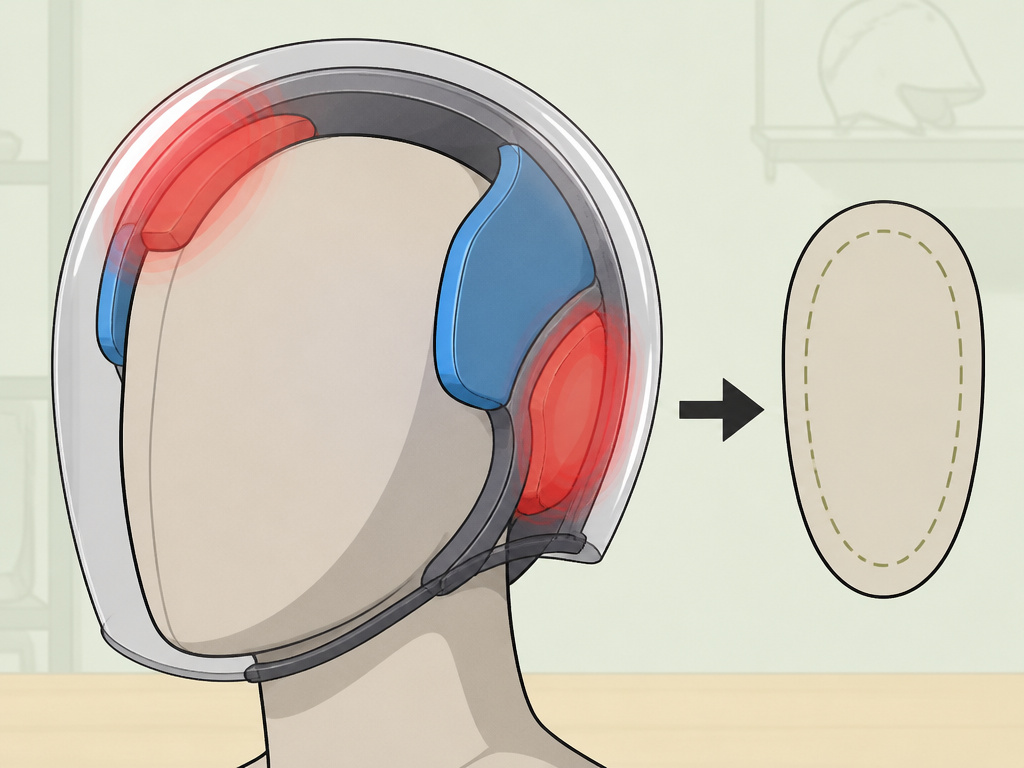
You can have the right circumference and the wrong helmet. Head shape is the silent fit killer. The NHTSA notes three general shapes: round oval, intermediate oval (the most common), and long oval.
If you have a long oval head (narrow from side-to-side, longer front-to-back) and try on an intermediate oval helmet, you’ll get painful pressure on your forehead and the back of your head. The helmet is too round for you. Conversely, a round-headed person in a long-oval helmet will feel pinching at the temples. This mimics a too-small fit but sizing up just creates a different set of gaps.
This is where a basic head measurement is just the starting point. You must identify your shape. To find a helmet that matches your head shape, you need to identify whether your head is round oval, intermediate oval, or long oval. Brands often design helmets for different head shapes; trying on multiple brands is necessary to find one that matches your shape. This is why trying on multiple brands is essential.
Some manufacturers, like SCOTT, provide replaceable cheek pads and liners to fine-tune the interior shape. The NHTSA mentions these systems can help adjust fit. Swapping for thinner or thicker official cheek pads can relieve cheek pressure without changing the shell size. Stick to the brand’s official padding system for adjustments. Stick to the brand’s official padding system.
What You Can Adjust vs. What Requires a New Helmet
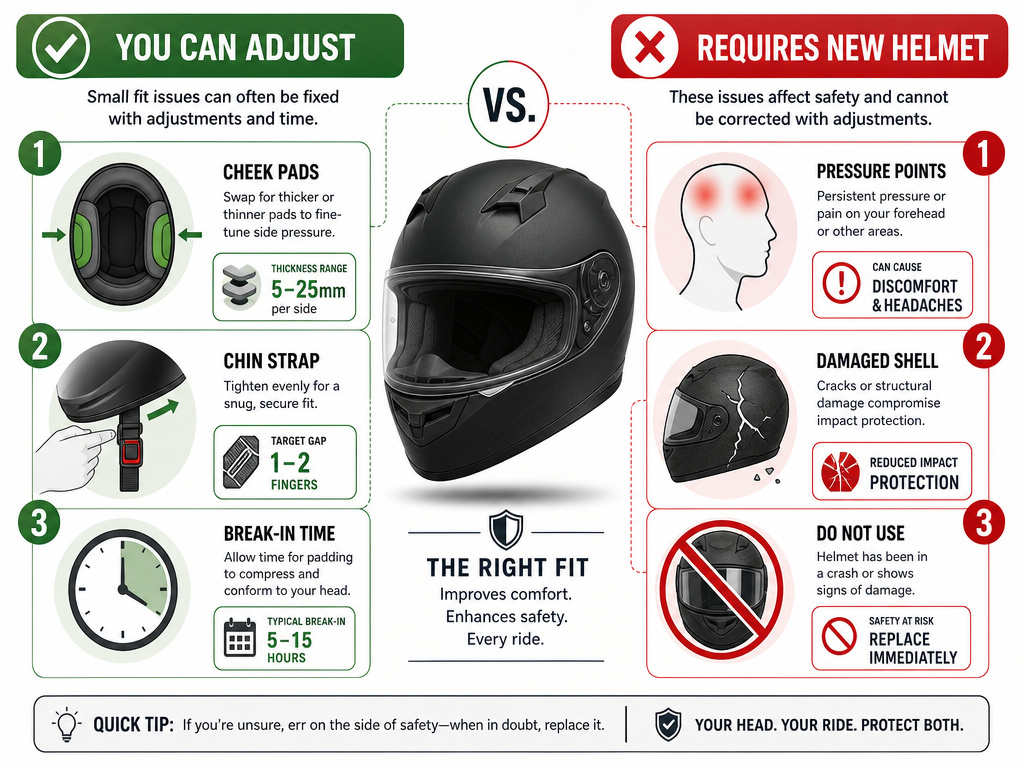
Not every fit issue means a return. Some have fixes; others are dead ends.
You can adjust:
- Cheek pad thickness. Many brands sell thinner or thicker cheek pads. This solves a helmet that fits well around the crown but is too tight or loose on the cheeks.
- Chin strap tension. The strap should be snug under your chin. Both Bell and Ruroc describe it as almost uncomfortable when closed. A loose strap makes any helmet feel insecure.
- Break-in time. Allow for the 15–20 hour bedding-in period Ruroc cites. Initial snugness on the cheeks is normal and should improve.
You cannot adjust:
- Pressure points on the forehead or temples from shell contact. This is a head shape or size mismatch. The shell is rigid. You need a different model or size.
- A helmet that is structurally compromised. The KYT manual is absolute: “Never use again a helmet that has suffered a shock.” Internal damage is often invisible.
- A used helmet. The Bell and KYT manuals are united: never buy used. The foam liner has permanently compressed to the previous owner’s head shape, altering its protective geometry and fit for you.
I used to think a pricier helmet was automatically safer. After comparing fit and certification labels more carefully, I saw that a well-fitted mid-priced helmet beat a poorly fitted expensive one every time. Now I tell readers to look at fit and certification first, graphics last.
If you’re between sizes, the universal advice is to size down. The padding will compress. A helmet that’s slightly snug at first will become perfectly snug. A helmet that’s slightly loose at first will become dangerously loose after break-in. The only exception is if the smaller size causes the specific, pinpoint pressure points we’ve defined as “tight.” In that case, that model’s shape is wrong for you.
Helmet not sitting flush/leaving a gap
A helmet that doesn’t sit flush against your head, leaving visible gaps, is a clear sign of a poor fit. This usually means the shell shape is wrong for your head, not necessarily that the size is too small. Helmets come in different shape styles like round oval, intermediate oval, and long oval. If the helmet rocks or you can see daylight between the liner and your forehead or cheeks, the shape is mismatched. Some manufacturers offer replaceable cheek pads and liners to adjust the interior fit, but a significant gap at the brow or temples often requires trying a different helmet model designed for your head shape.
Frequently Asked Questions
How do I tell if my motorcycle helmet is too small?
You’ll know it’s too small if you get localized red marks on your forehead or temples within 20 minutes, develop a focused headache on a short ride, or fail the official fit tests (like the shake test where your skin doesn’t move with the liner). General, even snugness is correct; specific, worsening pain is not.
What is the 2 2 2 rule when fitting a helmet on your head?
While not an official standard from the NHTSA or major manufacturers, a common “2-2-2” rule of thumb suggests you should only be able to fit two fingers under the chin strap, two fingers on your forehead between your brow and the helmet, and two fingers on the back of your head between your neck and the helmet. It’s a rough guide, but the manufacturer fit tests are more reliable.
Is it better to have a tight or loose helmet?
Neither. You want a snug helmet. A tight helmet causes pain, distraction, and can concentrate impact forces. A loose helmet can shift, obstruct vision, or even come off in a crash. The goal is even, firm contact all around your head with no painful pressure points.
Is it good to be small or bigger on a helmet?
It is better to be slightly on the snugger side of correct than bigger. Padding compresses over the first 15–20 hours of wear. A helmet that is perfectly snug when new will become perfectly broken-in. A helmet that is slightly loose when new will become unacceptably loose and unsafe. However, “snug” is not “tight” or “painful.”
How does my hairstyle affect helmet fit?
Thick or long hair can significantly affect fit. Always measure your head and try on helmets with your hair styled how you’ll typically ride (e.g., in a low ponytail). A helmet that fits with your hair down might be too tight when you put your hair up. If you change your hairstyle often, consider a helmet with a slightly more adjustable fit system to accommodate minor changes.
Before You Go
Fit first, features second. That’s the rule. A perfect-fitting mid-priced helmet beats a loose premium one every single time, and a professional fitting is worth more than a flashy graphic.
The one action to take this week: perform the 30–45 minute wear test on your current helmet. If you discover a delayed pressure point you never noticed before, you’ve just identified a distraction, and a potential safety compromise, before your next ride.
All this advice assumes a new, undamaged helmet. The moment a helmet suffers any impact, its protection is compromised and it should not be used again. The manuals from KYT, Bell, and SCOTT all converge on that point. A helmet is a single-use safety device disguised as something you can wear for years. Treat it that way.
