
How to Manage Motorcycle Riding Anxiety: A Rider’s Toolkit
This post contains affiliate links. As an Amazon Associate, we earn from qualifying purchases.
To manage motorcycle riding anxiety, you need a two-part approach: build your skills in a low-risk environment and develop mental tools to stay present and in control. The foundation is professional training, like an MSF course, followed by deliberate parking-lot practice. The mental game relies on systems like the SIPDE hazard-response strategy and techniques like naming your fear and using body scans to release tension. Anxiety is normal; the goal is to manage it, not eliminate it.
That distinction between managing and eliminating fear is where most advice falls short. Telling someone to “just relax” or “get more seat time” doesn’t work when their brain is shouting about potential disasters. A key question is how to manage motorcycle riding anxiety, as it isn’t about the bike itself, it’s about the unpredictable variables around it: other drivers, road conditions, and your own perceived lack of control.
What follows is a toolkit, not a pep talk. We’ll cover the mental system that replaces panic with procedure, the specific drills that build real confidence, and the in-the-moment tricks that pull you back from the edge. This is for the rider who knows how to operate the controls but hasn’t yet quieted the voice that asks “what if?”
Key Takeaways
- Anxiety is a normal protective response; your goal is to manage its volume, not silence it. Techniques like naming the fear (“This is anxiety about merging”) engage the rational part of your brain.
- The SIPDE system (Scan, Identify, Predict, Decide, Execute) is your mental operating system. It turns a panicked “what if?” into a series of manageable steps, giving your brain a job to do instead of spinning.
- Quality practice beats random miles. Drills in an empty lot, emergency stops, tight turns, clutch control, build the muscle memory that works when anxiety hijacks your working memory.
- Your body steers the bike. A 30-second body scan during a ride to check for tension in your hands, shoulders, and jaw can break the cycle of fear creating stiffness, which creates more fear.
- Fear that consistently stops you from riding may need outside help. A mindset coach or therapist specializing in CBT can provide tools that generic riding advice can’t touch.
Your Brain on Two Wheels: It’s Not Just You
We begin with the science, because it removes the shame. That racing heart and tunnel vision when a truck drifts into your lane is your amygdala, the ancient, hard-wired part of your brain for threat detection, screaming “DANGER.” The problem is, it can’t tell the difference between a real collision course and a car simply changing lanes with plenty of room.
Where this goes sideways: Trying to think your way out of a fear response in the moment. As fear expert Kris Fant notes, our rational prefrontal cortex alone cannot override the amygdala’s alarm. You need a pre-loaded strategy.
Research aggregated by sources like YourOneLife shows anxiety interferes with working memory. That’s the part of your brain that holds and uses information temporarily. This is why you can know the steps for an emergency stop in a parking lot, but freeze when you need them on the road. The fear isn’t just uncomfortable; it literally blocks the skills you’ve learned.
The good news? You can train around this. The solutions come from two directions: building automatic physical skills so they’re less likely to be blocked, and using cognitive techniques to calm the amygdala’s false alarms.
The SIPDE System: Your Mental Framework
When anxiety hits, your mind races through a hundred “what ifs” at once. The SIPDE system, outlined in the official Ohio Motorcycle Operator Manual, gives that chaotic energy a single, structured job. It’s not just defensive riding; it’s anxiety management through active engagement.
This process turns a passive fear into an active procedure.
Here’s how each step works as an anxiety antidote:
- Scan: Your eyes are your best early-warning system. The manual advises scanning “more than just looking in front of you.” This means frequent head checks and mirror glances, but with a priority: your main focus stays ahead. This forced, systematic scanning stops your gaze from fixating on a single threat (a symptom of panic) and builds a real-time map of your environment. You’re not a victim of the road; you’re gathering data.
- Identify: “That’s a car waiting to turn left at the intersection.” “That’s gravel in the corner.” Naming the hazard objectifies it. It becomes a problem to solve, not a monster to fear.
- Predict: This is the “what if” phase, but channeled. If that car turns, it will block my path. If I hit that gravel, my front tire may slip. This isn’t catastrophizing; it’s risk assessment based on what you see.
- Decide: Now you choose. Adjust speed? Change lane position? The manual states you often need to “compromise and choose a path…that offers the most time and space.” This decision-making moment is powerful. It replaces helplessness with agency.
- Execute: You carry out the decision. This step completes the loop, proving to your brain that you can observe, analyze, and act. That proof builds confidence for the next loop.
The power of SIPDE is that it’s a repeatable ritual for the how to manage motorcycle riding anxiety process. When you feel the first flutter of panic, maybe when riding in traffic feels overwhelming, you drop into the scan. You give your thinking brain a concrete task, which pulls focus away from the emotional brain’s alarm.
| SIPDE Step | The Anxiety Trap | The SIPDE Response |
|---|---|---|
| Scan | Tunnel vision on one threat. | Systematic search of front, sides, and mirrors. |
| Identify | “Everything is dangerous!” | Name the single, specific hazard. |
| Predict | Catastrophic “what if” spiraling. | Logical “if-then” based on the hazard’s likely action. |
| Decide | Freeze or panic reaction. | Choose one action (slow, move, communicate). |
| Execute | Hesitant, jerky inputs. | Smooth, committed control input. |
Build Skills in a Controlled Bubble
“Seat time” is useless if every mile is white-knuckled terror. The RevZilla guide’s author put it well: quality seat time requires understanding the fundamentals. You build confidence in a stress-free environment so you have a reserve to draw from when stress arrives.
The essential first step is professional instruction. An MSF Basic Rider Course does two critical things: it teaches correct technique in a closed range, and it does so in a structured, progressive way. You don’t wonder what to practice next; the instructor tells you. One rider in the RevZilla article started with the MSF course, took those drills to a parking lot, and only then started commuting. That’s the blueprint.
After a course, your mission is to create your own “closed range.” An empty parking lot on a Sunday morning is your laboratory.
- Practice the boring stuff: Slow-speed figure eights, clutch control at a crawl, stopping smoothly without wobbling. Mastery here makes the bike feel predictable.
- Drill emergency maneuvers: Practice straight-line emergency stops, swerving around an imaginary obstacle. Knowing you can physically perform these actions reduces the fear of needing them.
- Simulate stress off the bike: Kris Fant advises practicing fear-reduction skills off the bike. Visualize a challenging scenario in detail. Even physical exercise like sprinting up a hill can simulate the heart-pounding arousal of a feared situation, letting you practice calming techniques without a bike in the mix.
This kind of practice builds what’s called “muscle memory,” but it’s really neural pathway strength. The action becomes more automatic, requiring less conscious working memory. When anxiety strikes and clogs that working memory, the automatic pathway can still function.
In-the-Moment Tools for When Anxiety Strikes

You’ve practiced. You’re scanning. But you crest a hill to see a steep, rocky descent and the fear floods in anyway. This is where specific, portable tools separate the prepared rider from the overwhelmed one.
1. Name It to Tame It.
This technique, emphasized by both Kris Fant and YourOneLife, is deceptively simple. In your helmet, say exactly what you feel: “I’m scared of this steep downhill.” Or “I’m anxious about merging onto this highway.” Why it works: Brain science shows that labeling an emotion activates the prefrontal cortex, the rational, regulatory part of your brain. It literally reduces the intensity of the amygdala’s alarm. You’re not fighting the feeling; you’re acknowledging it, which robs it of its chaotic power.
2. The 30-Second Body Scan.
Fear creates physical tension. Tense muscles make the bike feel twitchy and less stable, which creates more fear. Break the cycle.
Easy to miss: We hold tension in specific places: a death grip on the bars, shoulders hunched to our ears, jaw clenched. A quick internal check-in, hands, shoulders, jaw, stomach, takes seconds. If you find tension, take one deep breath and consciously release that one muscle group. Fant suggests a mantra like “baby birds” to remind yourself of soft, gentle hands.
3. Have a Mantra.
A short, pre-chosen phrase can anchor you. It should be positive and instructional. “Smooth inputs.” “Look where you want to go.” “Space and pace.” Repeat it quietly. It crowds out the panicked internal monologue and gives your mind a constructive focal point, similar to how a systematic road scanning routine focuses your eyes.
4. Control Your Inputs.
When scared, riders often make abrupt throttle, brake, or steering inputs. Consciously focus on making every control action smooth. Say “smooth” out loud as you roll on the throttle or squeeze the brake. This direct physical focus is a form of mindfulness, it pulls you into the present moment and the mechanical task, away from the fearful future your brain is inventing.
When the Environment Feels Hostile
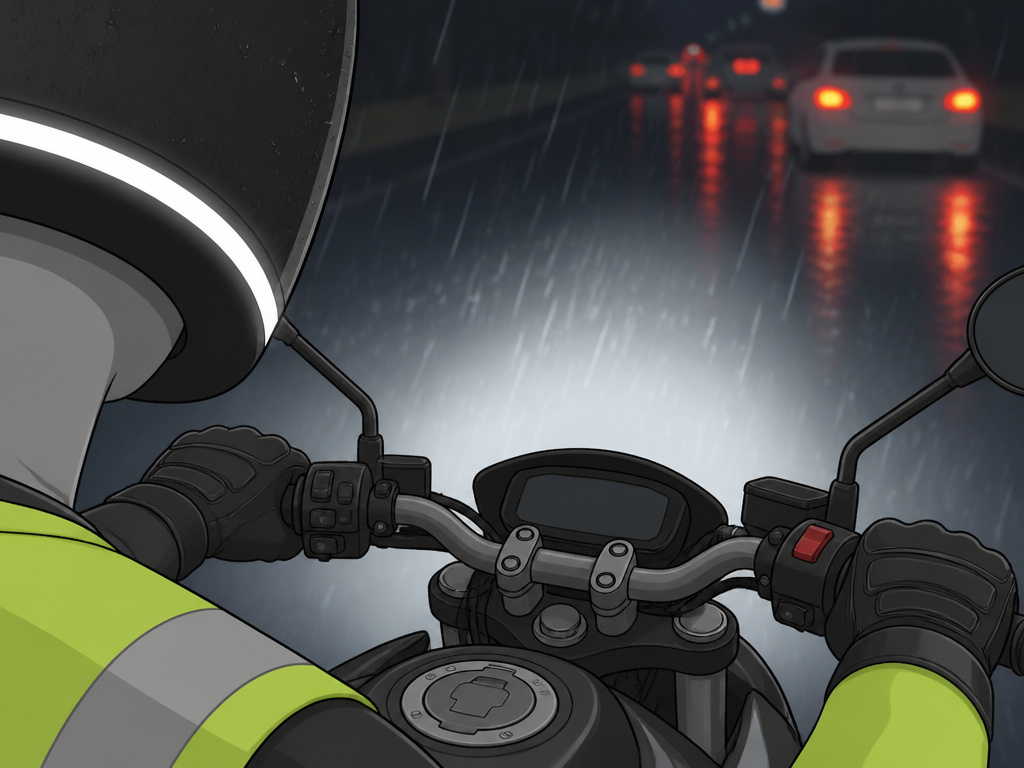
Sometimes the anxiety is tied to a specific condition. The generic “be confident” advice fails here. You need a condition-specific plan.
For Night Riding Anxiety:
The fear is usually about reduced visibility and feeling invisible. Your plan is technology and technique.
- Gear Up: Ensure your helmet visor is crystal clear (no old, scratched visors). Use clear or yellow-tinted lenses. Wear reflective strips or a high-visibility gear vest over your jacket.
- Technique Shift: Increase following distance dramatically. Use the headlights of the car in front of you to illuminate the road further ahead. Actively identify potential hazards (animals, debris) at the edge of your headlight beam. Read our full guide on riding a motorcycle at night for a deeper dive.
For Rain Riding Anxiety:
The fear is of losing traction. Your plan is about moderation and smoothness.
- Mindset: Accept that you will go slower and your stopping distance will be longer. That’s not failure; it’s adaptation.
- Technique: Everything is exaggeratedly smooth. Gentle throttle, early and progressive braking, minimal lean angle. Seek the best traction, often in the tire tracks of cars where oil has been washed away. Our article on riding in the rain covers the critical details of tire grip and line selection.
For Traffic Anxiety:
The fear is of other drivers. Your plan is about positioning and escape routes.
- Lane Position: Don’t hide in blind spots. Ride in the left or right tire track where you are most visible in side mirrors. Change position frequently to stay seen.
- Escape Route: Always know where you’d go if the car ahead slammed its brakes. The left shoulder? The gap to the right? This isn’t paranoia; it’s the “maintain an escape route” principle from the Ohio manual, and it’s a core defensive riding technique. It transforms anxiety into active observation.
When to Seek Help Beyond Riding Advice
This is the part most riding articles won’t touch. If your fear is persistent, overwhelming, and stops you from riding even when you want to, it may be more than a skills gap. This is especially true if you’re returning to riding after a long break or an incident.
- Mindset Coaching: Professionals like those at YourOneLife specialize in the psychological barriers to performance. They won’t teach you how to corner but will give you tools to manage the anxiety that prevents you from learning to corner.
- Therapy (CBT): Cognitive Behavioral Therapy is highly effective for anxiety. It helps you identify and reframe the catastrophic thoughts that fuel fear. An academic paper in MDPI’s journal Safety has even explored designing CBT specifically for motorcycle rider stress.
- Signs it’s time: If thoughts about riding consume you off the bike, if you have panic attacks, or if you avoid situations (like highways) to the point it limits your life, talking to a professional is a sign of strength, not weakness. It’s the ultimate form of managing fear for the long haul.
Frequently Asked Questions
How do I get rid of motorcycle anxiety?
You don’t “get rid” of it; you manage and reduce it. The goal is to turn down the volume of the fear response so it acts as a useful caution signal, not a paralyzing alarm. This is done through skill building (training, practice), mental frameworks (SIPDE), and in-the-moment tools (naming, body scans). Expect it to be a practice, not a one-time fix.
What is the 4-second rule for motorcycles?
This is a following-distance rule for increased safety. Pick a stationary object the car ahead passes. You should reach that object at least three seconds later, increasing it in poor conditions. In poor conditions (rain, night, heavy traffic), increase your following distance beyond the minimum. This gives you more time to see hazards, predict problems, and execute a safe response, which directly reduces anxiety by creating a larger safety buffer.
Is it normal to be scared when learning to ride a motorcycle?
Absolutely. As the RevZilla article states, “it’s OK to be scared, especially when you’re learning.” Fear is a normal, protective emotion when facing a new, complex skill with real risks. The key is to ensure the fear is proportionate and doesn’t prevent you from learning. Channel it into motivation for structured practice and professional training.
Can riding a motorcycle help with anxiety?
Interestingly, yes, but sources frame the benefit differently. A peer-reviewed study from Brain Mapping.org found that riding decreased stress hormone ratios and enhanced sensory monitoring, suggesting an automatic stress-buffering effect. In contrast, CBT papers and instructional guides (SheADV, YourOneLife) frame anxiety management as a skill requiring deliberate cognitive and behavioral techniques like mindfulness. However, this benefit is most pronounced when you have enough skill that operating the bike isn’t itself the primary source of anxiety.
What if I’m scared of dropping my bike?
This is a common and reasonable fear, especially with new or expensive motorcycles. The fix is practice in a zero-consequence environment. Take your bike to a grassy field or empty, smooth parking lot. Wear your full gear. Now, practice slowly letting the bike tip over while holding it. Learn how it feels at the point of balance and how to set it down gently. Doing this on purpose, a dozen times, demystifies the “drop” and removes a huge chunk of the fear. The bike can be picked up. Scratches can be touched up. The fear of the idea of dropping it is often worse than the reality.
The Bottom Line
Anxiety on a motorcycle is your brain trying, in a clumsy way, to keep you safe. Your job is to be a better manager, to train your brain with better information and procedures.
Start with a system. Make SIPDE your default mental loop. Build your skills where there are no consequences, so they’re there when consequences appear. And when the fear rises anyway, have your toolkit ready: name it, scan your body, smooth your inputs. If the fear stays in the driver’s seat no matter what you try, there’s zero shame in calling in a professional coach or therapist. That’s just another smart tool for your kit.
The thrill is in developing the competence to ride right alongside the fear, acknowledging it, and choosing your line anyway. That’s where real confidence lives.
