
How to Ride a Motorcycle at Night: The 12-Second Rule
This post contains affiliate links. As an Amazon Associate, we earn from qualifying purchases.
Riding a motorcycle at night requires adjusting your speed to stay within the distance your headlight illuminates, your lighting to manually override automatic systems in fog or rain, and increasing your following distance. The NHTSA notes alcohol plays a role in fatal night crashes at three times the daytime rate, so impairment is a non-starter.
The gap between your headlight’s reach and your stopping distance is where night riding gets real. Your high beam may show you farther ahead, but your stopping distance can easily exceed the illuminated area. A core principle of how to ride a motorcycle at night is managing this critical gap.
What follows breaks down the tactics that close that gap for how to ride a motorcycle at night. We’ll cover the 12-second rule for judging safe speed, why you must manually switch on your low beam in fog despite an ‘Auto’ setting, the 70/30 braking split for panic stops in the dark, and the specific intersection strategy that keeps you out of a car’s turning path.
Key Takeaways
- Ride at a speed where you can stop within the distance your headlight illuminates, the 12-second rule is your guide.
- Manually activate your low beam in fog, rain, or heavy cloud cover; automatic light sensors can fail to trigger it, impairing your visibility to others.
- Increase your following distance to at least 4 seconds to compensate for reduced depth perception and reaction time.
- Cover your front brake lever when approaching intersections; this pre-loads the system and can cut your stopping distance by a critical few feet.
- Assume you are completely invisible to every other driver and plan an escape route for every block you ride.
The 12-Second Rule and Overriding Your Headlight
Your headlight’s reach, not the speed limit, decides your safe speed at night. The old rule of thumb says you should be able to stop inside the distance your headlight shows you. That’s the theory. The practical version is the 12-second rule: pick a landmark your headlight just reaches and count the seconds until you pass it. If it’s less than 12, you’re overriding your headlight.
Most stock motorcycle headlights on low beam have a limited reach. At 60 mph, you cover a short illuminated distance very quickly, and stopping distances can be longer than the lit area. You’re already 40 feet into the darkness before you even hit the brakes. The 12-second count builds in a huge buffer for perception, reaction, and less-than-ideal traction.
The 12-second rule is a speed governor for darkness. If your headlight reaches a road sign and you pass it in 8 seconds, you are traveling too fast to identify and react to an obstacle in that illuminated zone.
This is also where your bike’s lighting technology can trick you. Modern bikes like the Ducati Scrambler NightShift have an ‘Auto’ lighting mode. The manual states that in good light the DRL is on and the low beam is off, and in poor light the DRL is off and the low beam is on. But it carries a critical warning: “Using the DRL light in ‘Auto’ mode in case of poor light conditions, especially in case of fog or clouds, could impair safety. In this case Ducati recommends to manually activate the low beam.”
Trust the sensor to detect night, but not to detect dangerous night. Fog, mist, or a moonless overcast sky can trick the sensor into keeping the dimmer DRL on instead of the brighter low beam. You think you’re seen, but to a driver you’re a faint pinpoint. The fix is simple. See fog, hit the switch. This isn’t a Ducati quirk, it’s a limitation of any ambient light sensor. For a deep dive on effective lighting, our guide covering the best lights for night riding covers auxiliary options that extend your visible footprint.
Pre-Ride Checks You Cannot Skip
A loose cable or a dim bulb is a daytime annoyance. At night, it’s a failure point that isolates you. The North Carolina DMV handbook outlines a pre-ride checklist that becomes law after dark. Fluids and tire pressure matter, but light and brake checks are the non-negotiables.
- Turn Signals: Activate both left and right. Walk around the bike. A dead signal on a dark road is an invitation for a sideswipe.
- Brake Light: Squeeze the front lever, then press the rear pedal. Each should trigger a bright, distinct flash from the tail. If one circuit is out, a following driver might miss your slowing cue entirely.
These checks are the mechanical baseline. Your gear is the next layer. Wearing reflective gear or adding retroreflective tape to your helmet and bike sides creates a 3D outline that car headlights can pick up from hundreds of feet away, far beyond the reach of your own taillight.
Vision and Conspicuity: Being Seen and Seeing
Night inverts the visibility problem. During the day, you work to see others. At night, your primary job is to be seen. A motorcycle’s single headlight is harder for drivers to triangulate and judge distance on than a car’s two points of light. You are a smaller object, often lost in a sea of brighter, larger lights.
Your first defense in how to ride a motorcycle at night is positioning. Ride in the left third of the lane (in countries where you drive on the right). This places your headlight in a driver’s side mirror, not buried in the glare of their center rearview. It also gives you more escape space to the left if a car doesn’t see you. Avoid riding directly in a car’s blind spot, especially at night when drivers are less likely to check their mirrors.
Your second defense is active lighting. Use your high beam whenever you’re not following close behind another vehicle or meeting oncoming traffic. That extra reach is precious. If an oncoming driver forgets to dim their highs, don’t stare at their lights. Look toward the right edge of your lane and use the painted line or road edge as your guide. This protects your night vision from being completely wiped out. For your eyes, clear lenses are mandatory. A tinted visor or sunglasses at night is illegal for a reason, it reduces light transmission when you need every photon. If you struggle with glare, specific glasses for night riding with anti-reflective coatings can help cut scattered light without darkening your view.
These vision techniques for scanning and using your peripheral vision are always important, but at night they become your primary navigation tool. You stop looking at things and start looking for things, shapes, shadows, and movements at the edge of your light.
Specific Night Hazards and How to Handle Them
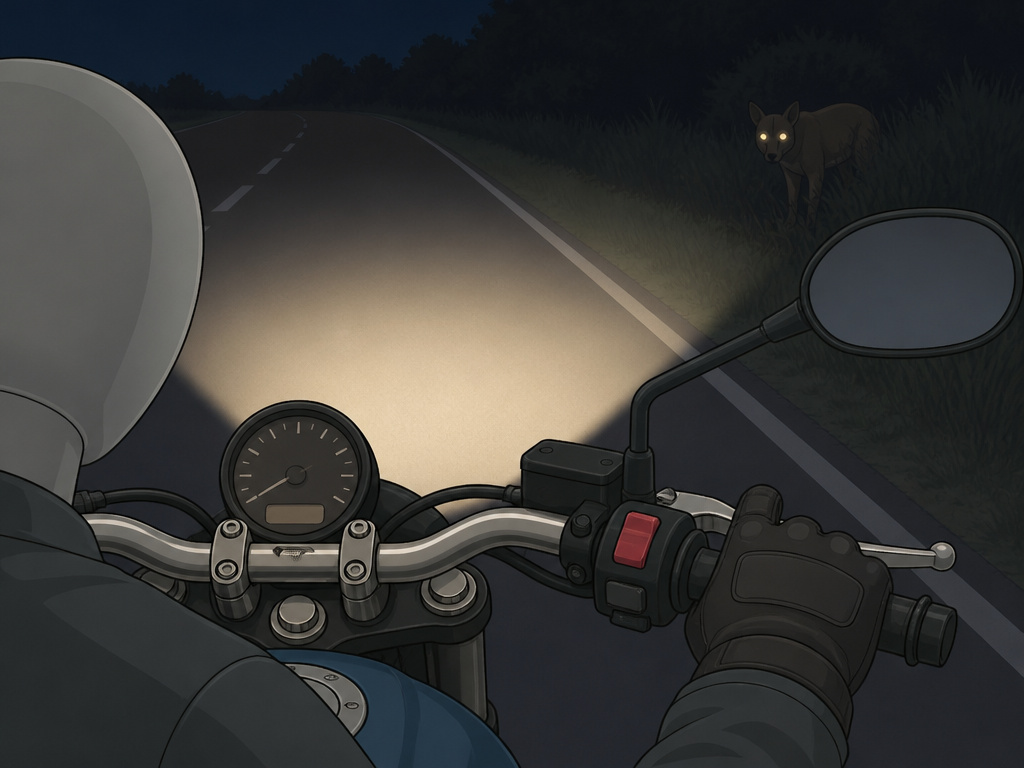
Darkness amplifies certain risks. Your strategy needs to shift for each one.
Animals: They are most active at dawn and dusk, but night rides through rural or wooded areas are high-risk. Use your high beam to sweep the shoulders. Look for the reflective glow of eyes; a pair of dots usually means a deer. If you see one, assume there are more. Slow down, cover your brakes, and be ready to swerve. Do not rely on the animal to move; they often freeze in the light. Our dedicated guide on how to avoid deer goes deeper into evasion techniques.
Road Surface Defects: Potholes, gravel patches, and tar strips disappear. Streetlights can create deceptive shadows that hide a crater. The best detection is your headlight’s angle. A shallow angle casts longer shadows, making imperfections more visible. If you can’t avoid a surprise hazard, straighten the bike, stand on the pegs to take weight off the seat, and roll over it. Do not brake or swerve abruptly mid-obstacle.
Intersections: This is the most common crash site at night. A car turning left across your path misjudges your speed and distance. To defend yourself, slow down as you approach any intersection with cross traffic. Change your lane position to put your headlight beam directly into the driver’s window. Cover your front brake. If you see a car’s wheels start to turn, be ready to stop or accelerate out of the way. The official Michigan Motorcycle Operator Manual and other state guides treat intersections with extreme caution for this reason.
Impaired Drivers: The NHTSA states alcohol consumption is a factor in fatal motorcycle accidents at a rate three times higher at night than during the day. Later hours mean more drivers leaving bars or parties. Be hyper-aware of vehicles weaving, drifting over lane lines, or driving inconsistently slow. Give them a wide berth and increase your following distance dramatically.
| Hazard | Night-Specific Risk | Defensive Action |
|---|---|---|
| Animals | Increased activity; eyes reflect light. | Use high beams, slow in active zones, watch for multiple animals. |
| Potholes/Gravel | Hidden in shadows or low light. | Use headlight angle to cast shadows, stand on pegs to absorb impact. |
| Intersections | Drivers misjudge motorcycle speed and distance. | Slow down, shift lane position to be seen, cover the front brake. |
| Impaired Drivers | Higher concentration on the road after dark. | Recognize signs of impairment (weaving), maximize distance, change route. |
Speed, Space, and Braking Technique
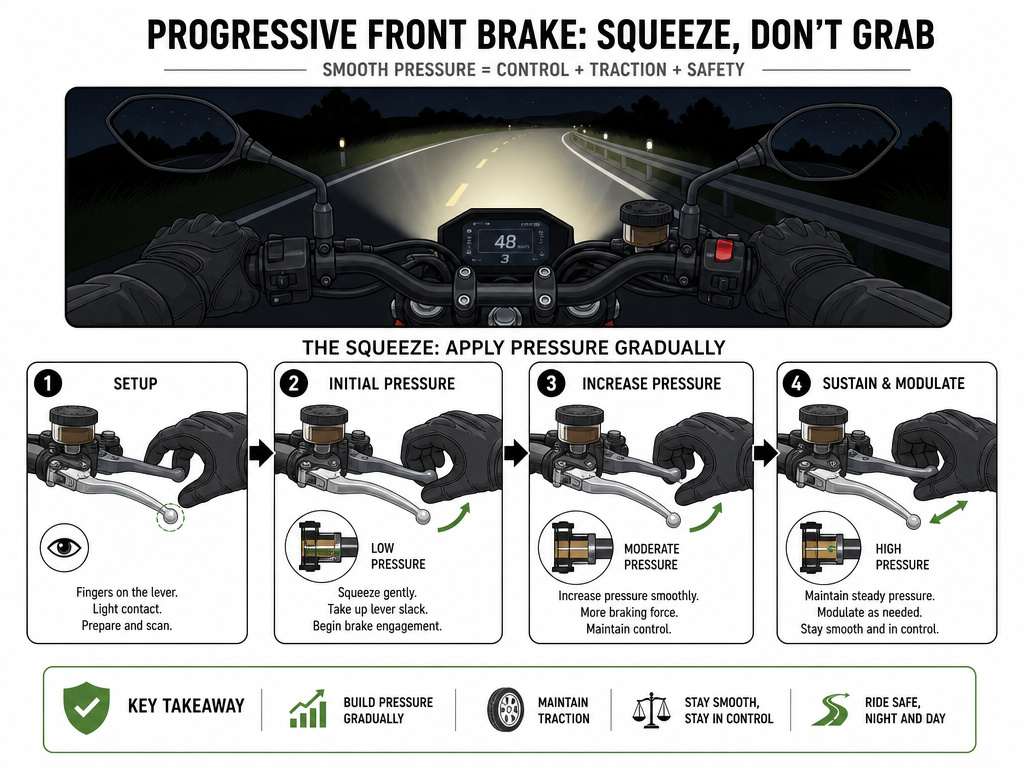
The commodity advice is “slow down and leave more space.” The useful version has numbers and a technique.
Speed: We covered the 12-second rule. Your maximum safe speed is dictated by your headlight’s reach on low beam. If you can’t see 12 seconds ahead, you are going too fast.
Following Distance: The standard 2-second following rule is a daytime minimum. At night, increase it significantly. Reduced depth perception makes it harder to judge how fast the car ahead is slowing. The extra time gives your brain a chance to process the brake lights as more than just pretty red dots.
Braking: In a controlled, straight-line stop on good pavement, a larger portion of your braking power comes from the front brake due to weight transfer. At night, with potentially unknown road surface conditions, you want to apply both brakes simultaneously but progressively. Squeeze, don’t grab. The goal is to load the suspension and tires before maximum braking force is applied. If you simply slam the front lever, the weight transfer hasn’t happened yet and the front tire can lock, leading to a crash you’ll never see coming.
Practicing this progressive squeeze in a parking lot builds the muscle memory so it happens automatically when a hazard appears in your headlight. The same smooth, controlled input is crucial for riding in rain or on slick roads, where traction is even more compromised.
Mental Preparedness and Legal Limits
Your mental state is as important as your bike’s state. Fatigue has a similar effect to alcohol, slowed reaction time, impaired judgment, and reduced coordination. A long night ride after a full day of work is a risk. If you feel yourself getting drowsy, fix it immediately. Stop, get off the bike, walk around, hydrate. Do not try to “push through.”
For new riders, there’s a legal layer. Check your local regulations. For example, Michigan’s Temporary Instruction Permit (TIP) explicitly prohibits nighttime operation, while other states like Missouri and North Carolina provide operational guidance for licensed riders without stating such a prohibition for learners. If you’re learning, get your daylight hours in first. The Missouri motorcycle operator manual and the NCDOT motorcyclist handbook provide the operational guidance for licensed riders, but always verify learner-specific rules with your own state’s DMV.
Staying mentally sharp is a skill. Techniques like verbalizing road hazards (“deer, right shoulder”) or planning escape routes for every block keep your brain engaged. This active riding alertness is the best defense against the monotony that can set in on a straight, dark highway.
How to clean and maintain your visor and lights for night riding
Use bright, clear lighting for your bike, ensuring your headlight and taillights function correctly and are clean. Before every ride, check headlights and taillights. Test your switch to make sure both high and low beams are working. Also check turn signals and the brake light. Make sure all lights are working properly. A clean visor is just as critical as clean lights. Bugs, grime, and smears on your visor will scatter light from oncoming traffic and streetlamps, drastically cutting your vision. Make cleaning your visor part of your pre-ride check, especially for night trips.
Cold weather and traction considerations for night riding
Nighttime riding demands heightened alertness. With reduced visibility, hazards such as potholes, animals crossing the road, and sudden bends become more perilous. Cold weather compounds these risks by affecting traction. Before mounting the motorcycle, check tires for air pressure, general wear and tread. Cold temperatures can lower tire pressure, reducing the contact patch. Road surfaces hold less heat at night, making them more susceptible to frost or being slick. Your margin for error shrinks, so smooth inputs on the throttle, brakes, and steering are essential. Be particularly vigilant in areas known for high animal activity.
Frequently Asked Questions
What should you do when riding a motorcycle at night?
Follow the 12-second rule to manage speed, manually ensure your low beam is on (especially in fog), increase following distance to 4 seconds, cover your front brake at intersections, and wear reflective materials. Assume you are invisible to every other driver and actively manage your lane position to maximize your visibility in their mirrors.
What is the 12 second rule on a motorcycle?
It’s a method to ensure you’re not overriding your headlight. Pick a landmark at the farthest edge of your headlight’s beam and count the seconds until you pass it. If it takes less than 12 seconds, you are traveling too fast to identify and react to an obstacle within your illuminated field of view. It builds a critical buffer for perception and reaction time.
Is it harder to ride a motorcycle at night?
Yes, significantly. Visibility is reduced for seeing hazards and for being seen by others. Depth perception and contrast are worse, making it harder to judge distances and speeds. Hazards like animals and impaired drivers are more prevalent. It requires more mental focus, slower speeds, and greater following distances than daytime riding.
What is the 70/30 brake rule for motorcycles?
It refers to the approximate braking force distribution between the front (70%) and rear (30%) brakes during a maximum, controlled stop on good pavement. The front brake provides most of the stopping power because weight transfers forward during deceleration, loading the front tire. At night, the technique emphasizes progressive, simultaneous application of both brakes to maintain control on potentially unknown road surfaces.
The Bottom Line
Night riding strips away your visual safety net. The rules that keep you safe are about managing the gaps, the gap between what you can see and where you can stop, the gap between being lit and being seen, the gap between a driver’s glance and their recognition.
One threshold decides it: if you cannot confidently identify and react to an obstacle within the cone of your headlight, you are going too fast. Everything else, the reflective tape, the intersection strategy, the 4-second gap, supports that core limit.
The Ducati manual’s warning about manual lights in fog is the perfect metaphor. Don’t trust the automation. Trust your own judgment. Flip the switch, add the second, cover the brake. The night doesn’t forgive assumptions.
