
Motorcycle Group Ride Pre Ride Briefing Checklist
This post contains affiliate links. As an Amazon Associate, we earn from qualifying purchases.
A motorcycle group ride pre ride briefing checklist is a 12-point script covering route, roles, formation, hand signals, and safety protocols. It must be delivered 10–30 minutes before departure, as per sources like CVMA Chapter 27-2 (10-15 minutes) and Winchester H.O.G. Chapter (15-30 minutes). The briefing ensures every rider knows the plan, their position, and how to communicate, turning a collection of bikes into a coordinated, safe group.
That timeline isn’t arbitrary. A briefing held five minutes before kickstands up gets rushed. Riders miss details, questions go unasked, and the formation starts messy. Sources like CVMA Chapter 27-2 recommend at least 10-15 minutes, while Winchester H.O.G. Chapter recommends 15-30 minutes.
What follows is the consolidated motorcycle group ride pre ride briefing checklist, pulled directly from published standards like the CVMA group riding standard operating procedure and the IAM RoadSmart group rides manual. It covers the non-negotiables every ride captain needs to vocalize, plus the gear and prep that happens before anyone says a word.
Key Takeaways
- Start the briefing 10–30 minutes before departure to allow time for questions and signal practice.
- Assign a competent sweep rider equipped with a cell phone, first-aid kit, and full tool kit — this is mandatory per CVMA protocols.
- Enforce the T-CLOCS inspection (Tires, Controls, Lights, Oil, Chassis, Stands) before riders leave home.
- Relay all hand signals back through the formation so the sweep rider sees them.
- Place less experienced riders near the front to minimize the dangerous rubber-band effect.
Before the Briefing: The Ride Leader’s Pack
The briefing starts before you open your mouth. It starts with what you bring and what you verify.
At least one rider in each group must pack a cell phone, first-aid kit, and full tool kit. The CVMA Chapter MS 44-1 SOP states this is required gear for the Tail Gunner. Don’t assume someone has it — confirm it. If you’re leading, your kit should include these items plus a printed route sheet, a sign-in list if it’s a formal event, and knowledge of the nearest hospitals along the route.
Every rider is responsible for their machine. That means showing up with a full gas tank and having conducted a pre-ride inspection. A widely recommended standard is the T-CLOCS checklist: Tires, Controls, Lights, Oil, Chassis, and Stands. The CVMA Chapter 27-2 manual gives a specific tolerance: tires must have more than 1/16 inch of tread — about the distance from the top of Lincoln’s head to the edge of a penny.
Worth knowing before you start: If your ride includes a Department of Defense installation, the pre-ride brief must review DOD Personal Protective Equipment (PPE) requirements. This isn’t a suggestion in the CVMA SOP; it’s a stipulated add-on for base access.
Arrive early to allow time for checks and the briefing. This time allows you to check bikes, greet new faces, and spot potential issues before the formal brief.
The 12-Point Pre-Ride Briefing Script
This is the core of the motorcycle group ride pre ride briefing checklist. Deliver it clearly, facing the group, and ask for questions after each major point. The IAM RoadSmart manual emphasizes that the briefing is a dialogue, not a lecture.
1. Route & Destination. State the destination, major highways, and any tricky turns. Announce the location of the first fuel or rest stop. For ride segment duration, sources offer different guidance: IAM RoadSmart advises not exceeding 90 minutes, while American Legion Riders (Escondido) advises being prepared to ride for at least one hour before stopping.
2. Ride Pace & Philosophy. Set the expected speed. Then state the iron rule: “Ride your own ride.” The American Legion Riders handbook advises riders to ride within their limits. Trying to keep up is how people crash.
3. Lead & Sweep Roles. Point out the Road Captain (you) and the designated Tail Gunner. Explain that the sweep rider will not overtake within the group and is the primary responder for breakdowns.
4. Group Formation. Explain you’ll ride in a staggered formation under normal conditions. Detail the positions: leader in the left third of the lane, second bike in the right third, and so on.
5. Following Distance. This is where sources differ. The Winchester H.O.G. Manual states to maintain a one-second spacing behind the motorcycle in the opposite third of the lane. The CVMA Chapter 27-2 SOP says to follow the bike directly in front by a minimum of two seconds, which creates a one-second diagonal gap. Pick one rule for your group and state it plainly.
6. Hand Signals. Review essential hand signals such as those for turns, slowing/stopping, and pointing out hazards. Demonstrate them. Emphasize that every signal must be relayed by each rider back to the sweep.
7. Lane Changes & Obstacles. Explain that the lead rider will initiate lane changes, and the sweep will clear them. For road debris, the spotter points at the hazard, and every following rider must repeat the signal.
8. Single-File Procedure. State when you’ll switch to single file: curvy roads, poor visibility, bad pavement, or construction zones. The CVMA Chapter 27-2 notes that a 2-second spaced single-file formation is preferred in these conditions.
9. Stopping at Lights/Signs. Explain that at a red light, the group will pull up side-by-side to compact the formation. You’ll resume stagger when the light turns green.
10. Breakdown & Separation Protocol. What happens if a bike fails? The rider should safely pull over. The sweep rider stops with them. The rest of the group continues to the next pre-planned stop to wait.
11. Planned Departures. Ask: “Does anyone plan to peel off before the final destination?” If so, they must inform the lead or sweep rider. The IAM RoadSmart manual states a rider leaving should let all others pass and then tell the tail-end rider.
12. Zero Tolerance Rules. State these clearly:
- No alcohol or impairing substances until the ride is officially concluded by the Road Captain.
- Policies on blocking traffic differ: The American Legion Riders (Escondido) states never to block traffic, while CVMA Chapter MS 44-1 acknowledges it is technically illegal but may be used in extraordinary, pre-briefed circumstances.
- New riders are not expected to block.
The technical snippet: A formal pre-ride briefing consolidates logistics and safety protocols into a shared mental model for all riders. It covers route navigation, formation discipline (staggered or single-file), communication standards (hand signal relay), and contingency planning for mechanical failure or separation. This transforms independent operators into a coordinated unit with defined roles, spacing rules, and emergency procedures.
Formation & Spacing: The Rules That Change
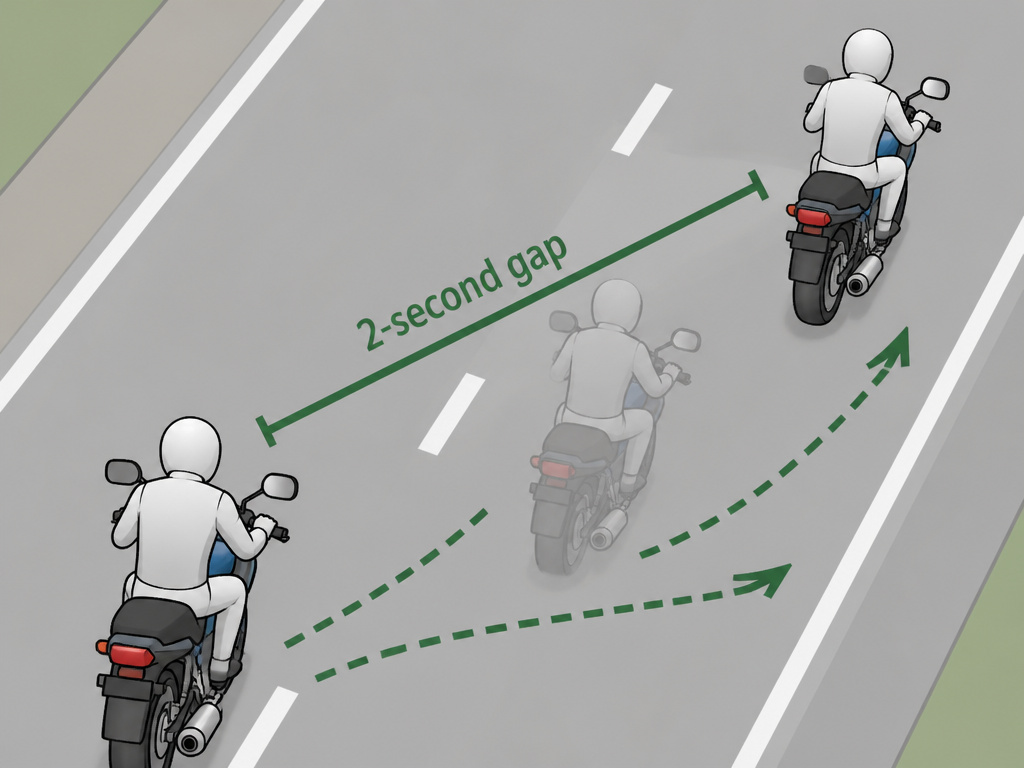
Formation isn’t static. It’s a tool you change for the road. Getting this wrong is how groups get stretched out or bunched up.
Staggered is the default for straight, open roads. This formation allows the group to occupy one lane while giving each rider an escape path to the left or right. The critical point is maintaining the gap. In a staggered formation, you follow the bike directly in front of you in your lane, not the bike diagonally ahead.
| Formation Type | When To Use | Following Distance | Key Risk If Misused |
|---|---|---|---|
| Staggered | Straight roads, good visibility, dry pavement. | 2-second minimum to bike directly ahead (CVMA 27-2). | Riders focus on the diagonal bike, drift into the center lane, and remove their escape path. |
| Single-File | Curves, poor visibility, rough roads, construction zones. | 2-second minimum to bike directly ahead. | Group stays in staggered out of habit, reducing each rider’s line choice and reaction space in a corner. |
The switch isn’t optional on twisty roads. Single-file gives every rider the full lane to choose their line through a corner. When you come to a stop in single-file, the CVMA 27-2 SOP says you may stop side-by-side, but you must resume single-file when moving.
Where do trikes and sidecars go? Both the Winchester H.O.G. Manual and the CVMA MS 44-1 SOP agree: they ride at the rear of the group, ahead of the Tail Gunner. Their different handling and width can disrupt the standard stagger rhythm.
Hand Signals & Communication: The Relayed Lifeline
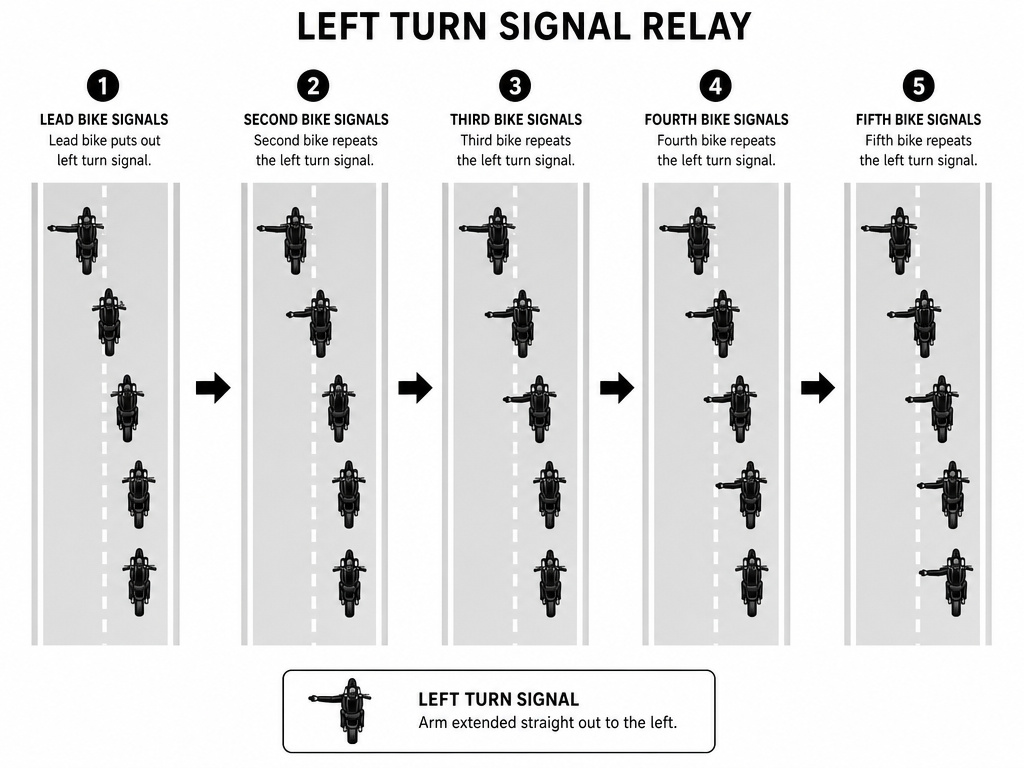
Hand signals are your low-tech, fail-safe comms. Your Bluetooth headset can die. Hand signals don’t.
The short list is what you need. Left arm straight out for left turn. Left arm up at 90 degrees for right turn. Left arm angled down with palm facing back for slow/stop. Left foot pointing down at a hazard on the road. These are universal.
The rule that matters is the relay. When the lead rider signals, the second rider repeats it, then the third, all the way back to the sweep. This ensures everyone gets the message. The American Legion Riders handbook emphasizes that all signals from the Road Captain should be relayed back through the group.
Where this goes sideways: Riders get lazy and stop relaying signals after the first hour. The formation stretches, the sweep rider misses a turn signal, and the group gets split at an intersection. Drill the relay in the briefing.
For lane changes, the lead initiates, and the sweep clears the lane. The sweep rider helps clear lane changes for the group. This prevents a car from darting into the middle of your formation.
Contingency Planning: When Things Go Wrong
A good briefing plans for the ideal ride. A great briefing plans for the breakdown, the wrong turn, and the sudden storm.
Breakdowns: The protocol is simple. The rider with the issue safely pulls over. The sweep rider stops with them. The rest of the group continues to the next pre-arranged stop to wait. The CVMA MS 44-1 SOP adds a layer: if the designated Tail Gunner stops, the last rider in the group must assume Tail Gunner duties.
Getting Lost/Separated: If you miss a turn or get separated by a light, don’t panic. Do not speed to catch up. Proceed safely to the next known stop on the route. The entire group will regroup there. This is why announcing the location of the first fuel or rest stop is important.
Rider Fatigue or Skill Issue: A rider who feels in over their head should signal for others to pass and pull over safely. The IAM RoadSmart manual states a rider feeling incapable should pull over safely and wait for the tail-end rider.
The Return Ride & Alcohol: This is a firm line. The generic Lead Rider Briefing document states no alcohol until the Road Captain declares the ride over. The Santa Maria H.O.G. Chapter adds a specific policy: the Lead Rider may designate a ride termination point (e.g., the final restaurant). After that point, riders may consume alcohol but are asked not to ride back with those who haven’t. This formally splits the group post-ride.
Group Composition & Rider Placement
Who rides where isn’t about ego. It’s about safety and group cohesion.
Less experienced riders should ride near the front, right behind the Road Captain. The American Legion Riders handbook recommends this to minimize the “rubber band effect,” where gaps exponentially grow and shrink through the pack, forcing newer riders to constantly accelerate and brake hard.
More experienced riders go toward the back. They can manage larger speed variations and are better equipped to handle a sudden problem from the rear.
How big should a group be? The CVMA Chapter 27-2 SOP states groups will typically contain 8-10 motorcycles.
| Rider Position | Best For | Reason | Common Mistake |
|---|---|---|---|
| #2 & #3 (Directly behind Lead) | Newer/less confident riders. | Closest to the pace-setter, minimal rubber-band effect. | Putting fast riders here who then feel held back and ride the leader’s bumper. |
| Middle of Pack | Average experienced riders. | Stable environment, can focus on formation and signals. | Becoming complacent and ignoring signal relay. |
| Last 3 positions, ahead of Sweep | Most experienced, patient riders. | Can manage larger gaps, monitor the whole group, assist if needed. | Using the position to socialize and not watching for sweep rider signals. |
Frequently Asked Questions
What is the 2-second rule in group riding?
The 2-second rule is the minimum recommended following distance from the motorcycle directly in front of you in your lane. You pick a stationary object the rider ahead passes, then count “one-thousand-one, one-thousand-two.” If you pass the object before finishing, you’re too close. This gap provides time to react to hazards or sudden braking.
What hand signals are absolutely necessary for a group ride?
The five necessary signals are left turn (arm straight left), right turn (arm up, elbow bent), slow/stop (arm down, palm back), hazard left (left foot point left), and hazard right (left foot point right). The “relay” of each signal back through the pack is as important as the signals themselves.
Who should be the sweep rider/Tail Gunner?
The sweep should be an experienced, patient rider with a mechanically sound bike. They must carry a cell phone, first-aid kit, and basic tools, as required by CVMA standards. They are the last bike, help clear lane changes, and are the primary responder for any rider who stops.
Can trikes ride in a normal motorcycle group formation?
Yes, but with a specific placement. Both H.O.G. And CVMA protocols state trikes and sidecar rigs should ride at the rear of the group, ahead of the Tail Gunner. Their different handling and width can disrupt the standard stagger, so placing them at the back minimizes this effect.
What if I need to leave the group ride early?
You must inform the Road Captain or sweep rider of your intent, preferably at the briefing. When you’re ready to leave, safely let all riders in your group pass you, then signal to the sweep rider as you peel off. Do not suddenly dart out of formation without warning.
The Bottom Line
Print this 12-point script or save it on your phone. Go through it, verbatim, before your next group ride. Deliver the briefing clearly and allow time for questions. A thorough briefing helps address common group ride problems such as unclear routes, unrelayed signals, and lack of a breakdown plan.
The one rule to enforce above all? Ride your own ride. No hand signal, no formation, no briefing can override a rider’s personal responsibility for their safety and control. Your job as leader is to give them the plan and the permission to ride within it, not beyond it. Everything else is just details on a checklist.
