
How to Ride a Motorcycle in the Rain: Step-by-Step Safety
This post contains affiliate links. As an Amazon Associate, we earn from qualifying purchases.
Riding a motorcycle in the rain safely requires three adjustments: smoother throttle and brake control, a deliberate lane position for visibility, and a maintenance routine that accounts for moisture. Modern street tires can provide up to three-quarters of their dry traction in the wet, but that grip plummets over painted lines, metal grates, and in the greasy film of a storm’s early stages.
That traction figure isn’t a license to push. It’s the ceiling your technique needs to work under. The difference between a controlled ride and a panic slide often comes down to the small, specific procedures buried in your owner’s manual that most riders never read, which is why it’s crucial to know how to ride a motorcycle in the rain.
What follows is the street-level technique that works for how to ride a motorcycle in the rain, the manufacturer-specific settings you should use, and the post-ride checklist that prevents moisture from costing you hundreds in repairs. This isn’t about avoiding rain. It’s about riding through it.
Key Takeaways
- Smooth is fast in the wet. Abrupt throttle, brake, or steering inputs break traction. Modern tires offer solid wet grip, but only if you load them gradually.
- Position for sight lines. Favor the left third of your lane to see and be seen by oncoming traffic, using the outside-inside-middle line through curves to maximize your view.
- Service intervals shorten. The Honda scooter manual specifies servicing the crankcase breather more frequently when riding in rain, a concrete example of wet-weather maintenance most guides miss.
- Use your bike’s tech. Indian Challenger, Pursuit, Chieftain PowerPlus, and Roadmaster PowerPlus models have a selectable Rain ride mode that decreases throttle response to maintain control; it’s there for a reason.
- Dry your brakes and bike. After riding in rain, apply the brakes at low speed to dry them, and if you use a full cover, remove it to let the motorcycle air out.
Your Gear: The Leak-Proof Layer
Fit first, features second. A waterproof jacket that flaps like a sail or gloves that leak at the cuff are worse than useless; they’re distracting. The goal isn’t to stay perfectly dry for four hours, that’s nearly impossible, but to stay dry enough that cold and wet don’t wreck your concentration.
Start with a helmet that has a solid seal. I once skipped checking my visor seal before a rain ride. Water crept in around the edge and I rode with a blurry view for about twenty minutes. It was a stupid, avoidable risk. Now, as part of my pre-ride, I press around the visor’s perimeter to feel for a consistent seal. A pinched or worn seal is a direct line for water to drip onto your nose or fog the inside.
Your jacket and pants need to be truly waterproof, not just resistant. Look for seams that are taped or welded shut, not just stitched. Zippers should have storm flaps behind them. This is one area where the waterproof vs water-resistant distinction is non-negotiable. Water-resistant fabric will soak through in a sustained downpour; waterproof fabric, backed by proper construction, won’t.
Common mistake: Relying on a water-resistant shell in heavy rain. In a sustained downpour, moisture wicks through the seams and layers, chilling you to the point where shivering becomes a control issue.
Boots and gloves are the usual failure points. Short boots let water run down your pants and straight into the top. Gauntlet-style gloves and boots that go over your gear, not under it, create a shingled effect that sheds water down and away. For a deep dive on specific kit, our roundup of best motorcycle rain gear breaks down what actually holds up.
Your Bike’s Wet-Weather Tech
Modern motorcycles have electronics designed to help. Ignoring them is leaving a tool in the box. If your bike has selectable riding modes, the Rain mode is your first adjustment.
On Indian Challenger, Pursuit, Chieftain PowerPlus, and Roadmaster PowerPlus models, the ‘Rain’ ride mode is explicitly labeled as “ideal for rainy conditions.” It works by decreasing throttle response to “maintain control and traction.” This isn’t a gimmick. It electronically enforces the smoothness you should be practicing, making it harder to accidentally whack the throttle open mid-corner.
Other electronic aids like traction control and ABS are not rain-specific, but their value multiplies on wet pavement. Leave them on. The goal is to avoid triggering them, but they are a critical safety net if you misjudge available grip or need to brake hard over a slick surface.
There’s also a hidden thermal setting some riders forget. On those same Indian PowerPlus models, the Rear Cylinder Deactivation system, which shuts off the rear cylinder at idle to reduce heat, only activates when the ambient temperature exceeds 59 °F (15 °C), engine speed is below 1000 RPM, and the throttle is closed. In cooler rain, the system may not engage, meaning your engine and exhaust will run hotter at stops. It’s a small thing, but knowing it explains why your bike feels different on a 50-degree rainy day versus a 70-degree dry one.
For a complete breakdown, see our guide on motorcycle riding modes.
The Riding Technique: Smoothness and Space
This is where commodity advice on how to ride a motorcycle in the rain stops and real technique begins. Yes, you need to be smooth. But smoothness isn’t a feeling; it’s a mechanical rule. Traction in the wet is a budget, and every input spends from it.
The throttle isn’t an on/off switch. Roll on and off as if you’re stretching a rubber band. The brakes are a progressive squeeze, never a grab. The front brake provides the majority of your stopping power, but adding more rear brake than usual in the wet helps stabilize the chassis. If you need a refresher, our primer on how to brake on a motorcycle covers the fundamentals that are doubly important on wet roads.
Your lane position is your lifeline. The RevZilla expert commentary advises riders to “favor the left portion of the lane to see and be seen by oncoming traffic.” This does two things: it moves you away from the center strip where oil and coolant accumulate, and it puts you in the sightline of drivers who might be turning left across your path. In curves, use the outside-inside-middle line. This path, hugging the outside early, turning in late, and exiting wide, maximizes how far ahead you can see and gives you a safety cushion if you need to tighten your line.
Where this goes sideways: Riding in the blind spot of the car ahead or beside you. In the rain, with windows fogged and wipers going, drivers are even less likely to see you. If you can’t see the driver’s face in their side mirror, they can’t see you.
Increase your following distance substantially. This gives you time to see hazards like puddles (which can hide potholes) and react without emergency braking. It also keeps the rooster tail of spray from the vehicle ahead from blinding you.
Vision and Visibility: Seeing and Being Seen
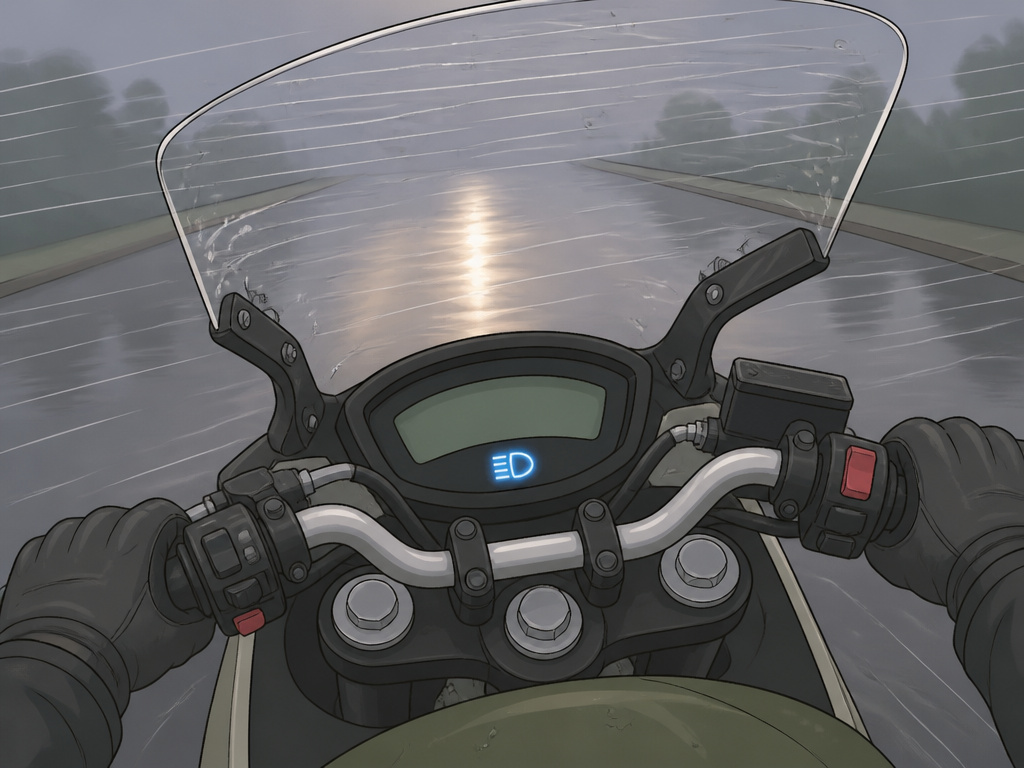
You can’t react to what you can’t see. Rain cuts contrast and turns windshields into mirrors. Your job is to maximize both your sight and your signal to others.
First, keep your visor clear. Even the best pinlock insert can fog at the edges if the seal is compromised. Crack your face shield open one notch to create a constant airflow. If you start to fog, turning your head slightly to either side can channel air across the inside of the shield. For a dedicated solution, our article on how to stop visor fogging has the proven methods.
Second, run your lights. In daytime rain, use your low beam. It makes your single headlight look more like a car’s, helping oncoming drivers judge distance and speed. If you have running lights or fog lights, use them. The goal is to create a “light signature” that stands out from the grey backdrop.
Conspicuity isn’t just about lights; it’s about placement. That left-side lane position we talked about also puts you where oncoming drivers are naturally looking. Avoid hiding behind pillars or in the blind spots of larger vehicles. In heavy spray, dropping back from the car ahead so you can see past it is more important than maintaining a specific speed.
For more tactics on making yourself seen, the principles in our guide on how to be more visible are built for conditions like this.
Road Hazards: The First 30 Minutes are the Worst
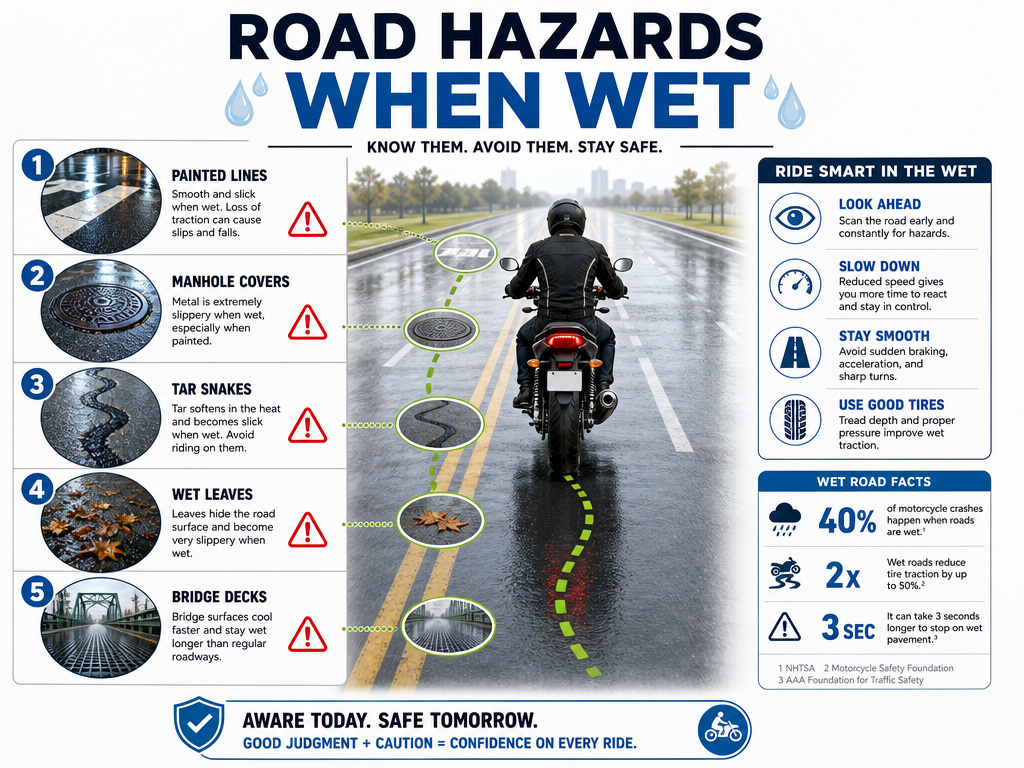
The most dangerous time to ride isn’t during a torrential downpour, but in the first half-hour after rain begins. A dry road accumulates a film of oil, rubber, and coolant. When the rain starts, it mixes with this grime to create a greasy, slick coating. As the RevZilla commentary notes, “the early stages of a rainstorm are particularly hazardous.”
You need to identify and avoid specific traps:
- Painted Lines & Crosswalks: These become like ice. Avoid braking, accelerating, or leaning on them.
- Manhole Covers & Metal Grates: Steel plates and drainage covers offer almost zero traction when wet. Cross them as upright as possible.
- Tar Snakes & Patchwork: Those black, tar-based road repairs get slick and soft.
- Leaf Litter & Mud: Watch for runoff from driveways or construction sites that washes debris into the lane.
- Bridge Decks & Overpasses: These freeze first and often retain moisture, staying slicker longer than regular road surfaces.
Hydroplaning is a real risk if you ride through standing water, especially on worn tires. If you must cross a puddle, hold a steady throttle, keep the bike upright, and avoid any steering or braking inputs until you’re back on damp asphalt.
Post-Ride: The 20-Minute Dry-Down
Start with your gear. Hang your jacket and pants somewhere with airflow, not crumpled in a bag. Remove the liners if possible. For gloves, stuff them with newspaper to wick moisture from the inside. Detailed steps are in our guide on how to dry gear after a wet ride.
Your bike needs attention, too. The Honda manual gives a specific warning for bikes stored outdoors with a full cover: “After rain, remove the body cover and allow the vehicle to dry.” Trapping wet air under a cover is a recipe for mildew and rust on seats, controls, and chrome.
Two critical mechanical checks are temperature-sensitive. The Indian manual is explicit: the drive belt system must be “cool, clean and dry to accurately measure belt tension.” Do not measure it “when the belt or drive system is wet or when it is hot (such as immediately after riding).” Similarly, when adjusting rear shock air pressure, you must “use only a dry air source… To prevent moisture from entering the shock.”
Finally, dry your brakes. The procedure from the Honda manual is simple and effective: “If the brakes get wet, apply the brakes while riding at low speed to help them dry.” A few gentle applications on a quiet street will restore normal braking feel.
How to prevent hydroplaning on a motorcycle
Hydroplaning occurs when your tires ride on a film of water, losing contact with the road. Modern street tires can provide a significant amount of traction in the wet, but they still have less grip than on dry pavement. The early stages of a rainstorm are especially hazardous as oil and road grime mix with water to create a slick surface. To maintain control, use smooth throttle and brake inputs. Some motorcycles offer a selectable ‘Rain’ ride mode that decreases throttle response to help maintain traction. Avoid sudden maneuvers, standing water, and painted road markings.
When to pull over in heavy rain
Heavy rain can drastically reduce visibility and road traction, requiring you to react accordingly. If the downpour becomes too intense to see clearly or you feel your control is compromised, find a safe place to pull over. Look for a designated rest area, parking lot, or a wide shoulder that is well off the travel lanes. Avoid stopping under bridges or in areas where you could be a hazard to other drivers or where visibility is poor. Wait until the rain lightens to a manageable level before continuing your journey. This pause allows the worst of the road grime to wash away, improving conditions.
Frequently Asked Questions
How difficult is it to ride a motorcycle in the rain?
It’s more demanding than dry riding, but not inherently difficult with the right approach. The primary challenges are reduced traction and visibility. By smoothing your inputs, increasing space, and wearing proper gear, you manage those risks. The mental hurdle, the anxiety, is often bigger than the physical one.
What do motorcycle riders do when it rains?
Riders who choose to continue slow down, increase following distance, and turn on their lights. They avoid sudden maneuvers and specific road hazards like painted lines. Many will use a dedicated rain riding mode if their bike has one. The unprepared seek shelter; the prepared adjust their technique and ride on.
What is the 12 second rule on a motorcycle?
It’s a visual lead-time rule. In good conditions, you should scan the road 12 seconds ahead of your current position. In the rain, extending that to 15 or more seconds gives you extra time to identify hazards like puddles, debris, or changing traffic patterns, allowing for smoother, earlier reactions.
How do you stay dry while riding a motorcycle in the rain?
Complete dryness on a long ride is a tough goal. The practical method is to use gear with taped seams and storm flaps (true waterproof gear), ensure boots and gloves have sealed closures that go over your other layers, and use a helmet with a well-sealed visor and pinlock. For a full battle plan, our tips on how to stay dry cover the details.
Before You Go
Rain riding boils down to a shift in mindset: from active control to managed finesse. Your tires have more grip than you think, but your margin for error is thinner. Trust the technology on your bike, the Rain mode, the ABS, but trust your smooth inputs more.
The one habit that changes outcomes is the post-ride ritual. The twenty minutes you spend wiping down the bike, airing out your gear, and giving the brakes a gentle dry run prevent a hundred small corrosions. It turns a wet ride from a damaging event into just another ride.
And if the rain turns torrential, the wind picks up, or your gut says it’s too much, there’s no trophy for pressing on. Pulling over is a valid technique. Sometimes, the smartest move is to wait it out, which is a strategy that also applies to riding in strong wind. The road will be there when the storm passes.
