
Open Face Motorcycle Helmet Pros and Cons: How to Choose
This post contains affiliate links. As an Amazon Associate, we earn from qualifying purchases.
An open face motorcycle helmet offers superior ventilation, visibility, and a classic style, but trades away critical facial and chin protection that is statistically the most likely area to hit the ground in a crash. The 2017 simulation study found a full-face helmet absorbed impact at 197 G, an open-face at 235 G, and a half-helmet at 303 G, all under the DOT limit of 400 G, but passing a lab test does not cover your jaw.
That gap between lab numbers and real-world coverage is the whole decision. The standards measure acceleration on a headform, not the odds of a chin-first slide. Your choice comes down to matching the helmet’s exposure to your actual riding: low-speed city cruising in good weather can justify the trade, but highway miles or varied conditions demand a chin bar. Considering the open face motorcycle helmet pros and cons is essential for this risk assessment.
What follows is a breakdown of the data, the feel, and the specific models that make the open-face compromise work, or fail, based on the open face motorcycle helmet pros and cons. We’ll cover the safety numbers you haven’t seen, the maintenance rules manuals insist on, and the one certification that tries to bridge the gap.
Key Takeaways
- The chin bar area hits the ground in 19.4% of crashes, a risk no open-face helmet can mitigate, regardless of its impact-test score.
- For legal highway use with an open-face experience, look for a modular helmet with P/J homologation (like the LS2 Advant X), certified for riding with the chin bar open or closed.
- Follow the manufacturer’s replacement guidelines: replace your helmet immediately after any impact, even if you see no damage.
- Never use petroleum-based solvents on the helmet shell or visor; they degrade the plastic’s optical clarity and structural strength within a few cleanings.
- A proper fit is essential; your skin should move with the liner when you gently twist the helmet, a loose fit ejects on first impact.
The Protection Gap: What Standards Say vs. Real-World Risk
The numbers from a 2017 finite element analysis study are clear. In a simulated impact, a full-face helmet peaked at 197 G, an open-face design at 235 G, and a half-helmet at 303 G. All three results are under the major safety limits: ECE 22.06’s 275 G, Snell’s 300 G, and the U.S. DOT’s 400 G threshold.
A simulated open-face helmet recorded a peak acceleration of 235 G, which meets the ECE 22.06 (275 G), Snell (300 G), and DOT FMVSS No. 218 (400 G) impact acceleration standards. This is laboratory data on a standardized headform.
Those results tell you the helmet’s energy absorption works where the polystyrene liner is. They do not tell you what happens to the 35% of your head that is completely exposed. The HJC IS-CRUISER manual includes a blunt warning other brands often soften: “This helmet does not provide as much coverage or protection as a full face helmet.”
The disconnect is between passing a standardized test and surviving a multi-angle crash. Your face and chin are not on the test headform.
| Impact Concern | What the Standard Tests | What an Open-Face Leaves Out |
|---|---|---|
| Linear Acceleration | Measured on crown of headform. Open-face can pass (235 G). | Jaw, cheeks, and chin experience direct, unmanaged impact. |
| Facial Abrasion | Not tested by DOT, ECE, or Snell. | Concrete, asphalt, or debris grinds directly against skin and bone. |
| Chin Bar Impact | Not applicable—no chin bar to test. | 19.4% of crashes involve the chin bar area (per Icon Airframe stats). |
| Helmet Ejection | Tests strap retention under vertical load. | Open-face design is more susceptible to rolling off in oblique strikes. |
I learned this the hard way reviewing a popular retro-style open-face helmet. On paper, its DOT certification checked the box. On a tight, gravel-strewn backroad, a sudden crosswind combined with a pothole jolt made my head twist violently. The helmet stayed on, but the sensation of my exposed jaw whipping past a guardrail post was a visceral, one-second education. The helmet passed the test. My face would not have passed the guardrail.
That is the trade you are making. The certification says it can absorb a hit where it covers you. It says nothing about the hits that land where it doesn’t.
Pros: Where Open-Face Helmets Shine
For specific types of riding, the open-face’s advantages are not just about style, they directly improve the experience, which is central to the open face motorcycle helmet pros and cons. The benefits are physical and practical.
Unmatched Airflow and Sensory Connection. Your face is in the wind. This cools you dramatically in stop-and-go city traffic or on a slow, scenic cruise. You can drink without removing the helmet, communicate easily with a passenger at a red light, and even fill up at gas stations that typically require helmet removal. The sensory feedback is direct; you feel the temperature change, smell the rain before it hits, and have a wider, less obstructed peripheral view. There is no visor to fog, ever.
Lighter Weight and Reduced Fatigue. By removing the chin bar, visor mechanism, and associated structure, open-face helmets shed weight. The LS2 Advant X weighs about 1,550 g, while a typical full-face can easily exceed 1,700 g. Over a six-hour riding day, that difference translates to less neck strain. The classic Bell Custom 500 comes in around 1,890 g, but its low, compact profile feels lighter than a bulky full-face.
Classic Style and Customization. The open-face silhouette is iconic. It pairs with a bubble shield, a flat peak, or a pair of dedicated motorcycle goggles. This modularity allows you to adjust the look and wind protection for your ride, something a sealed full-face cannot match. For riders on vintage or cruiser bikes, this aesthetic is a core part of the machine’s character.
Where this goes sideways: Assuming the airflow is always a benefit. At highway speeds, that same wind becomes a battering, deafening roar that fatigues you faster than a heavier, quieter helmet.
If your riding is purely urban, under 50 mph, and in fair weather, these pros can outweigh the cons. The moment you add speed, distance, or weather, the equation flips.
Cons: The Unavoidable Downsides
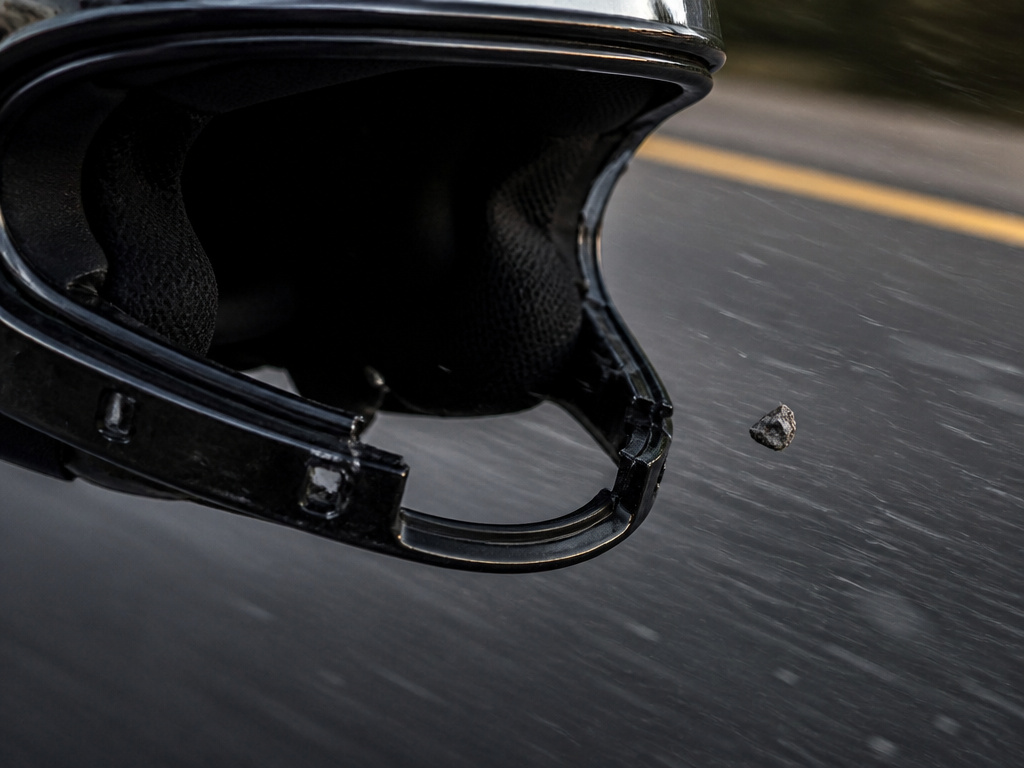
The disadvantages of an open-face helmet are not flaws in design; they are inherent to the concept. You cannot add protection where the helmet does not exist.
No Facial or Chin Protection. This is the unavoidable con. In a crash, your jaw, teeth, and cheekbones are unprotected. Road rash on the face is severe and disfiguring. Impact to the chin can cause catastrophic mandible fractures. As the data from the Icon Airframe shell shows, this area is struck in nearly one out of five accidents. You must pair an open-face helmet with eye protection, motorcycle goggles or glasses, which introduces its own set of issues with fogging, fit, and wind intrusion.
Increased Exposure to Elements and Debris. Rain feels like needles. Cold air numbs your face within minutes. Bugs, road dust, and kicked-up gravel become direct hazards. Even a bright sunny day requires a full application of sunscreen to prevent windburn. This constant environmental management adds cognitive load that distracts from riding.
Higher Noise Levels and Potential for Hearing Damage. Without a chin bar and sealed visor to manage airflow, wind turbulence around an open face is significant. Noise levels are significantly higher than with full-face helmets, which can cause permanent hearing damage on long rides. You will need earplugs, which then further isolate you from traffic sounds.
Limited Certification and Rating Options. According to Visor & Vent, no open-face helmet currently carries a Snell certification for public road use, although a 2017 simulation study applied the Snell impact threshold to an open-face design. The SHARP safety rating program in the UK does not test or rate open-face helmets at all. Your choices are typically between DOT and ECE 22.05 or 22.06. This limits your ability to compare protective performance using the most stringent independent benchmarks.
The P/J Homologation: A Smarter Compromise?
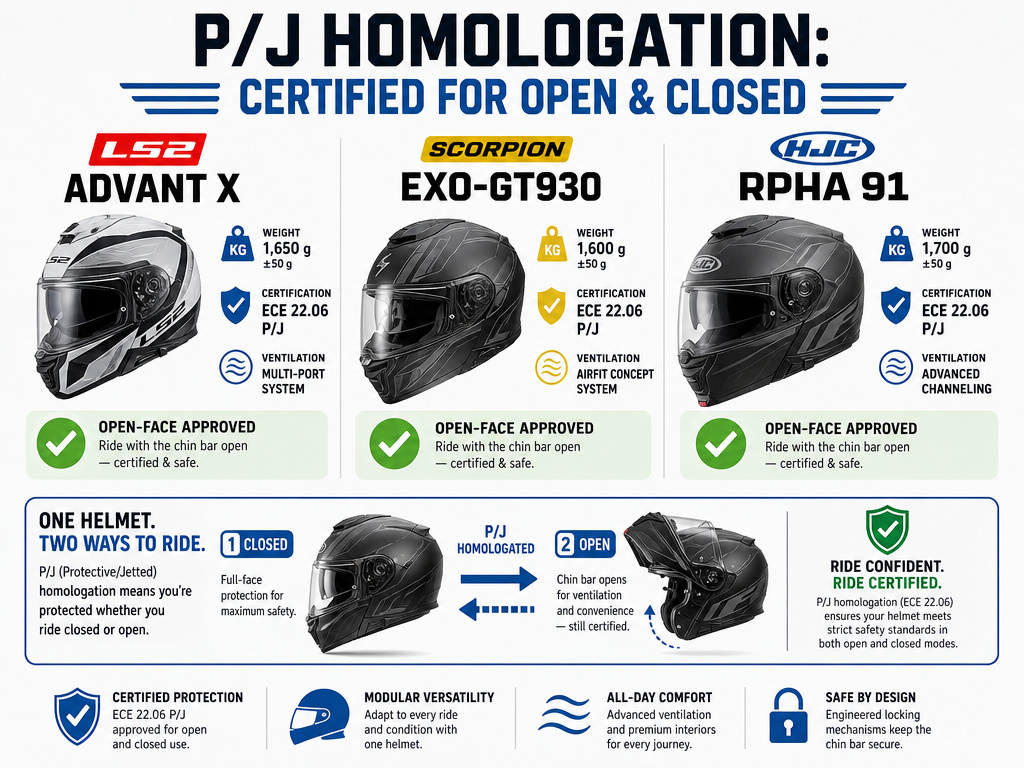
If you want the open-face experience but acknowledge the need for a chin bar, your best path is a modular helmet with a specific certification. Look for the P/J homologation within the ECE 22.05 or 22.06 label.
A helmet with P/J certification has been impact-tested and approved for use with the chin bar both closed (P) and open (J). This is legally distinct from buying a standard modular helmet and simply riding with the chin bar flipped up, an untested and potentially dangerous practice. The Schuberth E2 manual explicitly warns that riding with the chin bar open is only permitted if the helmet has the corresponding lock, and even then, the chin is unprotected.
| Model | Weight | Certification | Key Feature for Open-Face Use |
|---|---|---|---|
| LS2 Advant X | ~1,550 g | DOT + ECE 22.06 P/J | Forged carbon shell; entire chin bar removes to become a true open-face. |
| EXO-GT930 | ~1,890 g | DOT + ECE 22.05 | Converts to a true open-face; includes drop-down sun visor. |
| HJC RPHA 91 | Varies | DOT + ECE 22.06 P/J | Premium touring modular; certified for safe use in both positions. |
The EXO-GT930 is certified to the older ECE 22.05 standard. The LS2 Advant X and HJC RPHA 91 meet the newer 22.06 standard, making them a more future-proof choice. This is the closest you get to having both worlds without inventing safety data.
Essential Care and the 2-2-2 Replacement Rule
Open-face helmets require diligent maintenance, especially for the visor and exposed edges. The manuals from Arai, Bell, and Suomy all agree on a few essential rules.
Cleaning: Never use petroleum-based solvents, benzene, thinner, or abrasive cleaners on the shell or visor. Bell Helmets states these solvents “may impair the optical properties and reduce the mechanical strength of shields.” Use only a pH-neutral detergent diluted in water and a soft cloth. For the interior, follow the manufacturer’s instructions; for example, Suomy recommends hand-washing removable liners at a maximum of 30°C with mild soap.
Visor Care: A scratched visor scatters light and impairs night vision. Replace it immediately if deep scratches appear. Suomy mandates that the visor “must be operated only by using the lifting lever” and must always be fully locked open or closed while riding, never left in an intermediate position. Spare visors are typically available for up to five years after the helmet’s purchase date.
The 2-2-2 Replacement Rule: This owner’s guideline covers degradation that inspections miss.
- Replace after 2 years of daily, heavy use (sweat, UV exposure, and temperature cycles degrade the EPS liner).
- Replace after 5 years of occasional, light use, even if it looks new.
- Replace immediately after any impact, including a drop from handlebar height onto concrete. The Schuberth manual notes that small cracks can form from drops of less than 1 metre, invisibly compromising the shell.
Common mistake: Storing a helmet on a motorcycle mirror or in a rear window. Direct sunlight and high temperatures, common in a parked vehicle, accelerate the breakdown of adhesives and foams. Store it in its bag, at room temperature.
What is an open-face helmet?
Open-face helmets, also called three-quarter or 3/4 helmets, cover the top, back, and sides of the head but leave the face exposed. A half-helmet offers even less coverage. A modular helmet has a chin bar that can flip up, offering a full-face configuration or an open-face experience when raised. It’s important to know that helmets covering less of the head provide less impact protection and may be more susceptible to ejection in a crash. For riders wanting open-face feel with full-face protection, some modular helmets are homologated to a specific P/J standard, meaning they are certified for use with the chin bar both open and closed.
What is it like to ride with an open-face helmet?
While personal stories vary, the practical trade-offs are consistent. Riders often choose open-face helmets for a greater sense of freedom, easier communication, and better peripheral vision, especially on casual or urban rides. The downside is immediate exposure. Your face is unprotected from wind, rain, bugs, and road debris. In cooler weather, this can be uncomfortable, and in an accident, the chin bar area hits the ground in a significant percentage of crashes. The experience is less isolating than a full-face helmet, but that comes with accepting a higher level of risk and environmental exposure every time you ride.
Can you use goggles or an intercom with an open-face helmet?
Yes, open-face helmets are generally compatible with a range of accessories, but with important caveats. Since there is no built-in face shield, goggles or sunglasses are essential for eye protection. Remember that tinted eye protection should not be used at night or in poor visibility. Use only original spare parts, and never attach stickers or adhesive tape to the helmet shell, as this can compromise its integrity.
Frequently Asked Questions
How safe are open face motorcycle helmets?
They are safe for the areas of the head they cover, passing the same DOT and ECE impact tests as full-face helmets in simulations. However, they provide zero protection for the face and chin, which are involved in a significant percentage of crashes. Their safety is conditional on low-risk, low-speed riding environments.
What is the 2 2 2 rule for motorcycle helmets?
It’s a practical replacement guideline: replace your helmet after 2 years of heavy use, 5 years of light use, or immediately after any impact (the second “2” represents the two scenarios of time and damage). This accounts for material degradation from sweat, UV light, and temperature that isn’t visible.
Which helmet is better, open face or full-face?
For overall protection, a full face helmet is objectively better. It protects the entire head, is quieter, and shields you from the elements. An open-face helmet is better only for specific scenarios where maximum ventilation, easy communication, and classic style are the top priorities, and the rider accepts the increased risk.
Can you wear an open-face helmet on the highway?
You can, but you shouldn’t without significant preparation. The wind noise and buffeting are exhausting, and the risk from high-speed debris or a crash is magnified. If you want an open-face experience at highway speeds, a modular helmet with P/J homologation is a far safer choice, as it allows you to ride closed on the highway and open in town.
What is the safest style of motorcycle helmet?
The safest style is a full-face helmet that fits you perfectly. It provides the most complete coverage, including the critical chin and jaw area, and offers the best integration of a sealed visor for eye protection. No half helmet or open-face design can match its protective envelope.
Before You Go
The open-face helmet is a tool for a specific job. That job is low-speed, faff-free riding in good conditions where the sensory experience is part of the point. The moment your ride includes highway miles, uncertain weather, or higher traffic density, the tool no longer fits.
If you choose one, invest in a model from our best open face helmets guide, pair it with robust eye protection, and obey the replacement rules religiously. But understand the decision: you are trading a measurable amount of physical safety for an intangible quality of ride. For some riders, on some days, that’s a valid trade. Just don’t let the classic style fool you into thinking the trade doesn’t exist.
