
Should You Remove a Motorcycle Helmet After a Crash?
This post contains affiliate links. As an Amazon Associate, we earn from qualifying purchases.
Do not remove a motorcycle helmet after a crash unless it is necessary to maintain an open airway. If the rider is conscious, breathing, and has no neck pain, leave the helmet on and wait for emergency medical services. If you must remove it, use a two-person technique that stabilizes the cervical spine to prevent spinal injury. After any impact, the helmet is compromised and must be replaced, even if no damage is visible.
That rule is simple, but the physics behind it are absolute. A helmet works by sacrificing its internal structure to absorb energy. That process is invisible. The decision of should you remove a motorcycle helmet after a crash involves balancing an immediate airway threat against the risk of turning a spinal injury into a permanent one. Most riders and bystanders get one chance to get it right.
What follows is the procedure endorsed by first responders for the should you remove a motorcycle helmet after a crash question, the manufacturer mandates for replacement, and the inspection loopholes nobody mentions. By the last section you’ll know when to act, how to act, and why a helmet is a single-use device.
Key Takeaways
- Leave the helmet on if the rider is conscious and breathing. Your first job is to call 911 and keep the rider still, not to play medic.
- The two-person removal technique is the only safe method. One person stabilizes the head and neck while the other carefully opens and removes the helmet.
- Replace the helmet after any impact. Manufacturers like SHOEI, Bell, and Schuberth state their helmets are designed for one impact; the energy-absorbing liner compacts and will not protect again.
- A drop from as low as four feet can damage the shell or liner, per Suomy and KYT manuals. If you’re in doubt, the safest choice is replacement.
- Helmet materials degrade. Manufacturers recommend replacement every 3 to 5 years or 5 to 7 years, with five years being a common guideline.
When Removal is the Only Option
The rider isn’t breathing. Or they’re vomiting and you can’t clear the airway with the helmet on. Or they’re in a burning vehicle. In those specific, life-threatening scenarios, the answer to should you remove a motorcycle helmet after a crash is yes. In every other scenario—including an unconscious rider who is breathing—you stabilize the head and neck and wait for the pros.
Common mistake: Removing the helmet to “check for a head injury.” You can assess breathing, check a pulse, and look for major bleeding without ever touching the helmet. Removing it introduces massive, unnecessary risk.
Your first three actions are always the same: call 911, stop traffic from hitting the scene, and check for responsiveness. Do not move the rider. Ask simple questions: “Can you hear me? Can you squeeze my hand?” If they can respond, the airway is clear. Tell them not to move their head. Your job is now to keep them calm and still until EMS arrives. The helmet stays on.
The Two-Person Helmet Removal Technique
This is the step-by-step that missing from most guides. It requires two people. If you’re alone, you cannot safely do this. Wait for help.
Person A (Head Stabilizer): Kneels at the rider’s head. Reaches forward and places one hand on each side of the helmet, with fingers spread to grip the lower edges near the jaw. Their only job is to hold the head and neck completely still in a neutral, in-line position. They do not let go or adjust their grip until the helmet is off and Person B has taken over manual stabilization.
Person B (Helmet Remover): Kneels beside the rider’s shoulder. They are responsible for opening the helmet and maneuvering it off.
- Open the visor and chin strap. Person B opens the face shield and carefully releases the D-ring chin strap. For a modular (flip-up) helmet, they must first release and flip up the chin bar.
- Spread the helmet. Person B places their fingers inside the helmet at the temples and gently pulls the sides apart to clear the rider’s ears. This is the step where force can injure ears or aggravate neck movement if Person A isn’t holding firm.
- Tilt and lift. Person B tilts the helmet back slightly to clear the nose, then lifts it straight up and off. The motion is slow and controlled. Person A must maintain their grip on the rider’s head, feeling for any movement and countering it.
- Transfer stabilization. Once the helmet is off, Person B immediately places their hands where Person A’s were, using the same grip on the sides of the rider’s head. Only then does Person A let go. Manual in-line stabilization is maintained until a cervical collar is applied by EMS.
| Step | Person A (Stabilizer) | Person B (Remover) | Critical Warning |
|---|---|---|---|
| Setup | Grips helmet sides, locks head/neck neutral. | Positions at rider’s shoulder. | Never attempt alone. |
| Open | Maintains firm, steady grip. | Opens visor, releases chin strap, flips modular chin bar. | Do not twist the rider’s head with your motions. |
| Remove | Feels for head movement, counteracts it. | Spreads helmet sides, tilts back over nose, lifts straight up. | Pulling at an angle can shear the cervical spine. |
| Transfer | Holds until Person B’s hands are securely in place. | Takes over head/neck grip with same hand placement. | A lapse in stabilization can cause catastrophic injury. |
The whole process should be done calmly and deliberately, without rushing. Rushing it is how bystanders become part of the accident report. For a visual guide, see our detailed motorcycle crash first aid guide.
Why Every Impact Requires a New Helmet
The helmet did its job. Now it’s finished. This isn’t a manufacturer sales tactic; it’s basic materials science. The expanded polystyrene (EPS) liner inside the shell is a one-time-use crumple zone. On impact, the foam cells compress and crush permanently to dissipate energy. They do not rebound.
A helmet is designed to absorb only one impact. Replace the helmet after a fall, accident or other violent impact. Schuberth M1 Pro Manual
All major manufacturers say the same thing. The SHOEI safety instructions state helmets are “designed for ONE impact.” Bell’s manual says, “Replace your helmet immediately after an impact, even if no damage is visible.” The Snell M2025 helmet safety standard explains that a helmet’s protective capability may be exhausted through partial destruction of its components, which is often not apparent.
You cannot see this damage. The shell can look flawless. But its ability to manage another impact is gone. Wearing a compromised helmet is like driving a car with an already-deployed airbag. It’s just empty space wrapped in plastic. This is the core reason for your post-crash gear inspection—to identify what must be retired.
The Drop Debate: Four Feet vs. “When in Doubt”
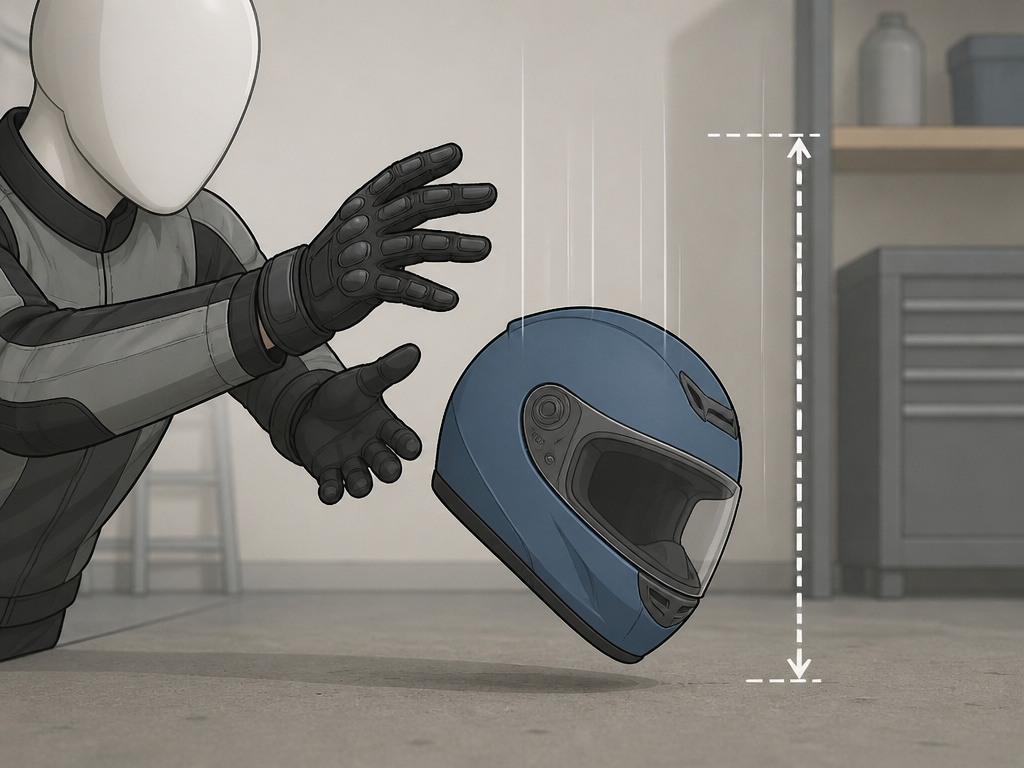
You fumble it getting off the bike. It rolls off the seat. That’s not a crash, so is the helmet still good? Here is where manufacturer advice diverges, and it’s the most common point of confusion.
Some manuals give a hard number: Suomy and KYT state a drop from as low as four feet is enough to damage the helmet, and Schuberth notes small cracks can occur from a drop of less than one meter. However, Dainese-AGV suggests that for a simple drop with no visible damage, inspection may be an option, though replacement is the safest choice if in doubt.
Other sources introduce an inspection clause. The Dainese-AGV article says that for a simple drop with no head inside, if no visible damage is present, “the helmet may not have sustained structural damage; when in doubt, the safest choice is replacement or, alternatively, having it inspected at a specialized retailer.”
| Scenario | SHOEI / Bell / Schuberth | Suomy / KYT | Dainese-AGV / Snell |
|---|---|---|---|
| Crash (head inside) | Replace immediately. | Replace immediately. | Replace immediately. |
| Drop from 4+ ft (empty) | Treat as an impact; replace. | Definitive damage; replace. | Inspect if no visible damage, but replace if in doubt. |
| Drop from <1 ft (empty) | Likely replace; liner shock is possible. | Could still cause damage. | May be okay; visual inspection recommended. |
The takeaway? If your helmet took a significant tumble, the conservative—and legally safest—path is typically replacement, though some sources like Dainese-AGV and Snell mention inspection as an alternative in specific cases. The cost of a new helmet is cheap insurance. This is covered in depth in our article on considerations for replacing a helmet after a drop.
Inspect or Destroy? What the Safety Standards Say
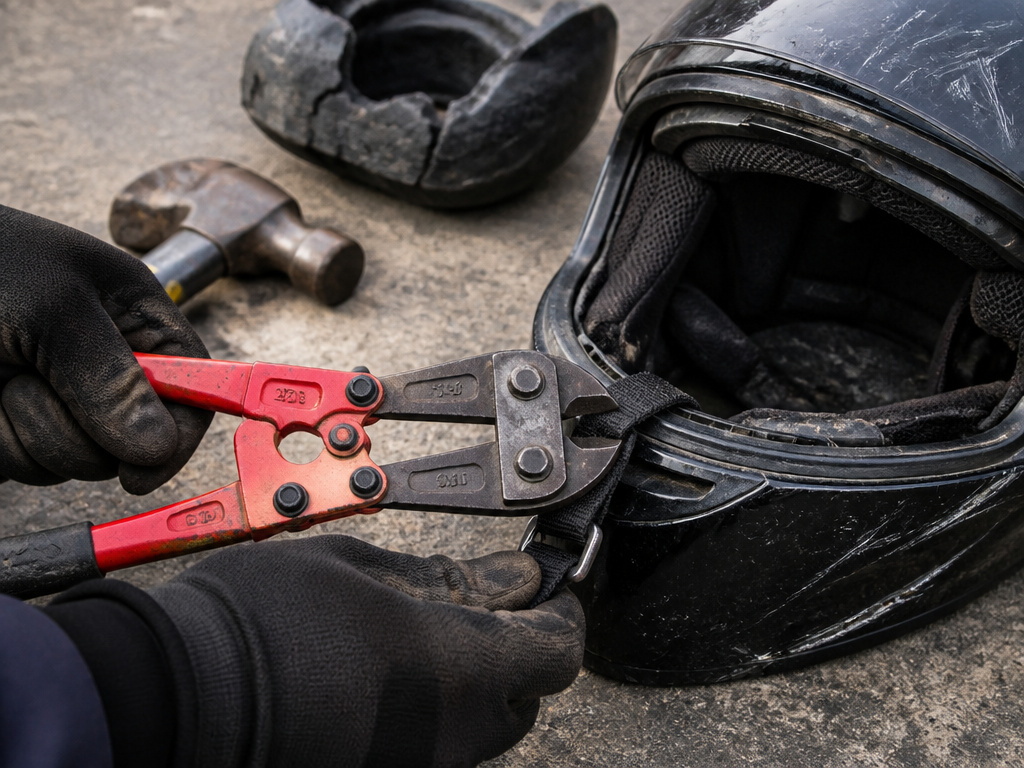
After a crash, you have two options: send the helmet to the manufacturer for a professional inspection, or destroy it. The Snell Foundation strongly recommends the former, but with a major caveat.
Their M2025 standard reads: “The Foundation strongly recommends that a helmet involved in an accident be returned to the manufacturer for complete inspection. If it is not possible to do so, the helmet should always be destroyed and replaced.”
Here is the honest take. The Snell Foundation recommends returning a crashed helmet to the manufacturer for inspection, but manufacturers themselves typically mandate replacement after an impact. They are looking for defect patterns, not giving your lid a clean bill of health. The inspection is for their data, not your reuse. Treat “return for inspection” as a polite way of saying “get it out of the supply chain so no one else uses it.” For you, the outcome is the same: you need a new helmet.
Destroying a helmet means making it unusable. Cut the chin straps. Smash the EPS liner with a hammer. Run a saw through the shell. Then discard it. This prevents it from being picked from the trash and sold to another rider, a shockingly common occurrence. Your old helmet is medical waste. Treat it that way.
The Five-Year Rule (And Why It’s a Range)
Sweat, ultraviolet light, and temperature cycles degrade helmet materials over time. The adhesives that bond layers together break down. The EPS liner can become brittle. This happens even if the helmet never leaves your closet.
Manufacturers publish recommended replacement intervals, but they don’t all agree. This isn’t a conspiracy; it’s a reflection of different materials and testing philosophies.
- SHOEI: “The expected lifetime… Is 5 years.”
- Bell: “Replace your helmet at least every five years.”
- Schuberth: “5 to 7 years, depending on use and care.”
- Suomy & KYT: “3 to 5 years depending on how much you use it.”
- Dainese-AGV: “Around five years after purchase.”
Where this goes sideways: Storing a helmet in a car trunk or near a heater. Temperatures above 122°F (50°C) can damage the liner and shell adhesives. If your helmet has baked in a hot garage for summers on end, its service life is shorter.
Five years is the safe, central guideline. If you ride daily in all weather, lean toward the three-to-five year window. If it’s a lightly used second helmet stored in a climate-controlled space, the five-to-seven year guidance from Schuberth is reasonable. Mark the purchase date inside the helmet with a permanent marker. When that date comes up, evaluate its condition and plan its replacement as part of your regular steps after a crash and maintenance routine.
Legal and Insurance Considerations
Are you liable if you remove a helmet and something goes wrong? In the United States, Good Samaritan laws generally protect bystanders who provide reasonable emergency aid in good faith. Your intent to help is the key legal shield. However, “good faith” implies you didn’t do something blatantly reckless, like yanking the helmet off a conscious rider who told you not to touch them.
The legal safest course is to provide only the aid you are trained to provide. For most of us, that’s calling 911, directing traffic, and offering reassurance. If you are a trained EMT or have specific first aid certification, your standard of care is higher.
From an insurance perspective, a helmet is considered personal protective equipment (PPE). After a crash, your health or auto insurance may cover a replacement helmet as part of your medical or property damage claim. You must list it specifically. Document the crash scene, get a police report, and mention the helmet was damaged in the impact. Do not assume it’s automatically covered. This is a practical step often overlooked in the emotional aftermath, so add it to your mental motorcycle crash checklist.
Dropping a helmet vs. A crash impact
A helmet is designed to absorb energy by partially destroying its internal components during a crash with a head inside. A simple drop of an empty helmet is a different event. Manufacturers note that a drop from a low height, such as from a seat or a table, can be enough to cause small cracks in the shell. Some sources state that if no visible damage is present after a simple drop, the helmet may not have sustained structural damage. However, the safest choice is always replacement if you are in any doubt, or having the helmet inspected by a specialized retailer.
Hidden damage inside the helmet
The energy-absorbing liner inside the helmet is designed to compact during an impact. This compression is often invisible. After a crash, the liner becomes compacted and loses its ability to protect you in a future impact. Manufacturers are clear that a helmet is designed for only one significant impact. Damage to the shell or liner may not be readily visible. Because you cannot reliably detect this internal damage, the universal instruction is to replace the helmet after any impact during riding, even if no external damage is visible.
Frequently Asked Questions
Why should you never remove a wrecked rider’s helmet?
You should never remove it unless necessary for airway management because of the risk of spinal injury. The helmet can provide some stabilization to the neck, and improper removal can turn a stable spinal fracture into an unstable, paralyzing one. The default is to leave it on and let trained personnel handle it.
Is a motorcycle helmet still good after an accident?
No. All major manufacturers and safety standards state that a helmet is designed for a single impact. The energy-absorbing liner is permanently compromised, even if no damage is visible. It must be replaced.
What is the 2 2 2 rule for helmets?
This isn’t a widely recognized official rule. It sometimes refers to a fitment check: two fingers between eyebrow and helmet, two fingers forming a V under the ears by the straps, and two fingers under the chin strap. However, for crash aftermath, focus on the established first aid and replacement protocols, not mnemonics.
What not to do after a motorcycle accident?
Do not remove the helmet without a clear airway threat. Do not move the rider unless they are in immediate danger (e.g., fire). Do not fail to call 911. Do not admit fault or make detailed statements to other parties before police arrive. Do not skip a medical evaluation because you “feel fine.”
Does insurance pay for a new helmet after a crash?
Often, yes, but you have to ask. It’s typically covered under the medical payments (MedPay) or property damage section of an auto insurance policy. Report the helmet as damaged gear when you file your claim and provide a receipt for the replacement.
Before You Go
The math is simple but brutal. A helmet is a critical piece of safety equipment. The helmet is disposable. The spine is not. When you see a crash, your first tool is your phone to call 911, not your hands to remove gear.
One rule most guides skip: if you are ever the rider on the ground, and you are conscious, tell the person leaning over you, “Do not move my head. Leave my helmet on.” Say it clearly. That one sentence does more to protect you than any armor you’re wearing. Everything above assumes a helmet that did its job once. A compromised helmet is a shell with a false promise inside. Treat it that way, and replace it without sentiment. Your next ride depends on gear that works, not gear that worked.
