
Polarized Motorcycle Sunglasses Pros and Cons
This post contains affiliate links. As an Amazon Associate, we earn from qualifying purchases.
Polarized motorcycle sunglasses cut reflected road glare by blocking horizontally polarized light. For riders, the main pros are reduced eye strain and better contrast on dry, sunny roads; the key cons are potential visibility loss on wet pavement, interference with laminated visors and LCD dashboards, and a reduction in overall scene brightness that can be hazardous in low light. The choice hinges on your bike’s instrumentation, your helmet’s visor, and the conditions you typically ride in.
That glare reduction number is specific and measurable. A 2023 study in Frontiers in Sports and Active Living found polarized lenses cut the luminance of a dry road to just 3% to 16% of what you see with non-polarized sunglasses when the sun is in front of you. That’s the physical mechanism at work, which is a key point when considering polarized motorcycle sunglasses pros and cons.
What follows is a breakdown of where that number helps and where it hurts, central to the polarized motorcycle sunglasses pros and cons. We’ll walk through the FAA’s ban for pilots, the conflicting research on actual visual performance, and the real-world reports from riders who watched oil slicks vanish. By the end, you’ll know whether your next pair of best sunglasses for motorcycle riding should be polarized.
Key Takeaways
- Polarized lenses block horizontally polarized light, cutting dry road glare to 3–16% of normal levels but also dimming the entire scene.
- The FAA does not recommend polarized lenses for pilots due to instrument and windscreen interference, a critical warning for riders with LCD dashboards or laminated visors.
- Peer-reviewed research is split: a Frontiers in Sports and Active Living study (2023) touts major glare reduction, while a PMC study (2024) found no significant difference in visual acuity or contrast sensitivity under controlled glare.
- A common rider report: polarized lenses can make wet patches and oil slicks harder to see, contradicting Polar-Optics‘ claim that its lenses allow a rider to see oil on the road ‘better than with a darker acrylic lens.’
- For eye protection, a shatterproof goggle or face shield meeting ANSI Z87.1 or CE is mandatory; sunglasses alone are not safety gear.
The 3% to 16% Luminance Reduction That Defines Polarized Glare Control
Polarization isn’t magic. It’s a filter. Sunlight reflecting off a flat, smooth surface like water or asphalt becomes partially polarized, meaning its light waves oscillate mostly in a horizontal plane. A polarized lens has a microscopic grid that acts like a venetian blind, blocking those horizontal waves while letting vertically oriented light pass through.
When the sun is in front of the observer, the ratio of horizontally to vertically polarized road luminance ranges from 1.3 to 2.6. Polarized sunglasses, which block the horizontal component, reduce perceived road luminance to a fraction of the non-polarized view, between 3% and 16%.
That drastic cut is the core benefit. On a long highway stretch into the afternoon sun, the road stops being a blinding sheet of light. Potholes, roadkill, and texture snap into sharper focus because the disabling glare veil is lifted. Your eyes aren’t working as hard to squint through the brightness, which translates directly to less fatigue on a multi-hour tour.
The catch is in the word “fraction.” The road isn’t just glare; it’s also your primary source of ambient light and visual information. Dimming it that much changes how you see everything else.
The part nobody mentions: This 3–16% range comes from a study on a dry, 10-year-old asphalt road in daylight. Add morning dew, light rain, or the sheen of a new blacktop, and the specular reflection, and the polarization effect, intensifies. The lens is working as designed, but the scene you’re trying to read is fundamentally different.
When Polarized Lenses Become a Liability
The same filter that kills glare can erase critical information. This isn’t hypothetical; it’s the reason major safety agencies issue specific warnings.
The Federal Aviation Administration’s guide for pilots states polarized lenses are not recommended for the aviation environment. Their reasoning is a direct checklist for motorcyclists: the lenses can reduce or eliminate the visibility of instruments with anti-glare filters, and they may interfere with visibility through a windscreen by enhancing striations in laminated materials.
Common mistake: Assuming your bike’s modern TFT dash is immune. Many LCD panels use circular polarizers or anti-glare coatings that can turn blank or rainbow-streaked when viewed through a polarized filter. Tilt your head and the display might reappear, a useless trick while riding.
Laminated materials are the second point. Many premium helmet faceshields and some motorcycle windscreens are laminated for impact resistance. The stress patterns in these layers are normally invisible. A polarized lens can act like a pair of cheap 3D glasses, making those patterns shimmer and dance in your sightline. It’s a visual artifact that ranges from mildly distracting to genuinely disorienting.
Then there’s the oil and water problem. Rider forums are filled with anecdotes that polarized lenses make wet patches and fuel spills “disappear,” a claim that directly pits manufacturer marketing (Polar-Optics claims its lenses allow a rider to see oil ‘better than with a darker acrylic lens’) against collective rider experience. The physics suggests both could be true under different conditions. A thick oil slick might be more apparent. A thin, clear film of fuel or water on matte asphalt might lose the visual cue of specular highlight that warns you of slickness.
The Research Split: Glare Reduction vs. Measured Visual Performance
Here is where the sales copy meets the lab data. Two recent peer-reviewed studies looked at polarized lenses and came to seemingly different conclusions.
The 2023 Frontiers study we cited earlier provides the hard numbers on luminance reduction. It frames this as a clear win for visual comfort and contrast discrimination in road sports. The study frames the luminance reduction as a clear win for visual comfort and contrast discrimination in road sports.
A 2024 study published in PMC took a different approach. It measured specific visual functions, acuity, stereopsis (depth perception), phoria (eye alignment), and contrast sensitivity, under controlled glare conditions. Its finding: there was no statistically significant difference between polarized and non-polarized sunglasses for any of those metrics.
| Visual Function | Polarized Sunglasses | Non-Polarized Sunglasses | No Sunglasses | Significant Difference? |
|---|---|---|---|---|
| Mean Stereopsis (arc sec) | 101.33 ± 56.139 | 105.67 ± 58.965 | 94.33 ± 46.632 | No |
| Visual Acuity (logMAR) | 0.00 | 0.00 | 0.00 | No |
| Contrast Sensitivity | Slight decrease vs. No glasses | Slight decrease vs. No glasses | Baseline | No |
What does this mean for you? The PMC study authors concluded that benefits may be limited to “specific situations” or “subjective comfort.” The glaring highway scenario might be one of those specific situations where the luminance cut is king. But if you’re hoping for a measurable, across-the-board upgrade in your eyes’ ability to resolve detail under glare, the science suggests you might not get it.
This is a classic case of subjective feel versus objective measure in the polarized motorcycle sunglasses pros and cons. Your eyes might feel more relaxed, which is valuable. But your raw visual performance, in a clinical sense, may be unchanged.
Polarized vs. Non-Polarized: A Rider’s Decision Matrix
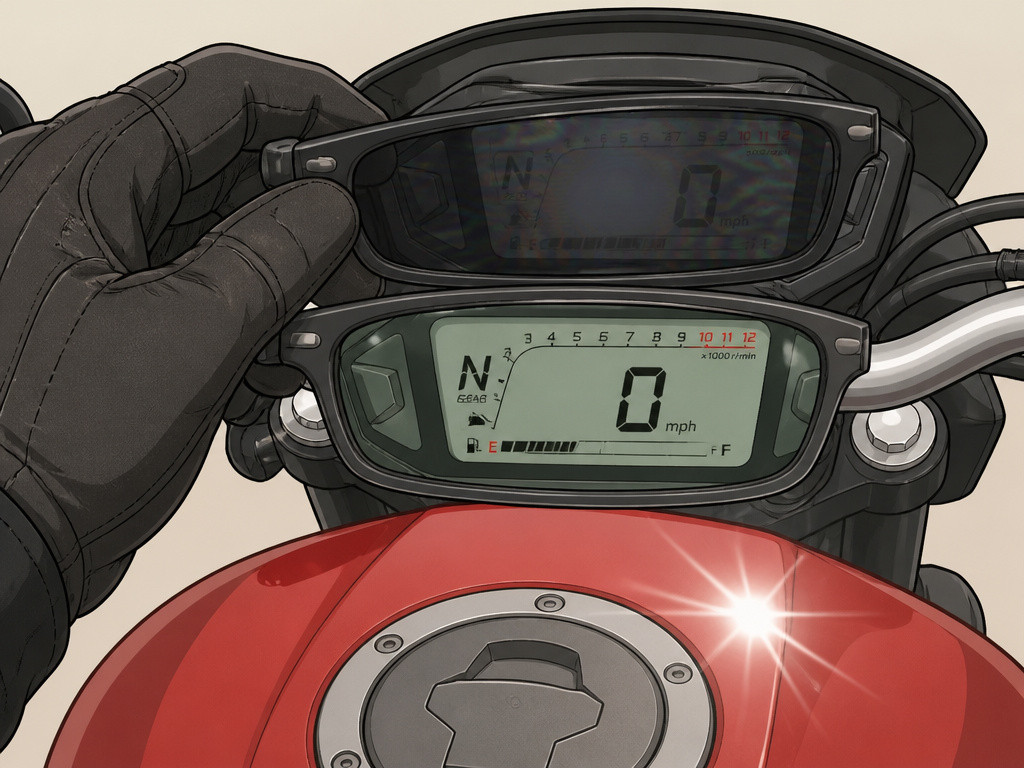
This isn’t an abstract choice. Your bike, your gear, and your routes decide it. Use this table to map your situation to a recommendation.
| Your Riding Scenario | Polarized Likely Helps | Polarized Likely Hurts | Verdict |
|---|---|---|---|
| Bike with LCD/TFT Dash | Glare reduction on tank/gauges. | Dash may blank out or distort. | Avoid. Test first if insistent. |
| Helmet with Laminated Visor | No specific benefit. | May see stress patterns. | Avoid. Stick with a standard iridium visor or tint. |
| Mostly Dry, Sunny Highway Riding | Major glare reduction, less eye strain. | Overall scene is darker. | Good candidate. |
| Urban/Commuting, Mixed Conditions | Helps with car windshield glare. | Wet pavement, oil slicks harder to spot. | Poor fit. Too many variables. |
| Touring with Changing Light | Consistent tint in bright sun. | Dangerous in tunnels, tree cover, dusk. | Risky. A photochromic visor is safer. |
The “overall scene is darker” point is the silent trade-off. That 3–16% road luminance is the reduction in perceived road glare. In marginal conditions, dusk, sudden tree cover, a tunnel entrance, that extra darkness can steal the split-second of clarity you need. This is why standards like DIN EN 1938:2010 set a 75% luminous transmittance limit for motorcycle goggle oculars intended for night driving. A polarized lens isn’t that dark, but the principle is similar: when light is scarce, you need every photon.
For many, the solution isn’t a compromise lens. It’s the right tool for the job. A polarized pair for brilliant summer days, and a neutral, high-contrast pair like amber or yellow for cloudy or variable conditions. This is why understanding the motorcycle goggles vs sunglasses debate matters, sealed goggles often accept interchangeable lenses, solving the problem entirely.
Safety First: Sunglasses Are Not Eye Protection
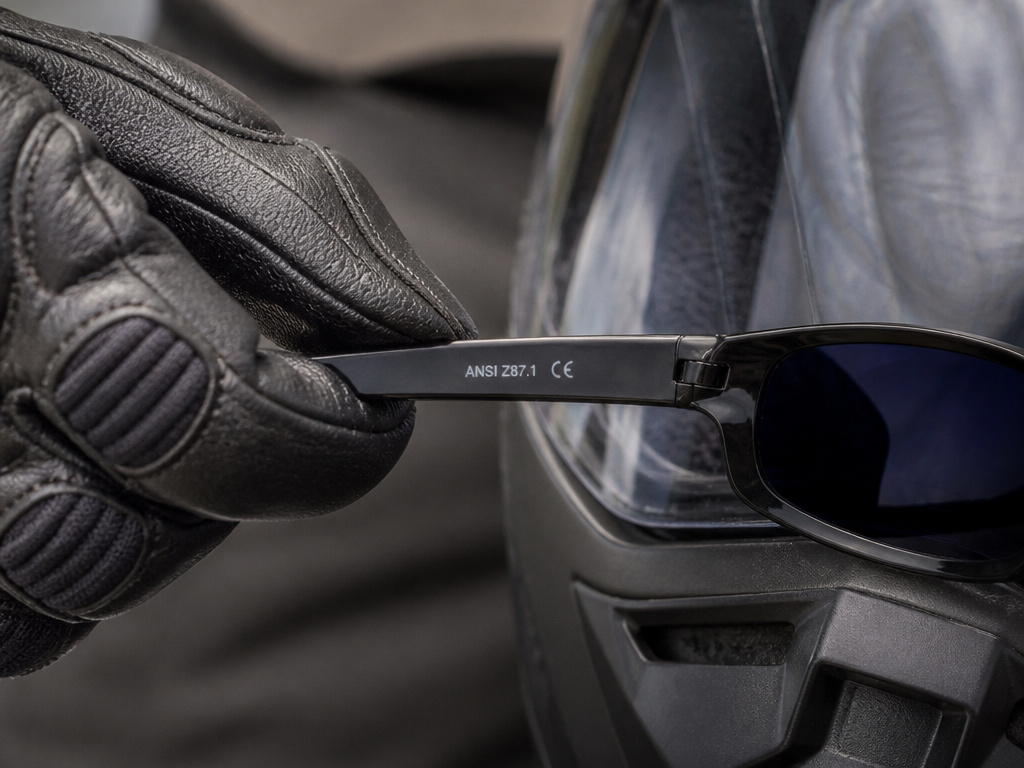
This conversation about polarization happens one layer up from a more fundamental rule. The Polaris owner’s manual states it bluntly: “Do not depend on eyeglasses or sunglasses for eye protection.” Your eyes need impact and shatter resistance from a bee, a stone, or a fall.
Any eyewear you choose for riding must be backed by a real safety standard. Look for markings like: * ANSI Z87.1 (American standard for impact resistance) * CE (European standard) * VESC 8 or V-8 (Vehicle Eyewear Safety Standard)
These certifications mean the lens material and frame have been tested to withstand a high-velocity impact without shattering into your eyes. No polarization filter provides that. Your base layer is always a shatterproof goggle or a helmet faceshield. Sunglasses, polarized or not, are a comfort layer you add behind that primary protection if they fit.
And fit is its own challenge. The quest to wear sunglasses under a helmet has ended many a rider’s love affair with bulky frames. Pressure points on your temples from helmet pads and arms that won’t seat cleanly are more than an annoyance; they’re a distraction.
Frequently Asked Questions
What are the downsides of wearing polarized sunglasses on a motorcycle?
The main downsides are interference with LCD instrument panels (which can go blank or distorted), enhanced visibility of stress patterns in laminated helmet visors or windscreens, and the potential to make thin, wet patches on asphalt harder to see. They also reduce overall scene brightness, which can be detrimental in low-light conditions.
Who should not wear polarized sunglasses?
Riders with modern LCD dashboards, laminated faceshields, or those who frequently ride in wet or variable light conditions should avoid polarized lenses. The FAA’s sunglasses selection for glare reduction guide explicitly warns pilots against them for these instrument and windscreen issues.
Are polarized sunglasses better for motorcycle riding?
They are better specifically for reducing intense glare from dry roads on bright, sunny days, which can reduce eye strain. However, peer-reviewed visual performance with polarized filters research found no significant improvement in measurable visual functions like acuity or contrast sensitivity. For many riders, the situational drawbacks outweigh the comfort benefit.
What is the best lens color for motorcycle sunglasses?
For general use, neutral gray or smoke is best as it distorts color perception the least, crucial for reading traffic signals and brake lights. Amber or yellow lenses are often recommended for low-light or cloudy conditions. Mirror coatings (iridium) reduce external glare.
Can you wear polarized sunglasses with a helmet visor?
You can, but it’s not always advisable. If your visor is laminated, you risk seeing interference patterns. If you have a built-in sun visor (a flip-down internal tinted layer), stacking it with polarized sunglasses can create a dense, cross-polarized effect that severely darkens your view. Always test the combination in a safe, static environment first.
The Bottom Line
The polarized lens question has a clear, physical answer that gets muddy in real-world application. The filter works exactly as advertised, cutting horizontal glare by a massive margin. But riding isn’t a lab test.
If your bike has an analog dash, you ride almost exclusively in bright sun, and your helmet has a standard polycarbonate visor, a pair of certified, polarized motorcycle sunglasses could be a great comfort upgrade. For everyone else, especially riders with color TFT screens, adventurers facing changing weather, or commuters navigating slick city streets, the cons stack up fast.
Your vision is your primary sensor. Don’t let a marketing claim for “better” override the specific feedback loop between your eyes, your bike, and the road. Sometimes, the best lens is the one that gets out of the way.
